
The right aquaponics fish tank size for most home systems is 50–300 gallons, with roughly equal volumes of fish tank and grow bed for media-bed systems. Smaller tanks (10–40 gallons) work for ornamental fish and a few herbs, but they swing quickly in temperature and ammonia. For edible fish such as tilapia, catfish or bluegill, plan on at least 100 gallons and stock no more than about 1 pound of fish per 5–10 gallons as a beginner. Bigger water volume is more stable and more forgiving.
Key takeaway: Choose tank size based on how many pounds of fish you’ll raise and how much grow area you want to feed, not on how many fish fit.
| Tank size | Good for | Approx. grow bed | Beginner fish load |
|---|---|---|---|
| 10–40 gal | Desktop, ornamental fish | 1–4 sq ft | A few small fish |
| 50–100 gal | Small edible or goldfish systems | 6–12 sq ft | 5–20 lb |
| 150–300 gal (IBC) | Backyard food systems | 16–32 sq ft | 15–60 lb |
| 500–1,000 gal | Large family or greenhouse | 50–100+ sq ft | 50–200 lb |
Why Aquaponics Fish Tank Size Matters
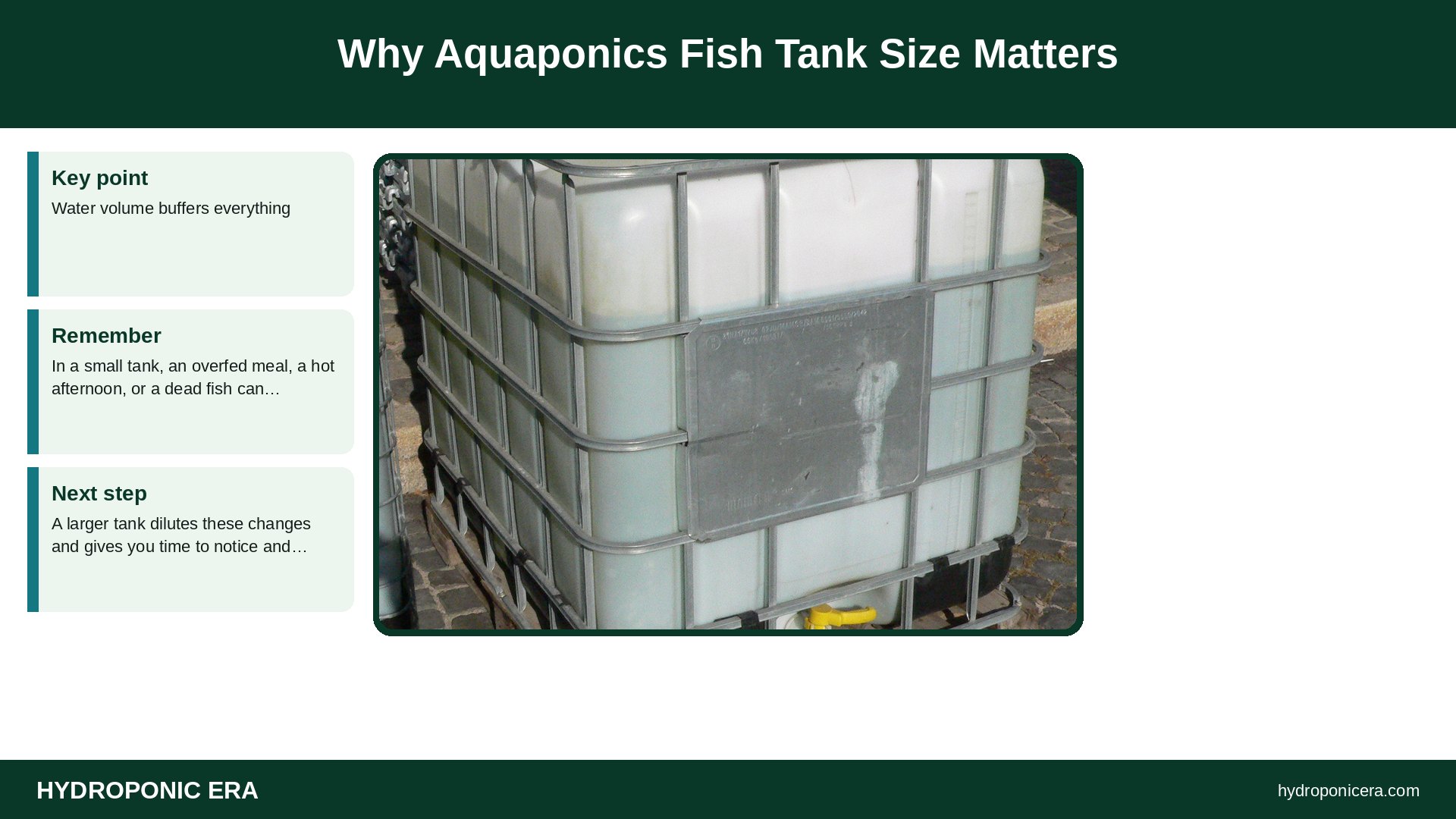
Water volume buffers everything. In a small tank, an overfed meal, a hot afternoon, or a dead fish can push ammonia, temperature and dissolved oxygen out of the safe range within hours. A larger tank dilutes these changes and gives you time to notice and correct them. FAO’s small-scale aquaponics guide recommends that beginners start with a system of about 1,000 liters (about 260 gallons) of fish tank for good stability and a meaningful harvest.
Matching Tank to Grow Bed
For media-bed systems, a 1:1 ratio of fish tank volume to grow bed volume is a common starting point, and many growers go up to 1:2 once the system is established. Raft and NFT systems are sized by feed rate rather than volume. The key link between fish and plants is daily feed: how many grams of fish feed go in per square foot of plants. See aquaponics fish to plant ratio and aquaponics media bed.
How Many Fish per Gallon
Beginner stocking is around 1 pound of fish per 5–10 gallons. Experienced growers with strong aeration and filtration can go higher, but risk rises fast. Remember fish grow: 20 fingerlings that fit easily today may weigh 20–30 pounds in six months. Size the tank for the final weight at harvest. See aquaponics stocking density.
Tank Shape

Round or rounded-corner tanks circulate water better and collect solids in the center for easy removal. Square tanks with sharp corners create dead zones where waste collects. Tank depth matters too: 2–4 feet suits most fish. Very shallow tanks heat up quickly; very deep ones are hard to net and clean.
Common Tank Options
- Aquariums: good for small indoor systems; glass is heavy and fragile. See aquarium aquaponics.
- IBC totes: 275–330 gallons, cheap, popular. Use food-grade ones and shade them from sunlight. See IBC aquaponics.
- Stock tanks: round, durable, 100–1,000+ gallons. See food-grade barrels and stock tanks.
- Food-grade barrels: 55 gallons, good for small builds.
- Lined ponds or frames: large volumes at low cost per gallon.
Aquaponics Fish Tank Size by Fish Species

| Fish | Minimum practical tank | Notes |
|---|---|---|
| Goldfish, guppies | 20–50 gal | Ornamental; small systems |
| Koi | 250+ gal | Grow large; long-lived |
| Tilapia | 100+ gal | Warm water; fast growth |
| Bluegill | 100+ gal | Hardy, cool to warm water |
| Catfish | 150+ gal | Tolerant; grow big |
| Trout | 250+ gal | Cold, highly oxygenated water |
Sump Tanks
A sump is a separate tank at the lowest point of the system where water collects before being pumped back. It keeps the fish tank level constant and adds volume. Size it to hold all the water that drains from the grow beds during a power outage, usually 20–30% of fish tank volume. See aquaponics sump tank.
Weight and Floor Load
Water weighs about 8.3 pounds per gallon. A 300-gallon tank weighs about 2,500 pounds full, plus the tank and media. Put large tanks on a slab or ground level, and check floor capacity before placing anything over 50 gallons on an upper floor or deck.
Starting Small
A small system teaches the basics cheaply, but it’s harder to keep stable. If you start with a 50-gallon tank, stock lightly, feed sparingly and test often. Many growers find that upgrading to an IBC-sized system actually makes aquaponics easier because problems develop more slowly. See aquaponics for beginners.
Calculating Aquaponics Fish Tank Size Step by Step
- Decide your grow area. For example, 32 square feet of media beds or rafts.
- Estimate daily feed. Leafy greens in raft systems commonly use about 40–50 grams of feed per square meter per day (roughly 4–5 grams per square foot). Fruiting crops need more. For 32 sq ft of greens, that’s about 130–160 grams of feed a day.
- Convert feed to fish weight. Grow-out fish eat about 1–2% of body weight daily. 150 grams of feed feeds about 7.5–15 kg (16–33 pounds) of fish.
- Size the tank for that weight. At 1 pound per 5–10 gallons, 16–33 pounds needs roughly 160–330 gallons.
This simple method shows why an IBC-sized tank of about 250–300 gallons pairs well with roughly 30 square feet of grow beds. Your numbers will vary with fish species, water temperature and crops, so adjust as you learn.
Aquaponics Fish Tank Size and Temperature
Large tanks hold temperature better, which matters a lot outdoors and in greenhouses. A 50-gallon tank in summer sun can rise 10°F in an afternoon; a 300-gallon tank changes much more slowly. In winter, a larger volume also takes longer to cool, giving heaters time to keep up. Insulating the tank walls and covering the surface at night help further. See aquaponics water temperature and aquaponics in winter.
Leave Room for Growth
Many growers raise fish in batches so there’s always a harvest coming. If you plan to stagger ages, consider two or more tanks instead of one large one. Smaller fish can be kept apart from large ones, which reduces bullying and lets you harvest a whole tank at once. Two 150-gallon tanks connected to the same sump give you this flexibility while keeping the total water volume high.
Covering the Tank
Whatever size you choose, cover most of the surface. A cover keeps fish from jumping, blocks sunlight that drives algae, reduces evaporation, and keeps leaves and pests out. Leave part of it open or use mesh so you can watch the fish at feeding time. See aquaponics algae control.
FAQs
What is the minimum aquaponics fish tank size?
About 10 gallons for ornamental fish; 50–100 gallons for edible fish.
How many fish in a 100-gallon tank?
About 10–20 pounds of fish for beginners.
Is bigger always better?
Bigger is more stable but costs more and needs more grow area to use the nutrients.
What ratio of tank to grow bed?
Start with 1:1 for media beds.
Can I use a plastic tote?
Yes, if it’s food-grade and UV-protected.
Do I need a sump?
Not always, but it improves stability and keeps tank levels constant.
Sources
- FAO — Small-scale aquaponic food production
- Southern Regional Aquaculture Center — SRAC 454: Aquaponics—Integrating Fish and Plant Culture
- New Mexico State University — Important Water Quality Parameters in Aquaponics Systems
- Photo credits (Wikimedia Commons, edited with titles): Fish farming on Øksfjorden in Loppa, Troms og Finnmark, Norway, 2022 August by Ximonic (Simo Räsänen) (CC BY-SA 4.0); Intermediate Bulk Container (fcm) by Photograph: Frank C. Müller, Baden-Baden (CC BY-SA 4.0); Recirculating Aquaculture System 1 by Narek75 (CC BY-SA 4.0); Solanum lycopersicum in aquaponics at the NC Greenhouse Nursery by Gogerr (CC BY-SA 4.0); Oreochromis-niloticus-Nairobi by Bjørn Christian Tørrissen (CC BY-SA 3.0)