
To dechlorinate water for aquaponics, first find out whether your utility uses chlorine or chloramine. Free chlorine leaves water on its own if you aerate it in an open container for 24–48 hours. Chloramine does not; it needs a dechlorinating product based on sodium thiosulfate or a chloramine-rated conditioner, ascorbic acid (vitamin C), or a catalytic carbon filter. For small top-offs, a water conditioner dosed by label is the simplest, safest option, and it works on both chlorine and chloramine.
Key takeaway: Never add untreated city water to an aquaponics system in large amounts. Chlorine and chloramine kill fish gills and the nitrifying bacteria your plants depend on.
| Method | Removes chlorine | Removes chloramine | Notes |
|---|---|---|---|
| Aerate 24–48 hours | Yes | No (very slowly) | Free, slow |
| Sodium thiosulfate conditioner | Yes | Yes (releases ammonia) | Fast; dose by label |
| Ascorbic acid (vitamin C) | Yes | Yes | Lowers pH slightly |
| Catalytic carbon filter | Yes | Yes, with enough contact time | Best for large volumes |
| Standard carbon filter | Yes | Partly | Needs slow flow |
| Rainwater or well water | Usually none present | Usually none present | Test for other issues |
Chlorine vs Chloramine
Water utilities disinfect drinking water with chlorine or chloramine (chlorine combined with ammonia). The EPA notes that many systems use chloramine because it lasts longer in the pipes. That stability is exactly why it’s harder to remove: it doesn’t off-gas like chlorine. Check your utility’s annual water quality report or call them. See chlorine and chloramine in tap water.
Why You Must Dechlorinate Water for Aquaponics
Chlorine and chloramine damage fish gills, cause stress and can kill fish at levels found in tap water. They also kill the nitrifying bacteria in your biofilter, which can trigger ammonia and nitrite spikes. Small top-offs of chlorinated water to a large system dilute quickly, but a big water change with untreated water can be deadly. See nitrifying bacteria and aquaponics ammonia spike.
How to Dechlorinate Water by Aeration
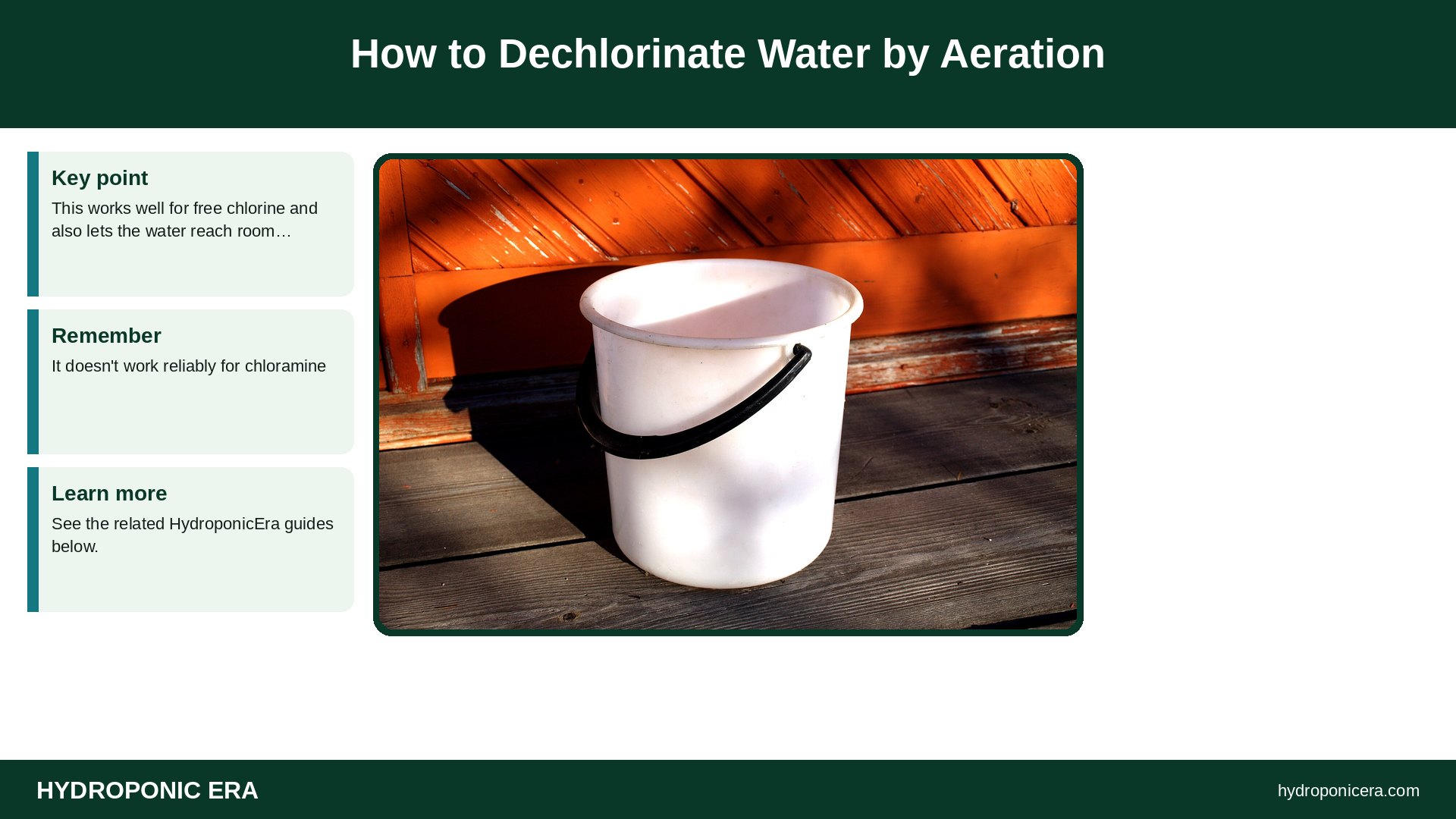
- Fill a clean, food-safe barrel or tote with tap water.
- Add an air stone or a small pump to stir the surface.
- Leave it open for 24–48 hours.
- Test with a chlorine test strip or kit before use.
This works well for free chlorine and also lets the water reach room temperature. It doesn’t work reliably for chloramine.
Using a Water Conditioner
Aquarium water conditioners usually contain sodium thiosulfate or similar compounds. They neutralize chlorine instantly and break chloramine into chloride and ammonia. In a cycled aquaponics system, the bacteria quickly convert that small amount of ammonia. Some conditioners also bind ammonia temporarily. Dose by the label for the volume of new water, not the whole system.
Vitamin C
Ascorbic acid and sodium ascorbate neutralize both chlorine and chloramine and are used by some utilities for main flushing. They work fast and are fish-safe at small doses but lower pH slightly. Use pure powder without additives and test pH after treatment.
Carbon Filters
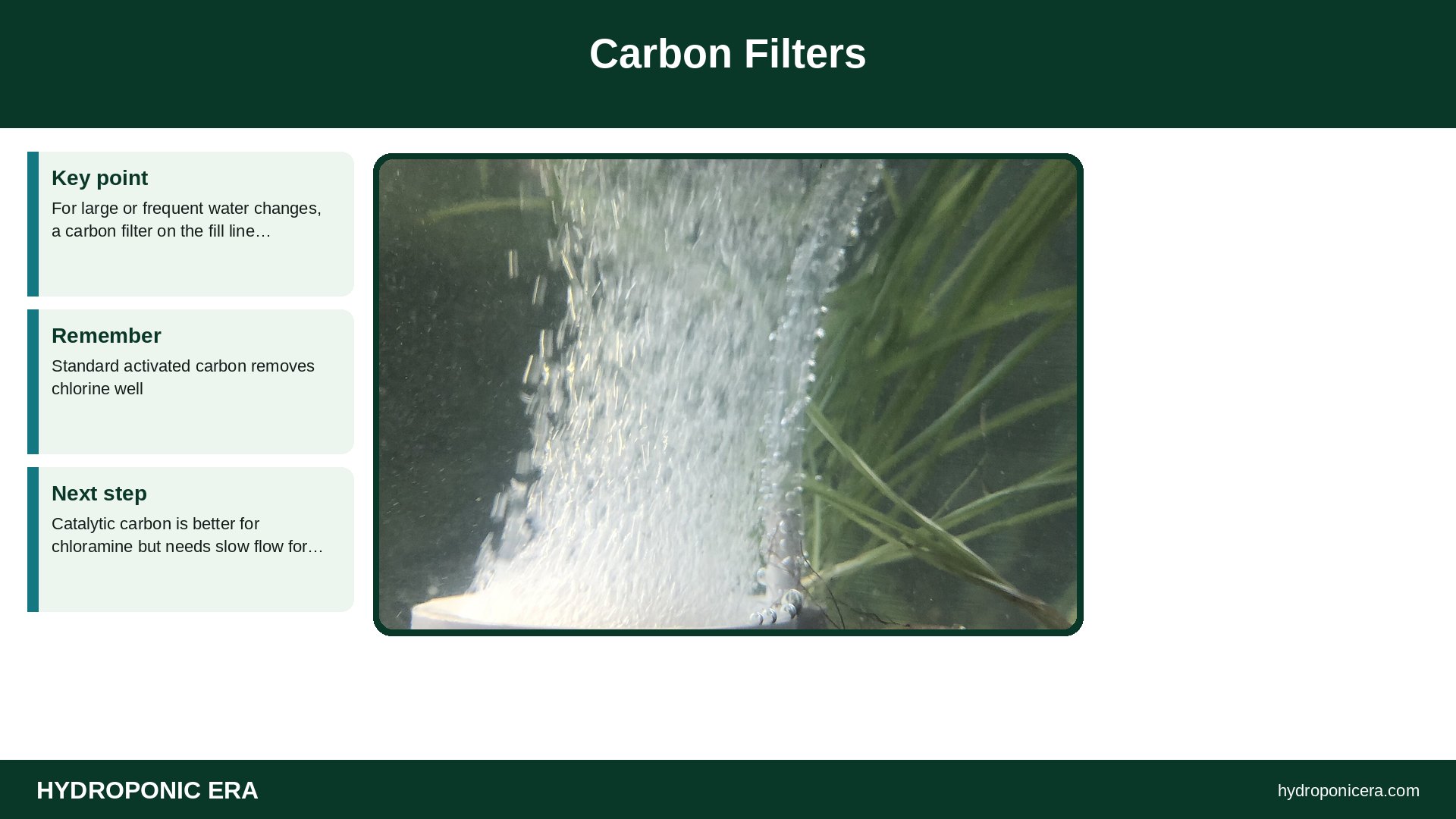
For large or frequent water changes, a carbon filter on the fill line is convenient. Standard activated carbon removes chlorine well. Catalytic carbon is better for chloramine but needs slow flow for enough contact time. Replace cartridges on schedule; an exhausted filter lets chlorine through. See RO and filtration systems.
How Much Water You Need
Aquaponics systems lose water to evaporation and plant transpiration, often 1–3% of total volume a day in warm weather. A 300-gallon system may need 3–9 gallons of top-off daily. Keep a dechlorinated reserve barrel ready so you can top off or do an emergency water change without waiting. See daily water use.
Testing for Chlorine

Pool and spa test strips or drop kits measure free and total chlorine. Total chlorine includes chloramine. Test new water after treatment until you trust your method. If the reading is above zero, treat again.
Other Water Sources
- Rainwater: no chlorine, but soft and low in minerals; may need buffering. See rainwater for hydroponics.
- Well water: usually no chlorine, but test for iron, hardness, nitrate and hydrogen sulfide. See well water testing.
- RO water: chlorine-free if the carbon prefilter is working; needs remineralizing.
Dechlorinate Water and Temperature
Match new water to system temperature within about 2–3°F, especially for large changes. Cold tap water in winter can shock warm-water fish. Letting treated water sit in the same room as the system for a day solves both chlorine and temperature at once. See aquaponics water temperature.
Setting Up a Reserve Barrel
The easiest way to always have safe water is a dedicated reserve. Use a 30–55 gallon food-grade barrel or tote with a lid, an air stone and, if your room is cold, a small aquarium heater. Fill it after every water change, treat it, and let it sit. Label it with the date filled. That way you dechlorinate water once, in bulk, and it’s ready the moment you need it. A float valve from the reserve into the sump makes top-offs automatic without ever exposing the system to raw tap water. See auto top-off float valves.
Dechlorinate Water for Emergency Changes
During an ammonia or nitrite spike, you may need to change 25–50% of the water quickly. Aeration takes too long, so keep a bottle of conditioner on hand. Treat the full volume of new water at the label dose, match the temperature, and add it slowly. If your city uses chloramine, test ammonia after the change, since the neutralized chloramine adds a little. In an established system that ammonia clears quickly.
Common Mistakes
- Assuming 24 hours of sitting removes chloramine. It doesn’t.
- Dosing conditioner for the whole system instead of the new water. Overdosing is usually harmless but wasteful; underdosing is the real risk.
- Using old, exhausted carbon cartridges.
- Filling with a garden hose that isn’t drinking-water safe.
- Forgetting that utilities sometimes switch to free chlorine for a few weeks a year to flush pipes, which changes the dose you need.
Cost Comparison
Aeration is essentially free beyond a few watts for an air pump. A bottle of concentrated conditioner treats hundreds or thousands of gallons for a few dollars. Vitamin C powder is cheap and lasts a long time. Catalytic carbon filters cost more up front and need replacement cartridges, but they make sense if you change large volumes every week. For most backyard systems, a reserve barrel plus a bottle of conditioner is the right balance. Whatever you choose, test until you’re confident your method works every time you dechlorinate water.
FAQs
How long does it take to dechlorinate water?
24–48 hours of aeration for chlorine; instantly with a conditioner.
Does letting water sit remove chloramine?
Not reliably; use a conditioner, vitamin C or catalytic carbon.
Can I top off with tap water?
Small top-offs to large systems are often tolerated, but treating it is safer.
Is water conditioner safe for plants?
Yes, at label doses.
Does vitamin C remove chlorine?
Yes, both chlorine and chloramine.
How do I know which my city uses?
Check the utility’s water quality report or call them.
Sources
- US Environmental Protection Agency — Chloramines in Drinking Water
- New Mexico State University — Important Water Quality Parameters in Aquaponics Systems
- FAO — Small-scale aquaponic food production
- Photo credits (Wikimedia Commons, edited with titles): Water faucet 2 by Yasmine.shal (CC BY-SA 4.0); Water droplets on a late cotoneaster (Cotoneaster coriaceus) leaf, Jardim da Fundação Calouste Gulbenkian, Lisbon, Portugal julesvernex2 by Jules Verne Times Two (CC BY-SA 4.0); White plastic bucket by Santeri Viinamäki (CC BY-SA 4.0); Air Stone Disk aquarium Germany 2024 by Nimmerwelk (CC BY-SA 4.0); Fish farming on Øksfjorden in Loppa, Troms og Finnmark, Norway, 2022 August by Ximonic (Simo Räsänen) (CC BY-SA 4.0)