
When aquaponics fish dying is the problem, act in this order: check that air and water pumps are running, test dissolved oxygen, ammonia, nitrite, pH and temperature, remove dead fish immediately, stop feeding, and do a 25–50% water change with dechlorinated, temperature-matched water if any reading is off. Most sudden deaths come from low oxygen, ammonia or nitrite spikes, temperature shock, chlorine from untreated tap water, or a chemical contaminant. Slow, steady losses over days or weeks point more often to disease, poor nutrition or chronic stress.
Key takeaway: Many fish dying at once means a water problem; one or two at a time over weeks often means disease. Test the water before you treat anything.
| Pattern | Likely cause | First check |
|---|---|---|
| Many deaths overnight, biggest fish first | Low oxygen | Air pump, DO, temperature |
| Deaths after a water change | Chlorine, temperature or pH shock | Dechlorinator, temperature log |
| Gasping, red gills | Ammonia | Ammonia test, feeding |
| Brown gills, die when chased | Nitrite | Nitrite test, chloride |
| Spots, sores, fin rot | Disease or parasites | Inspect fish, quarantine history |
| Deaths after spraying or cleaning | Chemical contamination | Pesticides, cleaners, metals |
| Slow losses, thin fish | Poor nutrition, chronic stress | Feed quality, stocking density |
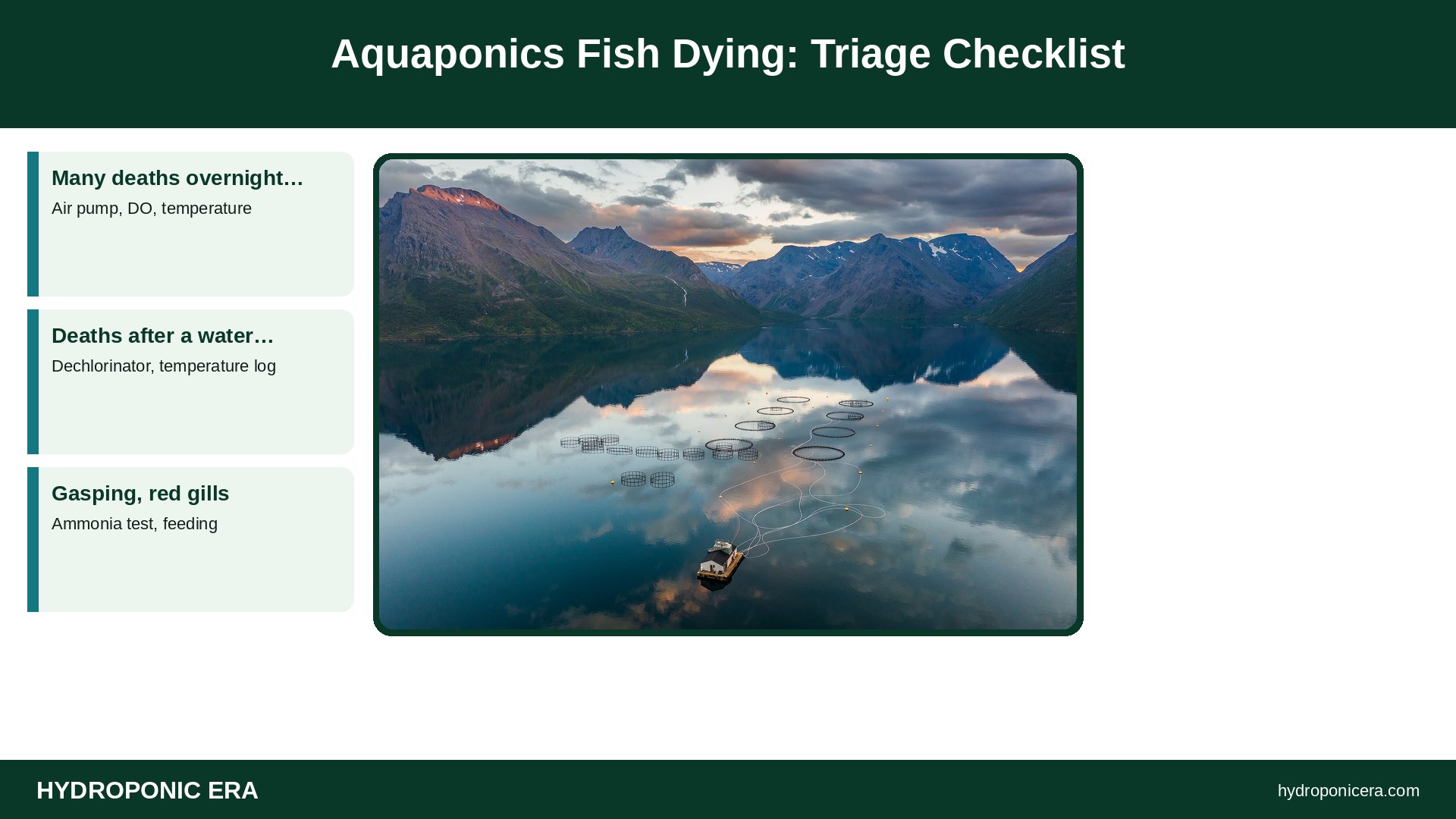
Step 1: Check Air and Water Flow

Listen for the air pump and look for bubbles from every stone. Check that the water pump is moving water and that the return isn’t blocked. A tripped breaker, unplugged pump or clogged air stone can drop oxygen in hours. If anything has stopped, restart it and add emergency aeration. See aquaponics air pump and aquaponics power outage.
Step 2: Test the Water
- Dissolved oxygen: should be above 5 mg/L. See aquaponics dissolved oxygen.
- Ammonia: should be under about 0.5–1 mg/L. See aquaponics ammonia spike.
- Nitrite: should be under about 0.5 mg/L. See aquaponics nitrite spike.
- pH: about 6.8–7.4 for most systems. See aquaponics pH.
- Temperature: within the species’ comfort range. See aquaponics water temperature.
- Nitrate: under about 150 mg/L. See aquaponics nitrate too high.
Step 3: Remove Dead Fish and Stop Feeding
Dead fish decay quickly, releasing ammonia and spreading disease. Remove them right away with a net used only for that purpose. Check corners, sumps, pipes and grow beds for fish that may have jumped or been sucked in. Stop feeding for 24–48 hours to reduce ammonia and oxygen demand.
Step 4: Emergency Water Change
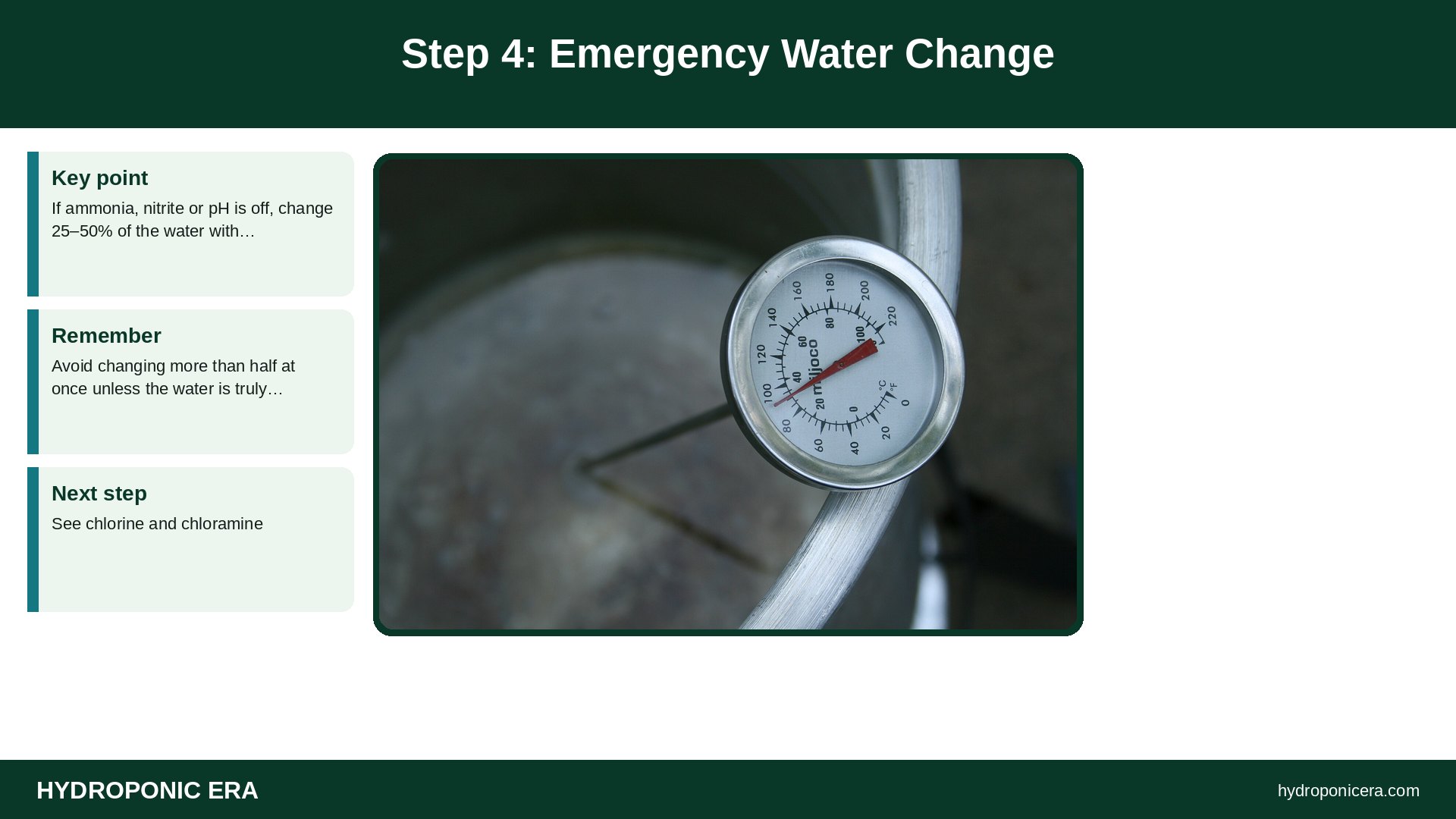
If ammonia, nitrite or pH is off, change 25–50% of the water with dechlorinated water within about 2–3°F of the system temperature. Retest after a few hours. Avoid changing more than half at once unless the water is truly toxic, because a big shift in pH or temperature is another shock. See chlorine and chloramine.
Step 5: Look at the Fish
- Gills: bright red is healthy; pale, brown or swollen gills point to oxygen, nitrite or parasites.
- Skin: white spots, fuzzy patches, red sores or excess mucus point to disease.
- Fins: frayed or rotting fins suggest bacterial infection or nipping.
- Eyes: cloudy or bulging eyes suggest infection.
- Body: thin or bloated fish suggest nutrition or internal disease.
If you see signs of disease, move sick fish to a hospital tank. See aquaponics fish diseases.
Step 6: Think About Recent Changes
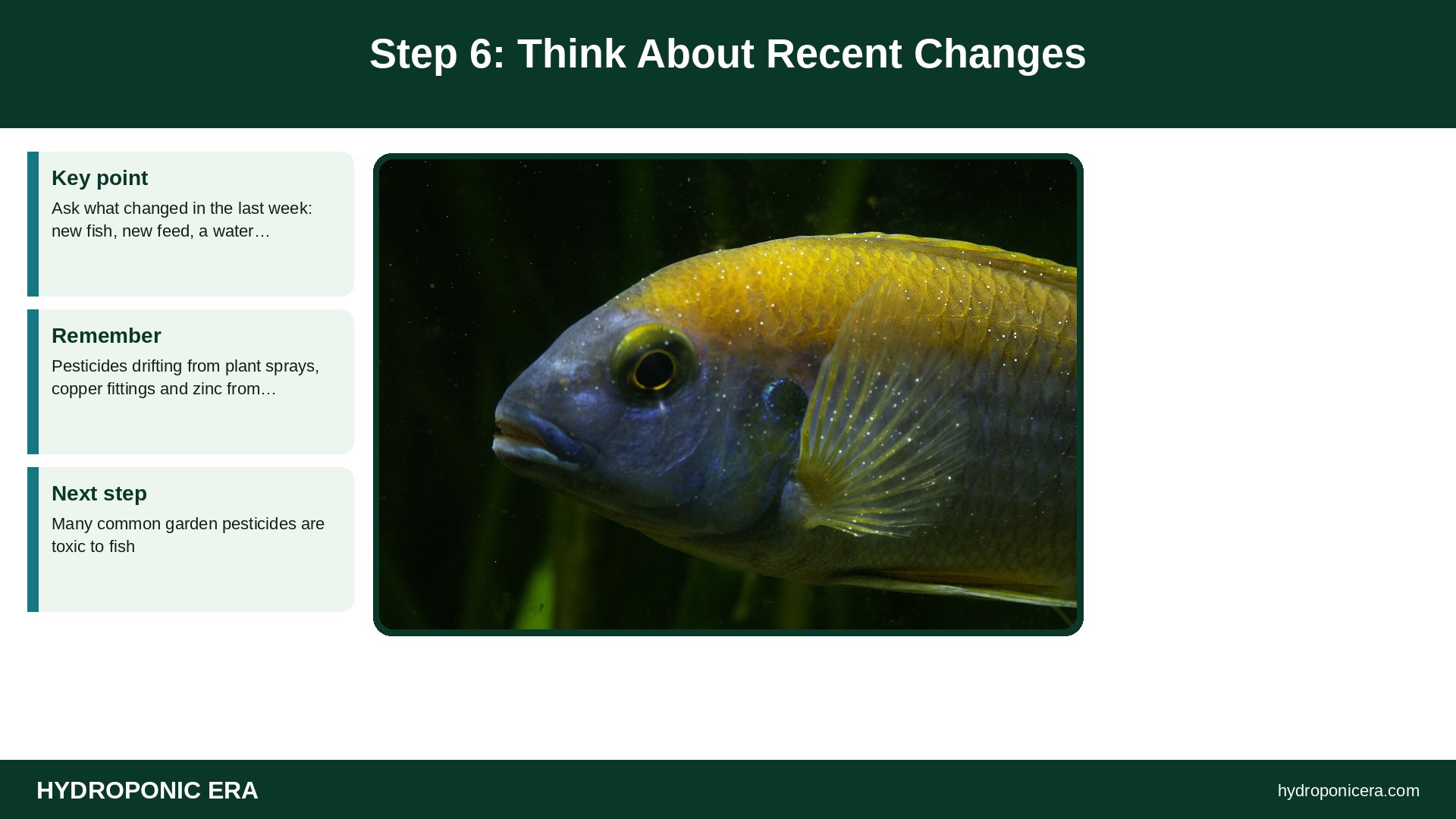
Ask what changed in the last week: new fish, new feed, a water change, pest sprays on the plants, cleaning products near the tank, new plumbing or metal fittings, a heater failure, a heat wave. Pesticides drifting from plant sprays, copper fittings and zinc from galvanized metal can kill fish at low levels. Many common garden pesticides are toxic to fish. See safe materials and pests on hydroponic plants.
Aquaponics Fish Dying After New Fish Arrive
Losses in the first week after stocking usually come from shipping stress, poor acclimation or disease brought in with the fish. UF/IFAS notes that disease often appears 1–3 weeks after shipping. Quarantine new fish for at least 30 days. See quarantine new fish and acclimating fish.
Aquaponics Fish Dying in Summer or Winter
Summer heat cuts oxygen and speeds disease; winter cold slows bacteria and fish immune systems. Large temperature swings in either season stress fish. Insulate tanks, shade them, and use a thermostat-controlled heater where needed. See aquaponics in winter.
Protect the Plants Too
A crisis in the fish tank affects the plants. Ammonia spikes, water changes and stopped feeding all change nutrient levels. Keep an eye on leaf color for a couple of weeks after an event, and avoid adding plant supplements until fish are stable again.
When to Get Help

If deaths continue after water quality is fixed, contact your state extension aquaculture specialist or a fish health lab. Bring a live, sick fish in a bag of system water if possible; dead fish decay quickly and are harder to diagnose. A diagnosis prevents wasted treatments.
Preventing Aquaponics Fish Dying
- Stock at moderate density. See stocking density.
- Keep backup aeration and alarms.
- Test water weekly, more often in summer and during cycling.
- Always dechlorinate top-off and change water.
- Quarantine new fish and plants.
- Use only fish-safe pest controls.
- Feed quality feed in the right amounts. See aquaponics fish food.
Aquaponics Fish Dying One at a Time
When aquaponics fish dying happens slowly, one fish every few days, the cause is usually chronic rather than acute. Look for low-grade disease, parasites, poor feed, bullying by larger fish, or a water parameter that sits just outside the comfort range for weeks. Weigh or measure a few fish to see whether they’re growing. Thin fish with big heads suggest underfeeding or internal parasites; fish with torn fins may be fighting. Separate aggressive fish, grade fish by size, and review feed quality and storage.
Aquaponics Fish Dying in a New System
New systems are prone to ammonia and nitrite spikes while bacteria establish. If you added fish before the system cycled, test daily and use water changes to keep levels safe. Cycling fishless first avoids most of these losses. See aquaponics cycling.
Keep a Death Log
Record the date, number, size and appearance of every dead fish, with water test results from that day. Patterns appear quickly: deaths after feeding, after hot afternoons, or only among the largest fish. That record turns aquaponics fish dying from a mystery into a problem you can solve, and it is exactly what a fish health lab will ask for. See record keeping and logs.
FAQs
Why are my aquaponics fish dying suddenly?
Usually low oxygen, ammonia or nitrite, temperature shock or chlorine.
What should I test first?
Dissolved oxygen, ammonia, nitrite, pH and temperature.
Should I do a water change?
Yes, 25–50% if any test is off, with matched, dechlorinated water.
Can plant sprays kill fish?
Yes; many pesticides are toxic to fish.
Why do fish die after a water change?
Chlorine, temperature or pH shock.
Who can diagnose dead fish?
State fish health labs and extension aquaculture specialists.
Sources
- UF/IFAS Extension — Ammonia in Aquatic Systems
- UF/IFAS Extension — Ichthyophthirius multifiliis (White Spot) Infections in Fish
- New Mexico State University — Important Water Quality Parameters in Aquaponics Systems
- Purdue Animal Disease Diagnostic Laboratory — Nitrite Toxicosis in Freshwater Fish
- Photo credits (Wikimedia Commons, edited with titles): Fish farming on Øksfjorden in Loppa, Troms og Finnmark, Norway, 2022 August by Ximonic (Simo Räsänen) (CC BY-SA 4.0); Aquarium-air-pump by User:Corydoras-adolfoi (CC BY-SA 4.0); 2008-09-20 Thermometer reading by Ildar Sagdejev (Specious) (CC BY-SA 4.0); Ichthyophthiriasis by No machine-readable author provided. Djpalme assumed (based on copyright claims) (Public domain); AQUAPONIE by Hopeballa (CC BY-SA 4.0)