
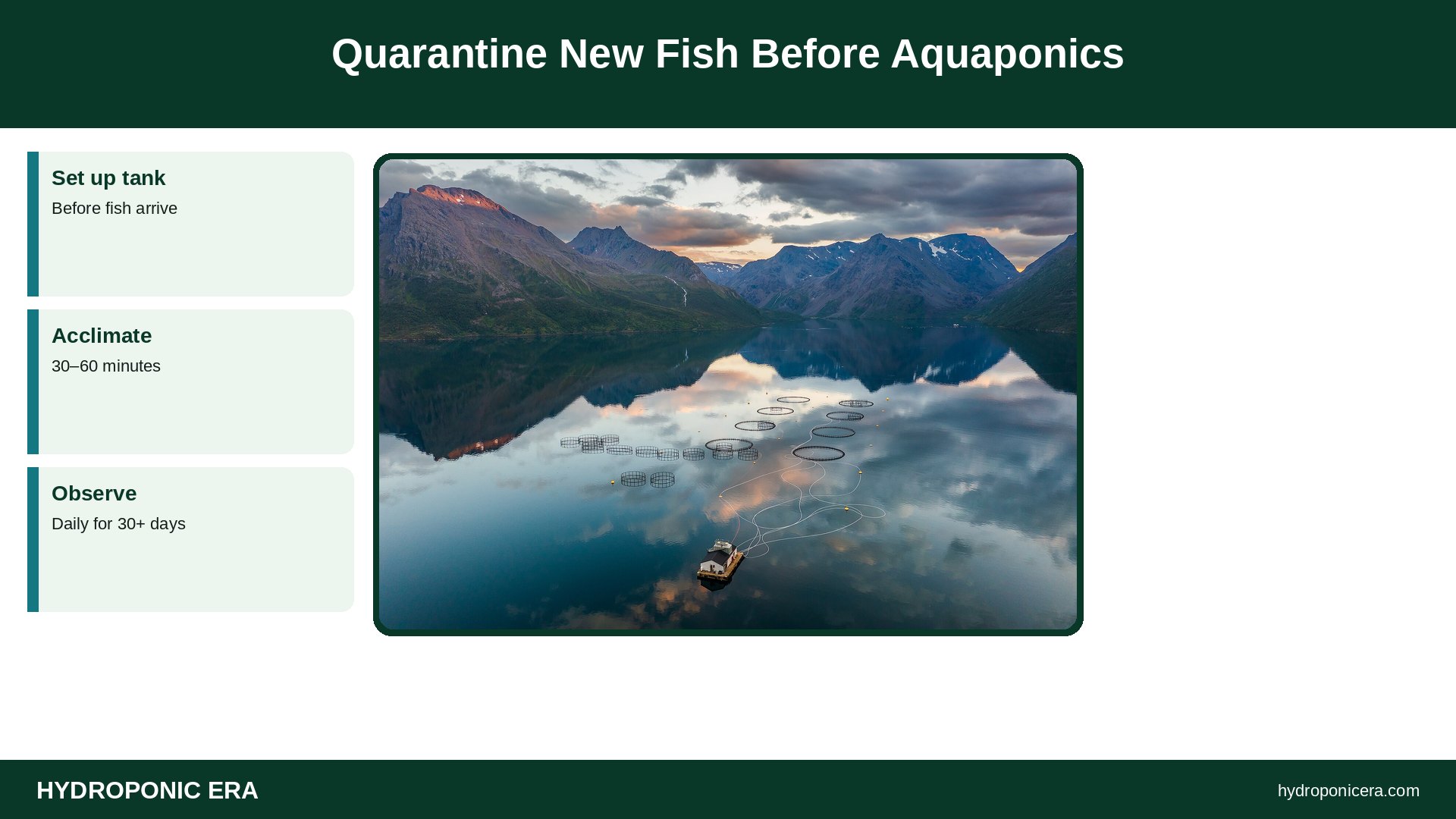
To quarantine new fish before adding them to aquaponics, keep them in a separate tank with its own water, filter, aeration and equipment for at least 30 days, the minimum UF/IFAS recommends to catch Ich and other diseases that often appear 1–3 weeks after shipping. Watch them daily, feed lightly, test water often, and treat any problems in the quarantine tank, where salt or medication can’t harm your plants or biofilter. Only move fish into the main system after they’ve eaten well and shown no signs of disease for the full period.
Key takeaway: A quarantine tank is the cheapest insurance in aquaponics. One sick fish added straight to the system can infect every fish you own.
| Quarantine step | What to do | Time |
|---|---|---|
| Set up tank | Separate tank, filter, air, heater, net | Before fish arrive |
| Acclimate | Match temperature and water slowly | 30–60 minutes |
| Observe | Check behavior, skin, fins, gills, feeding | Daily for 30+ days |
| Test water | Ammonia, nitrite, pH, temperature | Every 1–2 days |
| Treat if needed | Salt or diagnosed treatment in QT only | As needed |
| Release | Healthy, eating, no signs for 30 days | After quarantine |
Why Quarantine New Fish
Fish can carry parasites and bacteria without looking sick. The stress of netting, bagging and shipping weakens them, and disease often breaks out a week or more after arrival. UF/IFAS notes that Ich is easily introduced with new fish, plants or equipment, and that a minimum 30-day quarantine is recommended. In a recirculating system, a disease introduced this way reaches every fish, and the treatments that would help are often unsafe for plants. See aquaponics fish diseases.
Setting Up a Quarantine Tank
- Tank: a 20–100 gallon tank, stock tank or tote, depending on fish size and number.
- Filter: a sponge filter or small canister, ideally seeded with media from a healthy tank so it’s already cycled.
- Aeration: an air pump and stone. See aquaponics air pump.
- Heater for warm-water fish. See aquarium heaters.
- Lid to keep fish from jumping.
- Separate net, bucket and siphon used only for quarantine.
- Test kits for ammonia, nitrite and pH.
Keep the quarantine tank in a different area from the main system, so splashes and mist can’t carry pathogens across.
Bringing New Fish Home
- Float the sealed bag in the quarantine tank for 15–20 minutes to match temperature.
- Add small amounts of tank water to the bag every few minutes for 20–30 minutes.
- Net the fish into the quarantine tank. Don’t pour shipping water into your tank.
- Dim the lights and leave them alone for a few hours.
- Offer a small amount of food the next day.
Take your time; rushing acclimation adds stress at the worst possible moment.
What to Watch for While You Quarantine New Fish
- White spots, fuzzy patches or sores.
- Flashing or rubbing against surfaces.
- Clamped or ragged fins.
- Rapid breathing or gasping.
- Cloudy eyes, bloating or popeye.
- Refusing food after the first few days.
- Unusual swimming or isolation.
Preventive Salt Treatment
Many growers add low levels of salt to the quarantine tank to reduce stress and control some external parasites. Low salt levels are widely used in aquaculture to ease osmotic stress after transport and handling. Because the quarantine tank has no plants, you can use doses that would be too high for the main system. Use plain, non-iodized salt and follow established rates for your species. See aquaponics nitrite spike for chloride basics.
Water Quality in Quarantine
A small quarantine tank can build up ammonia fast, especially if the filter isn’t cycled. Feed lightly, test every day or two, and change 20–30% of the water when ammonia or nitrite rises. Keep temperature steady and matched to the main system near the end of quarantine, so moving the fish isn’t another shock.
When to Quarantine New Fish Longer
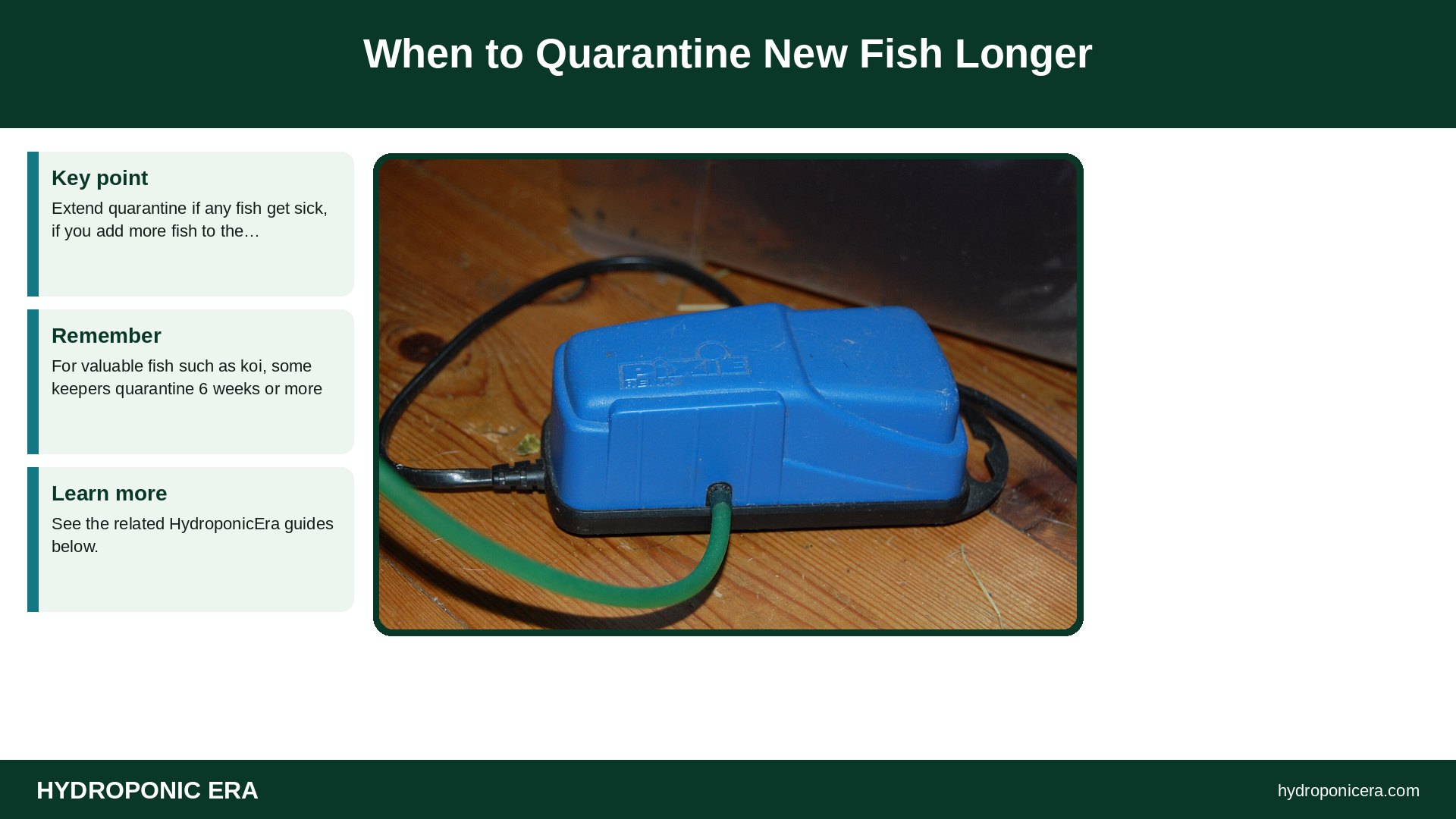
Extend quarantine if any fish get sick, if you add more fish to the quarantine tank partway through (restart the clock), or if fish came from an unknown source. For valuable fish such as koi, some keepers quarantine 6 weeks or more. See koi aquaponics.
Moving Fish Into the Main System
- Confirm 30+ days with no signs of disease and normal feeding.
- Match temperature and pH between the two tanks.
- Net fish rather than pouring quarantine water into the system.
- Add fish in small groups so the biofilter can adjust. See aquaponics ammonia spike.
- Disinfect the quarantine tank and gear afterward.
Quarantine New Plants Too
Plants from ponds or other aquaponics systems can carry Ich cysts, snails and pests. UF/IFAS notes that holding plants without fish for the duration of the Ich life cycle helps prevent infection. Rinse plant roots, and keep new plants separate for a week or two. See quarantining new plants.
Cleaning the Quarantine Tank
After each batch, drain the tank, scrub it, and disinfect it along with the net, bucket and siphon. Rinse well and let everything dry completely. Replace or re-seed the sponge filter before the next batch so the tank is ready when fish arrive.
Buying Healthy Fish
Choose suppliers that specialize in food or aquaponics fish and can tell you about their health checks. Avoid tanks with dead or sick fish. Buying all fish from one source and at one time reduces risk. See best fish for aquaponics and aquaculture permits.
How to Quarantine New Fish on a Budget
You don’t need an expensive aquarium to quarantine new fish. A food-grade storage tote or a cheap stock tank works, with a $15 air pump, a sponge filter and an aquarium heater. Keep a clean cycled sponge running in the main sump at all times, so it’s ready to move into the quarantine tank the day fish arrive. Total cost is usually under $100, far less than replacing a tank of sick fish.
Quarantine New Fish From Different Sources Separately
Fish from two hatcheries or stores can carry different pathogens. If you can, quarantine new fish from each source in its own tank, or at least don’t mix batches until both have passed the full period. Mixing them early defeats much of the purpose.
Keep Records During Quarantine
Log the arrival date, source, number and size of fish, daily observations, water tests, feeding and any treatment. If a problem shows up later in the main system, these notes help a fish health lab or extension specialist trace it. Good records are also useful if you sell fish or need permits. When you quarantine new fish this way every time, outbreaks become rare.
FAQs
How long should I quarantine new fish?
At least 30 days.
Can I skip quarantine if fish look healthy?
No; many diseases don’t show until weeks after shipping.
Do I need a cycled filter in quarantine?
It helps; otherwise test and change water often.
Can I use salt in quarantine?
Yes; it’s a common treatment because there are no plants to harm.
Should I quarantine fingerlings?
Yes, all new fish.
What if fish get sick in quarantine?
Diagnose and treat there, then restart the 30-day clock.
Sources
- UF/IFAS Extension — Ichthyophthirius multifiliis (White Spot) Infections in Fish
- UF/IFAS Extension — Fish Health Management Considerations in Recirculating Aquaculture Systems, Part 2
- Texas A&M AgriLife Extension — Bath Treatment for Sick Fish
- Photo credits (Wikimedia Commons, edited with titles): Fish farming on Øksfjorden in Loppa, Troms og Finnmark, Norway, 2022 August by Ximonic (Simo Räsänen) (CC BY-SA 4.0); Oweston sting fish for sale at Tsukiji Fishmarket, Tokyo-30 by MichaelMaggs (CC BY-SA 3.0); Dead Sea salt crystals by Petar Milošević (CC BY-SA 4.0); Raceways at Ennis National Fish Hatchery (51267218370) by USFWS Mountain Prairie (Public domain); Aquarium-air-pump by User:Corydoras-adolfoi (CC BY-SA 4.0)