
An aquaponics nitrite spike happens when nitrite (NO2) climbs above about 0.5–1 mg/L because the second group of nitrifying bacteria hasn’t caught up with ammonia conversion. Nitrite causes “brown blood disease,” which stops fish blood from carrying oxygen. The fast fix is to stop feeding, increase aeration, do a 25–50% water change, and add plain salt (sodium chloride) so chloride is at least 6 times the nitrite level, because chloride blocks nitrite uptake at the gills. Keep salt doses low in aquaponics, since plants are sensitive to sodium and chloride.
Key takeaway: Chloride protects fish from nitrite. Purdue’s diagnostic lab advises keeping chloride at 3–6 times the nitrite level to treat brown blood disease and at least 20 mg/L to prevent it.
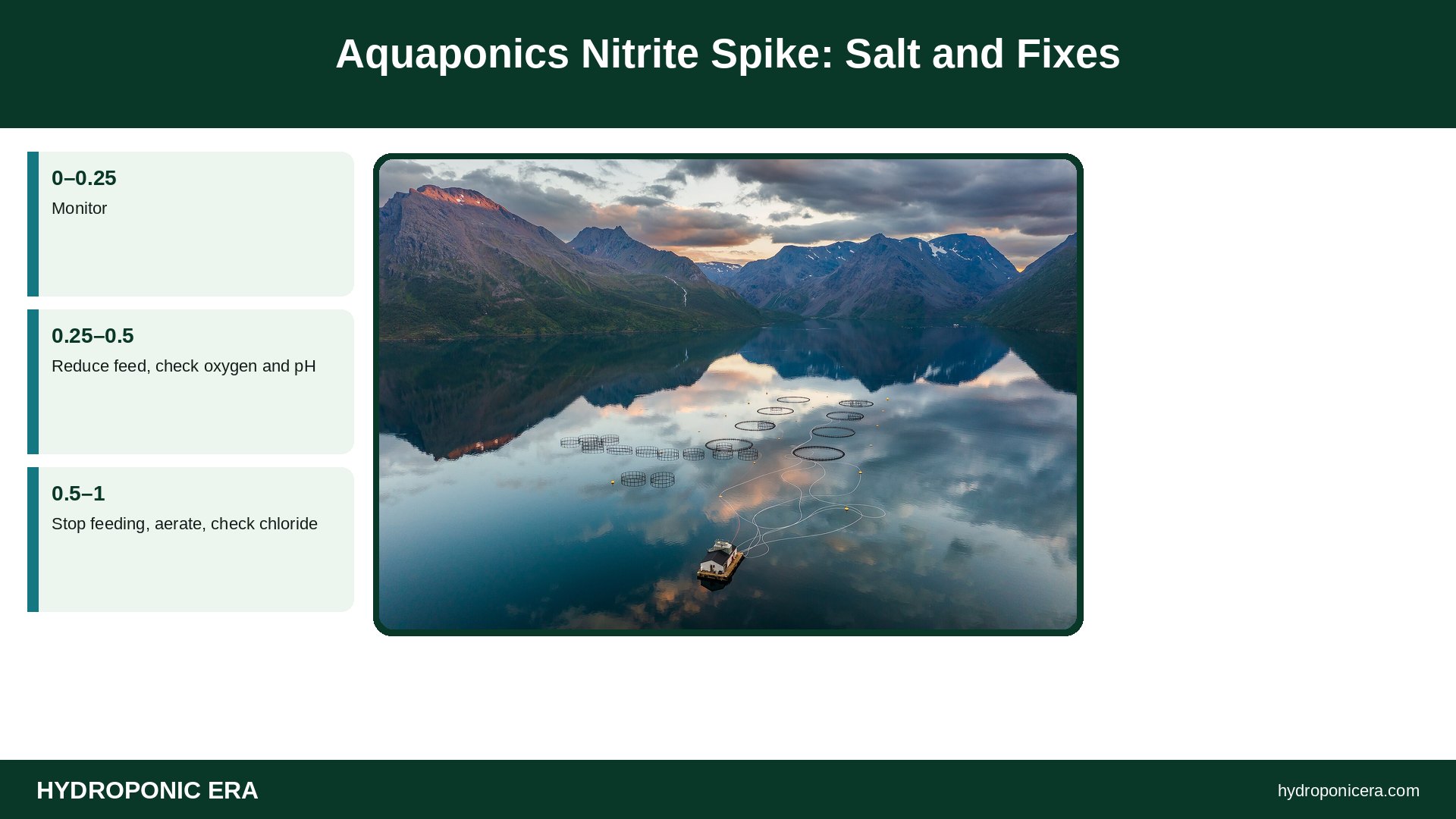
| Nitrite (NO2, mg/L) | Status | Action |
|---|---|---|
| 0–0.25 | Normal in a cycled system | Monitor |
| 0.25–0.5 | Elevated | Reduce feed, check oxygen and pH |
| 0.5–1 | Spike | Stop feeding, aerate, check chloride |
| 1–2 | Dangerous | Water change, salt to 6:1 chloride:nitrite |
| Over 2 | Emergency | Repeated water changes, salt, move fish if needed |
Why an Aquaponics Nitrite Spike Is Dangerous

Nitrite enters fish through the gills and turns hemoglobin into methemoglobin, which can’t carry oxygen. Purdue’s Animal Disease Diagnostic Laboratory describes this as brown blood disease, because affected blood turns chocolate brown. Fish may look normal at rest and die when they exert themselves. UF/IFAS notes that nitrite can be toxic at levels as low as 0.10 mg/L for sensitive species. See ammonia, nitrite and nitrate.
Common Causes
- New system: nitrite-oxidizing bacteria establish after ammonia oxidizers, so nitrite peaks late in cycling. See aquaponics cycling.
- A recent ammonia spike, which leaves a nitrite spike behind it. See aquaponics ammonia spike.
- Low oxygen in the biofilter.
- Low pH or alkalinity slowing nitrification.
- Cold water.
- Overfeeding or overstocking.
- Medications or cleaning chemicals that killed bacteria.
Emergency Steps for an Aquaponics Nitrite Spike

- Stop feeding for 24–48 hours.
- Max out aeration, because fish with brown blood are short of oxygen.
- Test nitrite, ammonia, pH, temperature and chloride if you have a kit.
- Do a 25–50% water change with dechlorinated water at the same temperature.
- Add salt to reach a chloride to nitrite ratio of about 6:1 (see below).
- Retest after 12–24 hours and repeat if needed.
How Much Salt to Add
Table salt is about 60% chloride by weight. To raise chloride by 1 ppm in 100 gallons of water, you need about 0.6 grams of plain salt. For example, if nitrite is 2 ppm, the treatment target is about 12 ppm chloride above what’s already in your water. In a 300-gallon system, that’s about 12 × 0.6 × 3 = 22 grams, or a little more than a tablespoon of fine salt.
- Use non-iodized salt with no anti-caking agents or additives, such as pure canning, pickling or solar salt.
- Dissolve salt in a bucket of system water first, then add it slowly near the return.
- Test chloride with a chloride kit rather than a salinity meter; Texas A&M AgriLife notes that chloride is the part of salt that does the work.
Higher therapeutic salt doses used against parasites are a separate treatment with much tighter plant limits, so don’t confuse the two.
Protecting Plants From Salt
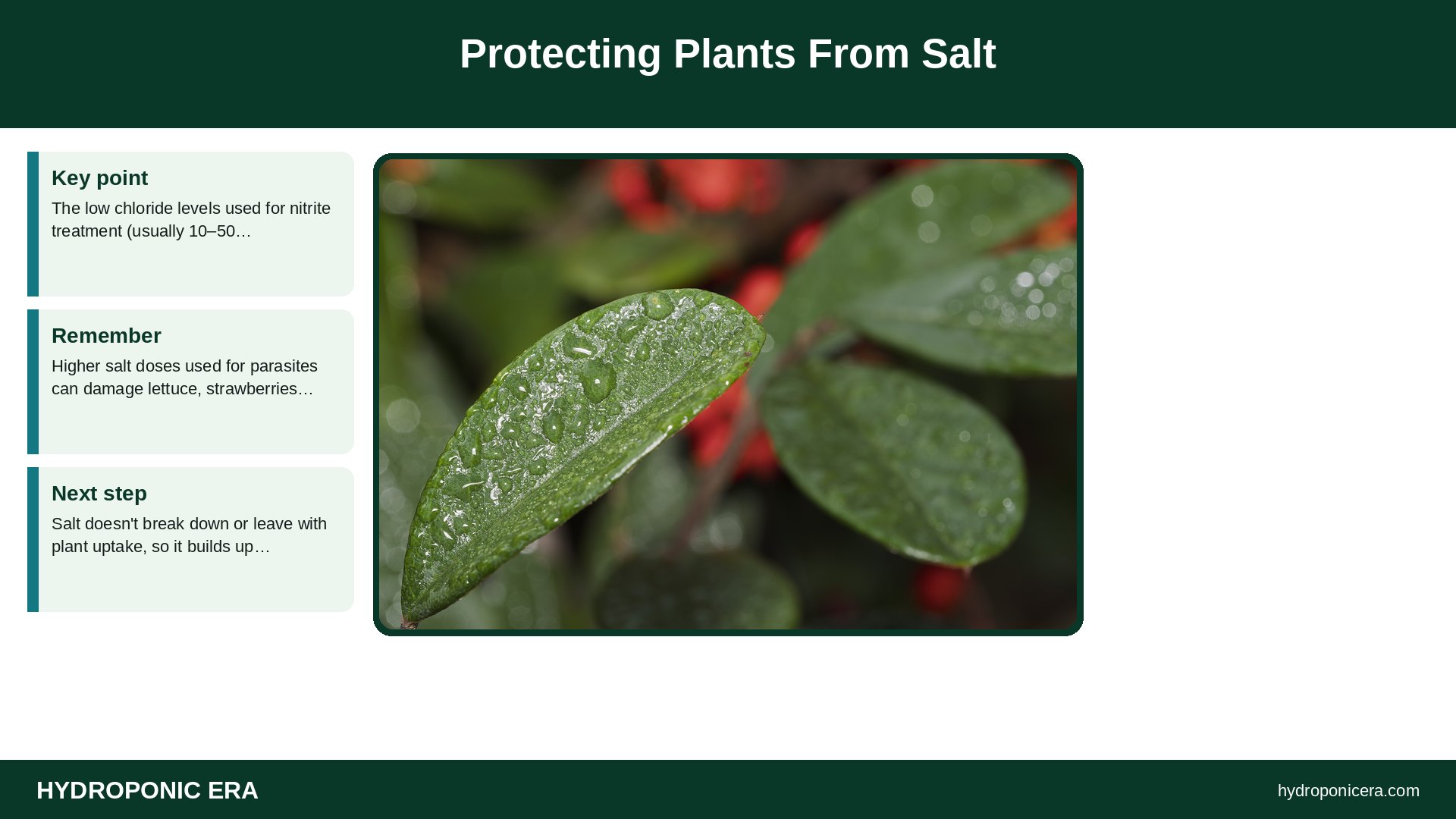
The low chloride levels used for nitrite treatment (usually 10–50 ppm) are generally tolerated by most plants. Higher salt doses used for parasites can damage lettuce, strawberries and other salt-sensitive crops. Salt doesn’t break down or leave with plant uptake, so it builds up over time. Track how much you add, and use water changes to bring sodium down. See sodium buildup.
Supporting the Biofilter
A nitrite spike ends when nitrite-oxidizing bacteria catch up. Help them by keeping dissolved oxygen above 5 mg/L, pH around 6.8–7.2, alkalinity in range, and temperatures in the comfort zone. Don’t clean the biofilter during a spike. See aquaponics biofilter, nitrifying bacteria and aquaponics dissolved oxygen.
Signs of Nitrite Poisoning

- Fish gasping or crowding near aeration.
- Gills tan or brown instead of bright red.
- Lethargy and sudden deaths after handling or excitement.
- Loss of appetite.
Preventing an Aquaponics Nitrite Spike
- Cycle the system fully before stocking.
- Increase fish and feed slowly.
- Keep oxygen and alkalinity in range.
- Maintain a baseline chloride of about 20 ppm if your source water is very low, while keeping plant tolerance in mind.
- Keep backup aeration for power cuts. See aquaponics power outage plan.
- Test nitrite weekly, daily during cycling.
Keep a Record
Write down every nitrite reading, water change and salt addition with the date and volume. Over time the log shows how fast your system recovers and how much salt has built up, which helps you decide when a larger water change is due for the plants’ sake.
Species Differences
Sensitivity varies widely. Trout and other salmonids are among the most sensitive. Channel catfish are a classic brown-blood species. Tilapia are relatively tolerant but still suffer at high levels. Goldfish and koi tolerate more but are not immune. See best fish for aquaponics.
Aquaponics Nitrite Spike During Cycling
In a new system, an aquaponics nitrite spike usually arrives two to four weeks after ammonia first rises, and it can last longer than the ammonia peak. Readings above 5 mg/L are common in fishless cycling and are not a problem without fish. If you cycle with fish, keep stocking light, feed very little, and use salt and water changes to keep fish safe until nitrite falls. Warm water (about 77–86°F) and good aeration speed the process.
Testing for an Aquaponics Nitrite Spike
Liquid nitrite kits are inexpensive and accurate enough for home use. Test at the same time each day during cycling and after any upset such as a power cut, a fish death or a big feeding increase. Note whether the kit reads nitrite (NO2) or nitrite-nitrogen (NO2-N); 1 mg/L of NO2-N equals about 3.3 mg/L of NO2, so mixing them up can make a reading look three times better or worse than it is. A chloride test kit is also worth having if you rely on salt for protection.
Recovery Timeline
After you fix oxygen, pH and feeding, nitrite usually falls within a few days in an established system. If an aquaponics nitrite spike lasts more than two weeks, look again at alkalinity, temperature and biofilter size, and consider whether the fish load is simply too high for the system.
FAQs
What nitrite level is dangerous for fish?
Above about 0.5–1 mg/L needs action; sensitive fish suffer at lower levels.
How does salt help with nitrite?
Chloride competes with nitrite at the gills and blocks its uptake.
How much salt should I add?
Enough for about 6 ppm chloride per 1 ppm nitrite.
Will salt hurt my plants?
Low doses usually don’t; high or repeated doses can.
Can I use iodized salt?
No; use plain salt without iodine or additives.
How long does a nitrite spike last?
Often days to a couple of weeks in a new system.
Sources
- UF/IFAS Extension — Ammonia in Aquatic Systems
- Purdue Animal Disease Diagnostic Laboratory — Nitrite Toxicosis in Freshwater Fish or Brown Blood Disease
- Texas A&M AgriLife Extension — Nitrite Poisoning or “Brown Blood” Disease
- Photo credits (Wikimedia Commons, edited with titles): Fish farming on Øksfjorden in Loppa, Troms og Finnmark, Norway, 2022 August by Ximonic (Simo Räsänen) (CC BY-SA 4.0); Dead Sea salt crystals by Petar Milošević (CC BY-SA 4.0); AQUAPONIE by Hopeballa (CC BY-SA 4.0); Water droplets on a late cotoneaster (Cotoneaster coriaceus) leaf, Jardim da Fundação Calouste Gulbenkian, Lisbon, Portugal julesvernex2 by Jules Verne Times Two (CC BY-SA 4.0); Oreochromis-niloticus-Nairobi by Bjørn Christian Tørrissen (CC BY-SA 3.0)