
Healthy aquaponics dissolved oxygen levels are at least 5 mg/L (5 ppm) in the fish tank and throughout the system, with 6–8 mg/L better for trout, high stocking densities and fast plant growth. Below about 4 mg/L most warm-water fish such as tilapia eat less and grow slowly; below 2–3 mg/L they gasp at the surface and can die within hours. Nitrifying bacteria and plant roots also need oxygen, so low aquaponics dissolved oxygen shows up as ammonia spikes and root rot as well as stressed fish.
Key takeaway: Keep DO above 5 mg/L at all times by sizing aeration for the fish load, keeping water cool, removing solids, and having a backup air supply ready for power cuts.
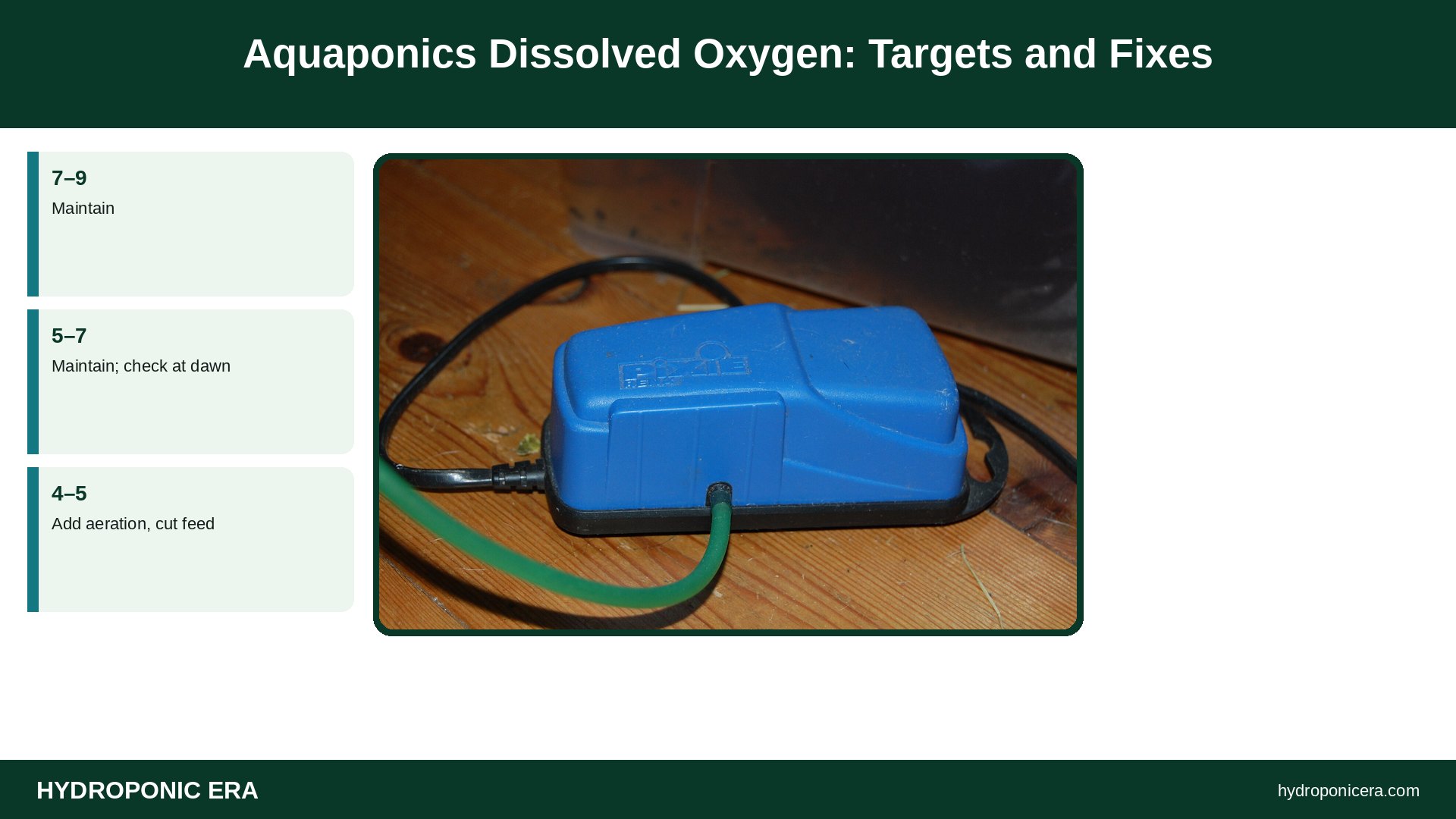
| DO (mg/L) | What it means | Action |
|---|---|---|
| 7–9 | Excellent; near saturation in cool water | Maintain |
| 5–7 | Good for most warm-water fish and bacteria | Maintain; check at dawn |
| 4–5 | Marginal; slower growth, stress | Add aeration, cut feed |
| 2–4 | Danger; fish gasp, nitrification slows | Emergency aeration now |
| Under 2 | Lethal for most species | Aerate, stop feeding, partial water change |
Why Aquaponics Dissolved Oxygen Matters
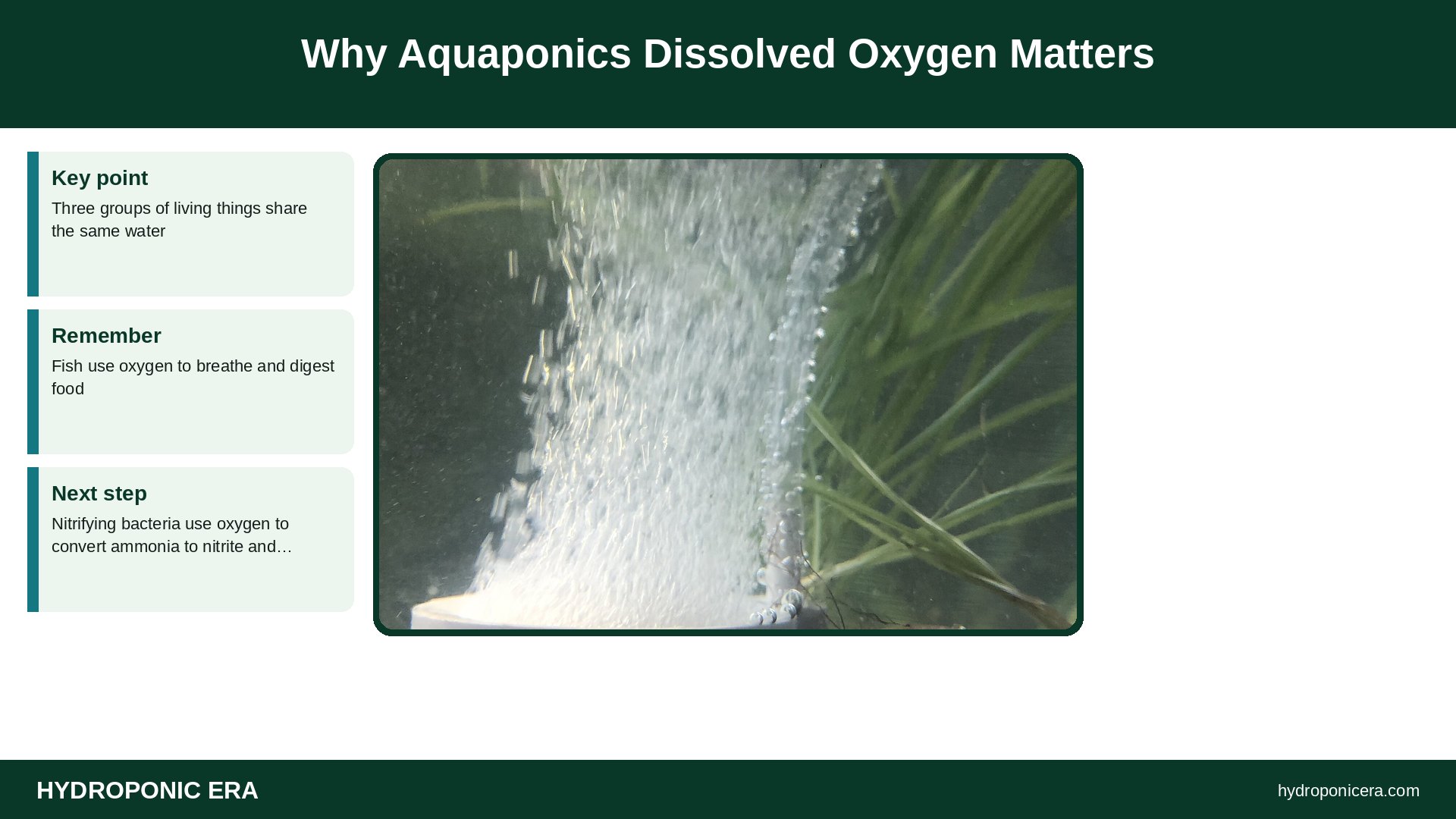
Three groups of living things share the same water. Fish use oxygen to breathe and digest food. Nitrifying bacteria use oxygen to convert ammonia to nitrite and nitrate; UF/IFAS notes that both groups of nitrifying bacteria need oxygen and alkalinity, and stop working when either runs short. Plant roots use oxygen to take up water and nutrients. Organic waste that settles in the system is broken down by other bacteria, which also consume oxygen. In a well-run system, aeration supplies all four. See nitrifying bacteria and the nitrogen cycle.
Targets by Fish Species
- Tilapia: survive brief lows but grow best above 5 mg/L. See tilapia aquaponics.
- Catfish, bluegill, goldfish, koi: 5 mg/L or more.
- Trout: need 6–8 mg/L or more and cold water. See trout aquaponics.
- Yellow perch: about 5–6 mg/L or more.
New Mexico State University lists dissolved oxygen as one of the key water quality parameters to monitor in aquaponics, alongside pH, temperature and nitrogen compounds.
Temperature and Aquaponics Dissolved Oxygen

Warm water holds less oxygen. At sea level, fully saturated fresh water holds about 10 mg/L at 59°F, about 8.3 mg/L at 77°F and only about 7.5 mg/L at 86°F. At the same time, fish and bacteria use oxygen faster in warm water. That’s why summer is the riskiest season for aquaponics dissolved oxygen, especially in greenhouses. Shade tanks, insulate them, and avoid letting water climb above the comfort range for your fish. See aquaponics water temperature.
What Lowers DO in Aquaponics
- Too many fish for the aeration and filtration. See stocking density.
- Overfeeding: uneaten feed rots and uses oxygen.
- Solids buildup in tanks, pipes and grow beds. See solids filters.
- Warm water in summer or heated systems.
- Pump or air failures, often during power cuts.
- Algae blooms that crash overnight. See algae control.
How to Measure Aquaponics Dissolved Oxygen

An optical or galvanic DO meter gives the most useful readings. Chemical drop kits work but are slower and less precise. Measure in the fish tank and in the sump or raft beds, at the same times each day. The lowest reading usually comes just before dawn, when plants and algae have been consuming oxygen all night with no photosynthesis. Calibrate the meter as the maker recommends and keep the membrane clean.
Watch the Fish
Fish gathering at the surface or near the water inlet, gulping air, or lying listless on the bottom are signs of low oxygen. A sudden loss of appetite is often the first warning. Don’t wait for a meter reading if fish are gasping; add aeration immediately.
How to Raise Aquaponics Dissolved Oxygen
- Add or upsize air pumps and stones. Place stones in the fish tank, sump and raft beds. See air pumps and stones and air pump sizing.
- Increase water movement. Returns that splash into the tank add oxygen, as do venturi fittings.
- Reduce feeding by half until levels recover.
- Remove solids from tanks and filters.
- Cool the water with shade, insulation or a chiller.
- Lower stocking density by harvesting or moving fish.
Oxygen in the Plant Beds

In deep water culture beds, roots need oxygen just as fish do. Use air stones every few feet under the rafts. In media beds, bell siphons and flood and drain cycles draw air into the media each time it drains. In NFT, the thin film and air space give roots oxygen, but warm channels can still run low. See raft systems, bell siphons and dissolved oxygen in hydroponics.
Power Outages
A power cut is the most common cause of sudden aquaponics dissolved oxygen crashes. A heavily stocked tank in warm water can drop to lethal levels in an hour or two. Keep a battery-powered air pump, a generator or an inverter, and an alarm that alerts you when power fails. See power outage recovery checklist and backup power for pumps.
Aquaponics Dissolved Oxygen and Feeding
Digestion raises a fish’s oxygen demand for several hours after a meal, and uneaten feed adds to the load as it breaks down. If aquaponics dissolved oxygen is marginal, feed smaller amounts more often rather than one large meal, and feed in the morning when DO is rising rather than in the evening before the overnight low. Watch how quickly the fish clear the feed; anything left after 5–10 minutes should be netted out. In hot weather, many growers cut rations by a quarter to a half until temperatures drop.
Aquaponics Dissolved Oxygen in New Systems
A new system has a small bacterial population and often a light fish load, so oxygen is rarely limiting at first. Problems start as fish grow and feeding rises while aeration stays the same. Plan aeration for the final fish weight, not the starting weight, and recheck aquaponics dissolved oxygen every time you increase feed or add fish. A system that held 7 mg/L in spring may drop below 5 mg/L by midsummer with the same equipment.
Daily DO Checklist
- Check fish behavior at every feeding.
- Read DO at dawn a few times a week, daily in summer.
- Listen for air pumps and check stones for even bubbles.
- Remove uneaten feed after 5–10 minutes.
- Clean filters and clear solids on schedule.
FAQs
What dissolved oxygen level do aquaponics fish need?
At least 5 mg/L for most species; trout need more.
When is DO lowest?
Usually just before dawn and on hot days.
Can plants suffer from low oxygen?
Yes; roots rot and growth slows.
Does a waterfall add oxygen?
Yes; splashing returns help, but may not be enough alone.
How fast can DO drop in a power cut?
In warm, crowded tanks, to dangerous levels in an hour or two.
Do I need a DO meter?
It is the most reliable way to know; drop kits are a cheaper option.
Sources
- New Mexico State University — Important Water Quality Parameters in Aquaponics Systems (CR-680)
- UF/IFAS Extension — Ammonia in Aquatic Systems
- Southern Regional Aquaculture Center — Aquaponics: Integrating Fish and Plant Culture (SRAC 454)
- FAO — Small-scale aquaponic food production
- Photo credits (Wikimedia Commons, edited with titles): Aquarium-air-pump by User:Corydoras-adolfoi (CC BY-SA 4.0); Air Stone Disk aquarium Germany 2024 by Nimmerwelk (CC BY-SA 4.0); Fish farming on Øksfjorden in Loppa, Troms og Finnmark, Norway, 2022 August by Ximonic (Simo Räsänen) (CC BY-SA 4.0); 2008-09-20 Thermometer reading by Ildar Sagdejev (Specious) (CC BY-SA 4.0); Solanum lycopersicum in aquaponics at the NC Greenhouse Nursery by Gogerr (CC BY-SA 4.0)