
An aquaponics solids filter removes uneaten feed and fish waste particles before they clog plant roots, pumps, and pipes. FAO’s aquaponics manual calls some level of mechanical filtration essential for healthy aquaponic tanks, and especially important for NFT and raft (DWC) systems. For small systems, FAO recommends a clarifier or mechanical separator, such as a swirl filter, which can remove up to 60% of removable solids. Size it at about one-sixth of the fish tank volume, or 10–30% depending on stocking density. Media beds act as their own filter at low stocking but need a separate solids filter above about 20 kg of fish per 1,000 liters (about 0.17 lb per gallon).
Key takeaway: Put a swirl or settling filter between the fish tank and the biofilter or grow beds, and flush the collected sludge regularly.
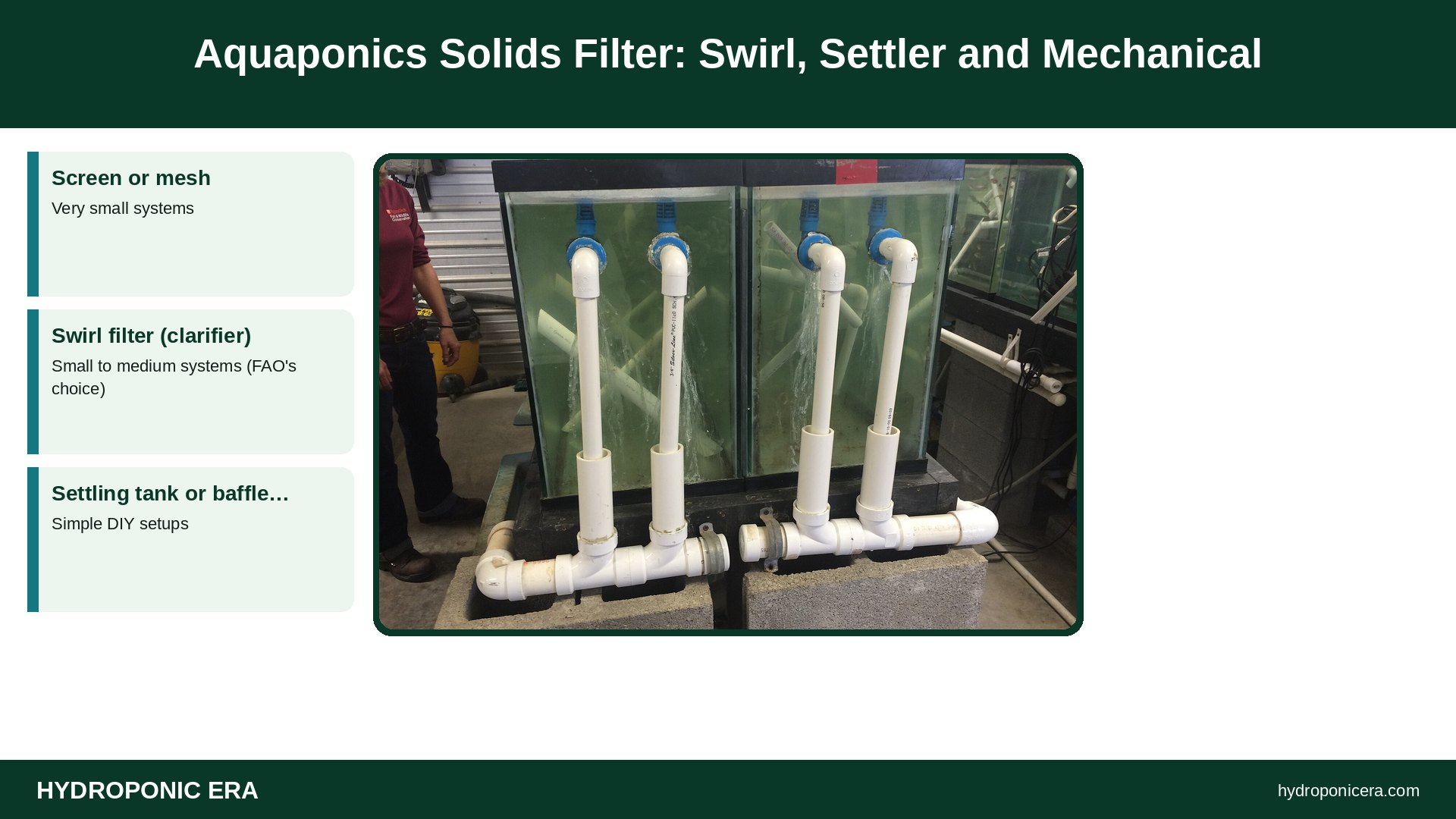
| Filter type | How it works | Best for |
|---|---|---|
| Screen or mesh | Catches solids; rinse often | Very small systems |
| Swirl filter (clarifier) | Circular flow drops solids to center and bottom | Small to medium systems (FAO’s choice) |
| Settling tank or baffle filter | Slows water so solids settle | Simple DIY setups |
| Radial-flow clarifier | Radial flow settles fine solids | Larger systems |
| Sand or bead filter | Traps particles in media | Larger, intensive systems |
Why an Aquaponics Solids Filter Matters
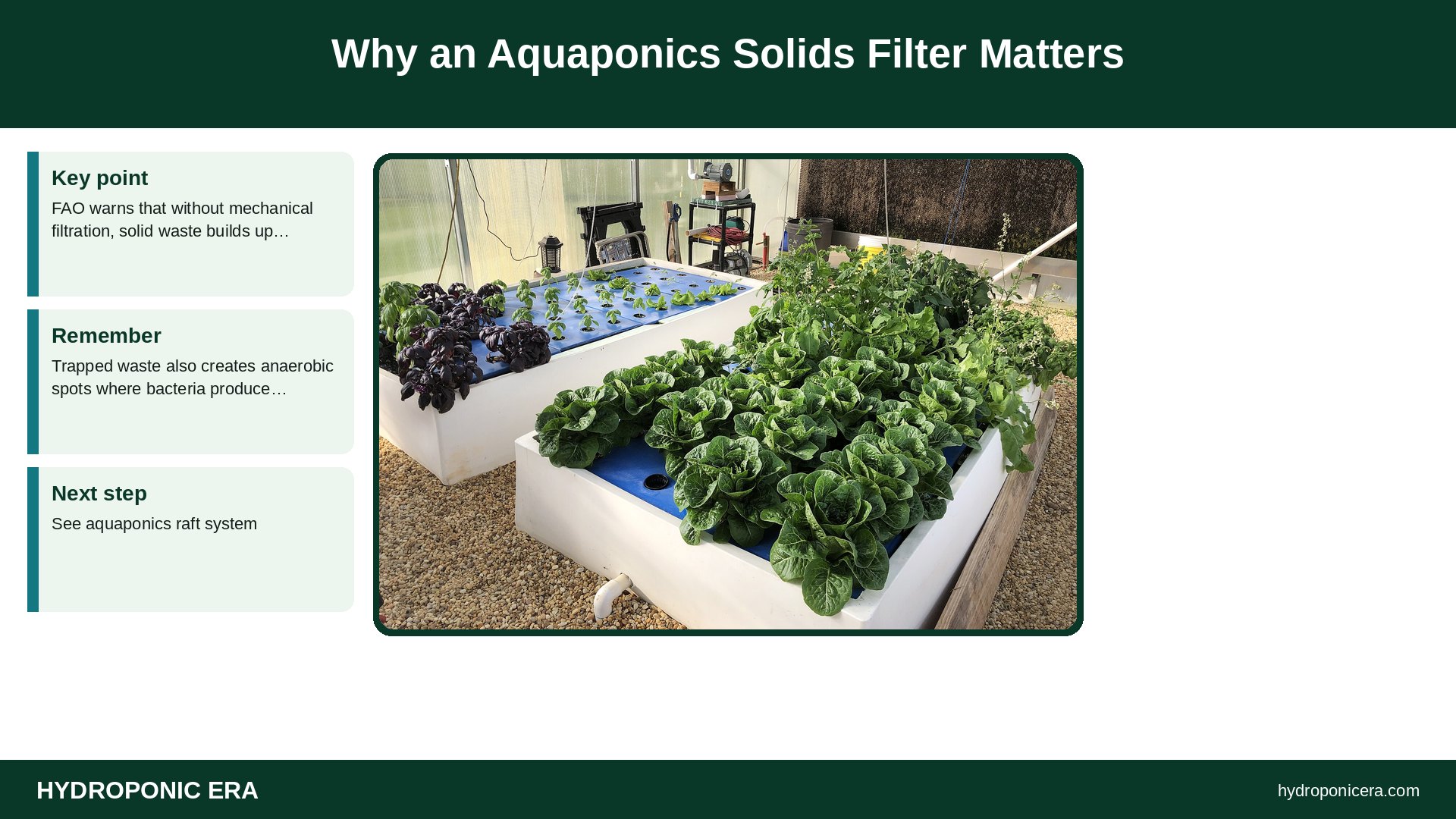
FAO warns that without mechanical filtration, solid waste builds up in NFT pipes and raft canals, clogs root surfaces, and blocks pumps and plumbing. Trapped waste also creates anaerobic spots where bacteria produce hydrogen sulfide, a gas lethal to fish that can often be detected by a rotten-egg smell. See aquaponics raft system.
How a Swirl Filter Works
In FAO’s description, water from the fish tank enters near the lower middle of the container through a pipe angled sideways (tangentially), which makes the water spin. Water at the center of the vortex moves slower, so solids collect at the center and bottom. A valve or swivel pipe at the bottom lets you flush the sludge. Clean water exits at the top through a slotted pipe covered with mesh and flows to the biofilter or grow beds.
DIY Aquaponics Solids Filter
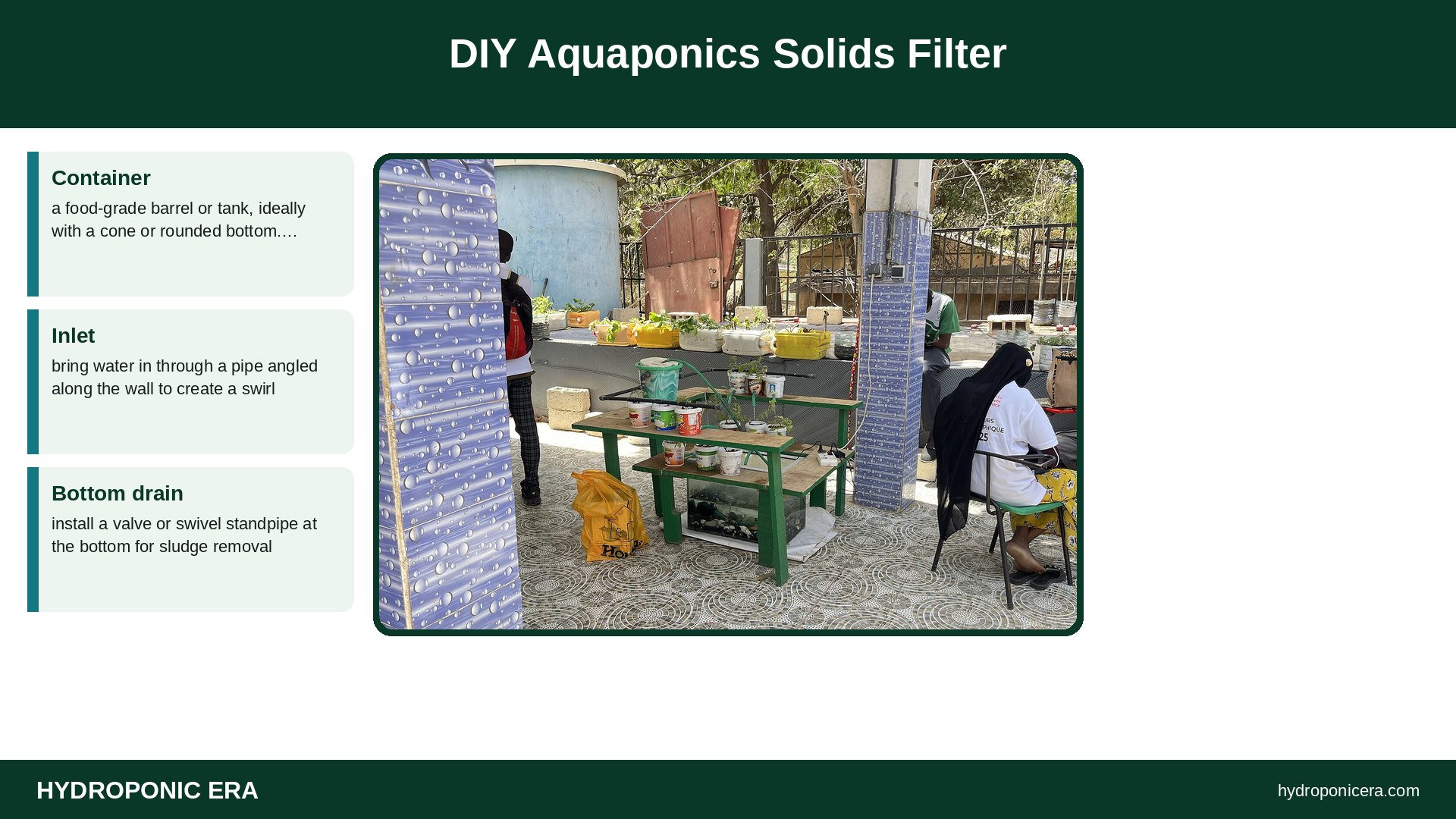
- Container: a food-grade barrel or tank, ideally with a cone or rounded bottom. Size it at about one-sixth of the fish tank volume.
- Inlet: bring water in through a pipe angled along the wall to create a swirl.
- Bottom drain: install a valve or swivel standpipe at the bottom for sludge removal.
- Outlet: a slotted pipe near the top, covered with mesh.
- Baffles (optional): FAO shows a baffle design that forces water down and up to drop more solids.
- Flush: open the bottom valve regularly, often daily in dense systems.
Adding Fine Filtration
FAO suggests extra fine filtration after the swirl filter, such as a bucket of nylon netting, sponges, or a mesh bag in the biofilter. These catch smaller particles but need rinsing. See aquaponics biofilter.
Do Media Beds Need an Aquaponics Solids Filter?
FAO notes that media beds work as both mechanical and biological filters at moderate stocking. But at high stocking densities, the beds can clog and develop dangerous anaerobic spots. FAO says mechanical separators apply to media bed units with more than about 20 kg of fish per 1,000 liters. If sludge builds up in your beds, add a solids filter upstream. See aquaponics media bed.
What to Do With the Sludge
The solids contain nutrients. FAO describes mineralizing them: store sludge in a separate aerated container until bacteria break it down, then decant the water back into the system and use the leftover solids in soil gardens. Never leave sludge without oxygen; it can produce toxic gas. Raw sludge is also good for garden beds near the system.
Common Problems
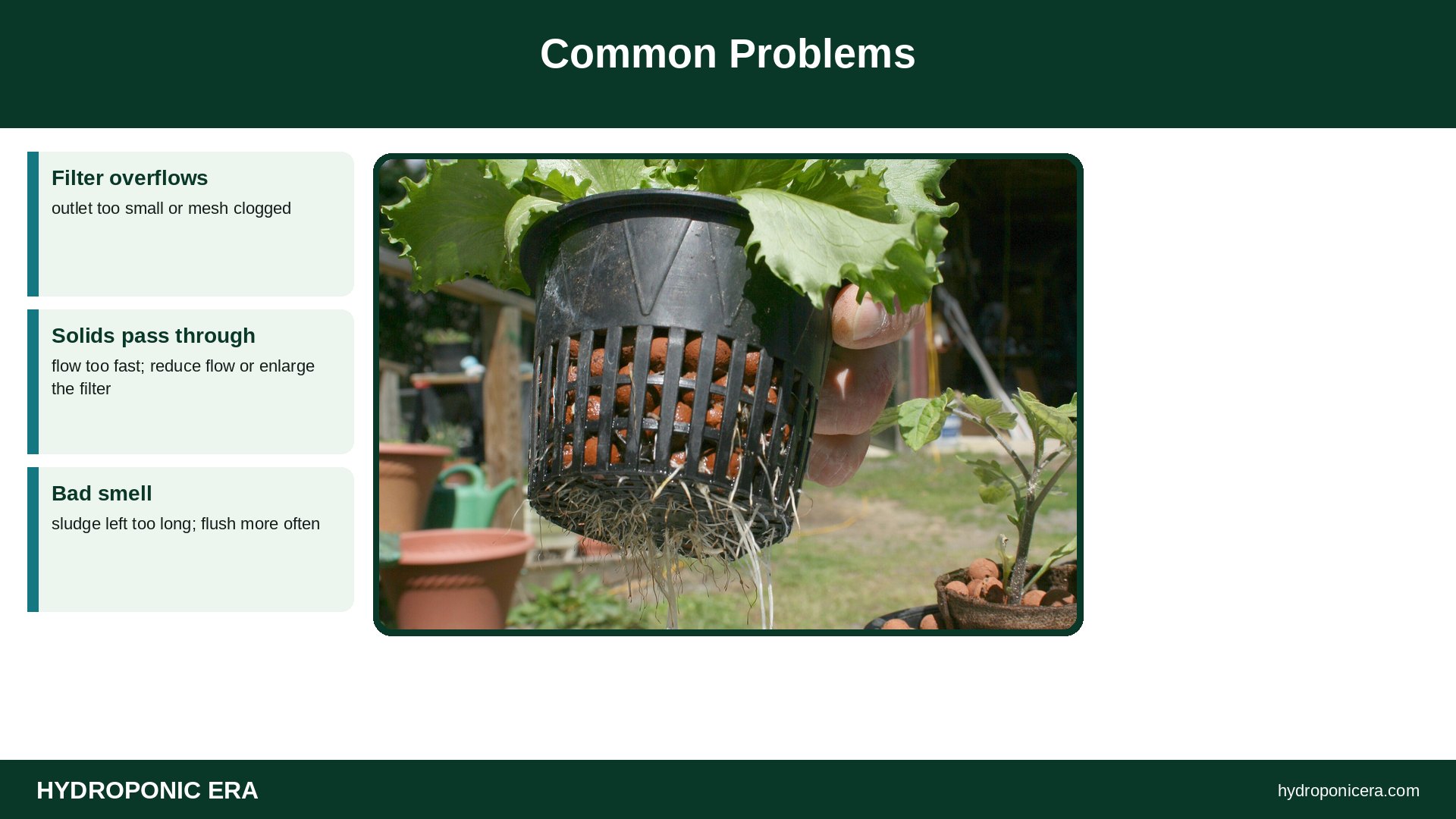
- Filter overflows: outlet too small or mesh clogged.
- Solids pass through: flow too fast; reduce flow or enlarge the filter.
- Bad smell: sludge left too long; flush more often.
- Air stones stirring solids: FAO advises placing air stones so they don’t re-suspend settling solids.
See aquaponics pump size and stocking density.
Aquaponics Solids Filter Maintenance Schedule
- Daily or every few days: open the bottom drain of the swirl filter to release sludge.
- Weekly: rinse the outlet mesh and any netting or sponges in system water.
- Monthly: check for buildup in pipes and the sump.
FAO’s routine checklist includes removing solids from the clarifier and rinsing filters. How often depends on stocking and feeding; a busy aquaponics solids filter may need daily flushing.
Sizing an Aquaponics Solids Filter to Your Fish
FAO’s Table 8.1 links filter volume to tank size: about 5 gallons (20 L) of filter volume for a 53-gallon (200 L) tank, and 26–53 gallons (100–200 L) for a 264-gallon (1,000 L) tank. Denser stocking needs the larger end. If solids still reach the grow beds, add a second stage or enlarge the aquaponics solids filter.
Aquaponics Solids Filter for Raft and NFT
FAO says adequate preliminary mechanical filtration is especially important for NFT and DWC units, because without it solids build up in grow pipes and canals and clog roots. For these systems, an aquaponics solids filter isn’t optional. Pair it with a biofilter and check roots regularly for brown buildup.
Buy or Build?
Commercial swirl filters and radial-flow settlers are available from aquaculture suppliers, but many home growers build one from a barrel and PVC fittings. The key features are the same: a tangential inlet, a bottom drain, and a screened outlet.
Sizing an Aquaponics Solids Filter
FAO gives a simple rule for small units: make the mechanical separator about one-sixth the volume of the fish tank, adjusted for stocking density and design. For a 250-gallon tank, that’s a separator of roughly 40 gallons. FAO stresses that good mechanical filtration is especially important for NFT and DWC units, because without it, solid and suspended waste builds up in pipes and canals and clogs root surfaces. The waste you remove is still valuable: FAO notes it contains nutrients that can be mineralized or used on garden plants.
FAQs: Aquaponics Solids Filter
Do I need a solids filter for aquaponics?
Yes for NFT and DWC, and for media beds at high stocking.
What is a swirl filter?
A container where spinning water drops solids to the center and bottom.
How big should a solids filter be?
About one-sixth of the fish tank volume, or 10–30% per FAO.
How much does a clarifier remove?
FAO says up to 60% of removable solids.
What do I do with the sludge?
Mineralize it with aeration or use it in garden soil.
Sources
- FAO — Small-scale aquaponic food production
- Photo credits (Wikimedia Commons, edited with titles): Recirculating Aquaculture System 1 by Narek75 (CC BY-SA 4.0); Deepwater Aquaponics Floating Rafts Growing Lettuce, Basil and Arugula by Alabama Extension (CC0); AQUAPONIE by Hopeballa (CC BY-SA 4.0); Fish farming on Øksfjorden in Loppa, Troms og Finnmark, Norway, 2022 August by Ximonic (Simo Räsänen) (CC BY-SA 4.0); 2009-03-30 Lettuce roots by Ildar Sagdejev (Specious) (CC BY-SA 4.0)