
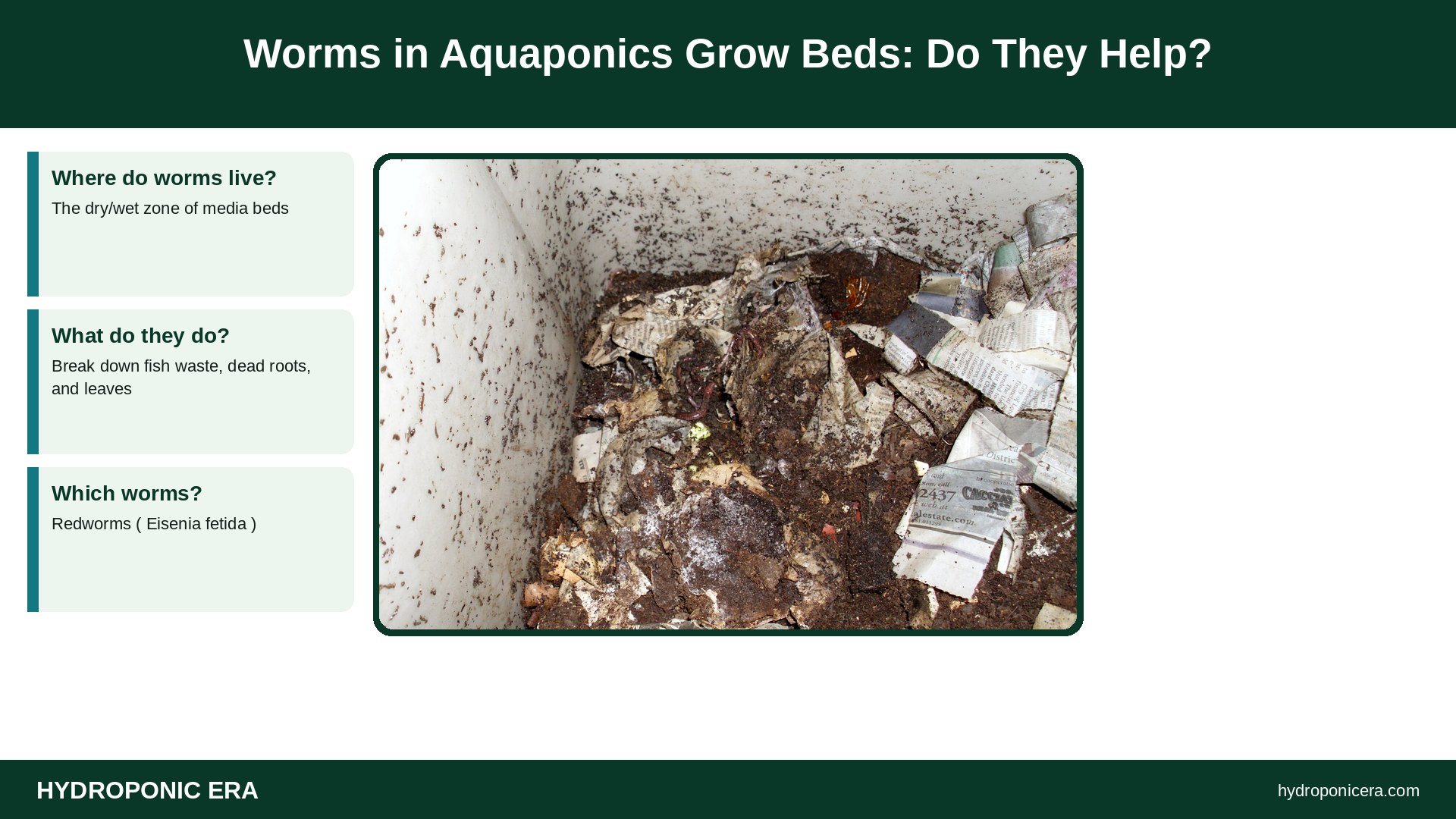
Aquaponics worms do help. FAO’s aquaponics manual describes adding worms to media beds as a common technique: the worms live in the moist middle zone of the bed, break down solid fish waste, and eat dead leaves and roots, which helps stop the bed from clogging. Red wigglers (Eisenia fetida), the standard composting worm, are the usual choice. Worms only suit media beds; they don’t belong in raft or NFT systems, where there’s no media for them to live in. Source worms from a reputable supplier, and FAO suggests a 1–2 day starve period for worms from outside sources if feeding them to fish.
Key takeaway: Add red wigglers to media beds at least 12 inches deep with a dry top layer, and keep a separate worm bin for castings and fish treats.
| Question | Answer (FAO) |
|---|---|
| Where do worms live? | The dry/wet zone of media beds |
| What do they do? | Break down fish waste, dead roots, and leaves |
| Which worms? | Redworms (Eisenia fetida) |
| Raft or NFT? | No; no media to live in |
| As fish food? | Yes, after a 1–2 day starve period |
How Aquaponics Worms Help Media Beds
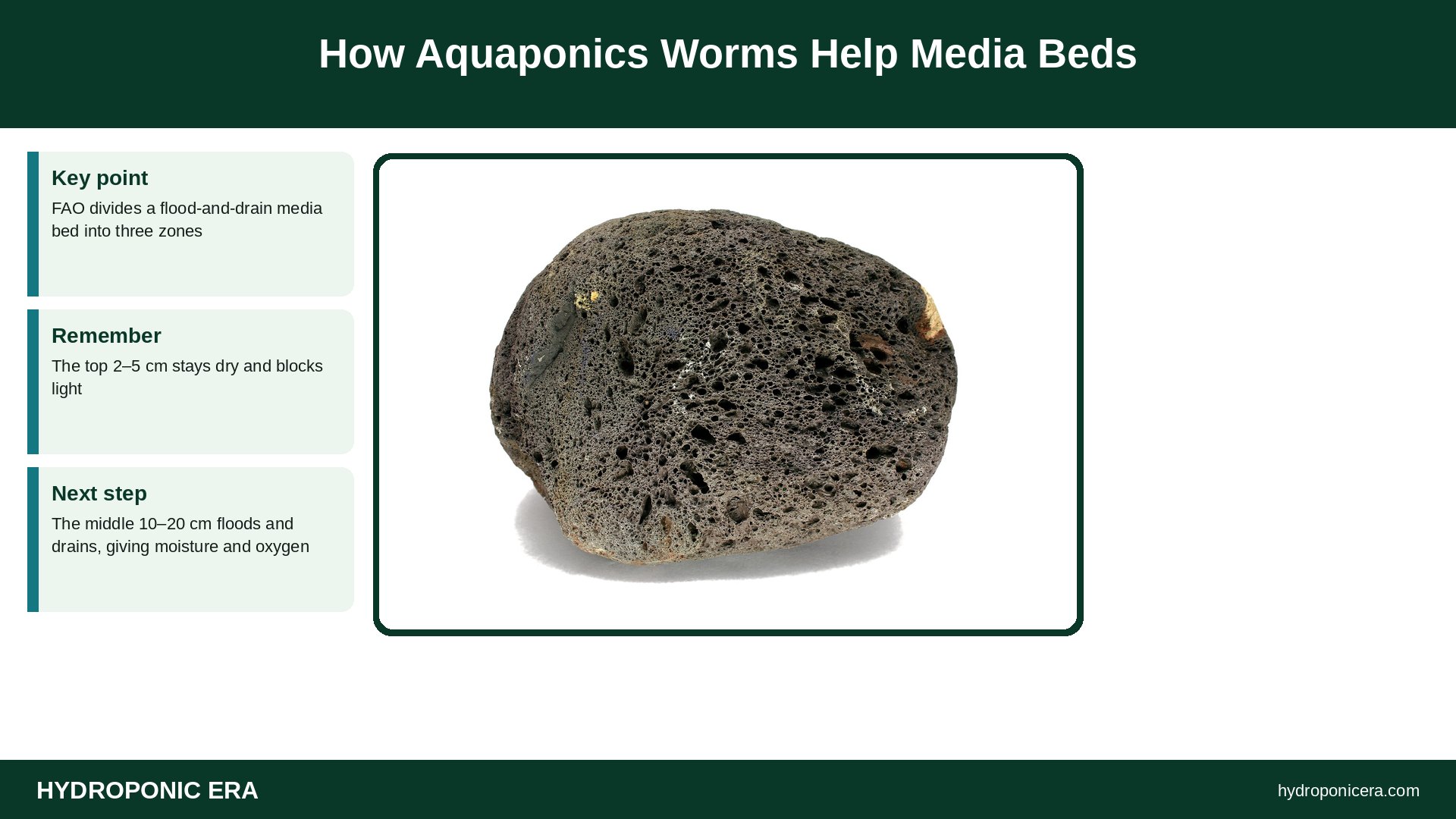
FAO divides a flood-and-drain media bed into three zones. The top 2–5 cm stays dry and blocks light. The middle 10–20 cm floods and drains, giving moisture and oxygen. The bottom 3–5 cm stays wet, collecting fine solids. Worms live in the middle dry/wet zone, where most biological activity happens. They eat solid waste and plant debris, and their castings release nutrients plants can use. FAO notes this prevents waste from clogging the system.
Best Worms for Aquaponics
Red wigglers (Eisenia fetida) are the classic choice because they live in rich organic material near the surface and tolerate moisture. FAO’s vermicompost section shows these worms. Nightcrawlers are deep soil burrowers and don’t suit media beds. Buy worms from a reputable supplier; FAO stresses sourcing worms that have never eaten meat or animal wastes.
How to Add Aquaponics Worms
- Wait until the system is cycled and stable.
- Add a handful or small cup of worms to each media bed.
- Bury them a few inches into the media where it stays moist.
- Avoid adding them during a flood cycle so they can settle.
- Let them multiply; no feeding is needed, as they eat fish waste and plant debris.
Will the Worms Drown?
Red wigglers survive the moist conditions in flood-and-drain beds well. In beds that stay constantly flooded, worms can struggle. Some worms end up in the sump or fish tank, where fish usually eat them, which is a free snack.
Requirements for Aquaponics Worms
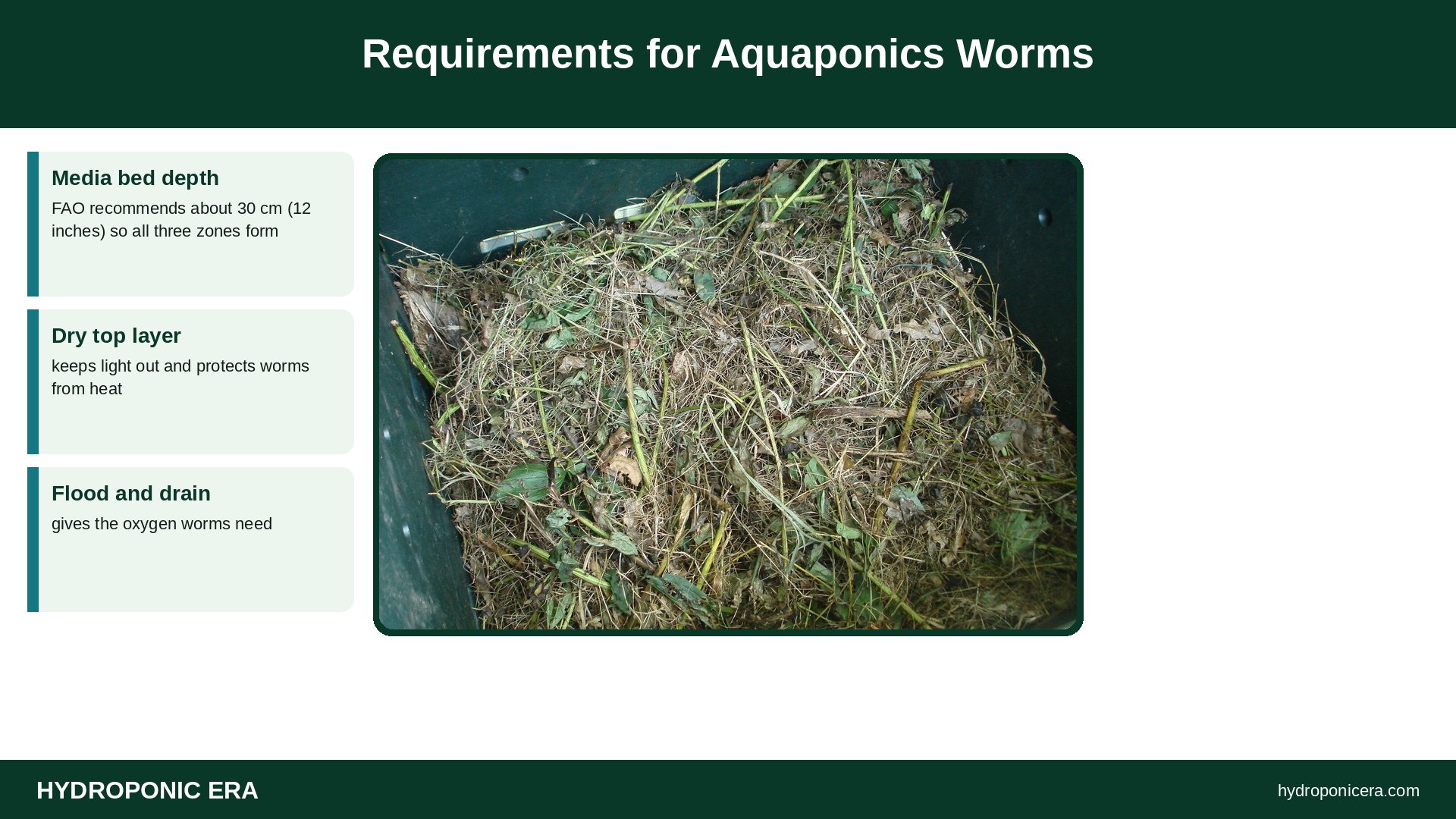
- Media bed depth: FAO recommends about 30 cm (12 inches) so all three zones form.
- Dry top layer: keeps light out and protects worms from heat.
- Flood and drain: gives the oxygen worms need.
- Moderate temperature: very hot media can harm worms.
- No pesticides: anything that harms fish can harm worms.
See aquaponics media bed and bell siphon.
A Worm Bin to Pair With Aquaponics Worms
FAO describes vermicomposting as a way to speed composting and make castings, an extremely effective, complete fertilizer. Castings can be used in seedling starts or made into compost tea for the system. FAO also lists earthworms as a fish feed supplement, with a 1–2 day starve period for worms from outside sources. See composting for beginners and aquaponics fish food.
Using Compost Tea Safely
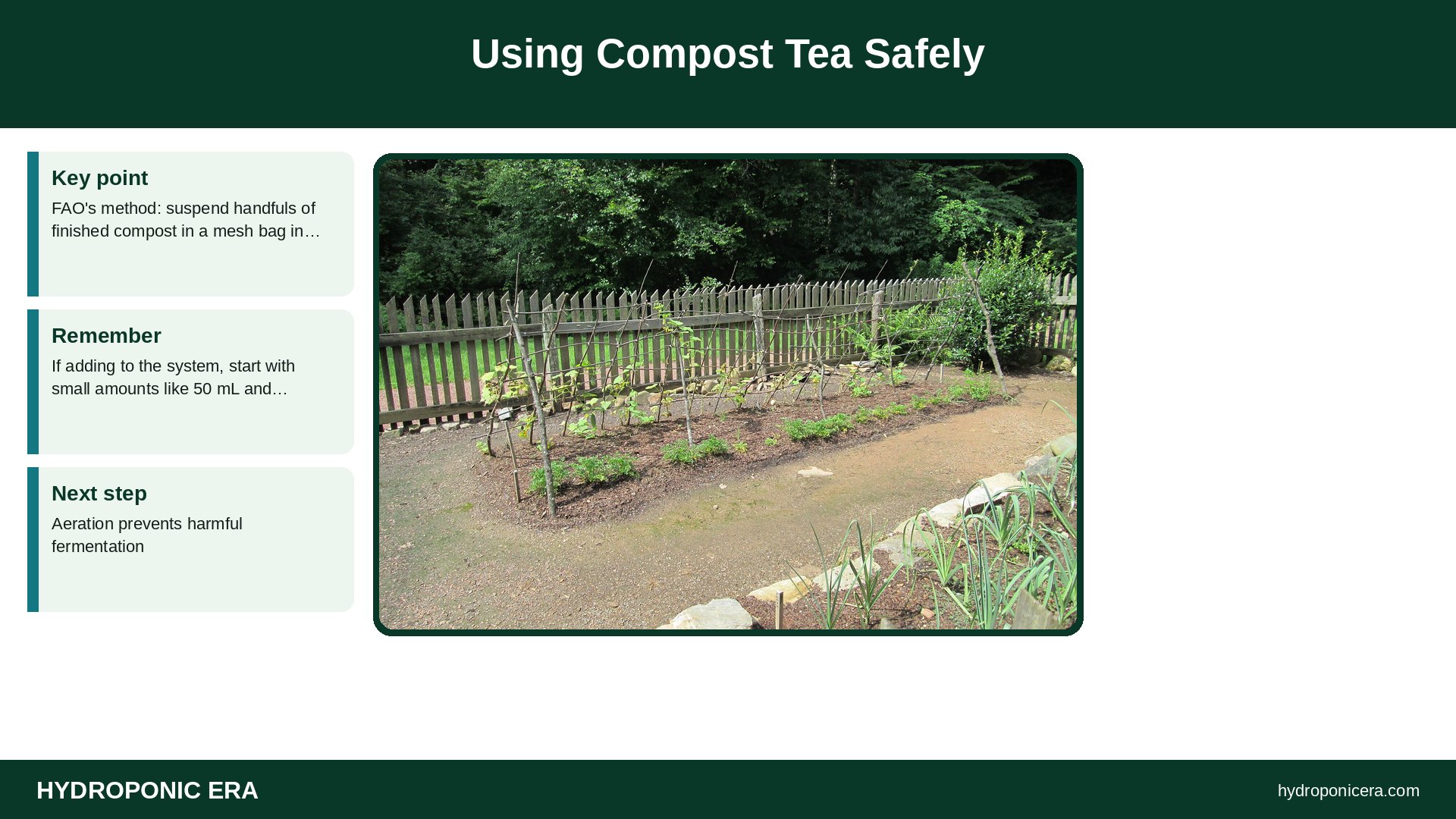
FAO’s method: suspend handfuls of finished compost in a mesh bag in about 5 gallons (20 L) of water with an air stone, aerate 2–3 days, strain, and dilute 1:10. If adding to the system, start with small amounts like 50 mL and monitor. Aeration prevents harmful fermentation.
Aquaponics Worms Don’t Replace a Solids Filter
Worms help but can’t handle large amounts of sludge. At high stocking, add a solids filter. See aquaponics solids filter.
Aquaponics Worms Myths
- “Worms replace the biofilter.” No. Nitrifying bacteria still convert ammonia; worms help with solids.
- “Worms will die in flood-and-drain beds.” Red wigglers generally do well in properly draining beds.
- “Any garden worm works.” Deep burrowers like nightcrawlers don’t suit media beds.
How Many Aquaponics Worms to Add
There’s no fixed number. A small starter population is enough, because red wigglers reproduce when food and conditions are right, and their numbers settle to what the bed can support. Adding more than the bed can feed just means more worms end up in the sump. If sludge keeps building, worms alone aren’t enough and the system needs better solids removal. That’s the honest limit of aquaponics worms.
Aquaponics Worms and Fish Health
Worms that fall into the sump or fish tank are usually eaten. FAO lists earthworms as a supplemental fish feed and recommends a 1–2 day starve period for worms from outside sources to reduce the risk of introducing bacteria. Worms already living in your system’s beds pose less risk because they’ve only eaten system wastes.
Aquaponics Worms in Cold and Hot Weather
Red wigglers slow down in cold beds and can suffer in very hot media. Shade and a dry top layer help in summer; in winter, beds in greenhouses or indoor systems keep worms active. If the system is shut down for winter, move worms to an indoor worm bin.
Using Worm Castings From Aquaponics Worms
FAO describes worm castings from redworms (Eisenia fetida) as an extremely effective and complete fertilizer. It suggests using castings directly in the plant nursery to start seeds, which carries nutrients into the system when seedlings are transplanted, or making them into a compost tea. FAO also advises sourcing worms from a reputable supplier and making sure they have never eaten meat or animal wastes, which reduces the risk of bringing pathogens into a food system.
FAQs: Aquaponics Worms
Do worms help aquaponics?
Yes. FAO says they break down solids and plant debris in media beds.
What worms are best?
Red wigglers (Eisenia fetida).
Can worms live in raft systems?
No. They need media.
Will fish eat worms?
Yes, and FAO lists worms as a fish feed supplement.
Do I need to feed the worms?
No. They eat fish waste and dead plant material.
Sources
- FAO — Small-scale aquaponic food production
- Photo credits (Wikimedia Commons, edited with titles): Worm composting 2 by Quadell (CC BY 3.0); Scoria Macro Digon3 by “Jonathan Zander (Digon3)” (CC BY-SA 3.0); Solanum lycopersicum in aquaponics at the NC Greenhouse Nursery by Gogerr (CC BY-SA 4.0); Compost pile by Ksd5 (CC0); Vegetable garden at Smith Family Farm by Julia Butler (CC BY-SA 3.0)