
Nitrifying bacteria are the invisible workers that make the whole system run. They turn toxic fish ammonia into nitrite and then into nitrate that plants absorb. FAO’s aquaponics manual names Nitrosomonas as the most common ammonia-oxidizing group and Nitrobacter as the most common nitrite-oxidizing group, and lists five keys to keeping them productive: lots of surface area, pH around 6–7, water at about 63–93°F (17–34°C), dissolved oxygen of 4–8 mg/L, and shade from direct sunlight. You can start them with an ammonia source and patience, speed things up with seeded media from a mature system, or use bottled bacteria.
Key takeaway: Give nitrifying bacteria surface area, oxygen, warmth, stable pH, and shade, and never sterilize or scrub away the biofilm that holds them.
| Factor (FAO) | Ideal for bacteria | What happens outside it |
|---|---|---|
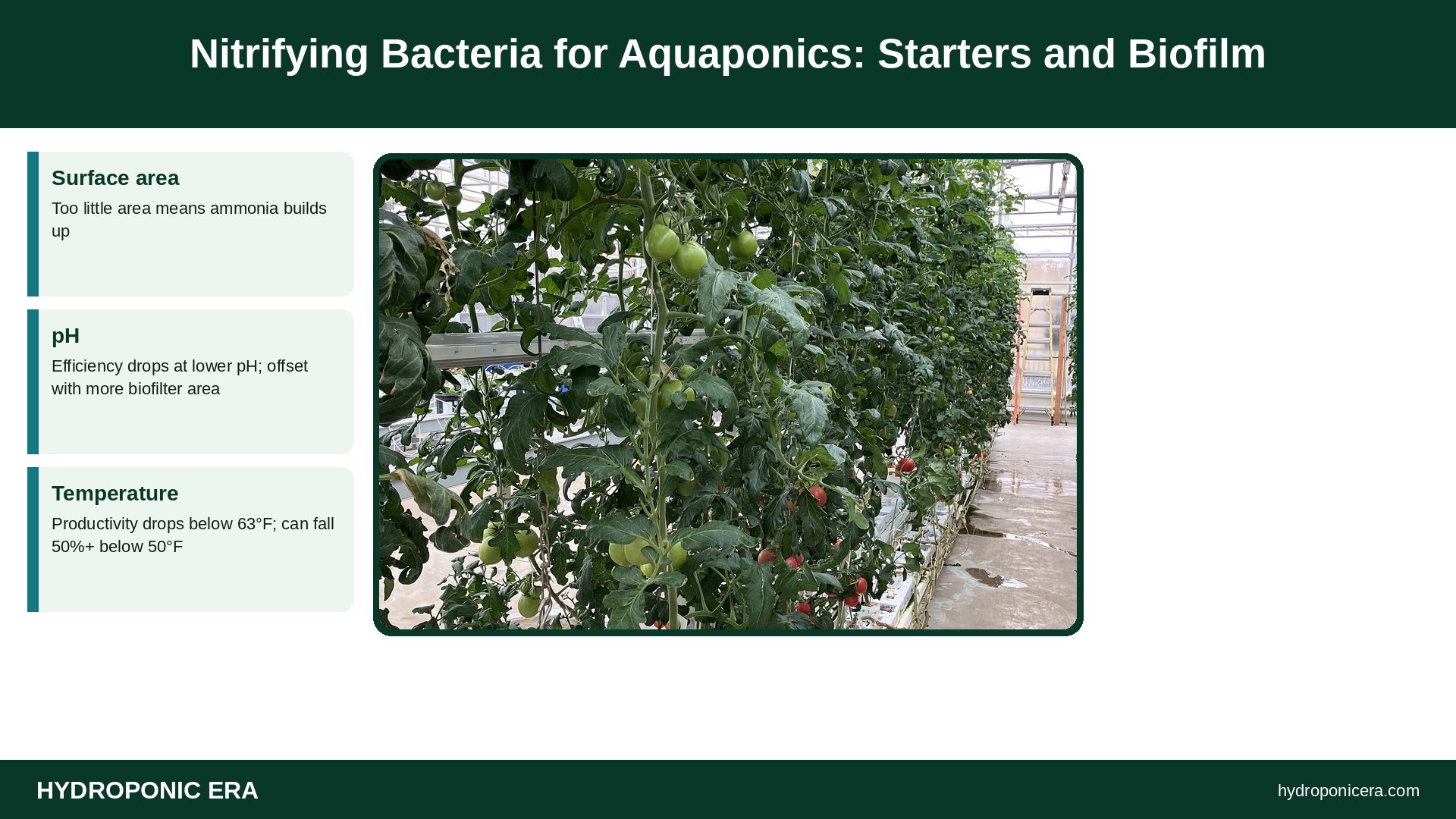
| Surface area | High (gravel, expanded clay, filter media, roots) | Too little area means ammonia builds up |
| pH | 6–7 compromise for aquaponics (bacteria optimum 7.2–8.2) | Efficiency drops at lower pH; offset with more biofilter area |
| Temperature | About 63–93°F (17–34°C) | Productivity drops below 63°F; can fall 50%+ below 50°F |
| Dissolved oxygen | 4–8 mg/L | Nitrification decreases below 2 mg/L |
| Light | Shaded | UV harms new colonies during the first days |
What Nitrifying Bacteria Do

FAO describes nitrification as a two-step process. First, ammonia-oxidizing bacteria (AOB) add oxygen to ammonia and create nitrite. Then nitrite-oxidizing bacteria (NOB) convert nitrite into nitrate. FAO stresses that the aquaponic ecosystem is totally reliant on these bacteria: without them, ammonia builds up and kills fish. With them, fish waste becomes the main nitrogen source for your plants. See ammonia, nitrite and nitrate levels.
Where the Bacteria Live: Biofilm
Nitrifying bacteria don’t float freely in large numbers. They attach to surfaces and form a thin biofilm. FAO notes bacteria will grow on plant roots, tank walls, and the inside of every pipe. In lightly stocked systems, those surfaces may be enough. More heavily stocked systems need a separate biofilter or media bed with a high-surface-area material such as volcanic gravel, expanded clay, or plastic biofilter media. The total surface area available determines how much ammonia the bacteria can process.
pH: The Aquaponics Compromise
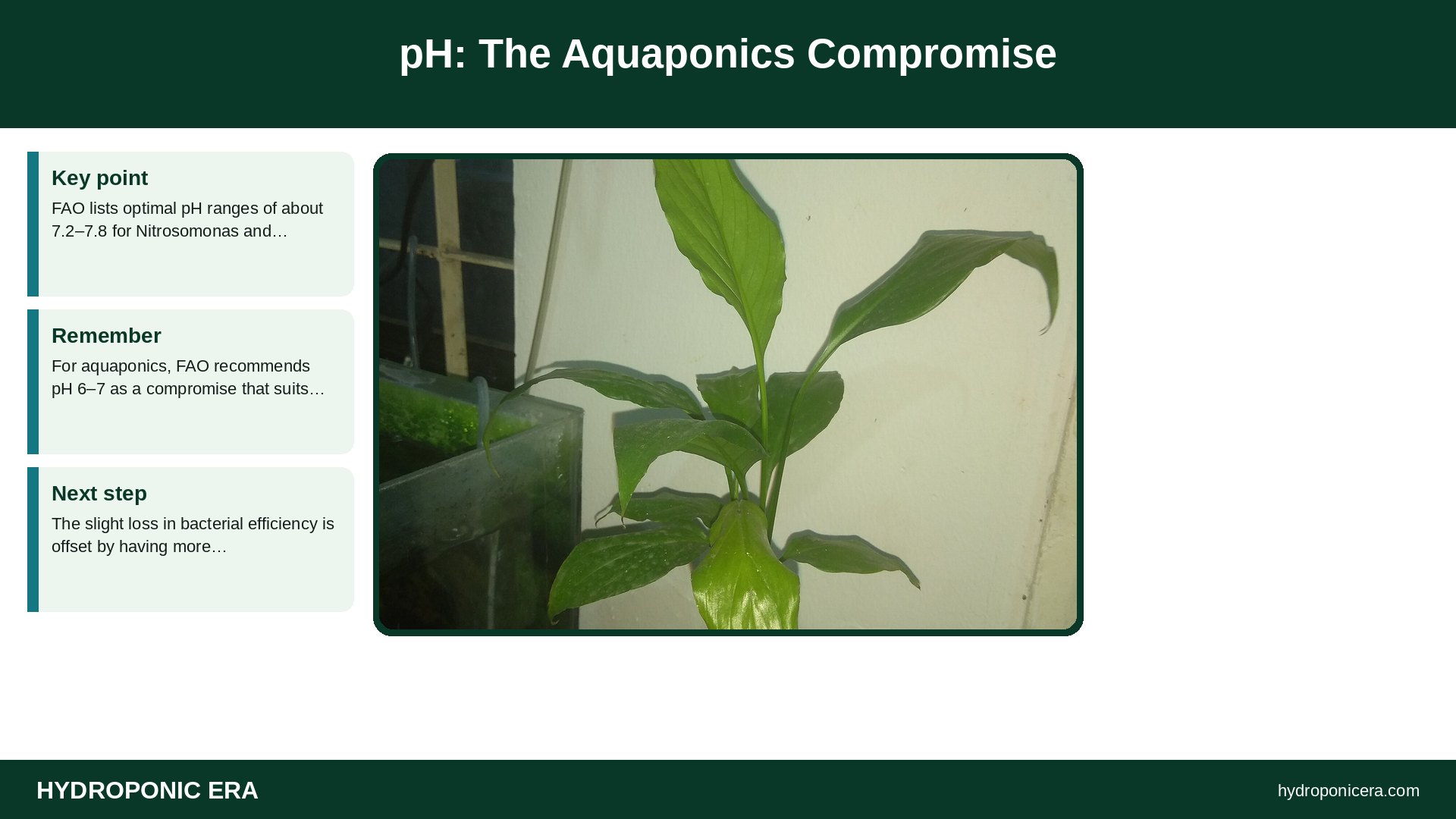
FAO lists optimal pH ranges of about 7.2–7.8 for Nitrosomonas and 7.2–8.2 for Nitrobacter, while noting bacteria can tolerate a wider range of about 6–8.5. For aquaponics, FAO recommends pH 6–7 as a compromise that suits plants and fish. The slight loss in bacterial efficiency is offset by having more bacteria, so size your biofilter generously. See pH meters.
Temperature
FAO gives 17–34°C (about 63–93°F) as the ideal range for bacterial growth and productivity. Below 63°F, productivity declines; below 50°F, it can drop by half or more. That’s why cool-water systems such as trout setups need extra biofilter capacity, and why winter can bring ammonia creep in unheated systems. See trout aquaponics and tank heaters.
Oxygen
Nitrification is an oxidation reaction, so bacteria need oxygen at all times. FAO lists 4–8 mg/L as optimal and says nitrification decreases below 2 mg/L. When oxygen runs low, other bacteria can take over and convert nitrate back into nitrogen gas, a process called denitrification, robbing plants of nutrients. Aeration, cascading return water, and keeping solids out of the biofilter all help. See dissolved oxygen.
Sunlight and UV

FAO notes nitrifying bacteria are photosensitive, and UV light from the sun is a threat especially while colonies are forming. Once bacteria have colonized a surface, which FAO says takes about 3–5 days, UV is less of a problem. Cover tanks and filters with shade material during setup, and keep them shaded long-term to limit algae.
Starting a Bacteria Colony
FAO outlines several ways to start nitrifying bacteria:
- Add ammonia and wait. Some AOB recruit naturally from air, water, and soil. Feed them with finely ground fish food or pure ammonia at about 1–2 mg/L.
- Seed from a mature system. FAO says sharing part of an existing biofilter greatly reduces cycling time.
- Pre-start media. Trickle a 2–3 mg/L ammonia solution over media for a few weeks, then add it to the new biofilter.
- Bottled bacteria. Products with live nitrifying bacteria can colonize quickly, though FAO notes they may be expensive or unnecessary.
Full steps are in aquaponics cycling.
Heterotrophic Bacteria: The Other Workers
FAO also describes heterotrophic bacteria, which feed on organic carbon and break down solid fish waste and plant debris. FAO notes most fish retain only about 30–40% of what they eat, releasing the rest as waste. Heterotrophs mineralize the solid portion, releasing micronutrients plants need. They grow far faster than nitrifiers, so if too many solids build up, heterotrophs can crowd nitrifiers and use up oxygen. Good solids removal keeps both groups in balance.
Protecting Your Bacteria

- Don’t over-clean. Rinse filter media in system water, not chlorinated tap water.
- Dechlorinate top-up water. Chlorine and chloramine kill bacteria.
- Avoid sudden pH swings. Adjust slowly.
- Avoid fish medicines in the main system unless they’re known to be safe for biofilters. Treat fish in a separate tank.
- Keep ammonia under control. FAO says ammonia above about 4 mg/L inhibits bacteria.
- Keep backup aeration. A long power outage can starve the biofilter of oxygen.
Signs Your Bacteria Are Struggling
- Ammonia creeping up without a change in feeding.
- Nitrite appearing in a mature system.
- Cloudy water after a large cleaning or media change.
- pH below 6, which FAO says the bacteria have difficulty with.
- Cold snaps that drop water below about 63°F.
Respond by reducing feed, checking oxygen and pH, and adding biofilter area if the system has grown. Keep extra seeded media, such as a mesh bag of gravel or bio-media in the sump, so you can reseed quickly after a problem.
FAQs: Nitrifying Bacteria in Aquaponics
What are nitrifying bacteria?
Bacteria that convert ammonia to nitrite and nitrite to nitrate. FAO names Nitrosomonas and Nitrobacter as the most common groups.
How long do nitrifying bacteria take to establish?
FAO says full cycling usually takes 3–5 weeks.
What temperature is best for nitrifying bacteria?
About 63–93°F (17–34°C).
Do I need bottled bacteria?
No. They can speed things up, but an ammonia source and patience work.
Can sunlight kill nitrifying bacteria?
UV can harm new colonies, so shade tanks and filters, especially at startup.
Sources
- FAO — Small-scale aquaponic food production
- Photo credits (Wikimedia Commons, edited with titles): Solanum lycopersicum in aquaponics at the NC Greenhouse Nursery by Gogerr (CC BY-SA 4.0); Hydroton by Lucis (CC BY-SA 3.0); Spathiphyllum wallisii hydroponically grown by Kephalian (CC BY-SA 4.0); Air Stone Disk aquarium Germany 2024 by Nimmerwelk (CC BY-SA 4.0); AQUAPONIE by Hopeballa (CC BY-SA 4.0)