
The best aquaponics water temperature for most systems is a compromise of about 64–86°F (18–30°C), the range FAO’s aquaponics manual gives for fish, plants, and bacteria together. Within that, match fish and crops to your climate. Warm-water fish such as tilapia, carp, and catfish, plus nitrifying bacteria, thrive at about 72–84°F (22–29°C), alongside crops like basil and okra. Lettuce, Swiss chard, and cucumbers prefer cooler 64–79°F (18–26°C) water, and trout won’t tolerate water above about 64°F (18°C). Bacteria slow down below 63°F (17°C), so cold water also means slower nitrification.
Key takeaway: Choose fish and plants that match the water temperature you can keep cheaply, rather than heating or cooling to fit the fish.
| Organism (FAO) | Optimal water temperature |
|---|---|
| Nile tilapia | 81–86°F (27–30°C) |
| Common carp (koi, goldfish are related) | 77–86°F (25–30°C) |
| Channel catfish | 75–86°F (24–30°C) |
| Rainbow trout | 57–61°F (14–16°C) |
| Giant river prawn | 79–90°F (26–32°C) |
| Yellow perch (SRAC) | 73–79°F (23–26°C) |
| Nitrifying bacteria | 63–93°F (17–34°C) |
| Most vegetables | 64–86°F (18–30°C) |
| Leafy greens | 57–68°F (14–20°C) ideal; bolt above about 79°F (26°C) |

Why Aquaponics Water Temperature Matters

FAO explains that temperature affects every part of an aquaponic system. Warm water holds less dissolved oxygen, and higher temperature also increases the share of toxic un-ionized ammonia. High temperatures can also limit calcium uptake in plants. On the cold side, nitrifying bacteria lose productivity below 63°F (17°C), and FAO notes productivity can drop by half or more below 50°F (10°C). Fish appetite also falls with temperature, which means less feed and fewer nutrients for plants.
Aquaponics Water Temperature for Fish
Fish are cold-blooded, so water temperature sets their metabolism, appetite, and growth. FAO’s general tolerances are 72–90°F (22–32°C) for warm-water fish and 50–64°F (10–18°C) for cold-water fish. Specific notes:
- Tilapia: FAO says tilapia don’t feed or grow below 63°F (17°C). See tilapia aquaponics.
- Trout: need cold, well-oxygenated water. See trout aquaponics.
- Yellow perch: SRAC notes growth nearly stops below 50°F (10°C), and perch become stressed and disease-prone above 79°F (26°C). See yellow perch aquaponics.
- Catfish and carp: handle a wide range, good for regions with hot summers.
Aquaponics Water Temperature for Plants

FAO says it’s water temperature, more than air temperature, that has the biggest effect on aquaponic plants. Winter vegetables do best at 46–68°F (8–20°C) and summer vegetables at 63–86°F (17–30°C). Leafy greens bolt and turn bitter in water around 79°F (26°C) and above. Pair cool-water crops like lettuce with cool-water fish, and fruiting crops with warm-water fish.
Keeping Water Cool in Summer
- Shade fish tanks, sumps, and biofilters from direct sun, as FAO recommends.
- Use white tanks, or paint dark tanks white, to reflect sunlight.
- Cover all tanks.
- Insulate tanks in very hot areas.
- Avoid exposed NFT pipes in hot sun; FAO notes they overheat.
- Add aeration, since warm water holds less oxygen.
FAO advises that in extreme heat above 95°F (35°C) air temperature, you must choose heat-tolerant fish and plants and shade everything.
Keeping Water Warm in Winter
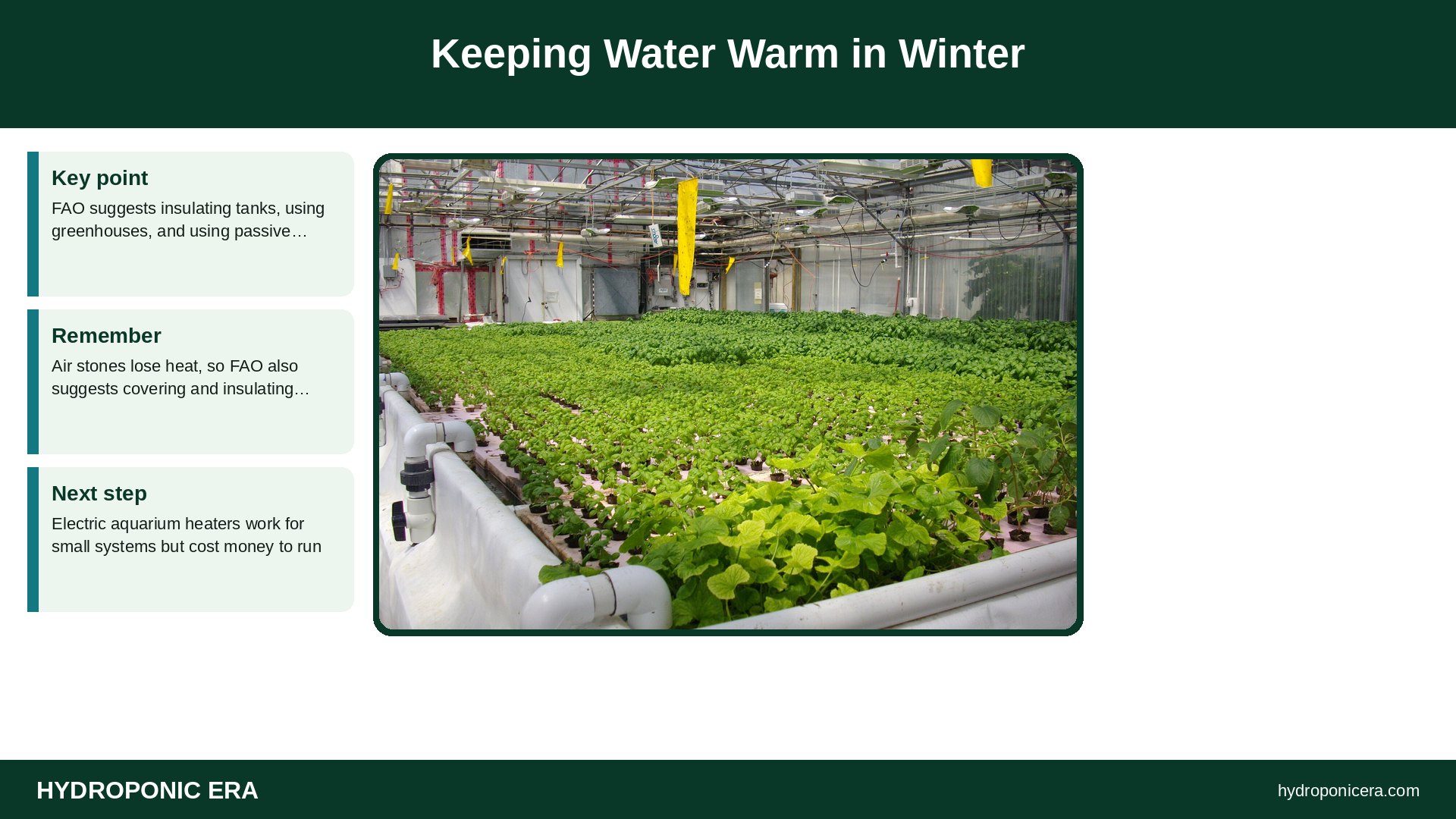
FAO suggests insulating tanks, using greenhouses, and using passive solar heating such as spiral heating: system water circulates through black 1-inch (25 mm) hose coiled in a spiral, roughly 130–260 feet (40–80 m) long. Air stones lose heat, so FAO also suggests covering and insulating the biofilter. Electric aquarium heaters work for small systems but cost money to run. See reservoir temperature in hydroponics.
Keep Aquaponics Water Temperature Stable
FAO notes systems are more productive when daily temperature swings are small. Large water volumes, insulation, shade, and greenhouses all help. A sudden change can stress fish more than a slightly off but stable temperature.
Measuring Aquaponics Water Temperature
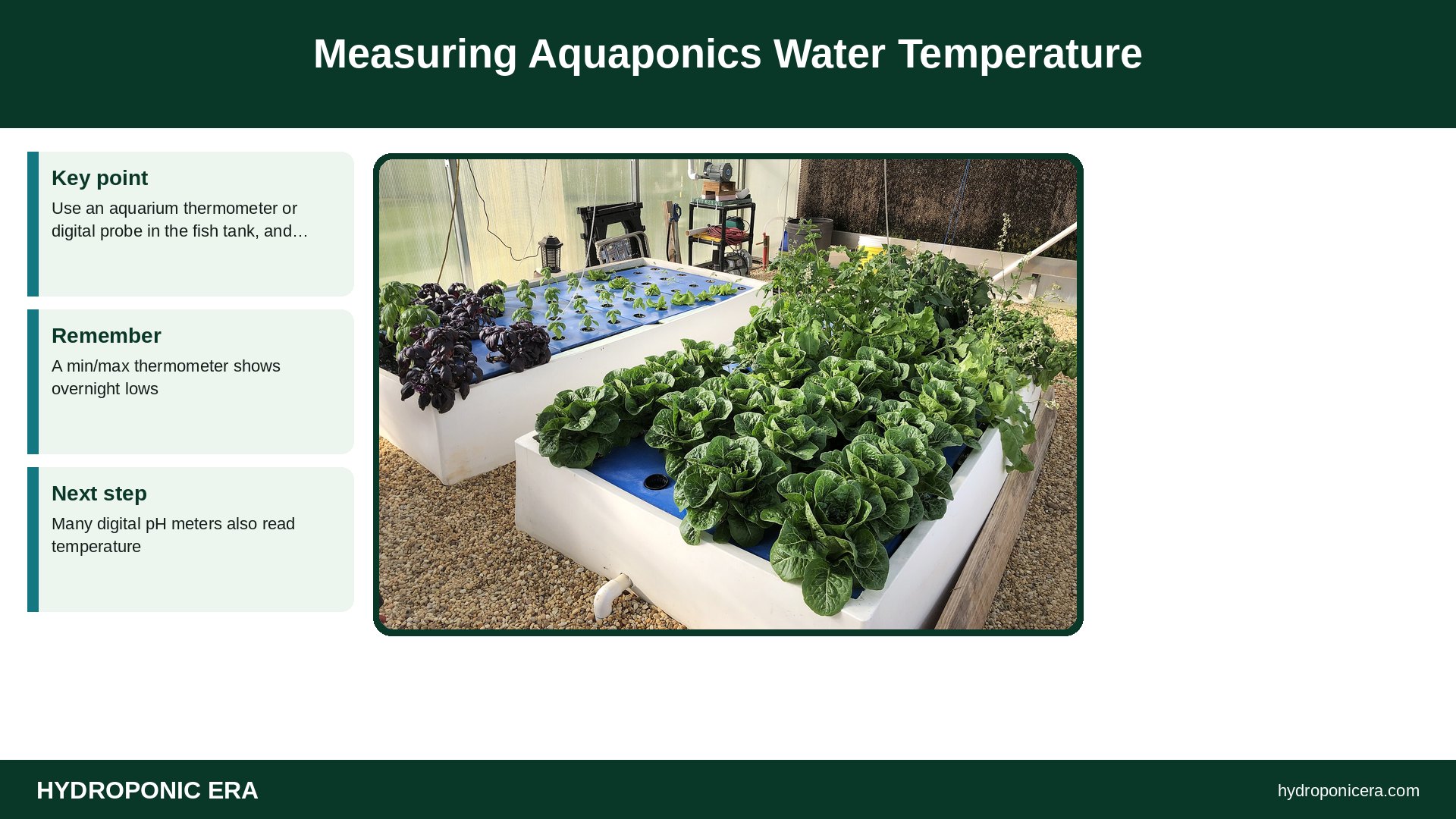
Use an aquarium thermometer or digital probe in the fish tank, and check daily at the same time. A min/max thermometer shows overnight lows. Many digital pH meters also read temperature.
What FAO Recommends When Temperature Is Out of Range
FAO’s troubleshooting table says above 91°F (33°C) fish stop eating and plants wilt, and below 59°F (15°C) bacteria stop working and some fish won’t eat. Its fixes: shade in summer; insulate and heat in winter while reducing feed and plant load; or switch to fish suited to your climate.
Aquaponics Water Temperature and Oxygen
FAO explains that warm water holds less dissolved oxygen, while fish need more oxygen as temperature rises because their metabolism speeds up. At the high end of the aquaponics water temperature range, add air stones and keep stocking moderate. FAO’s target is 4–8 mg/liter of dissolved oxygen for fish, plants, and bacteria.
Matching Fish and Crops by Aquaponics Water Temperature
- Warm water (about 75–86°F): tilapia, catfish, or prawns with basil, okra, peppers, and tomatoes.
- Moderate water (about 64–79°F): perch, bluegill, koi, or goldfish with lettuce, chard, cucumbers, and herbs.
- Cool water (about 50–64°F): trout with lettuce, kale, spinach, and other greens.
Pick the combination your climate supports for most of the year, so the system holds the right aquaponics water temperature without big heating or cooling bills.
Aquaponics Water Temperature and Ammonia
FAO notes that higher temperatures increase the share of ammonia in its toxic un-ionized form. In summer, the same ammonia test reading is more dangerous than in winter, so keep feeding moderate and test more often when water is warm. See ammonia, nitrite and nitrate.
FAQs: Aquaponics Water Temperature
What is the ideal aquaponics water temperature?
FAO’s general compromise is 64–86°F (18–30°C).
What temperature is too cold for tilapia?
FAO says tilapia don’t feed or grow below 63°F (17°C).
What temperature do trout need?
About 57–61°F (14–16°C), and no higher than about 64°F (18°C).
Does temperature affect bacteria?
Yes. Productivity drops below 63°F (17°C), and by half or more below 50°F (10°C).
How do I warm my system cheaply?
Insulation, a greenhouse, and passive solar spiral heating.
Sources
- FAO — Small-scale aquaponic food production
- SRAC — Species profile: yellow perch
- Photo credits (Wikimedia Commons, edited with titles): Oreochromis-niloticus-Nairobi by Bjørn Christian Tørrissen (CC BY-SA 3.0); Rainbow Trout (Oncorhynchus mykiss) Gavins Point by USFWS Mountain Prairie (Public domain); D3149-1. yellow perch (Perca flavescens) by Robert Colletta (Public domain); CDC South Aquaponics Raft Tank 1 2010-07-17 by Bryghtknyght (CC BY 3.0); Deepwater Aquaponics Floating Rafts Growing Lettuce, Basil and Arugula by Alabama Extension (CC0)