
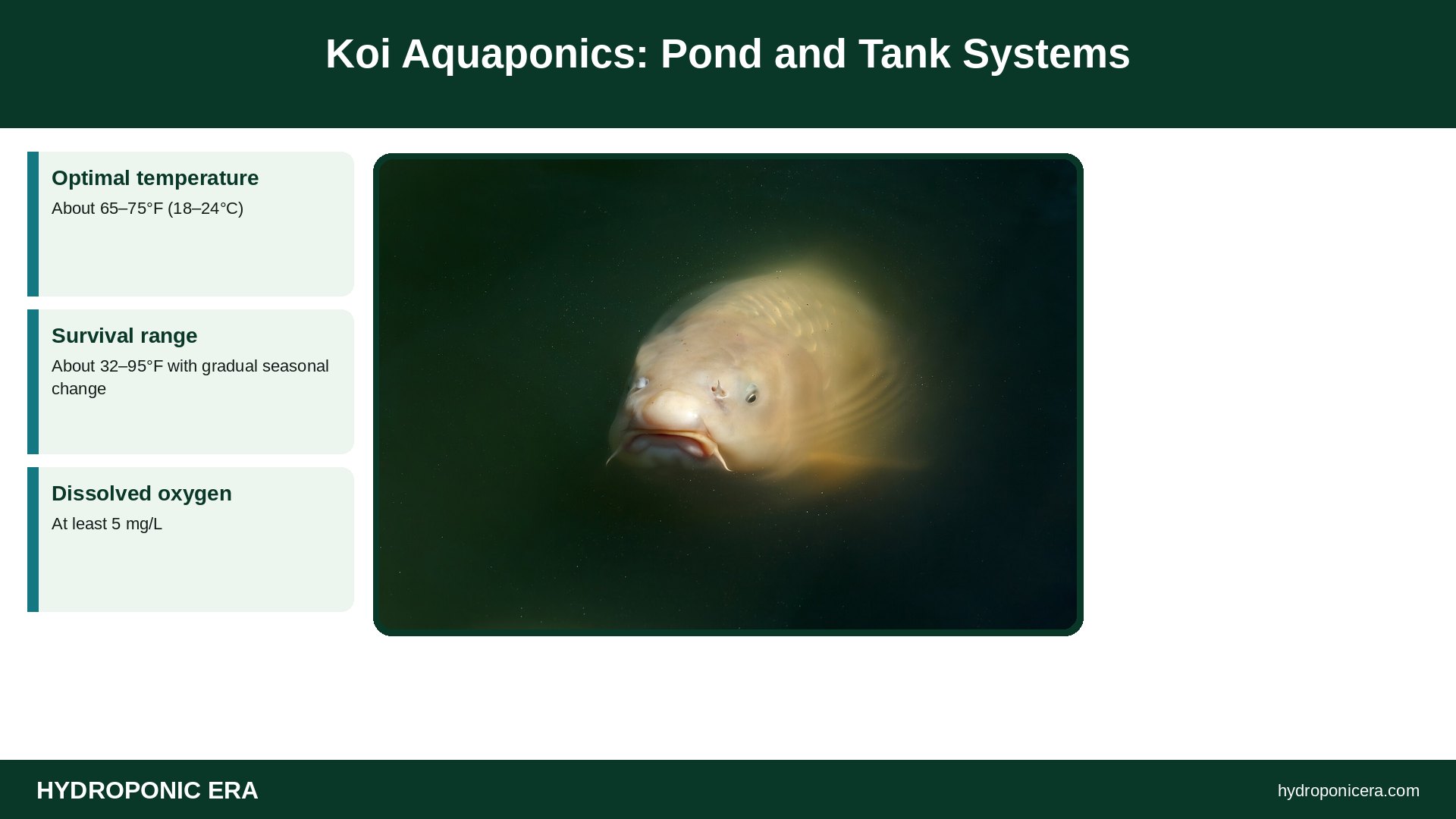
Koi aquaponics connects a koi pond or large tank to plant beds so the fish waste feeds vegetables, herbs, or ornamental plants while the plants and bacteria help clean the water. It suits koi well because they’re hardy temperate fish: the Southern Regional Aquaculture Center lists an optimum of about 65–75°F and survival from near freezing to about 95°F with gradual change. The challenges are size and load. Koi can exceed two feet long, eat heavily, and produce a lot of solid waste, so you need a large volume of water, good solids filtration, strong aeration, and enough planted area to use the nutrients.
Key takeaway: Are koi good for aquaponics? Yes, especially pond-based systems. Plan for big fish, heavy waste, and a solids filter before the grow beds.
| Factor | Koi aquaponics guideline |
|---|---|
| Optimal temperature | About 65–75°F (18–24°C) |
| Survival range | About 32–95°F with gradual seasonal change |
| Dissolved oxygen | At least 5 mg/L |
| pH | Near 7 for fish; 6–7 compromise for plants |
| Adult size | Often over 24 inches (UF/IFAS) |
| Best setup | Pond or large tank plus solids filter and grow beds |
Why Koi Aquaponics Works
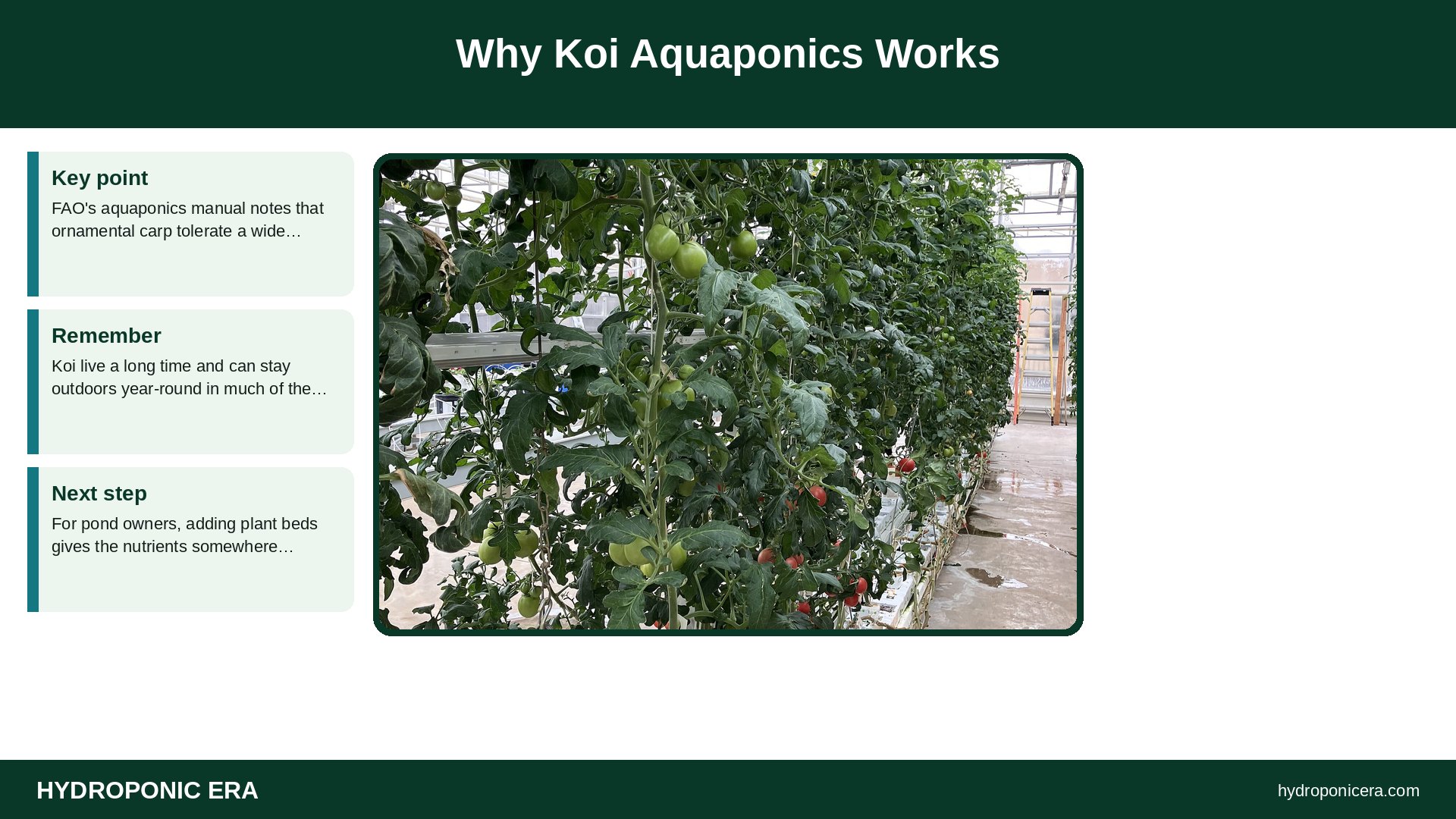
Koi are ornamental carp. FAO’s aquaponics manual notes that ornamental carp tolerate a wide range of water conditions, can be sold for more than food fish, and are popular with growers who don’t want to harvest fish. Koi live a long time and can stay outdoors year-round in much of the US if the pond is deep enough not to freeze solid. For pond owners, adding plant beds gives the nutrients somewhere useful to go and can reduce algae by competing for them.
Koi Pond Aquaponics vs Tank Systems
Pond-Based Koi Aquaponics
Most koi aquaponics systems start with an existing pond. A pump sends water through a solids filter, then into media beds or rafts, and the water returns to the pond by gravity. Plants grow in the beds, and the pond stays clearer. This works well because ponds already hold large volumes of water, which keeps conditions stable.
Tank-Based Koi Aquaponics
Indoor or greenhouse tanks can hold koi, but they need to be large. Young koi grow quickly, and adults need plenty of space. Many growers start with small koi in a tank and move them to a pond as they grow.
Handling Heavy Solid Waste
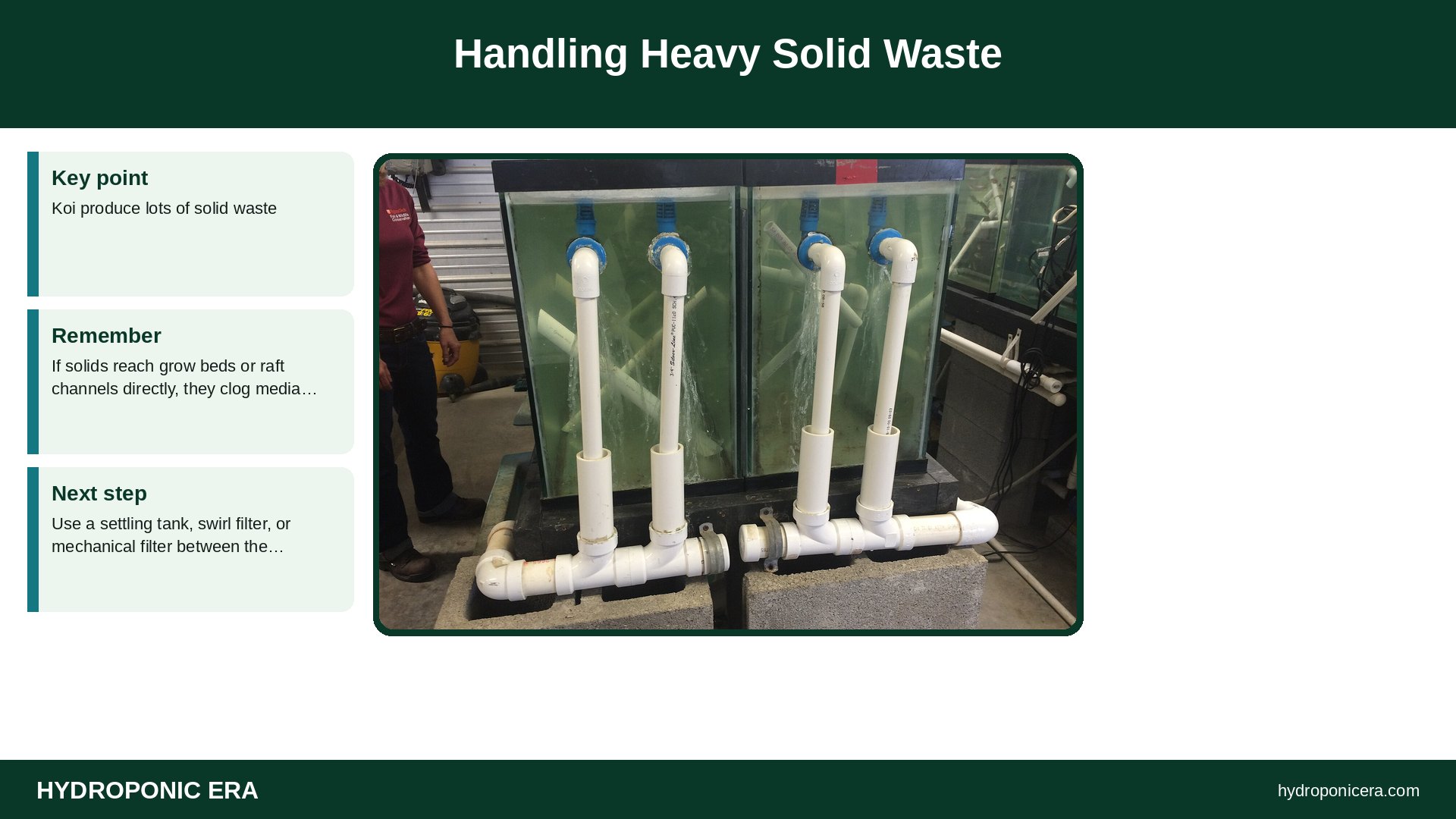
Koi produce lots of solid waste. If solids reach grow beds or raft channels directly, they clog media and rot, using up oxygen. Use a settling tank, swirl filter, or mechanical filter between the pond and the plant beds, and clean it regularly. Clean the filter often enough that solids don’t pile up and rot. Media beds can also handle some solids, especially with worms, but filtering first keeps them working longer.
Koi Aquaponics Water Quality
- Keep dissolved oxygen at least 5 mg/L; aerate ponds and tanks around the clock. See dissolved oxygen.
- Keep un-ionized ammonia and nitrite very low; SRAC suggests below 0.05 mg/L.
- Keep pH near 7 for fish; plants prefer slightly acidic, so aim for 6.5–7 as a compromise.
- Test weekly and after big changes like adding fish.
Seasonal Changes in Koi Aquaponics
Koi slow down in cold water and should be fed less, or not at all, when the water is very cold. That also means fewer nutrients for plants in winter. Many outdoor koi aquaponics systems grow warm-season crops in summer and cool-season greens in spring and fall, then pause plant beds in winter. Never let a shallow plant bed freeze with water trapped inside the plumbing; drain or bypass it in freezing weather.
Feeding Fish in Koi Aquaponics
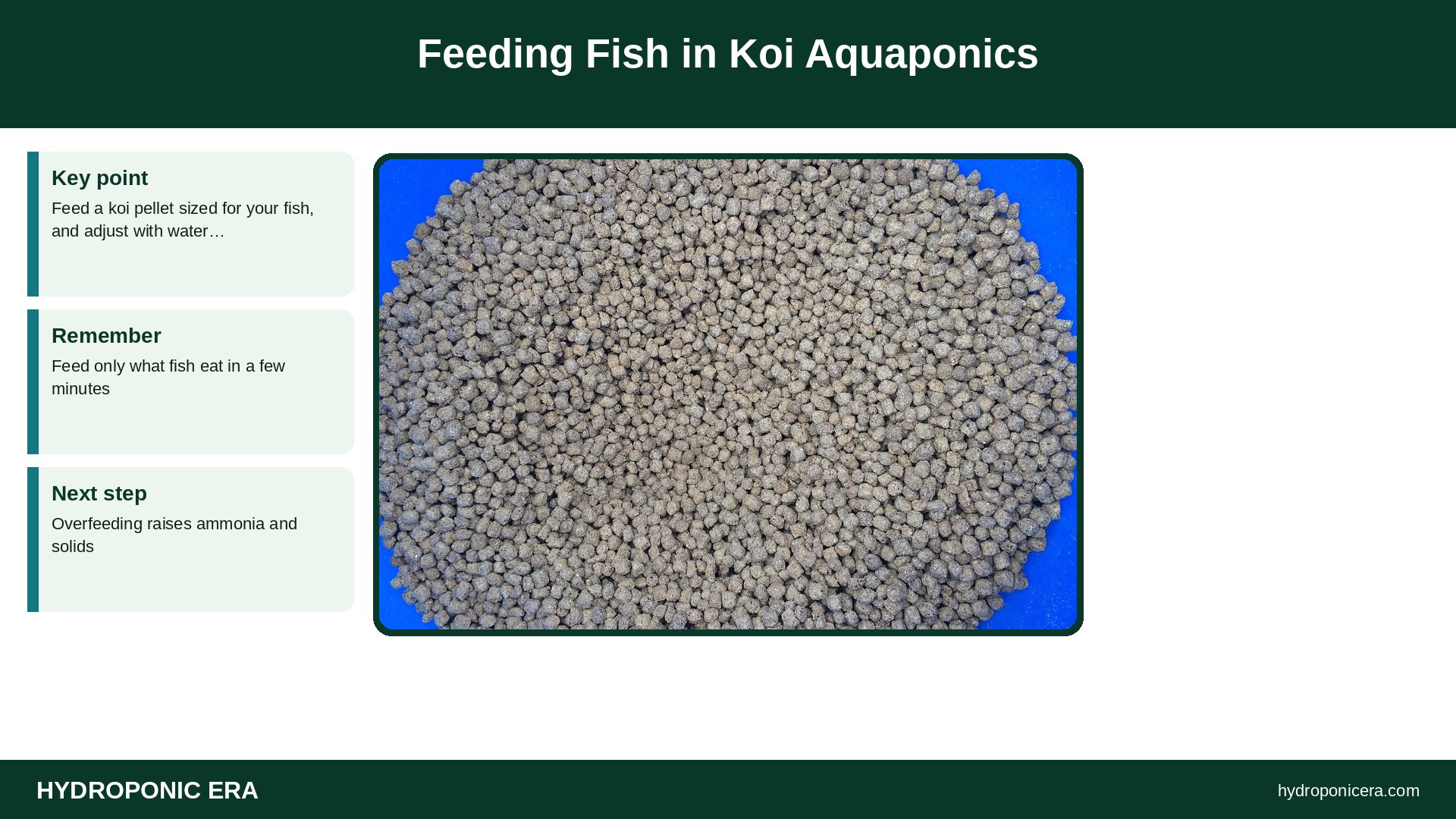
Feed a koi pellet sized for your fish, and adjust with water temperature. Feed only what fish eat in a few minutes. Overfeeding raises ammonia and solids. Because feeding drives plant nutrients, the planted area you can support grows with your fish and feed. FAO’s balance guideline is about 40–50 grams of feed per square meter of leafy greens per day.
Best Plants for Koi Aquaponics
Leafy greens, herbs, watercress, and ornamental bog plants work well. Many pond owners also grow decorative plants like irises in planted filters. In a summer system with enough feed, tomatoes and other fruiting crops can work. See best herbs.
Health and Biosecurity
SRAC notes that koi and goldfish can carry serious viral diseases, including koi herpesvirus and spring viremia of carp, some of which can kill many fish in a facility. Quarantine new koi in a separate tank for several weeks and buy from reputable dealers. Never release koi into natural waters.
Simple Koi Pond Aquaponics Layout
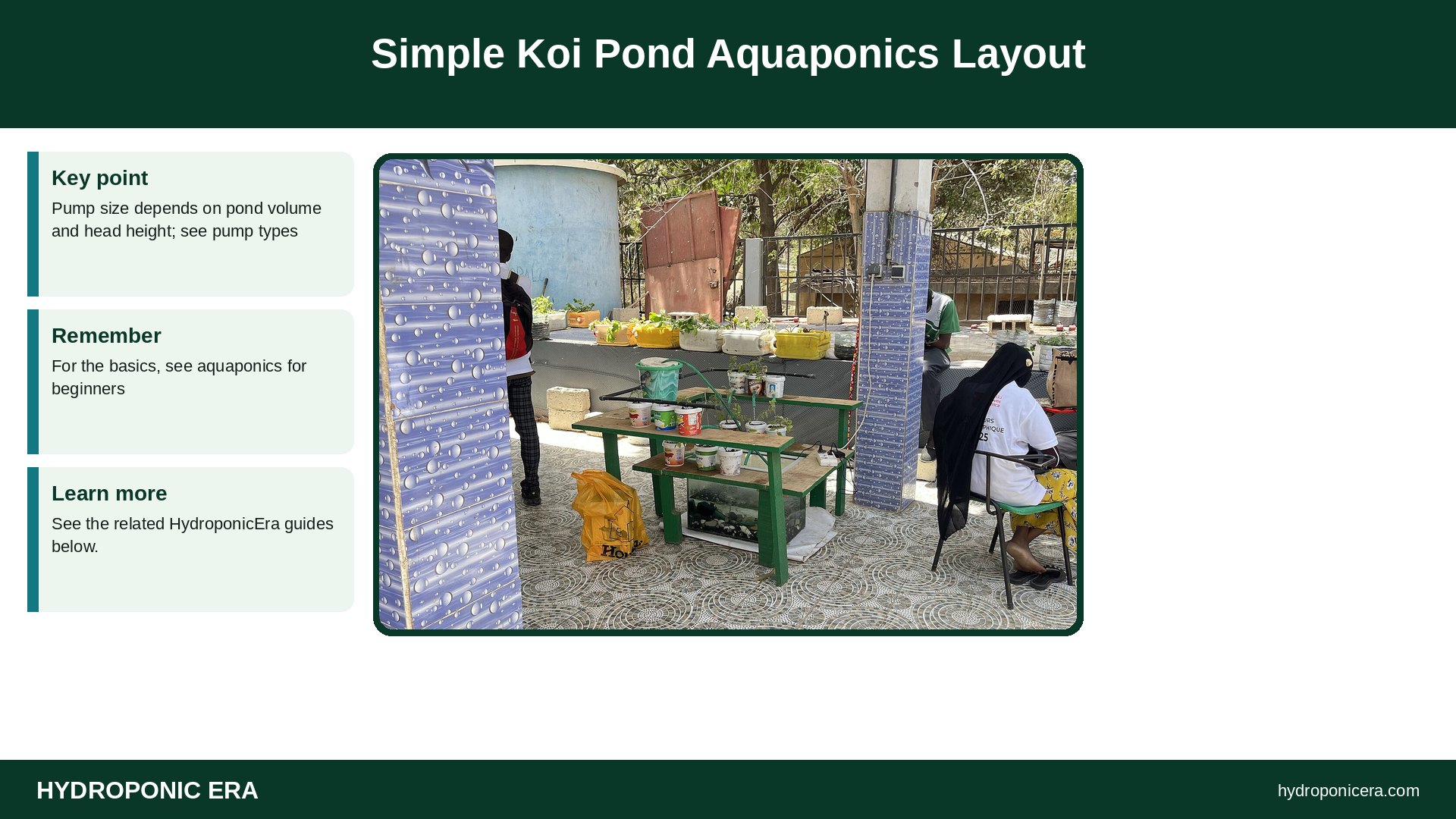
- Pump from the pond’s deepest area.
- Pass water through a settling or mechanical filter.
- Feed media beds or rafts with the filtered water.
- Return water to the pond by gravity, ideally over a small waterfall for aeration.
- Add an air pump with stones in the pond for backup oxygen.
Pump size depends on pond volume and head height; see pump types. For the basics, see aquaponics for beginners.
Common Koi Aquaponics Mistakes
- Sending raw pond water with heavy solids straight into grow beds.
- Undersizing the pond or tank for adult koi.
- Overfeeding in cool weather.
- Adding new fish without quarantine.
- Letting plumbing freeze in winter.
Acclimating and Quarantining New Koi
Koi are often expensive, so a careful start pays off. FAO’s aquaponics manual says the two main stress factors when moving fish are temperature and pH changes. Float the sealed transport bag in the tank for at least 15 minutes, then mix in small amounts of system water over another 15 minutes or more. If the pH differs by more than 0.5, FAO recommends holding the fish in an aerated tub of their original water and adding system water slowly over at least 24 hours.
FAO suggests quarantining new fish in a separate isolation tank, in some cases for 45 days, before they join the main system. That’s especially wise with koi because koi herpesvirus (KHV) and parasites can spread through a whole collection. Buy from dealers who quarantine and health-check their stock, and never move water, nets, or decorations between ponds without cleaning them.
If you need to treat parasites, do it in a separate hospital tank. FAO describes a salt bath of 1 kg of salt per 100 liters (about 8 pounds per 100 gallons) for 20–30 minutes, followed by 5–7 days in a weaker 1–2 g per liter solution. Don’t return salty water to the aquaponics system; salt damages plants.
Winter Care in Cold States
Koi slow down sharply in cold water, and so do the nitrifying bacteria. FAO notes bacterial productivity falls below about 63°F and can drop by half or more below 50°F. Feed less as water cools, switch to an easily digested low-protein food, and stop feeding when your koi stop showing interest. Keep part of the pond surface open with an aerator or de-icer so gases can escape, and expect plant beds to be idle or switched to hardy greens.
FAQs: Koi Aquaponics
Is koi aquaponics a good idea?
Yes. They’re hardy and produce plenty of nutrients, especially in pond-based systems.
Can you add aquaponics to an existing koi pond?
Yes. Pump pond water through a solids filter into plant beds and return it by gravity.
Do koi eat plant roots?
Koi can nibble roots and plants in the pond itself, so keep crops in separate beds.
Do koi need a heater?
No, they’re temperate fish, but feeding and plant growth slow in cold water.
Can you eat koi?
Koi are kept as ornamental fish. Choose a food species if you want to harvest.
Sources
- Southern Regional Aquaculture Center (via UF/IFAS) — Species Profile: Koi and Goldfish
- University of Florida IFAS — Freshwater Ornamental Fish Commonly Cultured in Florida
- FAO — Small-scale aquaponic food production
- Photo credits (Wikimedia Commons, edited with titles): Koi in a garden pond in Tuntorp 3 by W.carter (CC BY-SA 4.0); Solanum lycopersicum in aquaponics at the NC Greenhouse Nursery by Gogerr (CC BY-SA 4.0); Recirculating Aquaculture System 1 by Narek75 (CC BY-SA 4.0); Fish Feed Pellets by Narek75 (CC BY-SA 4.0); AQUAPONIE by Hopeballa (CC BY-SA 4.0)