
Aquaponics pH should usually sit between 6 and 7. FAO’s aquaponics manual calls this range a compromise: plants take up nutrients best around 6.0–6.5, fish do best at about 6.5–8.5, and nitrifying bacteria prefer about 7.2–8.2 but struggle below 6. Because nitrification constantly produces acid, most aquaponics systems drift downward over time. Raise pH gently with calcium carbonate or potassium carbonate (for example crushed eggshells or seashells in a mesh bag in the sump), and lower it only when hard, high-pH source water demands it, using phosphoric acid in top-up water rather than in the system. Never use baking soda or citric acid.
Key takeaway: Keep aquaponics pH between 6 and 7, change it slowly (FAO warns against shifts of more than 0.3 in 12–24 hours), and buffer with carbonates instead of chasing it with strong chemicals.
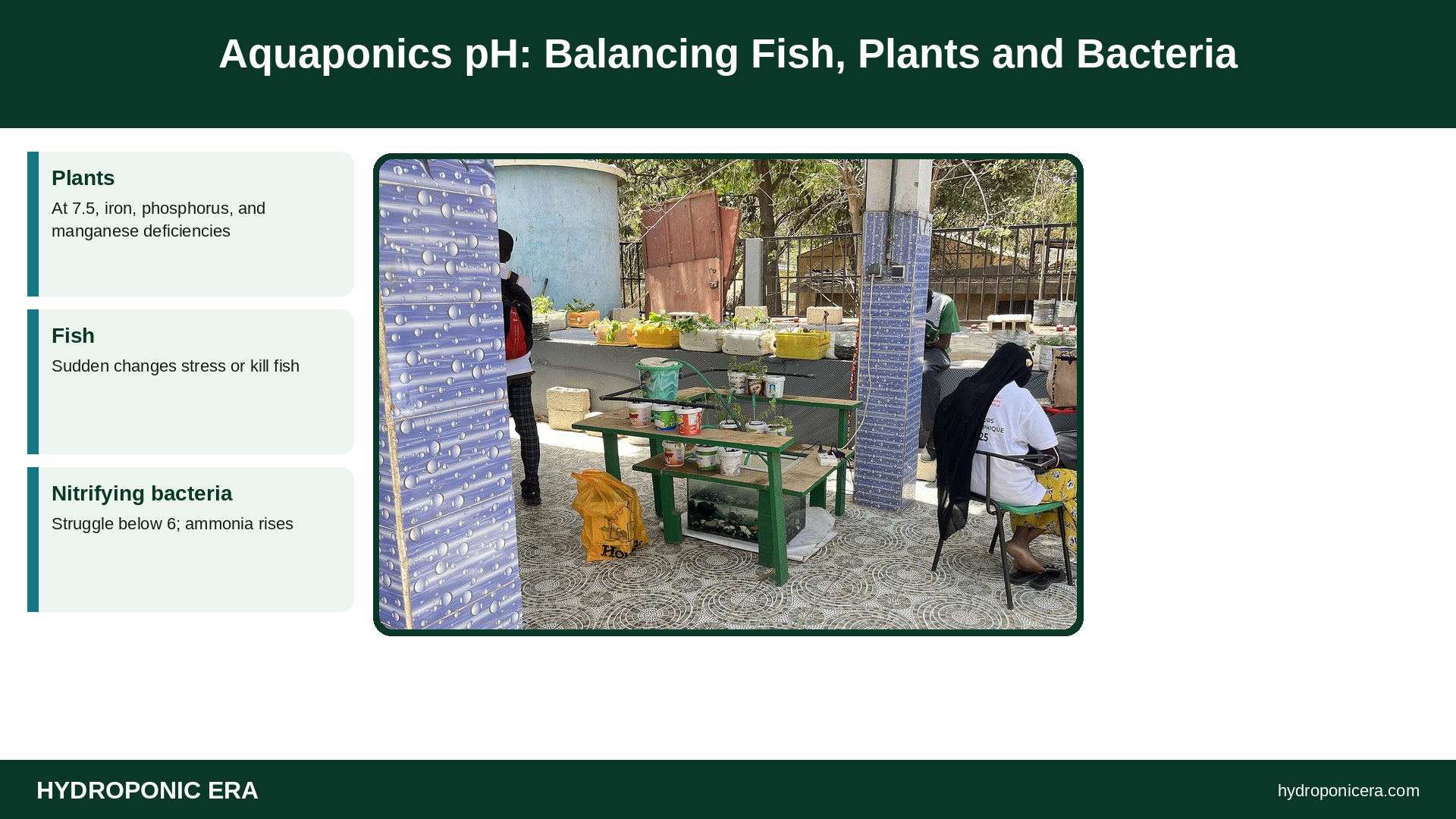
| Part of the system | Preferred pH (FAO) | Problem outside range |
|---|---|---|
| Plants | 6.0–6.5 for full nutrient availability | At 7.5, iron, phosphorus, and manganese deficiencies |
| Fish | 6.5–8.5 | Sudden changes stress or kill fish |
| Nitrifying bacteria | 7.2–7.8 (Nitrosomonas), 7.2–8.2 (Nitrobacter) | Struggle below 6; ammonia rises |
| Whole system target | 6–7 | Balance between all three |
Why pH Matters So Much in Aquaponics
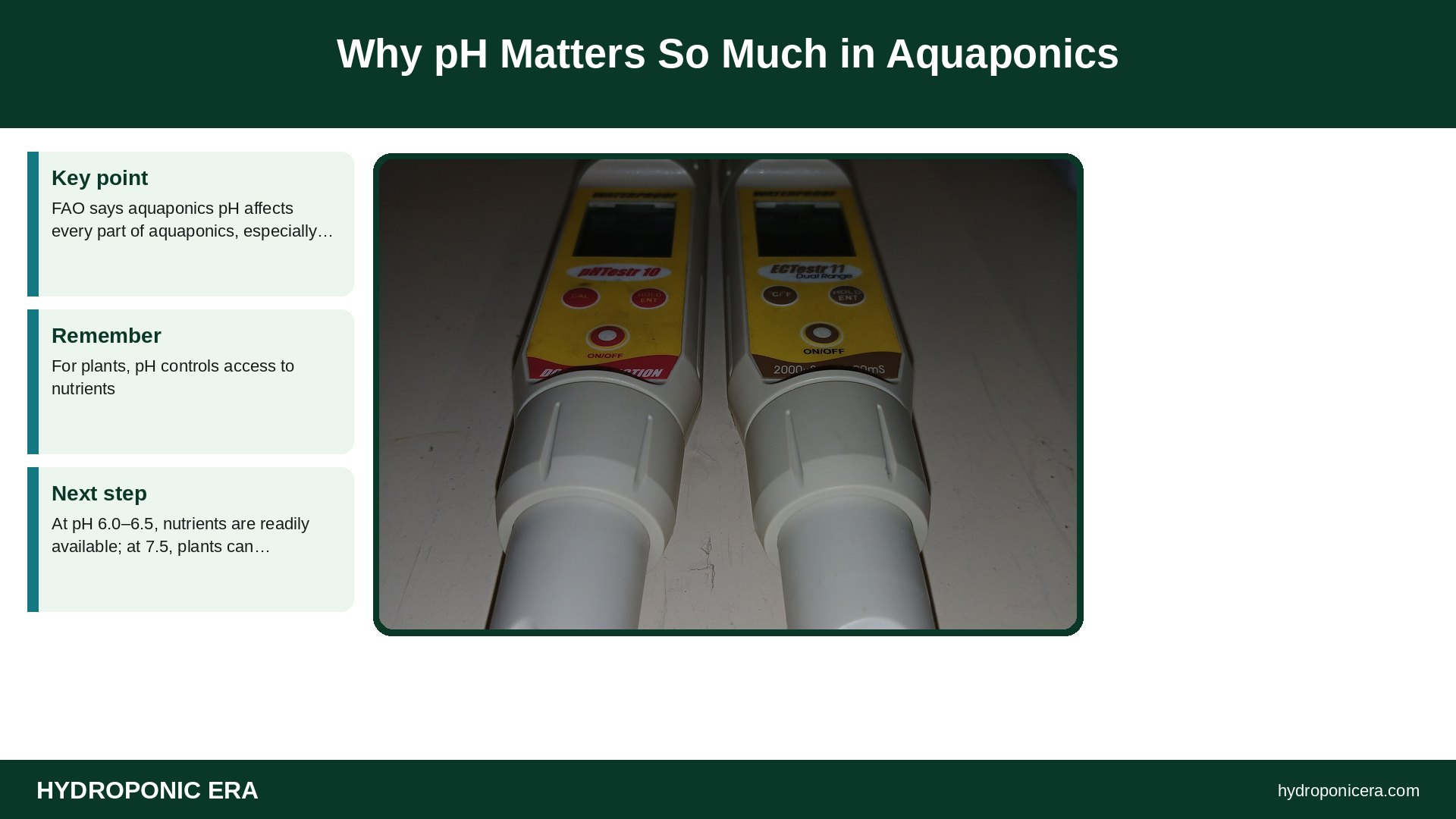
FAO says aquaponics pH affects every part of aquaponics, especially plants and bacteria. For plants, pH controls access to nutrients. At pH 6.0–6.5, nutrients are readily available; at 7.5, plants can show iron, phosphorus, and manganese deficiencies, a problem called nutrient lockout. For bacteria, FAO notes they have difficulty below pH 6, which slows ammonia conversion and can leave ammonia climbing. For fish, high pH makes ammonia more toxic because more of it stays in the un-ionized form. See ammonia, nitrite and nitrate.
Why Aquaponics pH Drops Over Time
FAO explains that nitrification produces nitric acid, which releases hydrogen ions into the water. Fish and bacterial respiration also add carbon dioxide, which forms carbonic acid. Carbonate hardness (KH) buffers this by binding the hydrogen ions, so pH stays steady until the buffer runs out. Once KH is gone, pH can fall quickly. That’s why KH testing matters as much as pH testing. FAO notes water from limestone aquifers often has KH of 150–180 mg/L, while rainwater has very little.
How to Raise Aquaponics pH Safely

FAO says to add a base or carbonate buffer when pH drops below 6.0. Options:
- Calcium carbonate: FAO suggests crushed eggshells, finely crushed seashells (rinsed of salt), coarse limestone grit, or crushed chalk in a porous bag suspended in the sump. Remove the bag if pH rises above 7. Or add 2–3 handfuls per 1,000 liters (about 264 gallons) directly to media beds or the biofilter.
- Potassium carbonate: raises KH and pH and adds potassium.
- Potassium hydroxide or calcium hydroxide (hydrated lime): strong bases that work fast; add slowly, in small doses.
FAO suggests choosing the base by crop: calcium helps leafy greens avoid tip burn, while potassium supports flowering and fruiting in crops like tomatoes. Many growers alternate. FAO is clear that sodium bicarbonate (baking soda) should never be used in aquaponics because sodium harms plants.
How to Lower Aquaponics pH (Only When Needed)
FAO says aquaponic water naturally acidifies, so patience usually solves high pH. Acid is needed only in unusual cases, such as very hard, high-pH source water combined with high evaporation, or a system with too few fish to drive natural acidification. If you must:
- Treat top-up water, not the system. FAO warns that acid first reacts with buffers, so pH doesn’t change, and then crashes suddenly. Treating a separate reservoir avoids shocking fish.
- Use phosphoric acid. FAO calls it relatively mild and available food-grade from hydroponic stores, but overuse can build up phosphorus.
- Avoid citric acid. FAO says it’s antimicrobial and can kill biofilter bacteria.
- Use safety gear such as goggles and gloves, and always add acid to water, never water to acid.
Rainwater, which FAO describes as near-neutral and very low in hardness, can also be blended with hard tap water to bring pH down. See pH up and pH down products, but check that any product is aquaponics-safe.
Testing Aquaponics pH and KH
- pH: test at least weekly with a liquid kit or calibrated meter, and more often when adjusting. See pH meters.
- KH: test periodically; falling KH warns of a coming pH drop.
- Same time each day: algae and plants can shift pH between day and night, so test at a consistent time.
Fish, Plants, and Bacteria: Making the Compromise Work
Because the three groups have different preferences, FAO recommends 6–7 and notes the loss in bacterial efficiency can be offset by a larger biofilter. If you grow mostly leafy greens, the lower end works well. If ammonia keeps creeping up, nudge toward 7 and check your biofilter. See nitrifying bacteria.
Common Aquaponics pH Problems and Fixes
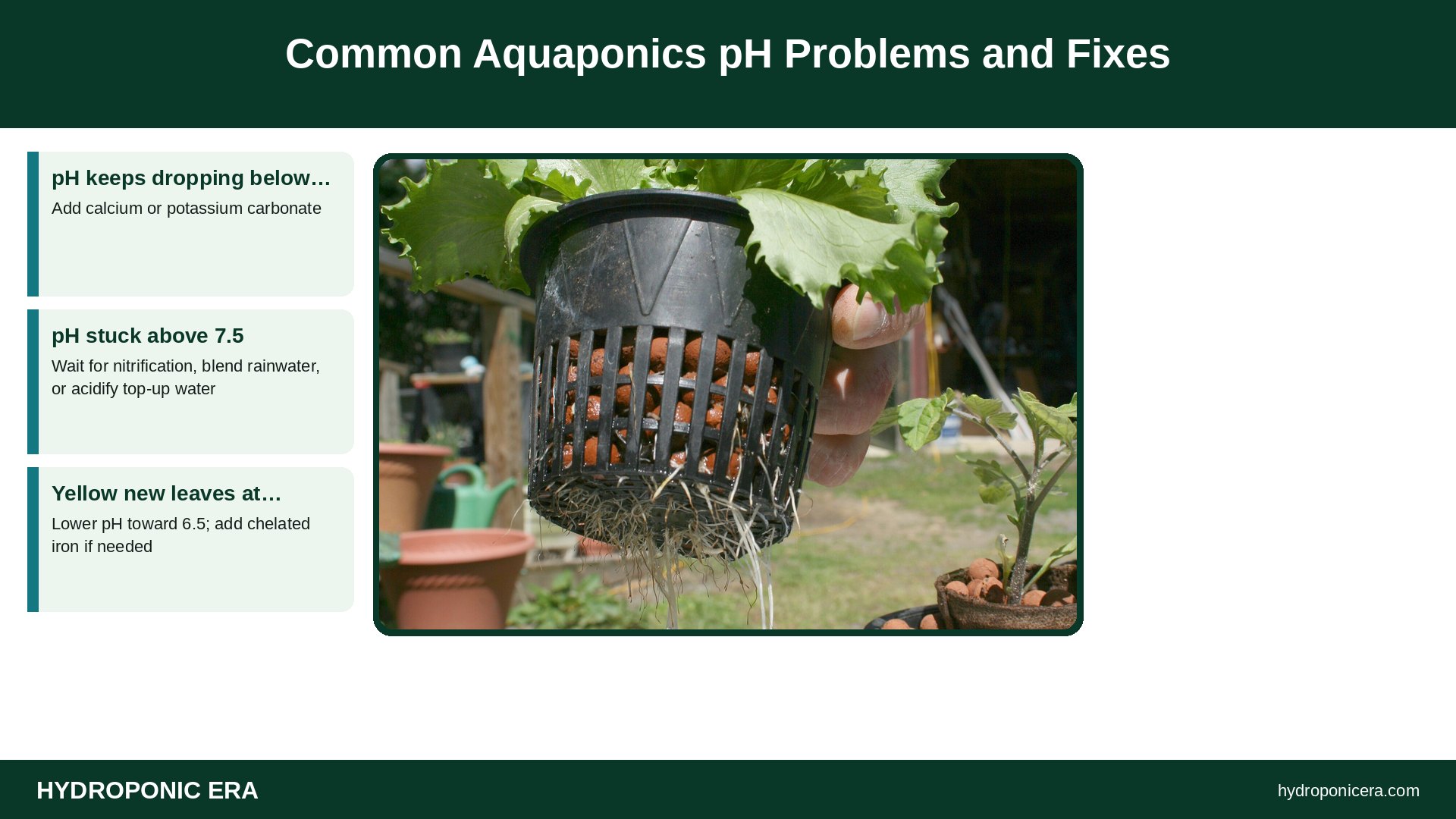
| Problem | Likely cause | Fix |
|---|---|---|
| pH keeps dropping below 6 | Low KH; nitrification acid | Add calcium or potassium carbonate |
| pH stuck above 7.5 | Hard, high-pH source water; limestone media | Wait for nitrification, blend rainwater, or acidify top-up water |
| Yellow new leaves at high pH | Iron lockout | Lower pH toward 6.5; add chelated iron if needed |
| Sudden pH crash | Buffer exhausted or acid overdose | Stop acid; add carbonate slowly; water change |
| Fish stressed after adjustment | pH changed too fast | Change pH by no more than 0.3 in 12–24 hours |
FAO also notes limestone is only acceptable as a grow medium when nothing else is available, because it keeps raising pH.
A Simple Weekly Aquaponics pH Routine
- Test pH at the same time each week (or more often while adjusting).
- Test KH monthly, or whenever pH starts falling faster than usual.
- If pH is below 6.5 and falling, add a small amount of carbonate buffer and retest after a few days.
- If pH is above 7.5, check your source water and media before reaching for acid.
- Log results with fish behavior and plant condition so you see the bigger picture.
FAQs: Aquaponics pH
What is the ideal pH for aquaponics?
FAO recommends 6–7 as the best compromise for fish, plants, and bacteria.
Why does my aquaponics pH keep dropping?
Nitrification produces acid. Once carbonate hardness is used up, pH falls.
How do I raise aquaponics pH?
Add calcium carbonate (eggshells, seashells, limestone grit) or potassium carbonate, slowly.
Can I use baking soda to raise aquaponics pH?
No. FAO says the sodium harms plants.
Can I use citric acid to lower pH?
No. FAO warns it can kill biofilter bacteria; phosphoric acid is the usual choice.
Sources
- FAO — Small-scale aquaponic food production
- Photo credits (Wikimedia Commons, edited with titles): AQUAPONIE by Hopeballa (CC BY-SA 4.0); PH- und Leitfähigkeitsmessgeräte by Rotkaeppchen68 (CC0); Solanum lycopersicum in aquaponics at the NC Greenhouse Nursery by Gogerr (CC BY-SA 4.0); Water droplets on a late cotoneaster (Cotoneaster coriaceus) leaf, Jardim da Fundação Calouste Gulbenkian, Lisbon, Portugal julesvernex2 by Jules Verne Times Two (CC BY-SA 4.0); 2009-03-30 Lettuce roots by Ildar Sagdejev (Specious) (CC BY-SA 4.0)