
DIY indoor aquaponics works best as a small media bed system: a fish tank of at least 20–50 gallons, a grow bed on top or beside it filled with expanded clay pebbles, a small submersible pump, and an air pump. Water pumps from the tank to the bed, trickles or siphons through the media, and drains back. FAO’s aquaponics manual notes that very small units with fish tanks up to about 200 liters (53 gallons) can pump straight from the fish tank to the grow bed without a sump. Indoors, plan for light, weight, humidity, and noise, and choose hardy ornamental fish such as goldfish, since FAO doesn’t recommend growing food fish in tanks under 500 liters.
Key takeaway: Start small and simple: one tank, one clay-pebble bed, an LED grow light, gentle stocking, and leafy greens or herbs.
| Part | Starter choice | Why |
|---|---|---|
| Fish tank | 20–55 gal aquarium or food-grade tote | Enough volume for stable water |
| Grow bed | Food-safe tray 6–8 in deep | FAO: 15–20 cm suits leafy greens |
| Media | Expanded clay pebbles | Light, pH-neutral, easy to clean |
| Water pump | Small submersible, adjustable | Circulate tank volume about once an hour |
| Air pump | Aquarium air pump + air stone | Oxygen for fish and bacteria |
| Light | LED grow light on a timer | Indoor plants need strong light |
| Fish | Goldfish or other hardy ornamentals | Hardy; suited to small volumes |

How a DIY Indoor Aquaponics System Works

Fish produce ammonia. Nitrifying bacteria living on the clay pebbles convert it to nitrate, and plant roots absorb it, cleaning the water before it returns to the fish. In a small media bed, the pebbles act as both the biofilter and the solids filter, so you don’t need separate filter tanks at light stocking. FAO notes media bed systems are the most popular design for small-scale aquaponics for this reason. See nitrifying bacteria and aquaponics media beds.
Step-by-Step DIY Indoor Aquaponics Build Plan
- Pick the spot. A full 40-gallon tank weighs well over 400 pounds with gravel and stand. Use a sturdy stand on a ground floor or over a joist, near an outlet with a GFCI, away from heat vents.
- Set up the tank. Rinse it with plain water only, no soap residue, and fill with dechlorinated water.
- Build the bed. Use a food-safe plastic tray at least 6–8 inches deep that fits over or beside the tank. Drill a drain hole and fit a bulkhead fitting.
- Add drainage. Use a simple standpipe for constant-level flow, or a small bell siphon for flood-and-drain. A media guard keeps pebbles off the drain. See bell siphons.
- Wash and add media. FAO says to wash media until the water runs clear; dust can harm fish gills.
- Install the pump. Run tubing from a small submersible pump to the bed, spreading water across the media.
- Add aeration. An air stone in the tank keeps oxygen up even if the water pump stops.
- Cycle the system before adding fish. See aquaponics cycling.
- Plant and light. Transplant seedlings into the bed and hang an LED grow light above them.
- Add fish slowly once ammonia and nitrite are near zero.
Choosing Fish for DIY Indoor Aquaponics
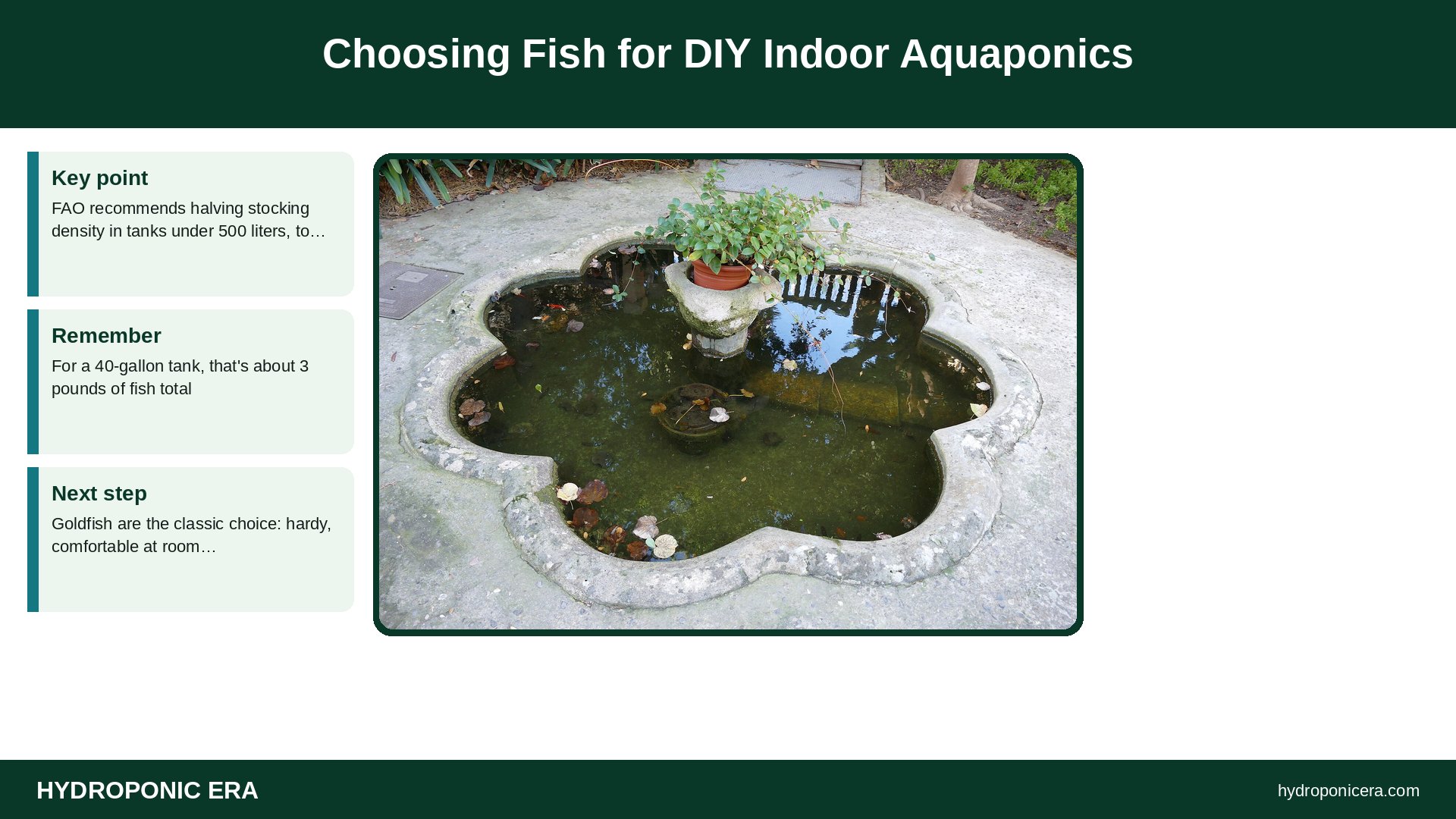
FAO recommends halving stocking density in tanks under 500 liters, to about 1 kg per 100 liters (roughly 0.08 lb per gallon), and doesn’t recommend growing food fish in tanks that small. For a 40-gallon tank, that’s about 3 pounds of fish total. Goldfish are the classic choice: hardy, comfortable at room temperature, and inexpensive. See goldfish aquaponics. If you want food fish, plan a larger tank of 132 gallons or more. See aquaponics stocking density.
Lighting DIY Indoor Aquaponics
Most indoor spaces don’t have enough light for vegetables. Use an LED grow light on a timer, typically 14–16 hours a day for leafy greens. Keep light off the fish tank water as much as possible, because FAO notes direct light encourages algae. Shade the tank sides and leave indirect light for the fish. See grow light watts per square foot.
Best Plants for Small Indoor Systems
Leafy greens and herbs are the easiest: lettuce, basil, mint, parsley, chives, kale, and watercress. Small beds have limited nutrients, so heavy feeders like tomatoes are harder. FAO’s feed rate ratio for leafy greens is 40–50 g of feed per m² per day, so a 2 × 2 ft bed (about 0.37 m²) only needs about 15–19 grams of fish feed daily. See fish to plant ratio.
DIY Indoor Aquaponics Issues to Plan For
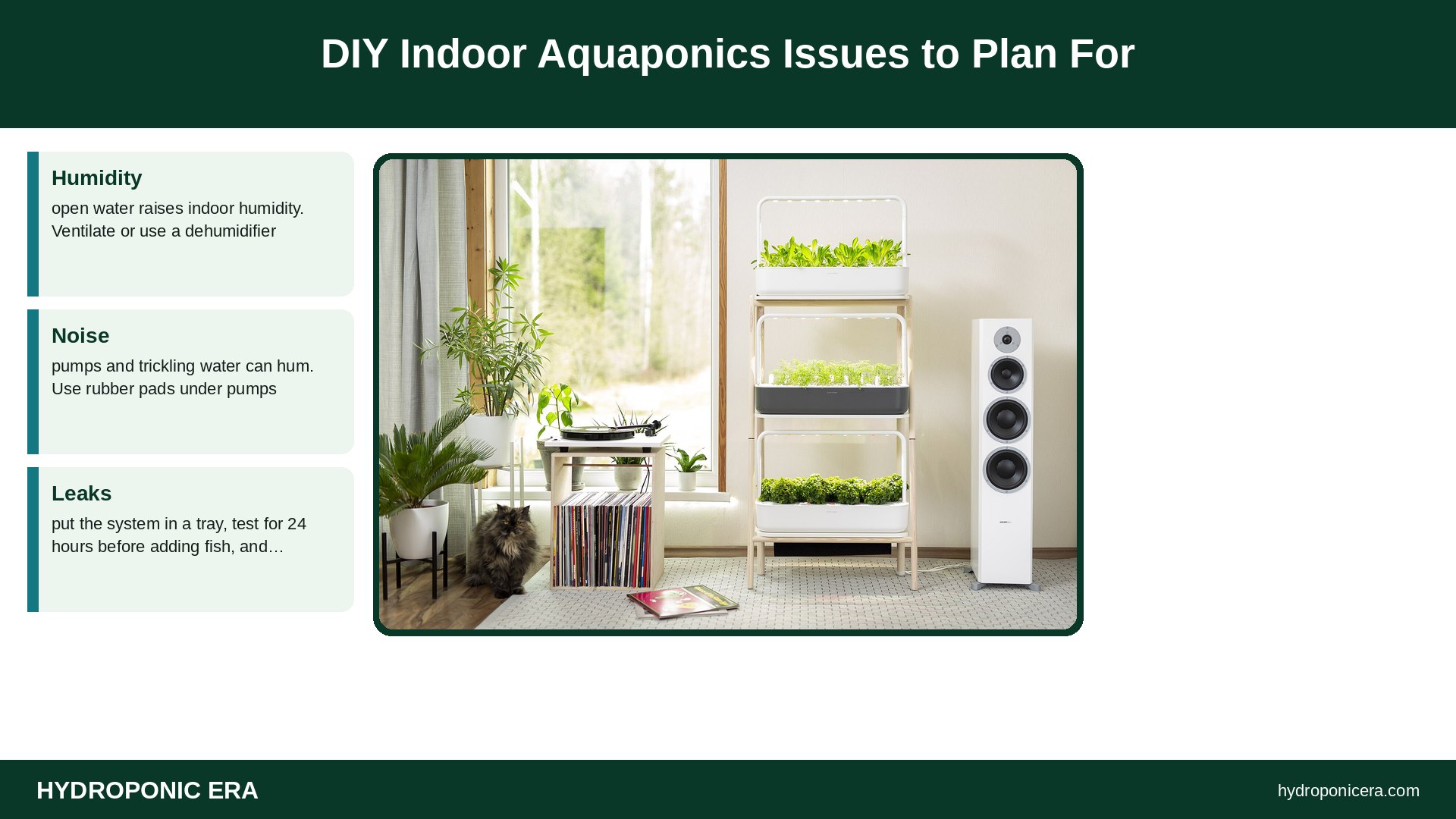
- Humidity: open water raises indoor humidity. Ventilate or use a dehumidifier.
- Noise: pumps and trickling water can hum. Use rubber pads under pumps.
- Leaks: put the system in a tray, test for 24 hours before adding fish, and keep electrical cords looped below outlets with drip loops.
- Pets and kids: secure lids so animals can’t reach the fish.
- Temperature: room-temperature water suits goldfish; tropical fish need heaters.
See electrical safety indoors.
Weekly DIY Indoor Aquaponics Routine
- Feed fish once or twice daily, only what they eat in a few minutes.
- Test ammonia, nitrite, nitrate, and pH weekly. See safe levels.
- Top up evaporation with dechlorinated water.
- Clean the pump intake every 2–3 weeks, as FAO suggests.
- Harvest and replant regularly to keep nutrients used.
DIY Indoor Aquaponics Budget Tips

Used aquariums, food-safe storage totes, and a basic aquarium pump keep costs low. The grow light is often the most expensive part. Skip extras until the basic loop is running well.
DIY Indoor Aquaponics Power and Safety
An indoor DIY indoor aquaponics setup combines water, electricity, and weight inside your home. Plug pumps and lights into GFCI-protected outlets, use drip loops on every cord, and keep power strips off the floor. Put a tray or pond liner under the system to catch leaks, and check fittings weekly for drips. FAO lists a float switch as an inexpensive way to stop the pump if the water level drops. For electricity costs, FAO’s example of a 30-watt pump plus a 5-watt air pump uses about 25 kWh per month; grow lights add more.
FAQs: DIY Indoor Aquaponics
What size tank do I need for DIY indoor aquaponics?
At least 20 gallons, and 40–55 gallons is more stable.
What fish are best indoors?
Goldfish are the easiest; FAO doesn’t recommend food fish in tanks under about 132 gallons.
Do I need a grow light?
Usually yes, unless the system sits in a very sunny spot.
Does indoor aquaponics smell?
A balanced system shouldn’t. Bad smells point to overfeeding or dead spots.
Do I need a sump?
Not for small systems under about 53 gallons, per FAO.
Sources
- FAO — Small-scale aquaponic food production
- Photo credits (Wikimedia Commons, edited with titles): Fish farming on Øksfjorden in Loppa, Troms og Finnmark, Norway, 2022 August by Ximonic (Simo Räsänen) (CC BY-SA 4.0); Dahlias started indoors by F. D. Richards from Clinton, MI (CC BY-SA 2.0); Fountain with goldfish in Jardí del Bisbe 03 by Kritzolina (CC BY-SA 4.0); Click & Grow Smart Garden 27 by Janar Raidla (CC BY-SA 4.0); AQUAPONIE by Hopeballa (CC BY-SA 4.0)