
What is guppy grass? Guppy grass is Najas guadalupensis, a fast-growing native submerged plant from the Americas, also called southern naiad or common water-nymph. Tropica calls it exceptionally easy, thriving in almost any conditions, usually free-floating, and an excellent shelter for fish fry and shrimp in aquariums and ponds.
Key takeaway: Guppy grass (Najas guadalupensis) is one of the easiest aquarium plants: it floats or roots, grows quickly, soaks up excess nutrients and hides fry. The catch is speed. Mississippi State Extension says it can quickly take over small ponds and lower oxygen at night, so trim it often and never release it outdoors.
| Trait | Guppy grass (Najas guadalupensis) | Source |
|---|---|---|
| Plant type | Submerged annual with fibrous roots | Washington Ecology |
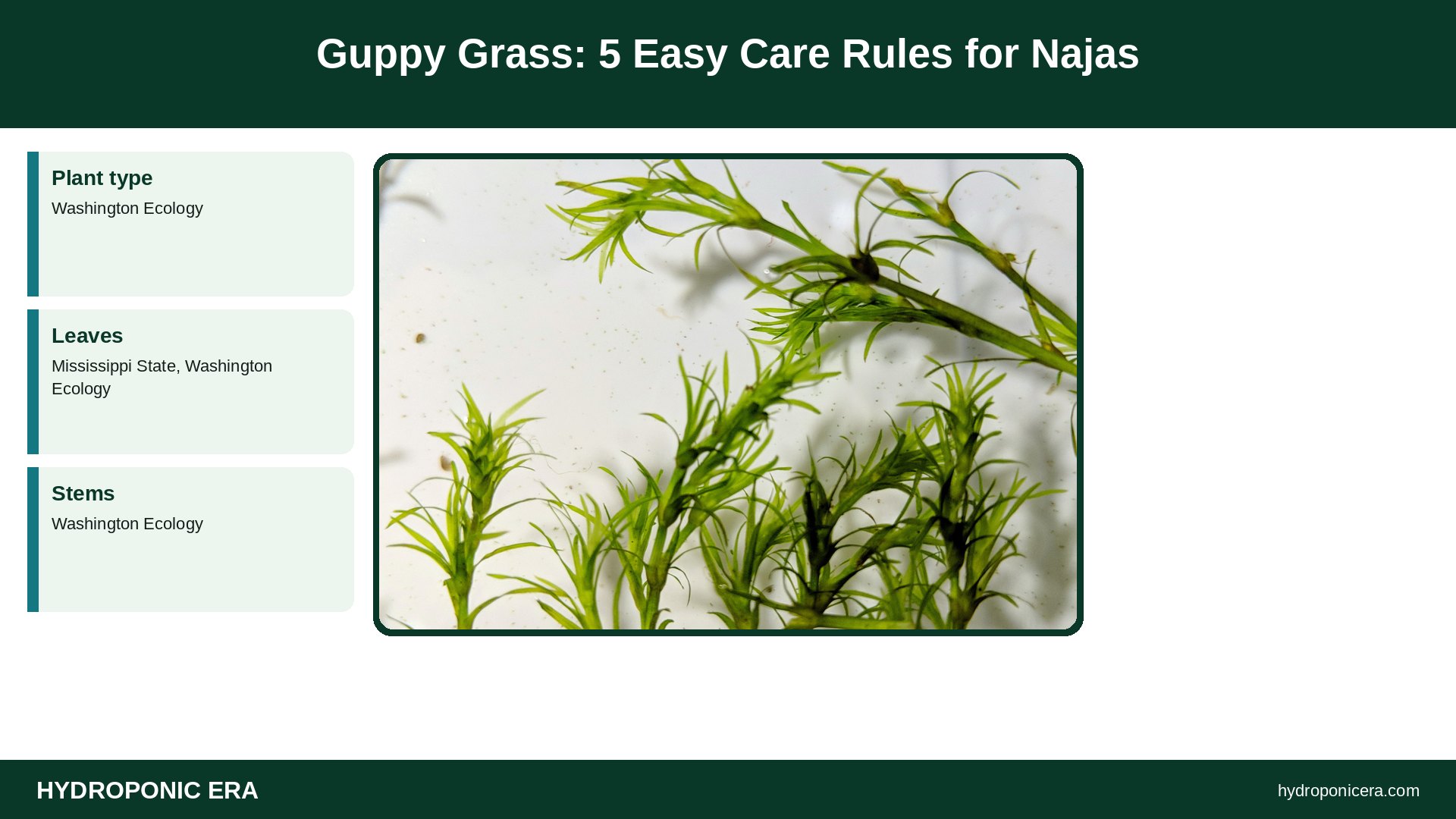
| Leaves | About 1 in (2.5 cm) long, opposite, finely toothed | Mississippi State, Washington Ecology |
| Stems | Slender, branched, easily broken | Washington Ecology |
| Growth | Fast; easy in almost any conditions | Tropica |
| Spread | Seeds and stem fragments | Washington Ecology |
| Wildlife value | Primary waterfowl food; cover for small fish | Texas A&M, Mississippi State |
What Is Guppy Grass and Where Does It Come From?
Guppy grass is the aquarium name for Najas guadalupensis, a native submerged plant that Washington State Department of Ecology lists from southern North America through Central and South America. Tropica says it originates in the USA and South America. In the wild it grows in ponds, lakes and slow streams, often as floating fragments.
Texas A&M AgriLife calls it southern naiad and notes it is often confused with sago pondweed and widgeon grass.
How Do You Care for Guppy Grass?
Care is simple: float it or tuck the stems lightly into the substrate, give moderate light, and trim it often. Tropica says it thrives under almost any conditions, grows quickly and propagates effortlessly, and may anchor itself with long, delicate roots even when kept free-floating.
- Rinse new stems and check for snails or hitchhikers.
- Float bunches near the surface or push stem ends into gravel.
- Give moderate light; see our grow light for aquarium guide.
- Thin it weekly once it fills the water column.
- Remove broken bits from the filter intake.
Why Is Guppy Grass Good for Fry and Shrimp?
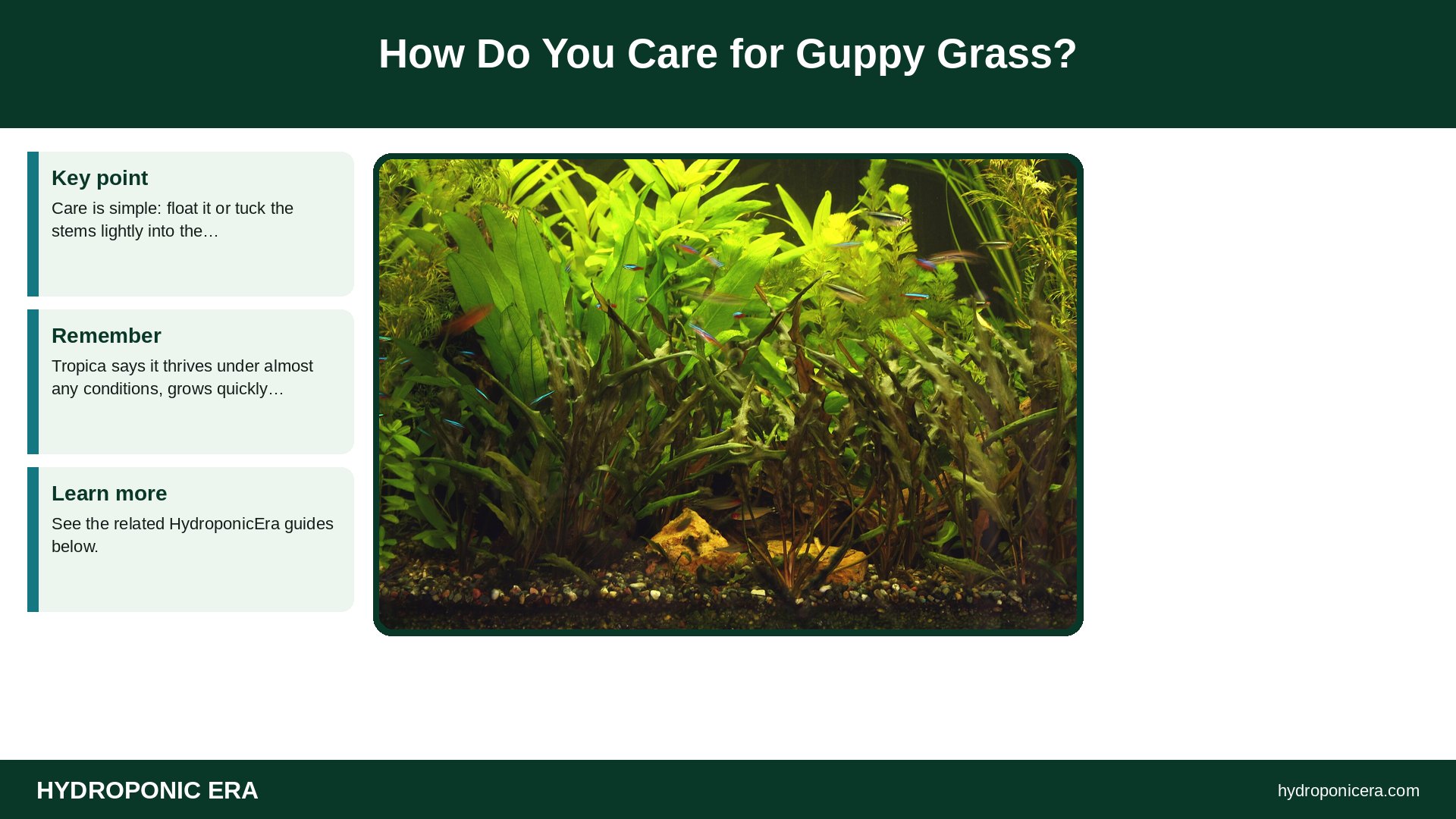
Najas suits fry and shrimp because its fine, branching growth forms a dense tangle. Tropica says the porous structure gives excellent shelter for fish fry and shrimp while absorbing excess nutrients and producing oxygen. Mississippi State notes that small fish use the dense growth as cover, the same reason breeders use it.
It pairs well with livebearers such as guppies and mollies, whose fry hide in the strands.
How Fast Does Guppy Grass Grow?
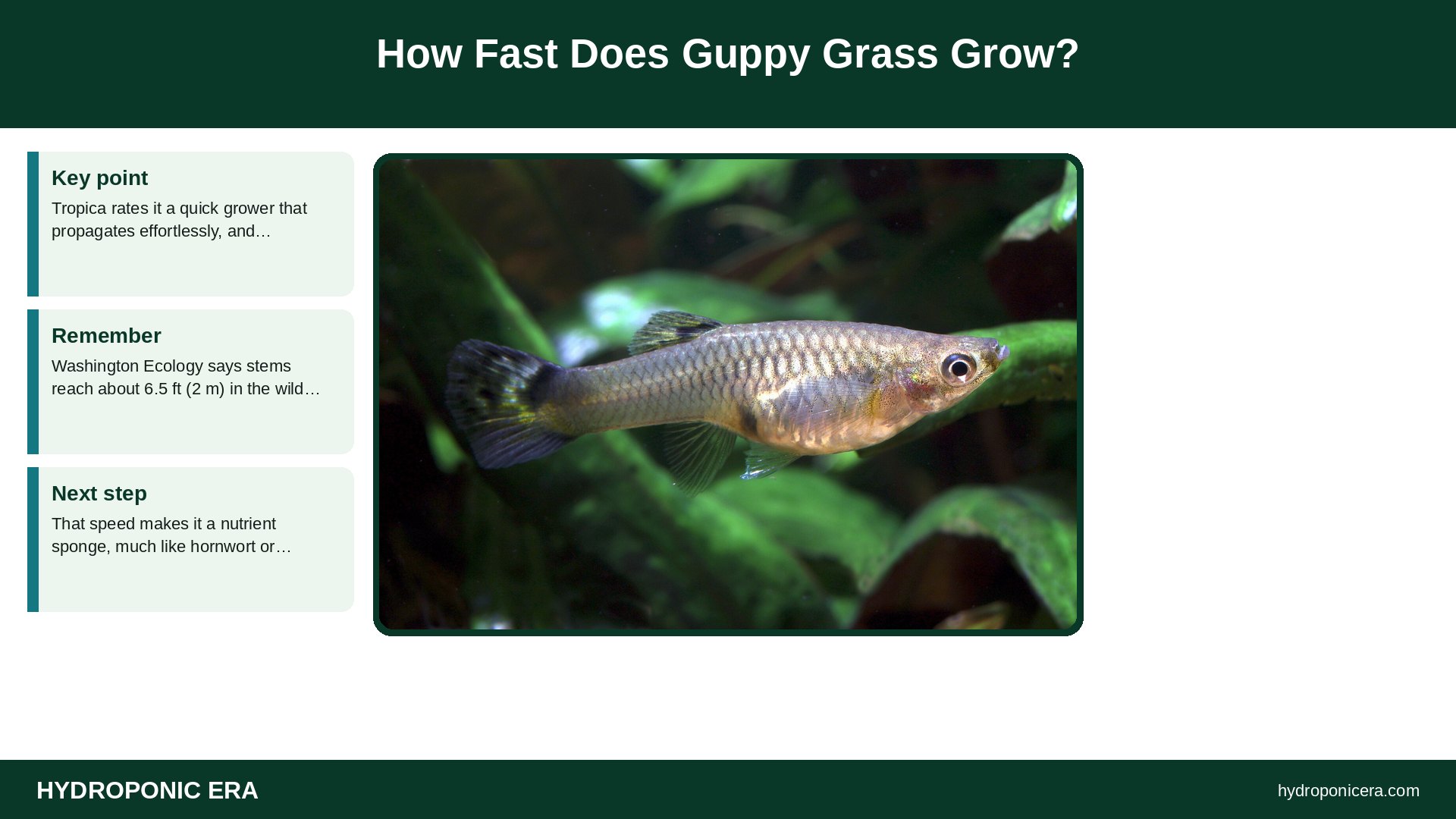
It grows very fast. Tropica rates it a quick grower that propagates effortlessly, and Mississippi State Extension warns the species grows rapidly and can quickly become a problem in small waters. Washington Ecology says stems reach about 6.5 ft (2 m) in the wild and break easily, and each fragment can start a new plant.
That speed makes it a nutrient sponge, much like hornwort or anacharis.
Can Guppy Grass Grow in Ponds?
It can grow in ponds, and Tropica describes it as suited to both aquariums and ponds. Use caution outdoors. Mississippi State says it is not recommended for small ponds because it grows rapidly, interferes with predator-prey balance, and can reduce oxygen at night or during die-offs. Keep pond stands thinned and contained.
- Benefit: Texas A&M calls southern naiad a primary food source for many ducks.
- Risk: dense mats can cut oxygen, per Mississippi State.
- Rule: never dump aquarium plants into natural waters.
How Do You Propagate and Trim Najas?
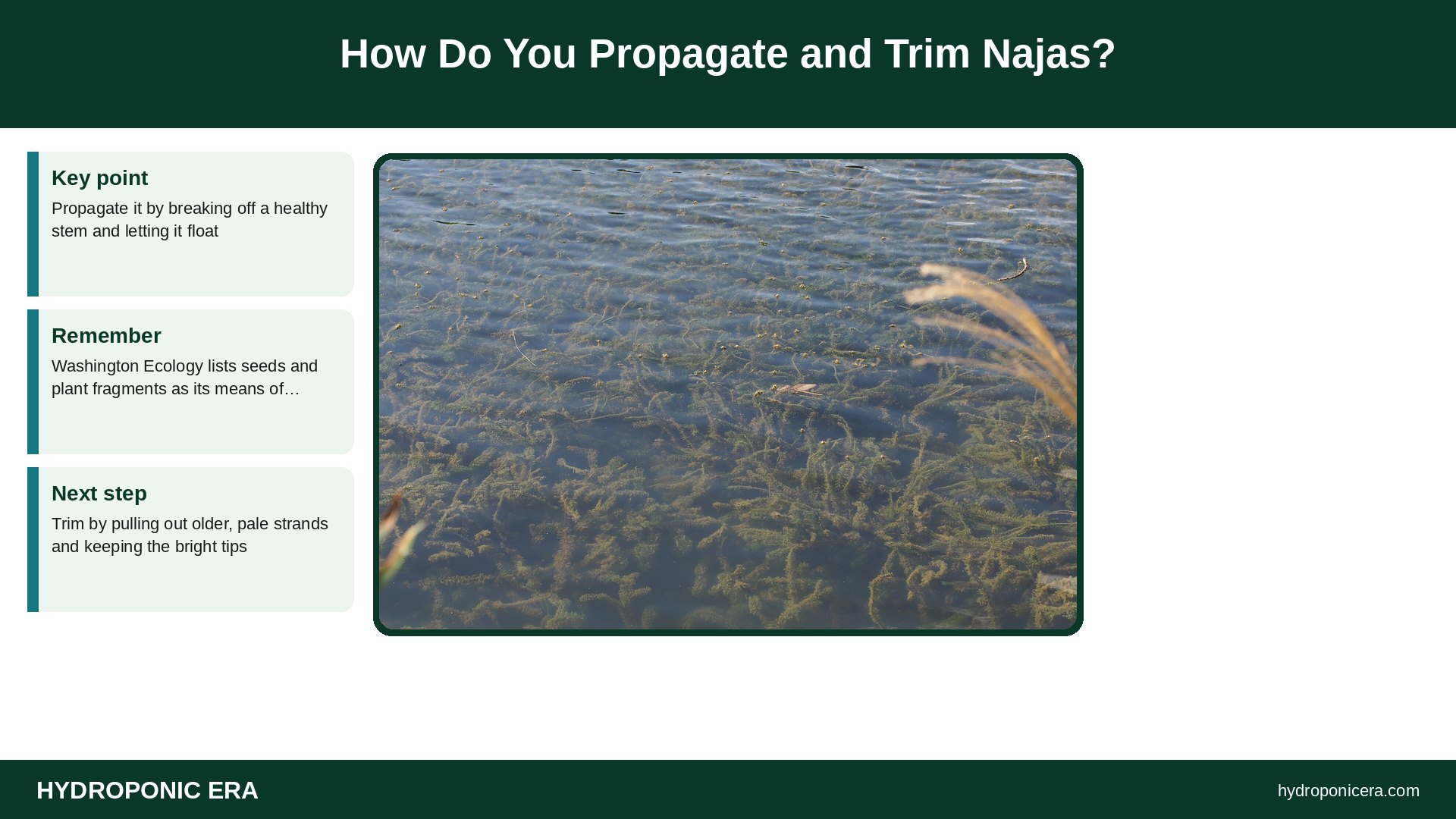
Propagate it by breaking off a healthy stem and letting it float. Washington Ecology lists seeds and plant fragments as its means of spread, so almost any piece will grow. Trim by pulling out older, pale strands and keeping the bright tips. Compost the trimmings rather than throwing them into ditches or streams.
How Do You Identify Najas guadalupensis?
Identify Najas guadalupensis by its narrow, opposite leaves with broad, clasping bases. Mississippi State Extension says the leaves are about one-sixteenth of an inch wide and an inch long, with tiny teeth visible only under magnification, and colored green to slightly purple. Sago pondweed, a common look-alike, has alternate leaves several inches long.
- Leaves: opposite, often looking whorled near stem tips, per Washington Ecology.
- Flowers: tiny, 0.08–0.12 in (2–3 mm), hidden at the leaf bases and pollinated underwater.
- Fruit: one dull, pitted seed about 0.12 in (3 mm) long, present in late summer.
- Habitat: ponds, lakes and slow streams to about 13 ft (4 m) deep.
Washington Ecology adds that seed features are the only reliable way to tell common water-nymph from slender water-nymph (Najas flexilis), its northern relative.
Does Najas Help Water Quality?
Yes, within limits. Tropica says the plant absorbs excess nutrients and produces oxygen, which helps a planted tank stay balanced. Mississippi State cautions that a dense stand works the other way at night and during die-offs, when respiration and decay can pull oxygen down. Thin it before it packs the whole water column.
For more nutrient-hungry plants that pair well with fish, see our aquarium aquaponics guide.
Is guppy grass the same as Najas?
Yes. Tropica sells Najas guadalupensis under the name ‘Guppy Grass’; it is also called southern naiad or common water-nymph.
Does guppy grass need CO2?
Tropica says it thrives under almost any conditions, so added CO2 is not needed.
Should guppy grass be planted or floated?
Either. Tropica says it is usually kept free-floating but may anchor with long roots.
Is guppy grass invasive?
It is native to the Americas, but Mississippi State says it can quickly become a problem in small ponds.
Do fish eat guppy grass?
It mainly serves as cover; waterfowl eat it, per Washington Ecology and Texas A&M.
Sources
- Tropica Aquarium Plants. Najas guadalupensis ‘Guppy Grass’(1)/30786).
- Mississippi State University Extension. Southern Naiad (Najas guadalupensis).
- Washington State Department of Ecology. Najas flexilis and Najas guadalupensis.
- Texas A&M AgriLife AquaPlant. Southern Naiad.
- Photo credits (Wikimedia Commons, edited with titles): Najas guadalupensis – Timothy McNitt by Timothy McNitt https://www.inaturalist.org/people/frondsinhighplaces (CC BY 4.0); Planted Tank 03 – Flickr – The Wandering Angel by The Wandering Angel from Makati City, Philippines (CC BY 2.0); Guppy Poecilia reticulata by Holger Krisp (CC BY 3.0); Egeria densa (22205195903) by harum.koh from Kobe city, Japan (CC BY-SA 2.0)