
How do you grow anacharis? Anacharis, sold as Brazilian elodea, grows in tanks with modest light and fish waste for food. Plant stems in gravel or let them float, keep the light moderate rather than intense, and trim often. It is invasive in US waterways and banned in several states, so keep it indoors and trash all cuttings.
Key takeaway: It is a fast, forgiving oxygenator for aquariums, but USGS reports it spreads from tiny fragments, so containment matters more than care.
| Fact | Brazilian waterweed (USGS NAS) |
|---|---|
| Scientific name | Egeria densa (formerly Elodea densa) |
| Native range | South America (Brazil, Argentina, Uruguay) |
| Leaves | 0.4–1.2 in (1–3 cm), whorls of four to eight |
| Stem length | About 10–16 ft (3–5 m) in the wild |
| Temperature range | About 37–95°F (3–35°C) survival |
| US plants | Male only; spreads by fragments |

What Is Anacharis?
Anacharis is the aquarium trade name for Brazilian waterweed, a submerged perennial in the waterweed family. USGS describes bright green stems with short internodes, giving a leafy look, and narrow leaves in whorls of four to eight. Small white flowers with three petals can float at the surface. In the wild it grows from bottom mud or as floating mats.
It is sold widely as an “oxygenator” plant. That popularity is exactly how it spread worldwide, according to USGS.
Anacharis vs Native Elodea: What Is the Difference?
The main difference is leaf count. Brazilian waterweed has leaves in whorls of four to eight and looks bushier, while native common waterweed, Elodea canadensis, usually has smaller leaves in whorls of three. The native plant is not the invasive one, but both should stay out of waters where they do not belong.
| Trait | Brazilian waterweed | Common waterweed |
|---|---|---|
| Leaves per whorl | 4–8 | Usually 3 |
| Look | Large, leafy | Smaller, sparser |
| Origin | South America | Native to North America |

Is Anacharis Legal to Buy?
Rules vary by state. USGS reports that sale and transport of Brazilian waterweed is prohibited in Illinois, Indiana, Michigan, Minnesota and Wisconsin, and other states may regulate it too. It forms thick mats that alter light and nutrients for other life. Check with your state natural resources agency before buying, and never release it.
How Do You Plant Anacharis in a Tank?
To plant anacharis, trim the bottom of each stem, strip the lowest leaves, and push the stems 1–2 in (2.5–5 cm) into gravel or sand, spaced so light reaches each one. You can also let stems float. Moderate light and a stocked tank supply what it needs. New roots grow from stem nodes.
- Rinse stems and check for snails or hitchhikers.
- Trim the base and remove lower leaves.
- Plant 1–2 in (2.5–5 cm) deep, or float the stems.
- Space them so light reaches lower leaves.
- Use moderate light on a steady timer.
- Trim weekly and replant healthy tops.
- Bag trimmings for the trash.
See our guide to quarantining new plants before adding stems to an established tank.
How Much Light and What Temperature Does It Need?
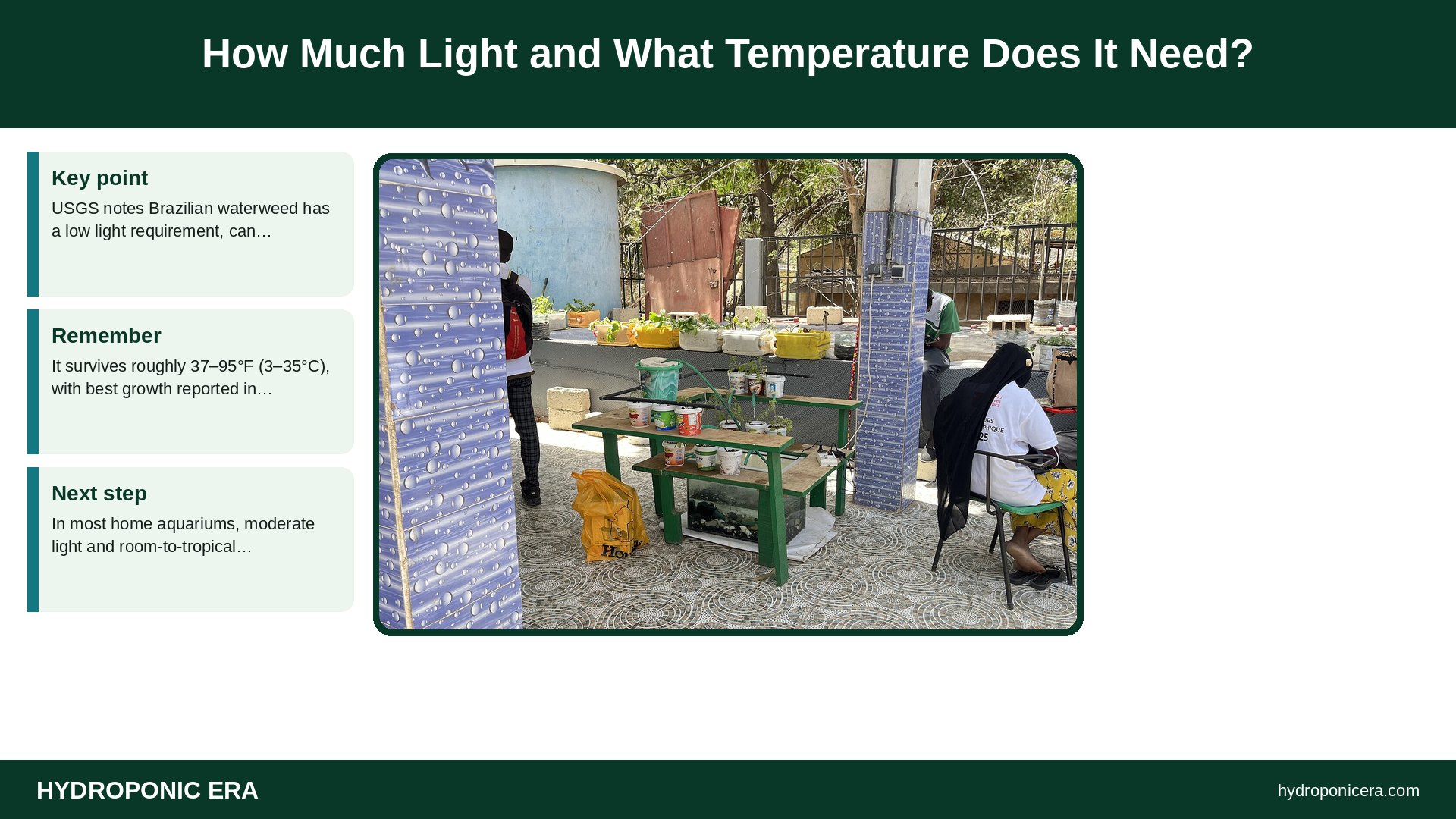
USGS notes Brazilian waterweed has a low light requirement, can thrive in murky water and is damaged by very intense light, yet cannot grow in total shade. It survives roughly 37–95°F (3–35°C), with best growth reported in cool water. In most home aquariums, moderate light and room-to-tropical temperatures work well.
For lighting, see our guide to light schedules.
Does Egeria Really Oxygenate the Water?
Like any submerged plant, it releases oxygen while it photosynthesizes in light and uses oxygen at night. A healthy, growing stand adds oxygen by day and takes up nutrients that algae would otherwise use. It does not replace an air stone in a crowded tank, especially overnight.
Our guides to dissolved oxygen and air pumps explain how to keep levels safe.
Can Anacharis Grow in an Aquaponics System?
Anacharis can grow in the fish tank or sump of a small indoor aquaponics system, where it uses fish waste and gives cover to fry. Keep it out of pumps and plumbing, and never use it in outdoor systems that could overflow into ditches or streams. Our aquaponics for beginners guide covers system layout.
How Do You Propagate Anacharis?
Propagating anacharis is as simple as cutting a healthy top section with several leaf whorls and planting or floating it. USGS notes stems with at least two nodes can break off and form new plants, which is why it spreads so easily. Replant the best tops and remove leggy or bare bases.
- Cut cleanly with sharp scissors above a node.
- Keep tops with dense, bright green growth.
- Net loose bits so they do not clog the filter.
- Never share cuttings where the plant is banned.
Which Fish and Tank Mates Work Well With It?
Most small community fish, livebearers, snails and shrimp do well with this plant, using it for cover and grazing on the film that grows on the leaves. Fry hide in dense stands. Goldfish and some large plant-eating fish may eat it faster than it grows, so give them extra stems from a separate tank.
Rinse new stems and watch for hitchhiking snails. Our plants that grow in water list offers other easy options if your fish keep eating it.
What Problems Affect It in Tanks?
Common problems are melting after a move, pale growth and stems that drop leaves. Some goldfish also eat it. Most issues improve with stable conditions and moderate light. USGS notes the species is susceptible to iron deficiency, so a pale stand in a lightly stocked tank may benefit from an aquarium plant fertilizer with iron.
| Symptom | Possible cause | Fix |
|---|---|---|
| Melting stems | Recent move | Remove soft parts; keep stable |
| Pale or yellow | Low iron or nutrients | Add iron-containing plant food |
| Bare lower stems | Shading | Thin and replant tops |
| Eaten tips | Goldfish grazing | Grow extra in a separate tank |
FAQ About Anacharis
Does it need CO2?
No. USGS notes it photosynthesizes well in low-CO2 water.
Can it float instead of being planted?
Yes; floating stems still grow.
How fast does it grow?
Quickly in good light; trim regularly.
Can I compost trimmings?
Dry them fully first, or bag them for the trash.
Is it safe for fish?
Yes; many fish use it for cover.
Sources
- US Geological Survey Nonindigenous Aquatic Species — Brazilian Waterweed Species Profile
- National Invasive Species Information Center — Brazilian Waterweed
- Washington State Department of Ecology — Brazilian Elodea Plant Identification
- Photo credits (Wikimedia Commons, edited with titles): Egeria densa (22205195903) by harum.koh from Kobe city, Japan (CC BY-SA 2.0); Hydra viridissima in freshwater aquarium (also visible are a rhabdocoelan and albino planorbid ramshorn snail) 02 by Obsidian Soul (CC0); AQUAPONIE by Hopeballa (CC BY-SA 4.0); Oweston sting fish for sale at Tsukiji Fishmarket, Tokyo-30 by MichaelMaggs (CC BY-SA 3.0)