
How do you care for a marimo moss ball? A marimo moss ball is a round colony of green algae, not moss. Keep it in cool, dechlorinated water out of direct sun, change the water every week or two, and roll it gently now and then. Inspect new balls for zebra mussels, which were found in imported marimo in 2021.
Key takeaway: Care is simple, but safety comes first. The US Fish and Wildlife Service says contaminated balls must be destroyed and trashed, never flushed or dumped outdoors.
| Fact | Detail (US Fish and Wildlife Service) |
|---|---|
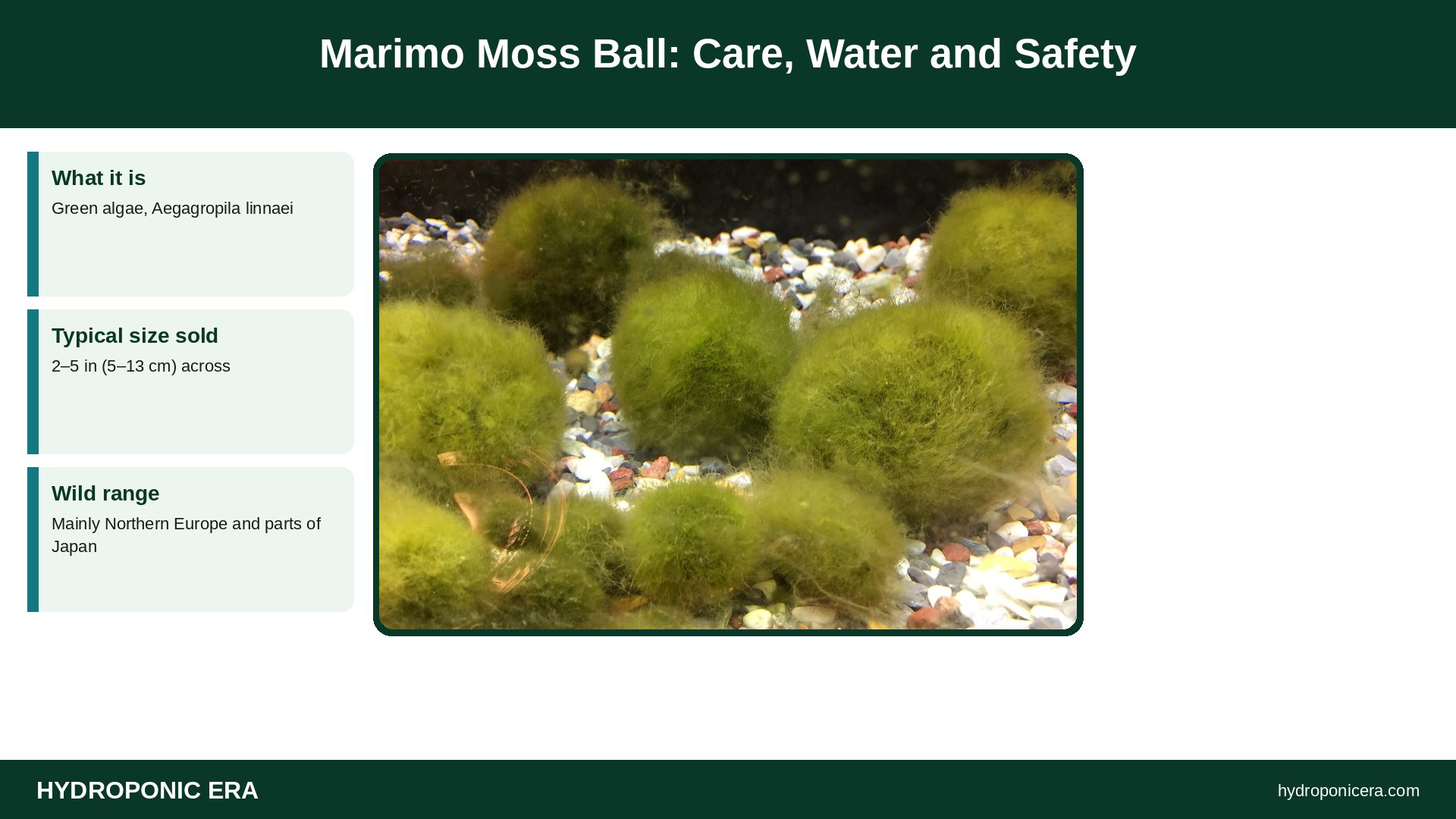
| What it is | Green algae, Aegagropila linnaei |
| Typical size sold | 2–5 in (5–13 cm) across |
| Wild range | Mainly Northern Europe and parts of Japan |
| Invasive itself? | No, per USFWS |
| 2021 issue | Zebra mussels found in moss balls in 46 states |
| State rules | Several states restrict or ban sales |
What Is a Marimo Moss Ball?
A marimo moss ball is a velvety green sphere of filamentous algae. USFWS notes it is not moss but Aegagropila linnaei, found mainly in Northern Europe and parts of Japan, and the ball itself is not considered invasive. Balls sold for aquariums, terrariums and water gardens are usually 2–5 in (5–13 cm) across.
Some “moss balls” in stores are true mosses such as Java moss, and some are plastic. Read labels so you know what you are buying.
Why Were Zebra Mussels Found in Moss Balls?
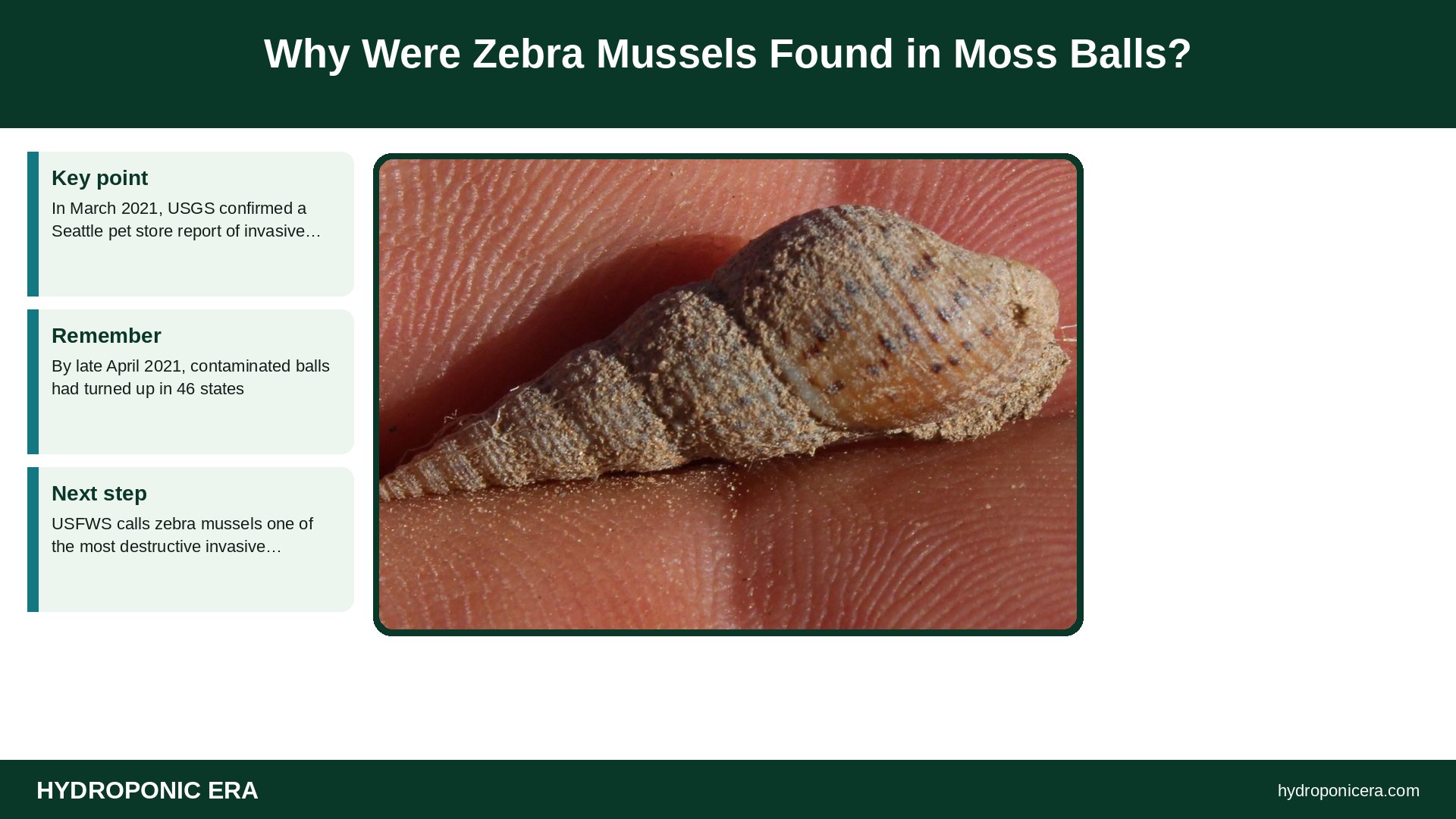
In March 2021, USGS confirmed a Seattle pet store report of invasive zebra mussels attached to and inside imported moss balls. By late April 2021, contaminated balls had turned up in 46 states. USFWS calls zebra mussels one of the most destructive invasive species in North America because they clog pipes and smother native mussels.
Sales were stopped and contaminated stock pulled. USFWS reports no known introductions to waterways from that incident, but still asks owners to inspect balls.
How Do You Check a Marimo Moss Ball for Mussels?
Look closely for small, hard, D-shaped shells, often striped, stuck to the surface or tucked inside the ball. Gently part the filaments with clean fingers over a white tray. Larvae are often too small to see, so USFWS treats any contaminated tank as needing decontamination. Report finds to your state agency and USGS.
What If Your Marimo Moss Ball Has Mussels?
Follow the USFWS “Destroy, Dispose, Drain” steps. Destroy the ball by freezing it in a sealed bag for at least 24 hours, boiling it for at least one full minute, or soaking it in bleach or vinegar as directed. Then seal it in a bag in the trash, and decontaminate the tank.
- Destroy: freeze 24+ hours, boil 1+ minute, or use the bleach or vinegar soak.
- Dispose: seal the ball and packaging in a bag in the trash.
- Drain: move fish to clean water, then treat the tank water before pouring it down a household drain.
- Clean: use hot water at 120°F (49°C), a salt soak or a bleach soak on decor and media.
- Report: tell your state agency and the USGS NAS database.
Never use a storm drain, garden or waterway. After any bleach use, dechlorinate before restocking; see our chlorine guide.
How Do You Care for a Healthy Aegagropila Ball?
Healthy balls need cool water, low to moderate indirect light and regular fresh water. Common care advice is to change the water every one to two weeks, keep the jar away from heaters and direct sun, and gently roll the ball so all sides get light and it keeps its shape.
- Water: dechlorinated tap or clean rainwater.
- Light: bright room light, not direct sun.
- Temperature: keep it cool; avoid warm windowsills.
- Rolling: turn it gently during water changes.
- Cleaning: rinse and lightly squeeze in clean water.
Our guide to collected rainwater covers water quality.
Why Is My Marimo Moss Ball Turning Brown or White?
Brown patches often point to too little light, dirty water or debris trapped in the filaments; white or pale patches often mean too much direct light. Move the jar, change the water, and rinse the ball. Trim badly damaged spots with clean scissors. Most color problems improve slowly once conditions are corrected.
| Symptom | Likely cause | Fix |
|---|---|---|
| Brown spots | Low light or dirty water | Change water; brighter indirect light |
| White or pale | Direct sun | Move out of sun |
| Floating | Trapped air | Gently squeeze |
| Falling apart | Damage or age | Re-form or split into smaller balls |
How Do You Split or Reshape a Marimo Moss Ball?
To split or reshape a marimo moss ball, gently pull it apart into pieces over a bowl of clean water, then roll each piece between your palms until it holds a loose round shape. Some keepers wrap new pieces lightly in cotton thread for a few weeks while they firm up.
- Work in clean water so filaments stay wet.
- Remove brown sections before re-forming.
- Roll often at first so the shape sets evenly.
- Be patient: growth is slow, and new balls stay small for a long time.
Only split balls you have already inspected and know are clean. Do not mix pieces from an unknown source into an established jar or tank; our guide to quarantining new plants explains why.
Can a Marimo Moss Ball Go in a Fish Tank?
You can add a verified clean marimo moss ball to a cool aquarium, but warm tropical tanks can stress it, and some fish pick at it. In aquaponics it adds little filtration. Only buy from domestic sellers who can verify origin, as USFWS advises; never order from foreign retailers. Our guide to aquarium water safety covers sharing water with plants.
Is It Legal to Buy Moss Balls in My State?
It depends. USFWS says several states restrict or prohibit sales, and any imported shipment needs a permit, phytosanitary certificate and USDA inspection. It also warns that online claims of “lab tested” or “mussel free” are false and misleading. Ask your state fish and wildlife agency before buying.
FAQ About Marimo Moss Balls
Is it a plant or algae?
Algae, per USFWS.
How often should I change the water?
Every one to two weeks is common advice.
Can I quarantine instead of destroying it?
USFWS offers a quarantine protocol; follow it exactly.
Why does it float?
Trapped gas; a gentle squeeze usually sinks it.
Can I flush a dead marimo moss ball?
No. Seal it in a bag in the trash.
Sources
- US Fish and Wildlife Service — Invasive Zebra Mussels Found in Moss Balls
- US Geological Survey Nonindigenous Aquatic Species — NAS Database and Sighting Reports
- Photo credits (Wikimedia Commons, edited with titles): Aegagropila linnaei, Hokkaido, Japan by bryan… from Taipei, Taiwan (CC BY-SA 2.0); Melanoides tuberculata (O. F. Müller, 1774) upper view – iNaturalist.org by Rebelo, Tony (CC BY-SA 4.0); Water faucet 2 by Yasmine.shal (CC BY-SA 4.0); Water droplets on a late cotoneaster (Cotoneaster coriaceus) leaf, Jardim da Fundação Calouste Gulbenkian, Lisbon, Portugal julesvernex2 by Jules Verne Times Two (CC BY-SA 4.0)