
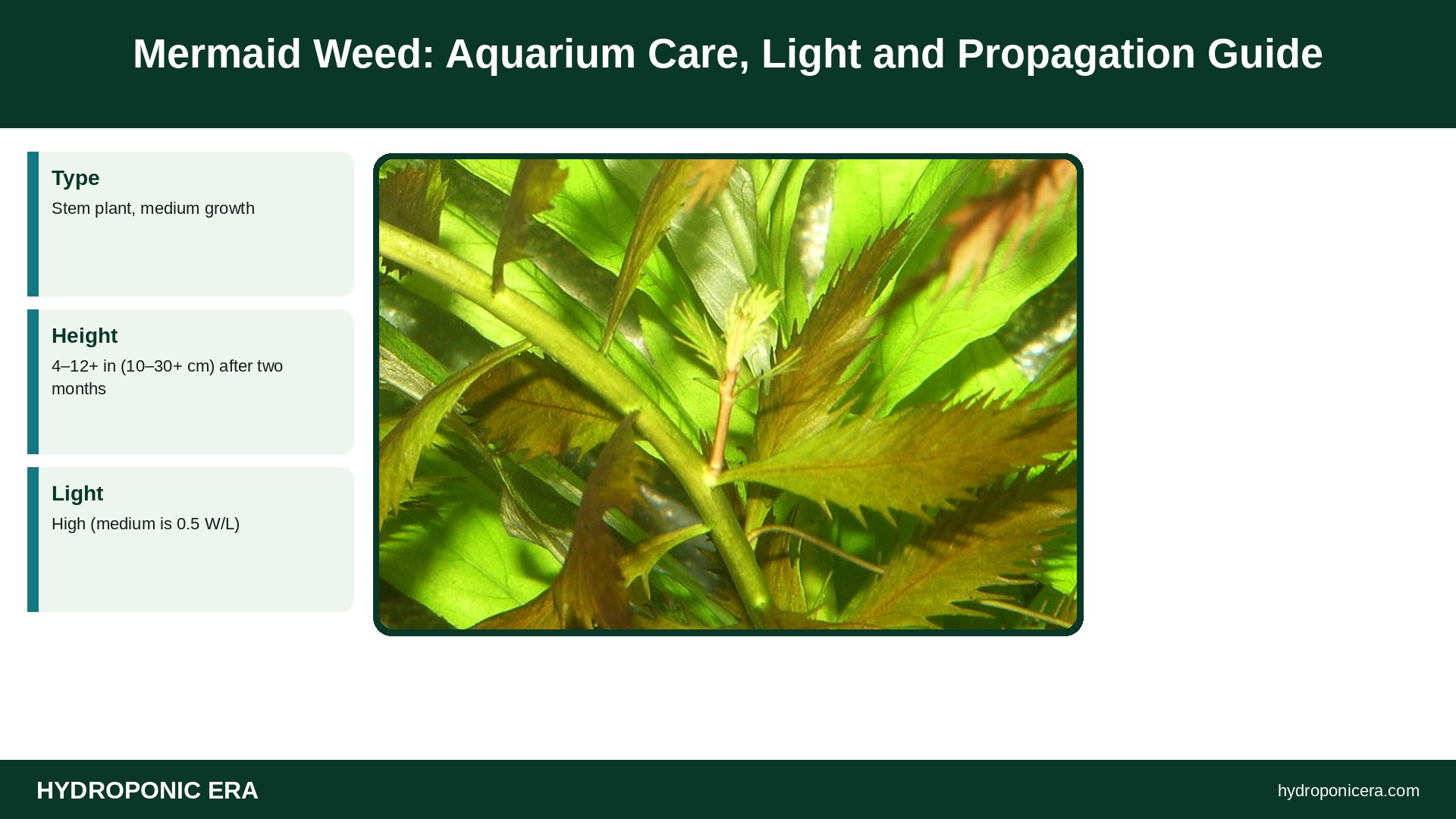
How do you grow mermaid weed in an aquarium? Grow mermaid weed (Proserpinaca palustris) as a midground stem plant under high light with CO2. Tropica rates its ‘Cuba’ form high for both light and CO2. Give it steady iron, low nitrate and replant trimmed tops. New plants need weeks to switch from emersed leaves to needle-like underwater leaves.
Key takeaway: Mermaid weed is a copper-orange stem plant from the Americas. Tropica says the ‘Cuba’ cultivar grows 10 to 30+ cm (4 to 12+ in), with high light and high CO2 demand of about 15 to 25 mg/L. Flowgrow adds that lower nitrate, good phosphate and a constant iron supply keep the color deep.
| Factor | Value | Source |
|---|---|---|
| Type | Stem plant, medium growth | Tropica |
| Height | 4–12+ in (10–30+ cm) after two months | Tropica |
| Light | High (medium is 0.5 W/L) | Tropica |
| CO2 | High, about 15–25 mg/L | Tropica |
| Temperature | 68–77°F (20–25°C) optimum | Flowgrow |
| pH | 5–7.5 | Flowgrow |
| Color tips | NO3 5–10 mg/L, PO4 1.5–2 mg/L, steady iron | Flowgrow |
How Do You Grow Mermaid Weed in an Aquarium?
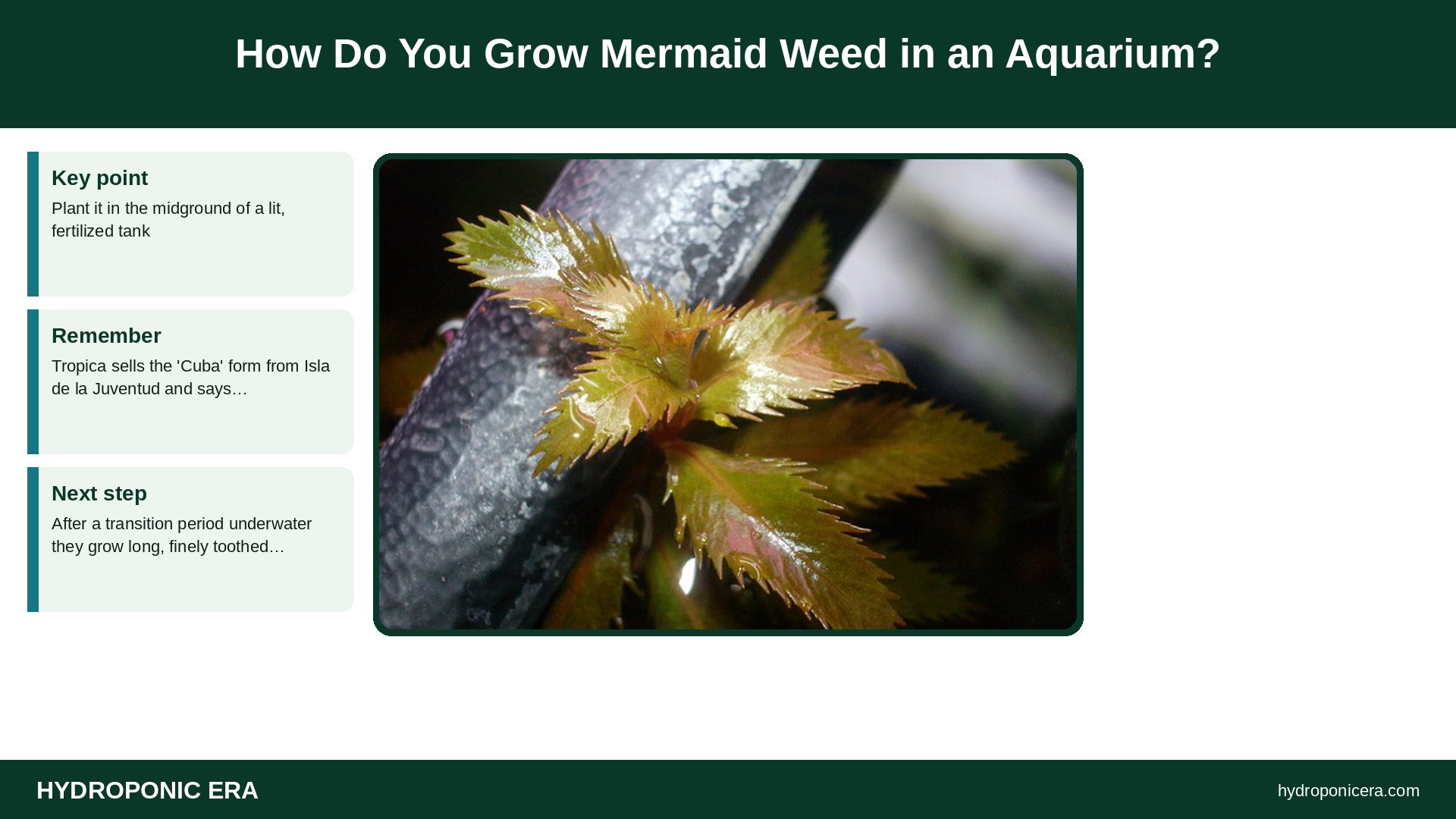
Plant it in the midground of a lit, fertilized tank. Tropica sells the ‘Cuba’ form from Isla de la Juventud and says plants arrive with saw-toothed leaves. After a transition period underwater they grow long, finely toothed, needle-like leaves. Mermaid weed is the common US name; Flowgrow says it grows wild across the eastern and southeastern United States.
- Rinse the plant and remove any rock wool or gel.
- Plant stems individually, a little apart, in nutrient-rich substrate.
- Place it where strong light reaches the leaves.
- Be patient while old leaves change form.
Pair it with other colorful stems like Rotala or Ludwigia.
What Light, CO2 and Fertilizer Does Mermaid Weed Need?
Lots of light and CO2, plus balanced nutrients. Tropica rates mermaid weed high for light and CO2 and defines high CO2 as about 15 to 25 mg/L. Flowgrow says medium to strong light of 0.5 W/L or more is needed, and that CO2 helps it reach full potential. Low nitrate and steady iron deepen its orange-red color.
- Light: high; reduce shading from taller plants.
- CO2: injected; see aquarium CO2 for plants.
- Nitrate: Flowgrow suggests about 5–10 mg/L for color; higher turns it orange-green.
- Phosphate: about 1.5–2 mg/L.
- Iron: keep a constant supply with aquarium plant fertilizer.
Root feeding helps too; see aquarium root tabs.
How Do You Trim and Propagate Mermaid Weed?
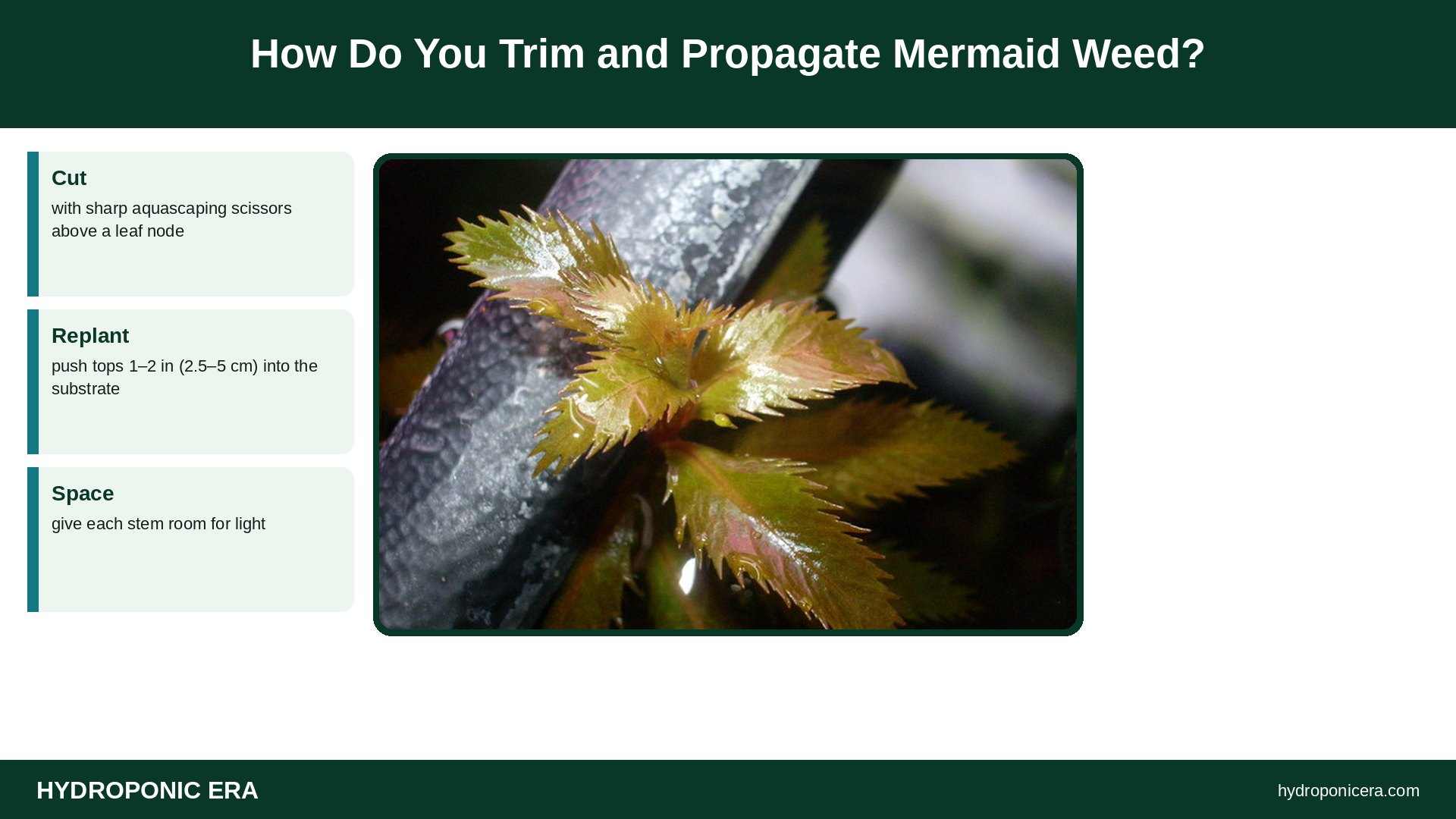
Replant the tops. Flowgrow says the plant is not a fast grower and forms few side shoots. When trimming, replant the upper part of the stem rather than keeping the old base. You can also leave the old base in place; it will form new side shoots that you can cut and replant.
- Cut: with sharp aquascaping scissors above a leaf node.
- Replant: push tops 1–2 in (2.5–5 cm) into the substrate.
- Space: give each stem room for light.
Why Is Mermaid Weed Melting or Not Growing?
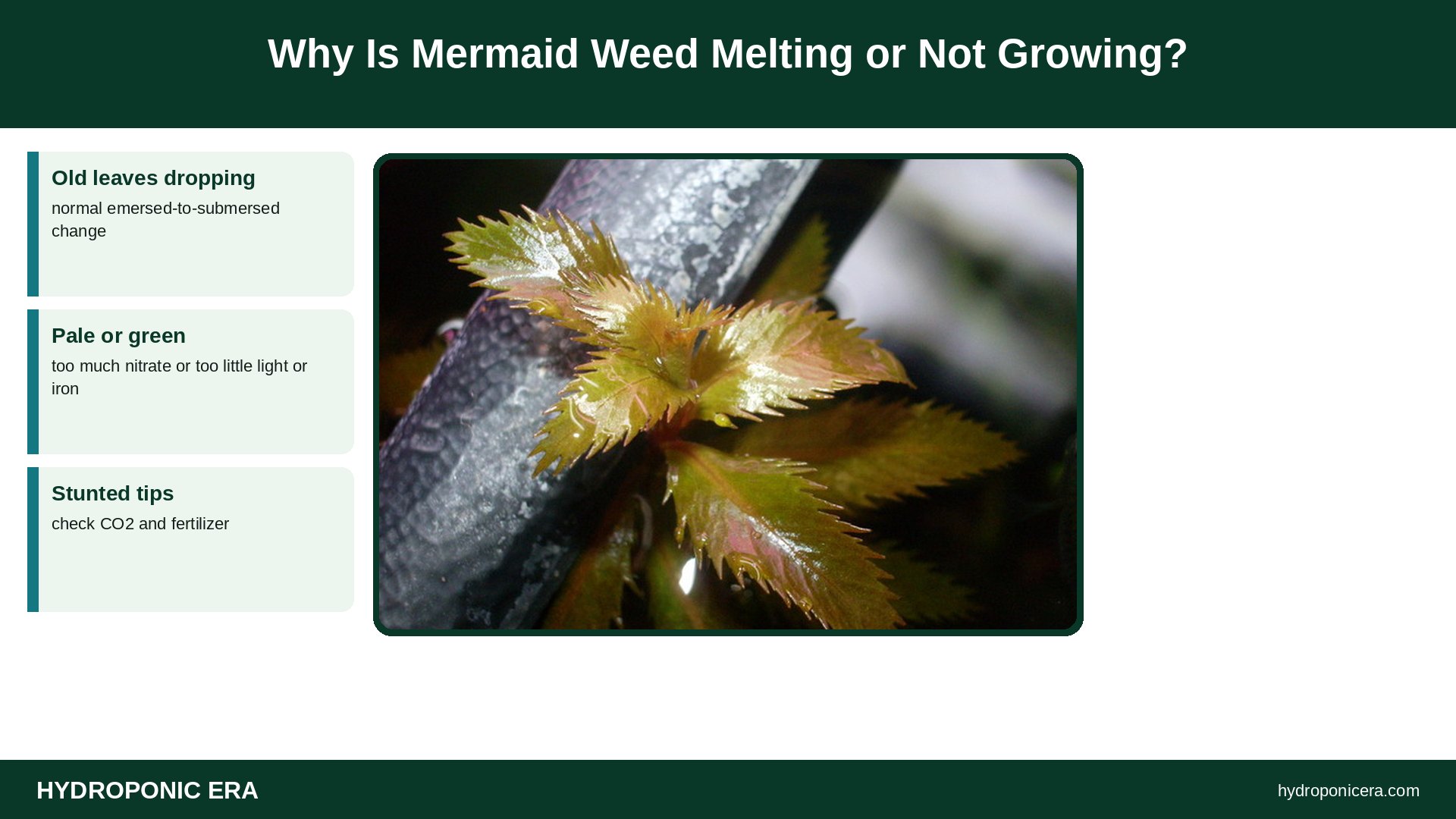
Usually it is still adjusting or lacks light, CO2 or iron. Flowgrow notes the plant takes time to move from its emersed green form to its underwater orange-red form, so some old leaves may drop. Plants that stay green or stall often needs brighter light, more CO2, or a lower nitrate level.
- Old leaves dropping: normal emersed-to-submersed change.
- Pale or green: too much nitrate or too little light or iron.
- Stunted tips: check CO2 and fertilizer.
- Too warm: Flowgrow lists a tolerance up to 82°F (28°C).
Where Does Mermaid Weed Fit in an Aquascape?
Use it as a color accent in the midground. Flowgrow calls it an excellent choice for smaller aquariums because it neither grows very tall nor very fast, and says it works in the midground or foreground as an eye-catcher. Tropica shows it in layouts from about 7 to 79 gallons (25 to 300 liters).
- Contrast: its fine copper leaves stand out against broad green plants such as Staurogyne repens.
- Group stems: a cluster of five or more reads better than a single stem (our view).
- Keep it in light: do not let taller background stems shade it.
- Nano tanks: its slow growth means fewer trims.
Because the ‘Cuba’ form is grown in tissue culture cups by Tropica, it arrives pest- and algae-free, which is a good way to avoid snails and duckweed hitchhikers.
How Does Mermaid Weed Compare to Similar Red Stems?
It grows slower and stays finer than most red stems. Flowgrow says it is not a fast grower and forms few side shoots, so it needs less trimming than fast Rotala species. The trade-off is that it demands strong light and CO2 to color up. Below is a quick comparison based on Tropica ratings and our experience.
- Rotala rotundifolia: faster, bushier, more forgiving.
- Ludwigia repens: broader leaves, easier in low tech tanks.
- Alternanthera reineckii: bolder red, larger leaves; see AR mini.
FAQ About Mermaid Weed
Is mermaid weed easy?
Flowgrow rates it medium difficulty.
Does it need CO2?
Tropica rates its CO2 need as high.
How tall does it get?
About 4–12+ in (10–30+ cm) in Tropica’s guide.
Why are the leaves different shapes?
Emersed leaves are saw-toothed; submersed are needle-like.
Where is it native?
Eastern and southeastern US, the Caribbean and Central America.
How do I make it redder?
More light, steady iron and lower nitrate.
Sources
- Tropica — Proserpinaca palustris ‘Cuba’
- Flowgrow Aquatic Plant Database — Proserpinaca palustris
- Photo credits (Wikimedia Commons, edited with titles): Proserpinaca palustris 001 by Rudi77 (CC BY-SA 3.0); Proserpinaca palustris 003 by Rudi77 (CC BY-SA 3.0)