
Is rotala easy to grow? Yes, if you start with Rotala rotundifolia. Tropica calls it relatively undemanding, with low light and CO2 needs, though it needs good light to turn red. It branches into bushy stems about 6–12 inches (15–30 cm) tall within two months. R. macrandra is harder and needs strong light, CO2 and soft water.
Key takeaway: Rotala is a group of fine-leaved stem plants loved for red and pink tips. R. rotundifolia is the easy starter, growing in low light but coloring best under strong light. Trim tops often so light reaches lower leaves, replant cuttings to thicken the group, and never release fragments, because USGS records it established in south Florida.
| Feature | R. rotundifolia | R. macrandra |
|---|---|---|
| Difficulty | Relatively undemanding | Demanding |
| Light demand | Low (red needs good light) | High |
| CO2 demand | Low | CO2 addition vital |
| Growth rate | Medium | Medium |
| Height after 2 months | 6–12+ in (15–30+ cm) | 8–12+ in (20–30+ cm) |
| Origin | Asia | Asia |
| Source | Tropica | Tropica |
What Is Rotala?
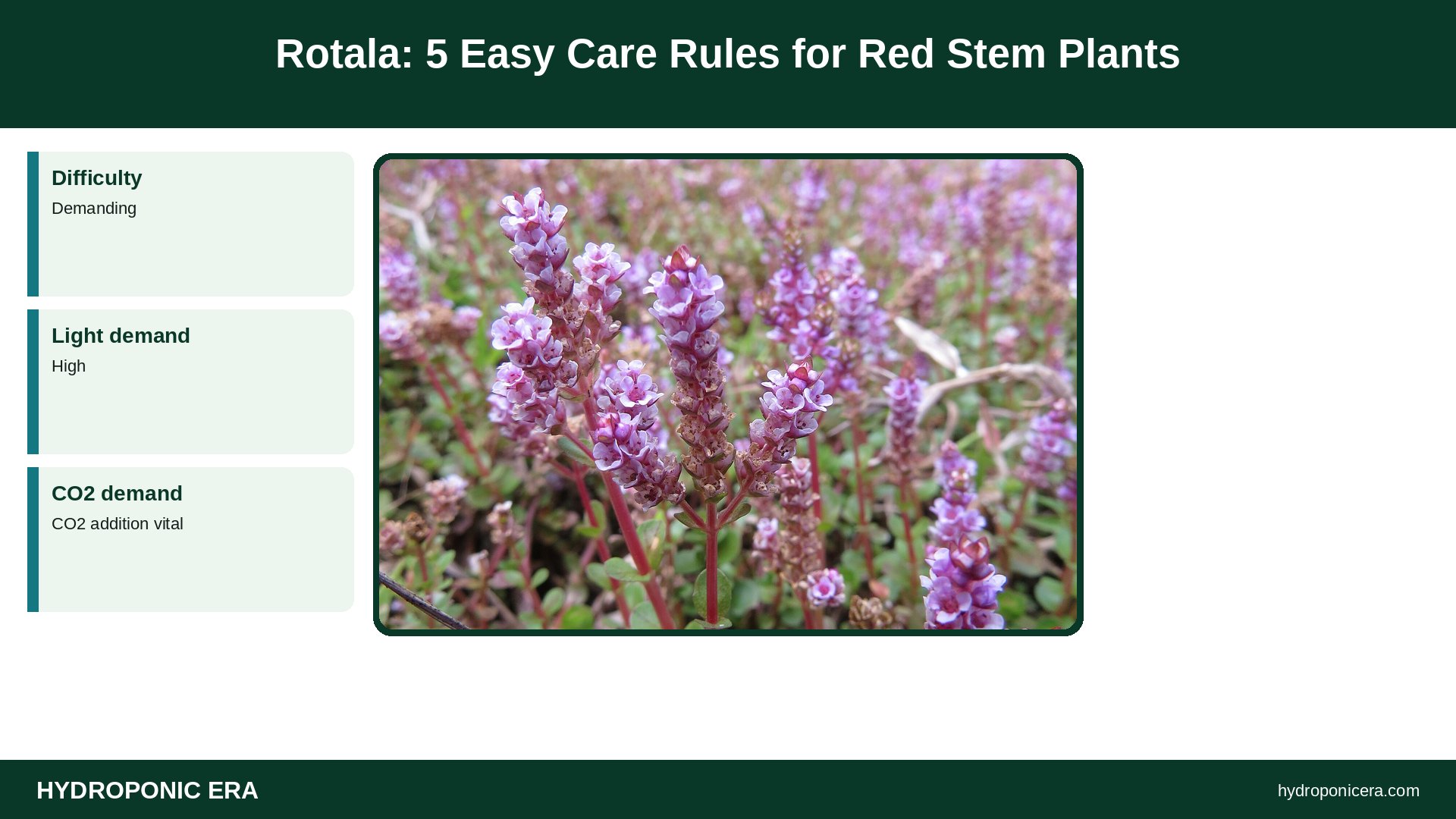
Rotala is a genus of stem plants in the loosestrife family, and the aquarium favorite is Rotala rotundifolia, also sold as R. indica. USGS says it comes from Southeast Asia, southern India and Japan. Its submerged leaves are thin, lance-shaped and up to about 0.8 inch (2 cm) long, green to reddish on top and red or purple beneath.
USGS notes the plant changes shape with conditions. Grown emersed, it has rounded, bright green leaves and can produce clusters of rose-colored flowers, which is how it earned the name roundleaf toothcup.
How Do You Get Rotala to Turn Red?
Rotala turns red mainly with strong light. Tropica says R. rotundifolia is undemanding but needs good light to produce red leaves, and that R. macrandra needs very good light, CO2 and soft water for its red shades. Under weak light, stems stay green and grow longer between leaf pairs.
- Place the stems under the brightest part of your aquarium grow light.
- Add CO2 if you want deep red tops; see our CO2 enrichment guide.
- Keep the stems free of shade from floating plants.
- Dose a balanced fertilizer that includes iron.

How Do You Trim Rotala?
Trim these stems often, because it branches heavily. Tropica says R. rotundifolia forms side shoots willingly and becomes compact and bushy, which makes it hard for light to reach the lower leaves, so it should be pruned frequently. For R. macrandra, Tropica advises cutting the longest stems 2–4 inches (5–10 cm) above the substrate and replanting them.
- Cut stems with sharp aquarium scissors just above a leaf pair.
- Replant the healthy tops in the gravel beside the group.
- Remove bare, leggy lower stems every few trims.
- Collect all floating bits so none reach the filter.
Like other stem plants, new roots form at the nodes; our plant node guide explains where to cut.
What Water Does Rotala Need?
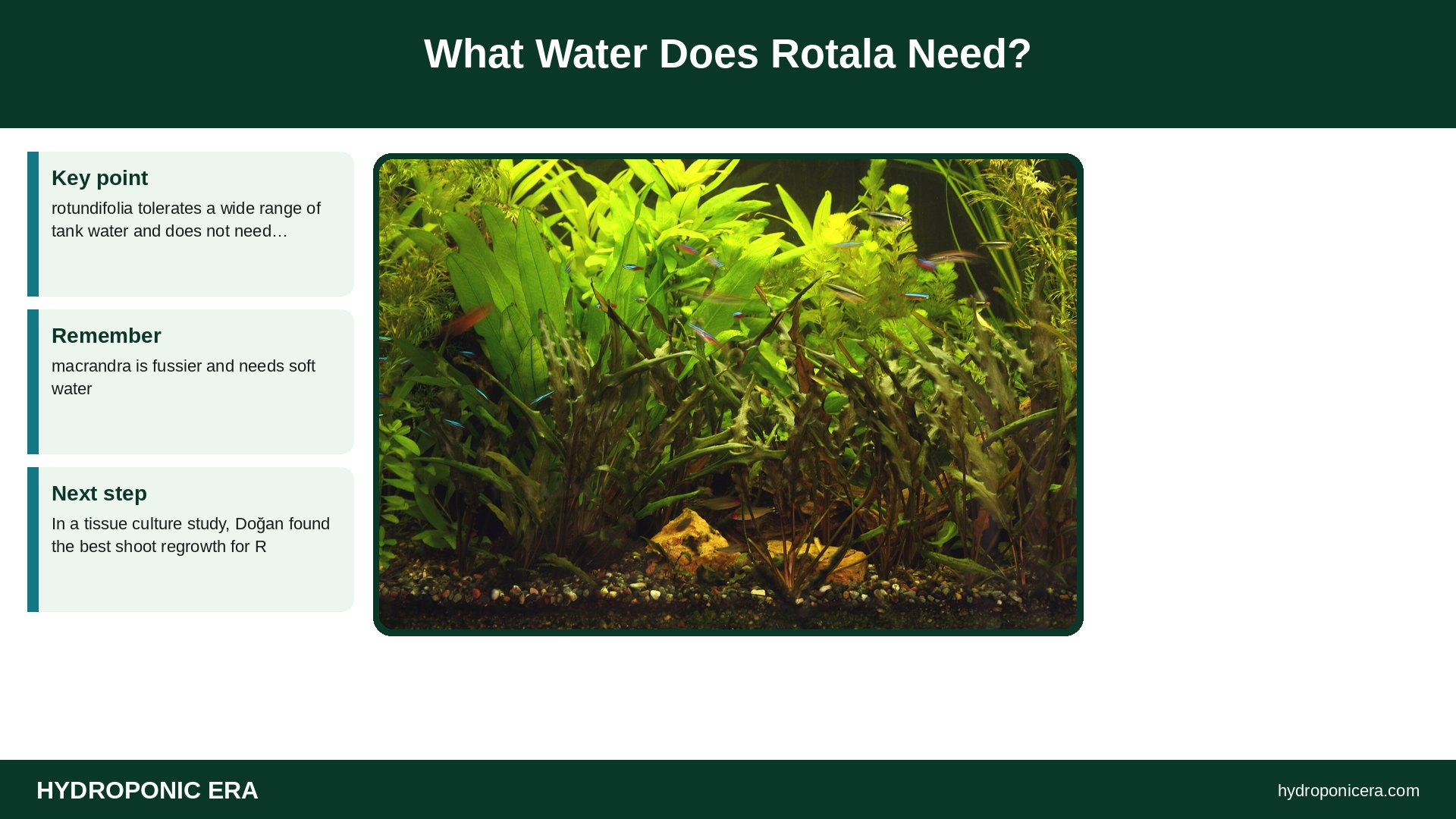
R. rotundifolia tolerates a wide range of tank water and does not need CO2 injection, per Tropica, which rates its CO2 need as low. R. macrandra is fussier and needs soft water. In a tissue culture study, Doğan found the best shoot regrowth for R. rotundifolia at 77°F (25°C) and pH 6, and the lab-grown shoots adapted well to aquariums.
- Aim for a stable temperature in the mid-70s °F (about 24–25°C).
- Keep pH slightly acidic to neutral for best growth.
- Test hardness with our GH and KH water tests guide.
How Fast Does Rotala Grow?
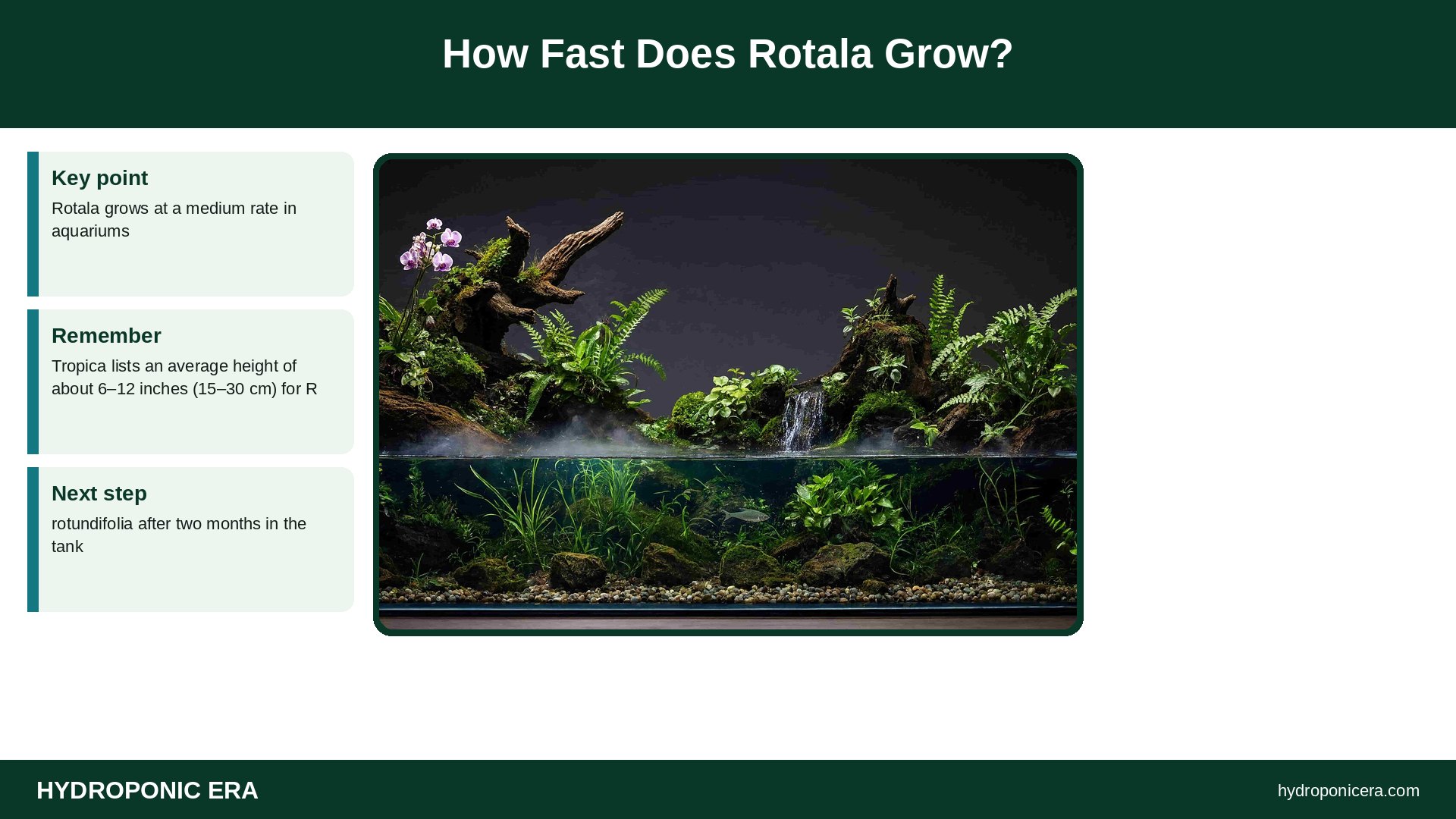
Rotala grows at a medium rate in aquariums. Tropica lists an average height of about 6–12 inches (15–30 cm) for R. rotundifolia after two months in the tank. In the wild it can be far larger: USGS reports submerged colonies more than 6.5 feet (2 m) high that reach the surface and form thick mats.
Growth speeds up with stronger light, CO2 and regular feeding, and slows in dim, unfertilized tanks. Plan a trim every couple of weeks in a bright tank. In a dim tank without added CO2, expect slower, greener growth with more space between leaf pairs, which is normal and not a sign of disease.
Which Plants Pair Well With Rotala?
Plant it in the midground or background, where its fine leaves contrast with broad-leaved plants in front. Slow, low-light plants such as anubias and java fern sit well at the base because they tolerate the shade cast by a dense stem group. Keep fast floaters thin so they do not steal light from the red tops. Small schooling fish such as tetras and rasboras look striking against a dense red-and-green stem background.
Is Rotala Invasive?
R. rotundifolia can become invasive outdoors. USGS says it is established in south Florida, likely eradicated in Alabama, and spreads from stem fragments that root at the nodes and from seeds. Dense mats shade other plants and can block canals. Never dump trimmings or tank water into ponds, ditches or drains.
Does rotala need CO2?
R. rotundifolia does not. Tropica rates its CO2 need as low, though CO2 improves color. R. macrandra needs CO2.
Why is my rotala not red?
Usually low light. Tropica says R. rotundifolia needs good light to produce red leaves.
How tall does rotala get?
About 6–12 inches (15–30 cm) after two months, per Tropica, so trim it to keep it below the surface.
Can rotala grow out of water?
Yes. USGS describes an emersed form with rounded leaves and pink flowers.
Is rotala good for beginners?
R. rotundifolia is. Tropica calls it relatively undemanding compared with other species in the genus.
Sources
- Tropica Aquarium Plants. Rotala rotundifolia/4447).
- Tropica Aquarium Plants. Rotala macrandra/4445).
- USGS Nonindigenous Aquatic Species. Roundleaf toothcup (Rotala rotundifolia) Species Profile.
- Doğan, M. (2019). The effect of different temperature and pH on axillary shoot regeneration of Rotala rotundifolia. Türk Tarım ve Doğa Bilimleri Dergisi.
- Photo credits (Wikimedia Commons, edited with titles): Rotala rotundifolia by Vinayaraj (CC BY-SA 3.0); Rotala SN68AJG by Kk70088 (CC BY-SA 4.0); Planted Tank 03 – Flickr – The Wandering Angel by The Wandering Angel from Makati City, Philippines (CC BY 2.0); Nature Aquarium Aquascape by Dileepkumardr (CC0)