
Is LECA better than bark for orchids? Neither wins outright. In the LECA vs orchid bark choice, the American Orchid Society calls fir bark the most popular orchid medium, while orchid growers note LECA clay pebbles never decompose or compact. Bark holds more water but breaks down in 18 to 24 months; LECA is reusable but needs steady feeding.
Key takeaway: The LECA vs orchid bark debate comes down to how you water and how long you want between repots. Fir bark is the traditional standard, and LECA (lightweight expanded clay aggregate) is the base of semi-hydroponic culture. This guide compares both using American Orchid Society articles, the St. Augustine Orchid Society and Oklahoma State Extension.
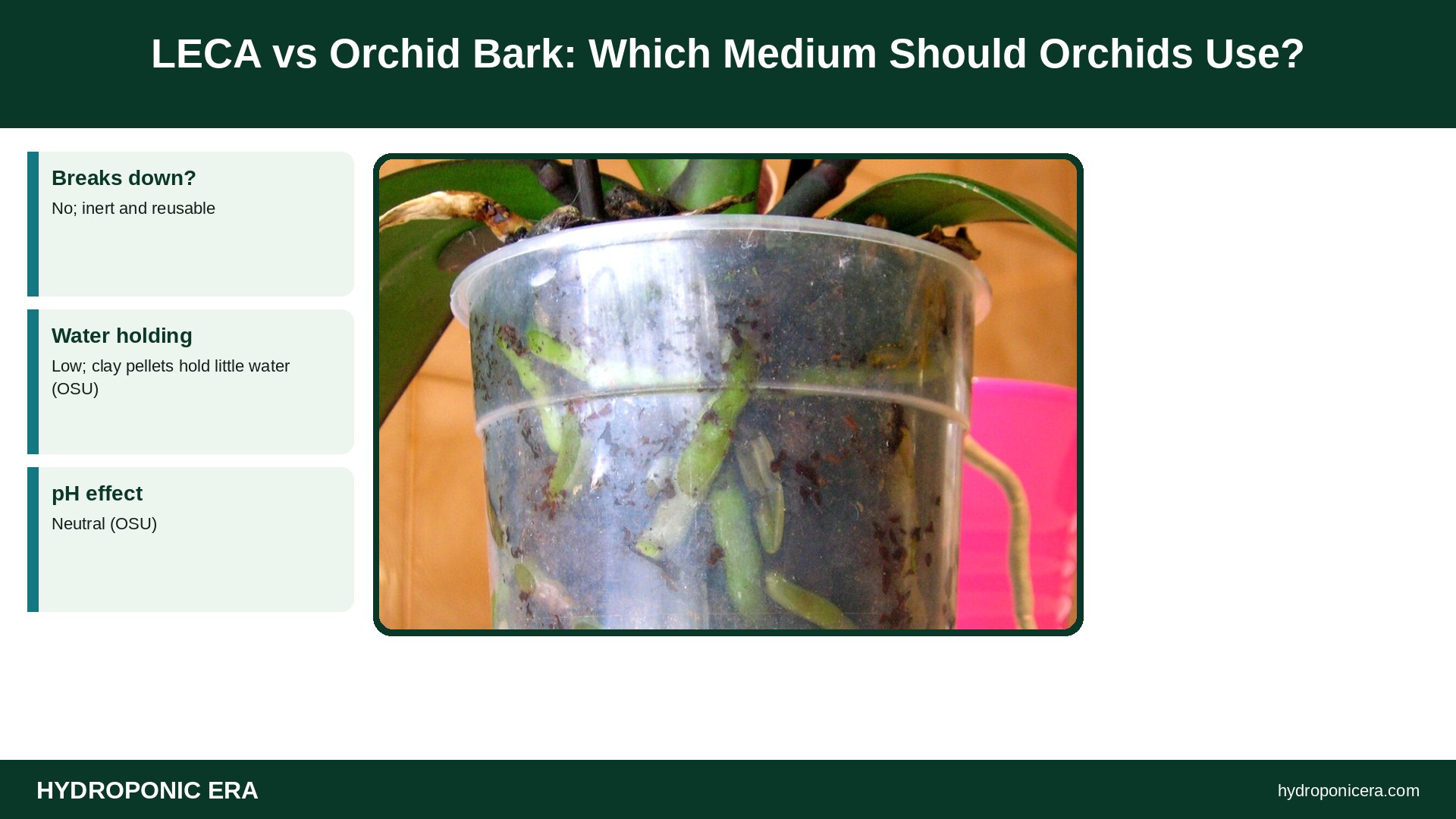
| Factor | LECA (Clay Pebbles) | Orchid Bark |
|---|---|---|
| Breaks down? | No; inert and reusable | Yes; most last 18 to 24 months |
| Water holding | Low; clay pellets hold little water (OSU) | Moderate, rising as it decays |
| pH effect | Neutral (OSU) | Acidic; can drop further with pure water |
| Cost | Higher upfront (OSU) | Low |
| Best watering style | Reservoir or frequent watering | Water, then let drain |
| Nutrients | Supplies almost none | Supplies almost none |
| Repotting | When roots or plant outgrow pot | Every 1 to 2 years as bark decays |
Is LECA Better Than Bark for Orchids?
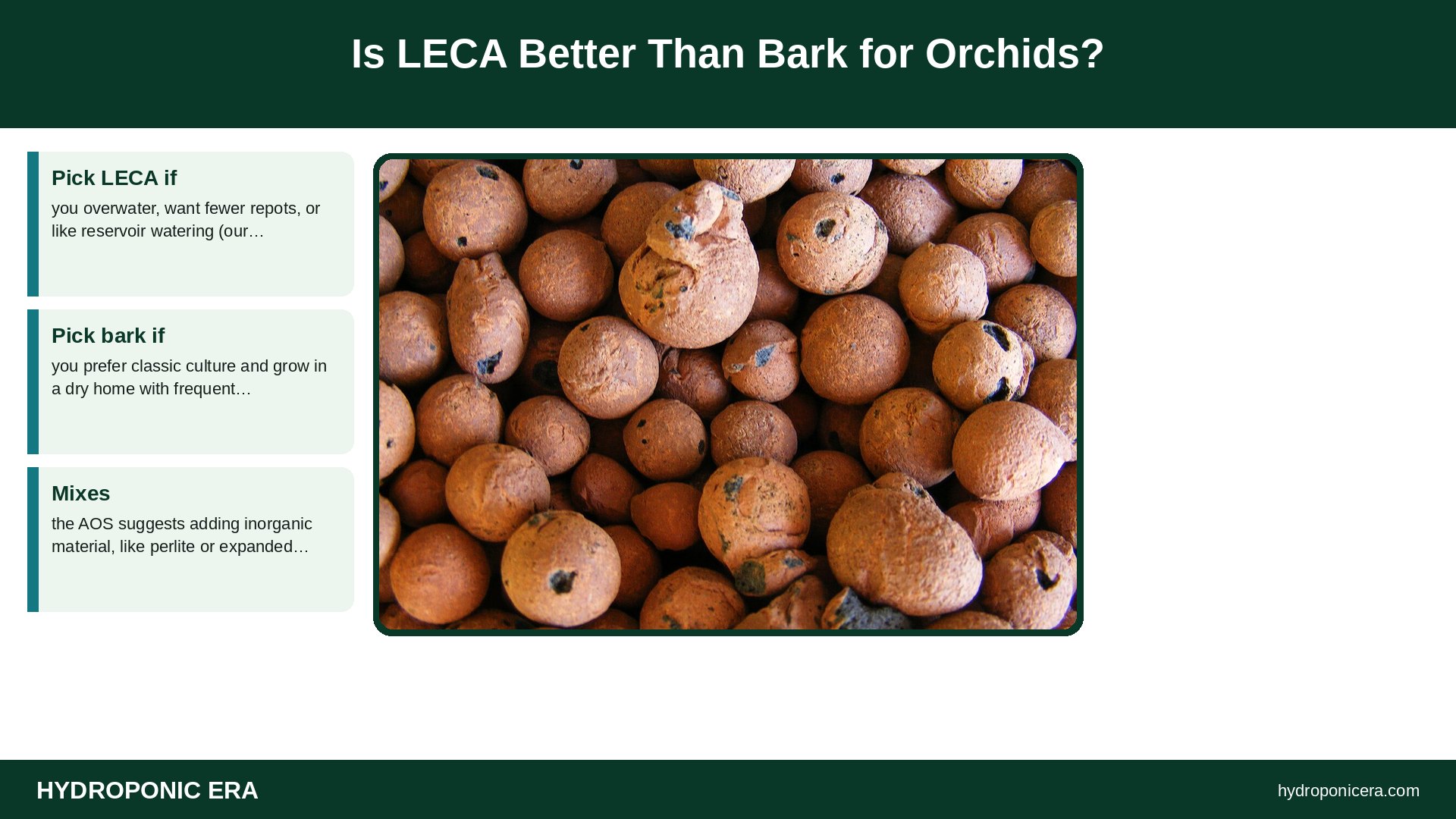
In LECA vs orchid bark, the answer depends on your habits. The American Orchid Society says fir bark has been the reigning orchid medium for 40 years because it is cheap, drains well and is easy to use. The St. Augustine Orchid Society notes clay pebbles do not decompose, compact or suffocate roots, and are often used in semi-hydroponic culture for many orchids.
- Pick LECA if: you overwater, want fewer repots, or like reservoir watering (our guidance).
- Pick bark if: you prefer classic culture and grow in a dry home with frequent watering.
- Mixes: the AOS suggests adding inorganic material, like perlite or expanded shale, to bark to get the best of both.
- No perfect mix: AOS writer Ray Barkalow says no single medium is perfect for every plant.
How Do You Switch an Orchid From Bark to LECA?
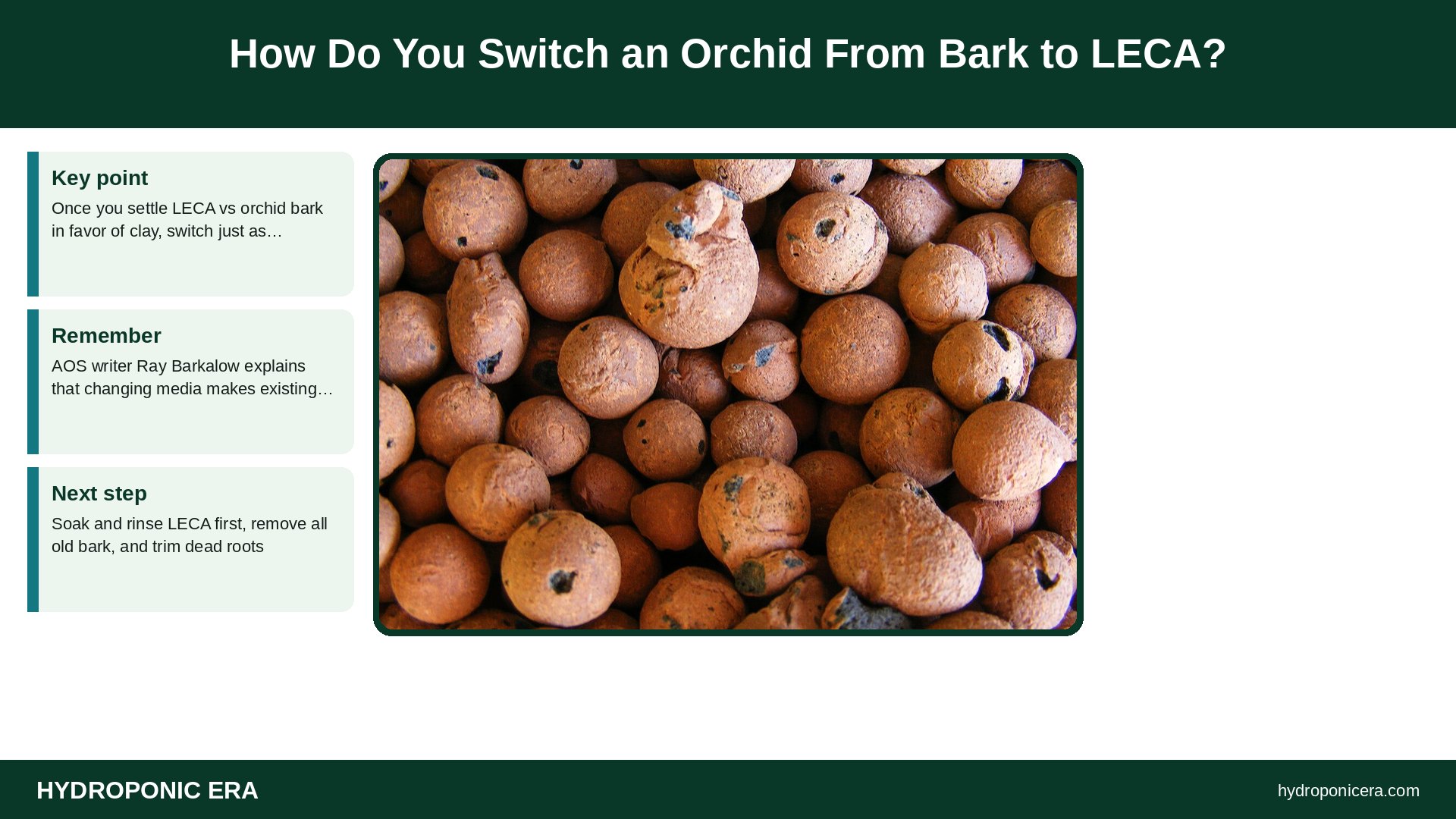
Once you settle LECA vs orchid bark in favor of clay, switch just as new roots start to grow. AOS writer Ray Barkalow explains that changing media makes existing roots poorly suited to the new conditions, so the best time to repot is when fresh roots emerge from the base. Soak and rinse LECA first, remove all old bark, and trim dead roots.
- Rinse LECA until water runs clear, then soak it overnight (our guidance).
- Unpot the orchid and wash away every bark chip.
- Trim mushy or hollow roots with sterile scissors.
- Set the plant in a slotted pot and fill around roots with LECA.
- Keep a small reservoir of 1/2 to 1 in (1.3 to 2.5 cm) below the roots (our guidance).
See our semi-hydroponics with LECA guide for more setup detail. In LECA vs orchid bark trials at home, change one plant first and watch it for a few months (our guidance).
Which Orchids Dislike LECA or Semi-Hydro Culture?
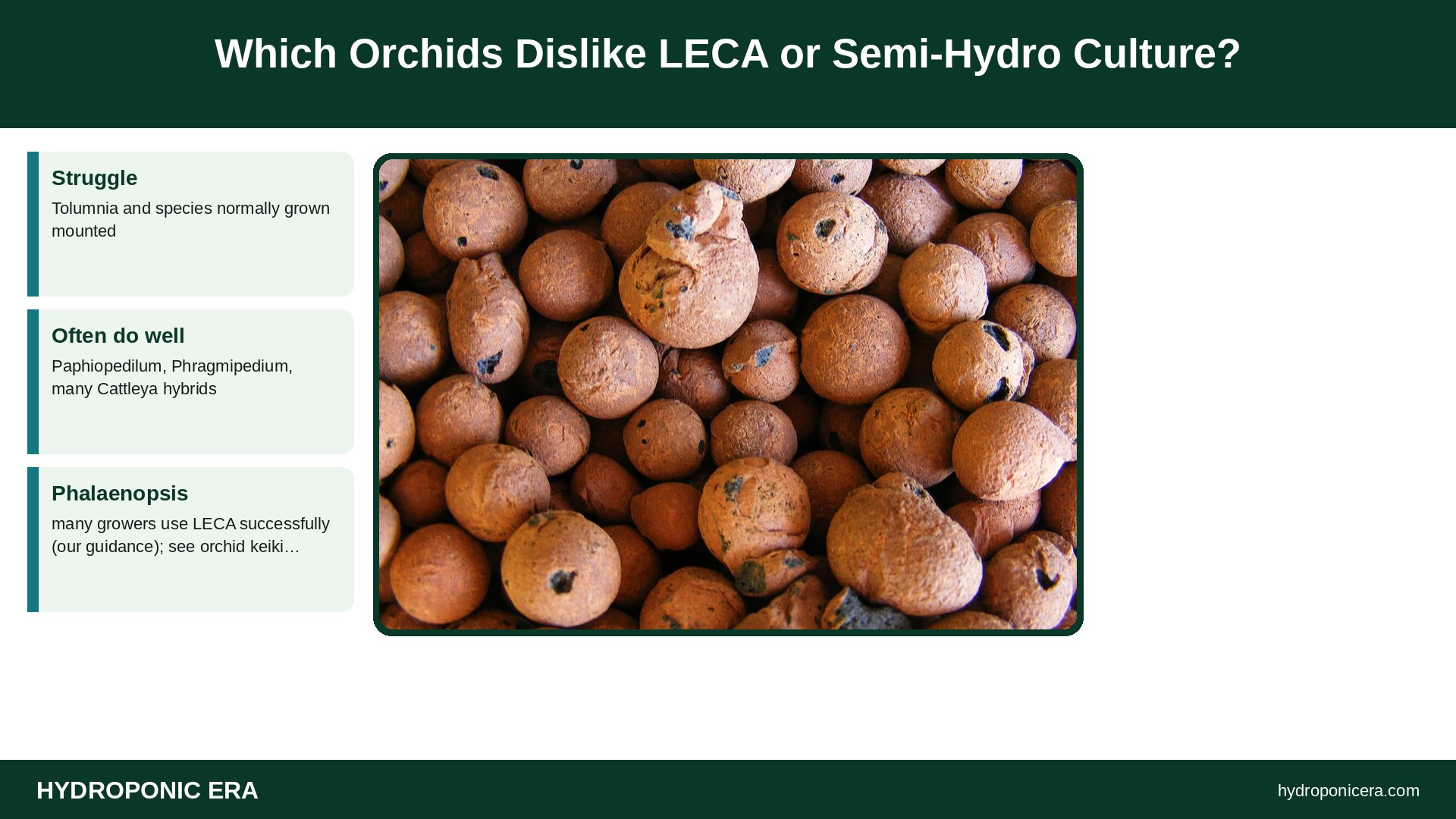
Orchids that need to dry fast tend to struggle, which matters in any LECA vs orchid bark decision. In an AOS article, long-time grower Katherine Weitz reports that her Tolumnia orchids all died in non-draining pots, while Paphiopedilum, Phragmipedium and most Cattleya hybrids did well. She adds that species described as best grown mounted will likely not do well in pots that drain slowly.
- Struggle: Tolumnia and species normally grown mounted.
- Often do well: Paphiopedilum, Phragmipedium, many Cattleya hybrids.
- Phalaenopsis: many growers use LECA successfully (our guidance); see orchid keiki for propagation.
- Watch for: black, mushy roots, a sign the medium stays too wet, per the AOS.
How Do You Water and Feed Orchids in LECA vs Bark?
Feeding is a key LECA vs orchid bark difference. LECA holds almost no nutrients, so feed lightly but often. Ray Barkalow recommends a weekly solution with about 75 to 125 ppm nitrogen. Flush LECA pots every few weeks with plain water to remove salts (our guidance). Bark dries unevenly and is hard to wet at first, so the AOS suggests soaking new bark overnight before potting.
- LECA: top up the reservoir; flush regularly.
- Bark: water thoroughly, then let excess drain.
- Old bark: holds more water as it decays and can turn very acidic, per the St. Augustine Orchid Society.
- Fertilizer: see fertilizer for orchids in water.
What Does Each Medium Cost Over Time?
Cost also shapes LECA vs orchid bark. Oklahoma State Extension rates expanded clay as high in cost but reusable, while pine bark is low cost but short-lived. Since LECA can be washed and reused for years, its long-term cost evens out (our guidance). Bark needs replacing every repot, and Sue Bottom notes most barks resist breakdown for at least 18 to 24 months.
- LECA: buy once; sterilize between plants (our guidance).
- Bark: cheap per bag but replaced regularly.
- Related media: see clay pebbles for hydroponics and water culture orchids.
For most beginners weighing LECA vs orchid bark, start with bark for blooming store-bought plants and test LECA on one orchid (our guidance).
Which Should You Choose: LECA vs Orchid Bark?
Choose by your watering style, climate and patience. If you water often and live in a dry home, bark is forgiving and cheap. If you forget to water or tend to overwater, LECA with a small reservoir gives steadier moisture (our guidance). Either way, healthy roots matter more than the medium.
- Busy or forgetful: LECA.
- Classic, low cost: bark.
- In between: a bark mix with perlite or clay, as the AOS suggests.
Keep notes on root color and new growth so your LECA vs orchid bark test gives a clear answer (our guidance).
FAQ About LECA vs Orchid Bark
For Phalaenopsis, which wins in LECA vs orchid bark?
Both work; LECA suits growers who overwater.
Does LECA cause root rot?
Not if roots sit above the reservoir.
How long does orchid bark last?
Most barks last 18 to 24 months.
Do I need special fertilizer in LECA?
Use a balanced orchid feed, lightly and often.
Can I mix LECA and bark?
Yes; the AOS endorses adding inorganic media to bark.
When should I switch an orchid to LECA?
When new roots are starting to grow.
Sources
- American Orchid Society — Beginner’s Series Part 2: Media Mania Revisited
- American Orchid Society — Orchid Growing in a Nutshell (Ray Barkalow)
- American Orchid Society — A New Way to Grow Orchids (Katherine Weitz)
- St. Augustine Orchid Society — Orchid Potting Media (Sue Bottom)
- Oklahoma State University Extension — Soilless Growing Mediums (HLA-6728)
- Photo credits (Wikimedia Commons, edited with titles): Tiesto transparente phalaenopsis by Javier Mediavilla Ezquibela (CC BY 2.5); Hydroton by Lucis (CC BY-SA 3.0)