
Can you root citronella cuttings in water? Yes, but slowly and with some rot risk. Citronella cuttings in water root from a node on a 3 to 5 in (8 to 13 cm) stem tip with the lower leaves removed. Let the cut end dry a few hours first. A moist rooting mix is usually faster and safer.
Key takeaway: The “citronella plant” or “mosquito plant” sold at garden centers is a scented geranium, Pelargonium ‘Citrosum’. Like other geraniums, it is easy to clone from stem tips. This guide uses Washington State, Arizona, Purdue e-GRO and Colorado State guidance to explain how citronella cuttings in water root, how long it takes and when to pot them.
| Step | Detail | Source |
|---|---|---|
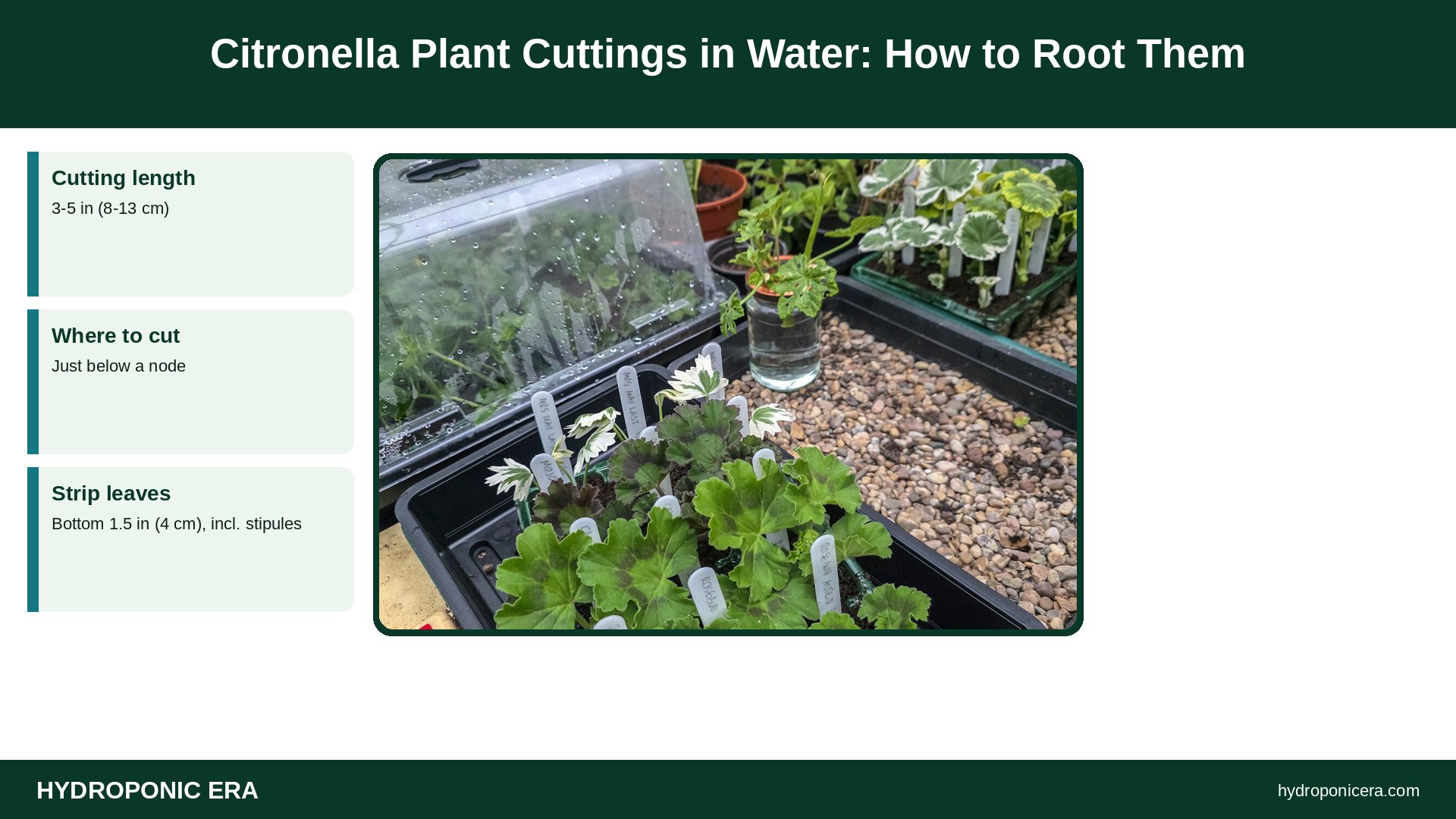
| Cutting length | 3-5 in (8-13 cm) | WSU PNW 151 |
| Where to cut | Just below a node | WSU PNW 151 |
| Strip leaves | Bottom 1.5 in (4 cm), incl. stipules | WSU PNW 151 |
| Before water | Let the cut end dry a few hours | WSU PNW 151 |
| Rooting time in a mix | 1-2 weeks (geranium) | WSU PNW 151 |
| Rooting time in water | About 2-4 weeks | Our guidance |
| Best temperature | 60-65°F (16-18°C) | WSU PNW 151 |
Can You Root Citronella Cuttings in Water?
Yes, with care. The University of Arizona’s propagation guide says most indoor plants root easily in plain water. Washington State’s PNW 151 adds a warning: some cuttings root in water, while others rot for lack of air. Geraniums sit near that line, so citronella cuttings in water need fresh water and a clean, dry-ended cut.
PNW 151 says plants with sticky sap, such as geraniums and cacti, do better if the cut end dries for a few hours before it goes into the rooting medium. That lets the wound seal and helps keep disease out.
- Take a 3 to 5 in (8 to 13 cm) tip from a healthy, non-flowering stem (PNW 151 gives the length).
- Cut just below a node, where roots form most readily.
- Strip leaves and the small stipules from the bottom 1.5 in (4 cm).
- Let the cut end dry for a few hours.
- Stand the stem in a small jar with 1 to 2 in (2.5 to 5 cm) of water, nodes under the surface (our guidance).
- Change the water every 3 to 4 days (our guidance).
PNW 151 also stresses disease-free stock, noting that geraniums can carry diseases not visible when cuttings are taken. Choose a clean, vigorous plant for citronella cuttings in water.
How Long Do Citronella Cuttings Take to Root?
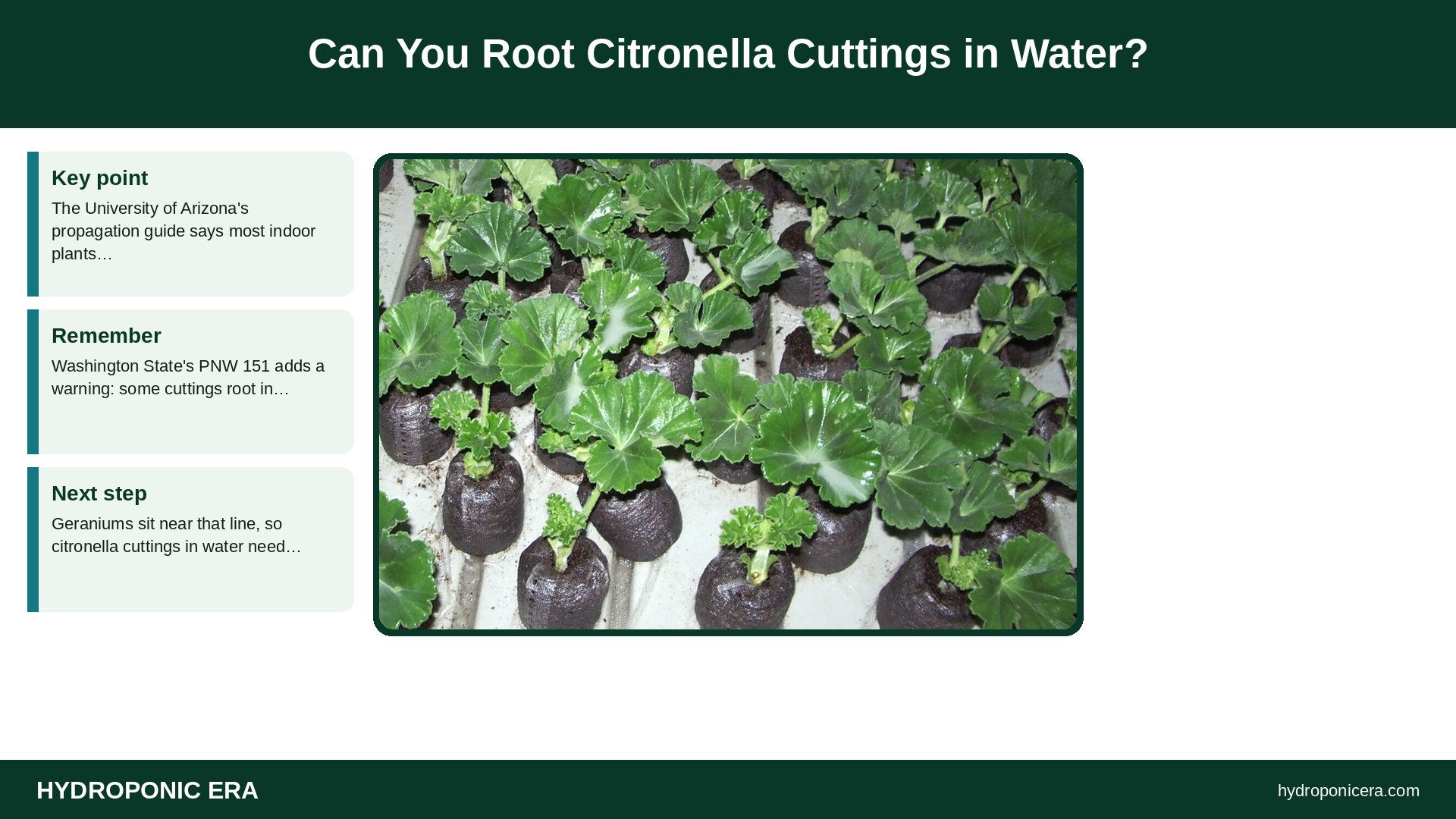
In a rooting mix, about 1 to 2 weeks. PNW 151’s table lists Pelargonium (geranium) stem cuttings at 1 to 2 weeks. Citronella cuttings in water are often slower; plan on about 2 to 4 weeks for roots 1 in (2.5 cm) long (our guidance).
- Warmth: PNW 151 says most plants root best at about 60 to 65°F (16 to 18°C), with bottom heat 5 to 10°F (3 to 6°C) warmer helping.
- Light: bright, indirect light; PNW 151 warns against direct sun on cuttings.
- Rooting hormone: e-GRO lists zonal geranium among crops that benefit from IBA rooting hormone; see rooting hormone for water propagation.
- No fertilizer yet: Arizona says a rooting medium should have little or no nitrogen fertilizer.
Slow or failing cuttings usually show a soft, dark base. Cut above the rot, let it dry and start again in fresh water or a mix (our guidance). Our how long water propagation takes guide compares timelines.
When Do You Move Rooted Citronella to Soil?
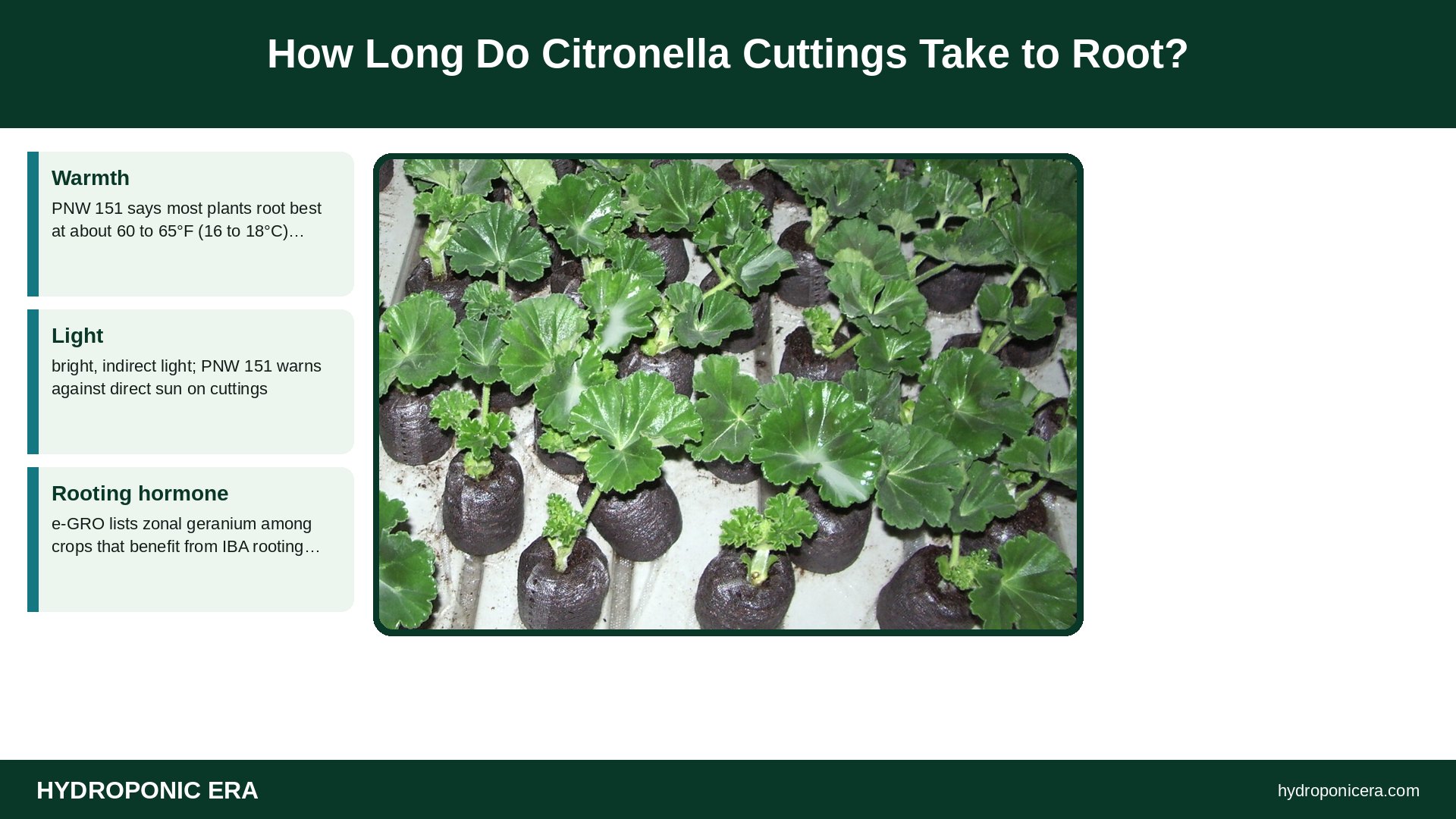
When roots are about 1 to 2 in (2.5 to 5 cm) long (our guidance). PNW 151 simply says to transplant the cutting to a permanent pot after roots form. Water roots are fragile, so move citronella cuttings in water before roots get long and tangled (our guidance).
- Use a 4 in (10 cm) pot with drainage and a light, well-drained potting mix (our guidance).
- Plant the stem at the same depth it sat in water.
- Water well, then keep the mix lightly moist for 1 to 2 weeks.
- Keep the pot in bright, indirect light for a week, then move it to sun.
After that, treat it as a normal scented geranium. Pinch the tips to make it bushy (our guidance). Bring pots indoors before frost, since it is tender (our guidance).
Is Water or a Rooting Mix Better for Citronella Cuttings?
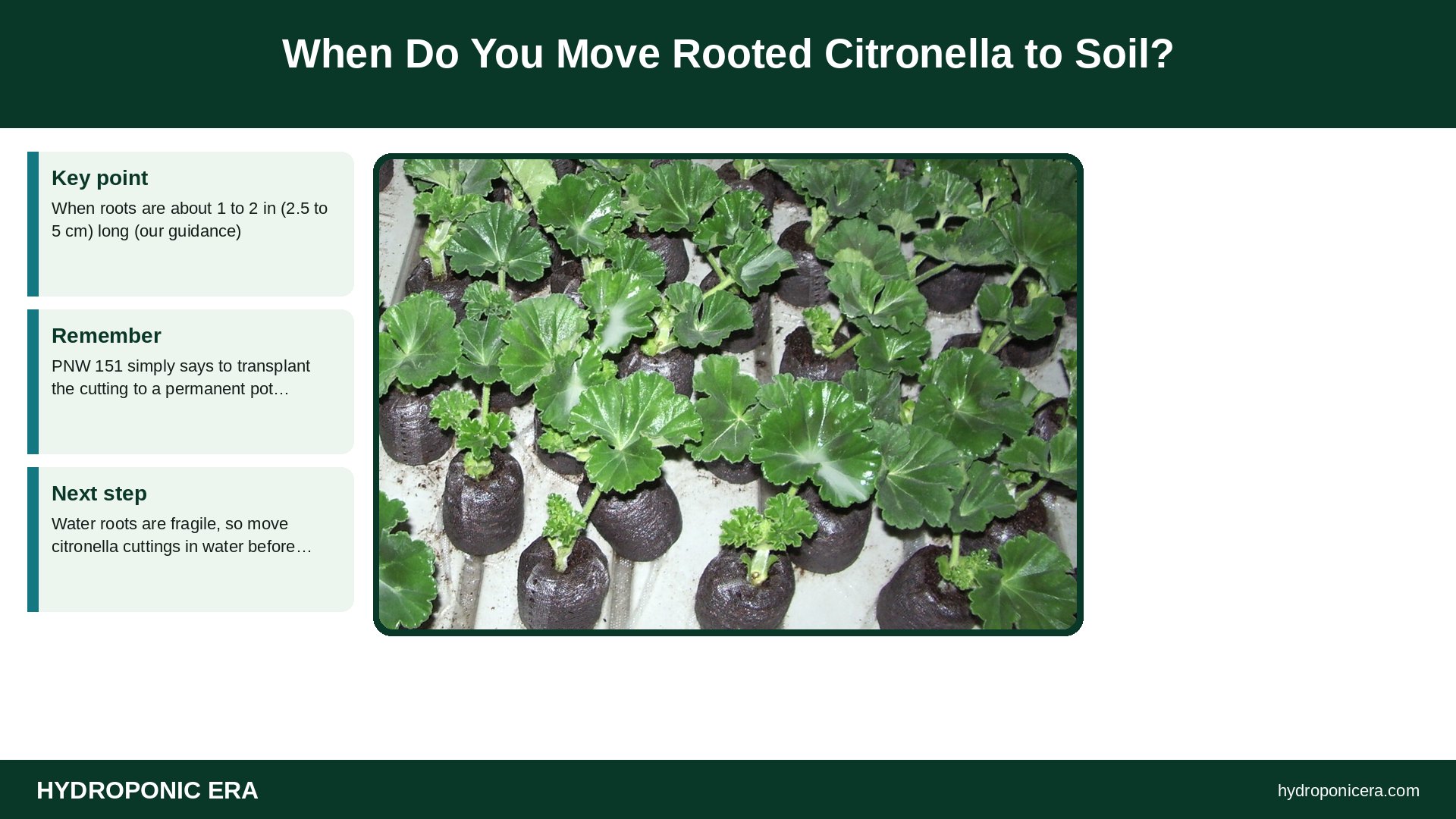
A mix is usually better. PNW 151 says water and moist sand can root cuttings but are not necessarily the best media. It recommends a mix with one part that holds water and one that gives large pores for air, such as peat with perlite. Our perlite propagation guide shows a simple setup.
Citronella cuttings in water are still worth trying, because you can watch roots form. Try both: put a few cuttings in water and a few in a mix (our guidance). The same method works for common geraniums; see geranium cuttings in water. For multiple jars, a propagation station keeps things tidy.
Does the Citronella Plant Repel Mosquitoes?
Not in any useful way. Colorado State University Extension says Pelargonium citrosum ‘Van Leenii’ is marketed as a “mosquito plant” and smells of lemon when leaves are crushed, but it does not contain citronella oil, the ingredient used in repellent sprays and candles. CSU says the best control is removing standing water and using a repellent with DEET. Grow citronella cuttings in water for a fragrant plant, not for bite protection.
FAQ About Citronella Cuttings in Water
How long do citronella cuttings in water take to root?
About 2 to 4 weeks (our guidance); 1 to 2 weeks in a rooting mix, per PNW 151.
Why are my citronella cuttings rotting in water?
Low oxygen and dirty water; dry the cut end first and change the water often.
Do I need rooting hormone?
No, but e-GRO lists zonal geranium among crops that benefit from it.
Can citronella cuttings in water stay there?
Not long term; pot them once roots reach 1 to 2 in (2.5 to 5 cm).
When is the best time to take cuttings?
PNW 151 says spring is easiest, but cuttings root year-round with warmth.
Is the citronella plant toxic to pets?
Scented geraniums can irritate pets; keep them out of reach (our guidance).
Sources
- Washington State University Extension — PNW 151: Propagating Herbaceous Plants from Cuttings (PDF)
- University of Arizona Cooperative Extension — Propagating Plants (PDF)
- e-GRO, Roberto Lopez (Purdue University) — Propagating Vegetative Cuttings (PDF)
- Colorado State University Extension — PlantTalk 1400-20: Do Plants Repel Mosquitoes?
- Photo credits (Wikimedia Commons, edited with titles): Taking pelargonium cuttings, 2 – geograph.org.uk – 8188774 by Jonathan Billinger (CC BY-SA 2.0); Pelargonium zonale rooted cutting 2005-12-15 by Blumenfischer (CC BY-SA 3.0)