
Here’s how to grow wasabi hydroponically: start with clean plantlets, keep the nutrient solution cool (about 54–59°F), give flowing, oxygen-rich water and heavy shade, and feed lightly. Wasabi hates heat. It’s a slow specialty crop; WSU Extension reports harvests at 16–20 months in traditional water beds.
| Question | Quick answer |
|---|---|
| Plant | True wasabi (Eutrema japonicum, also called Wasabia japonica) |
| Ideal water temperature | 54–59°F (WSU/PNW Extension) |
| Ideal air temperature | 54–59°F; damage risk above about 77–82°F |
| Water pH | About 6.0–7.0 in semi-aquatic systems (WSU) |
| Light | Shade; indoor research used modest light for 12 hours a day |
| Time to harvest | About 16–20 months for stems (WSU) |

Can You Grow Wasabi at Home Hydroponically?

Yes, if you can keep it cool. Washington State University’s Pacific Northwest Extension guide explains that wasabi thrives in cool, moist climates, is poorly adapted to many regions of the United States, and grows well along the coastal Pacific Northwest. In Japan, it’s traditionally grown in shaded beds of gravel with cold, flowing spring water.
The same guide notes that hydroponic greenhouse systems aren’t used in Japan and that no instructional literature existed at the time, yet some U.S. growers had used them successfully. Japanese research has since tested wasabi in nutrient solution systems. So learning how to grow wasabi hydroponically is realistic, but you’re working at the edge of the known.
What Is Real Wasabi, and Why Grow It?
WSU describes wasabi as a perennial in the mustard family, native to Japan, grown for its enlarged stem, which is 2–4 inches across and 6–12 inches long. Because it’s hard to grow, the guide says “fake” wasabi is common: a mix of horseradish, mustard, soy sauce and green food coloring. Fresh stems are prized, and the leaves and stalks can be pickled or dried.
A WSU “Dr. Universe” article makes the same point for kids: the green paste served with sushi is usually not real wasabi. That scarcity is a big reason people want to learn how to grow wasabi hydroponically at home.
What Conditions Does Wasabi Need?
| Factor | Target | Source |
|---|---|---|
| Water temperature | 54–59°F ideal; oxygen drops and growth slows when warmer | WSU |
| Air temperature | 46–64°F, ideal 54–59°F; heat damage and soft rot above 82°F | WSU |
| Solution temperature (indoor test) | 55°F (13°C) grew better than 68°F (20°C) | Gifu University |
| Air during the light period | Growth fell as air rose from 61°F to 77°F (16–25°C) | Gifu University |
| pH | 6.0–7.0 | WSU |
| Nutrient strength (indoor test) | EC 0.5 dS/m | Gifu University |
The pattern is clear: how to grow wasabi hydroponically is mostly about temperature and oxygen control. See reservoir temperature and dissolved oxygen.
What System Works Best for How to Grow Wasabi Hydroponically?
- Recirculating gravel or media bed. Closest to the traditional flowing-water bed. WSU describes a shaded Washington greenhouse built on a slope with water flowing through a gravel bed.
- Recirculating channel (NFT-style) with a chiller. Gifu University tested an indoor circulating hydroponic system under fluorescent lamps. See NFT basics.
- Ebb and flow. Gifu found an intermittent supply of warmer solution helped growth by improving oxygen at the roots.
- Avoid stagnant water. Warm, still water is the fastest path to rot.
In most U.S. homes, a reservoir chiller is what makes how to grow wasabi hydroponically possible in summer.
How to Grow Wasabi Hydroponically Step by Step
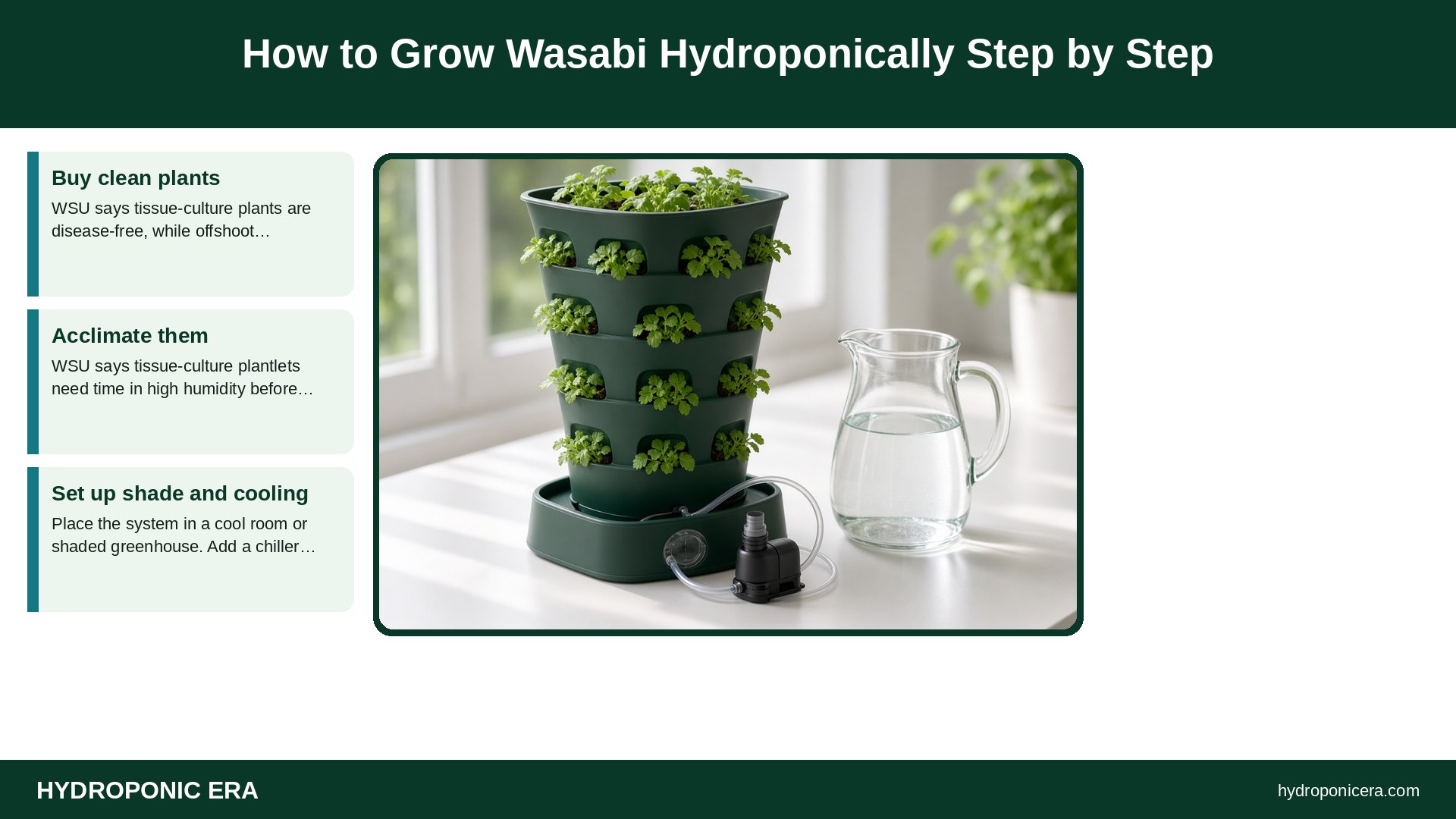
- Buy clean plants. WSU says tissue-culture plants are disease-free, while offshoot plantlets can carry disease. ‘Daruma’ and ‘Mazuma’ are the cultivars most often available.
- Acclimate them. WSU says tissue-culture plantlets need time in high humidity before transplanting.
- Set up shade and cooling. Place the system in a cool room or shaded greenhouse. Add a chiller if the water warms past the high 50s °F.
- Plant in inert media. Use gravel, clay pebbles or rockwool with the crown above the surface.
- Feed lightly. Gifu’s indoor test used a low EC of 0.5 dS/m. Keep pH around 6.0–7.0.
- Keep water moving. Circulate or cycle the solution so roots get oxygen.
- Be patient. Patience is the final skill in how to grow wasabi hydroponically. WSU suggests evaluating plants early in the second year, when stems approach harvest size.
How Long Does Hydroponic Wasabi Take?
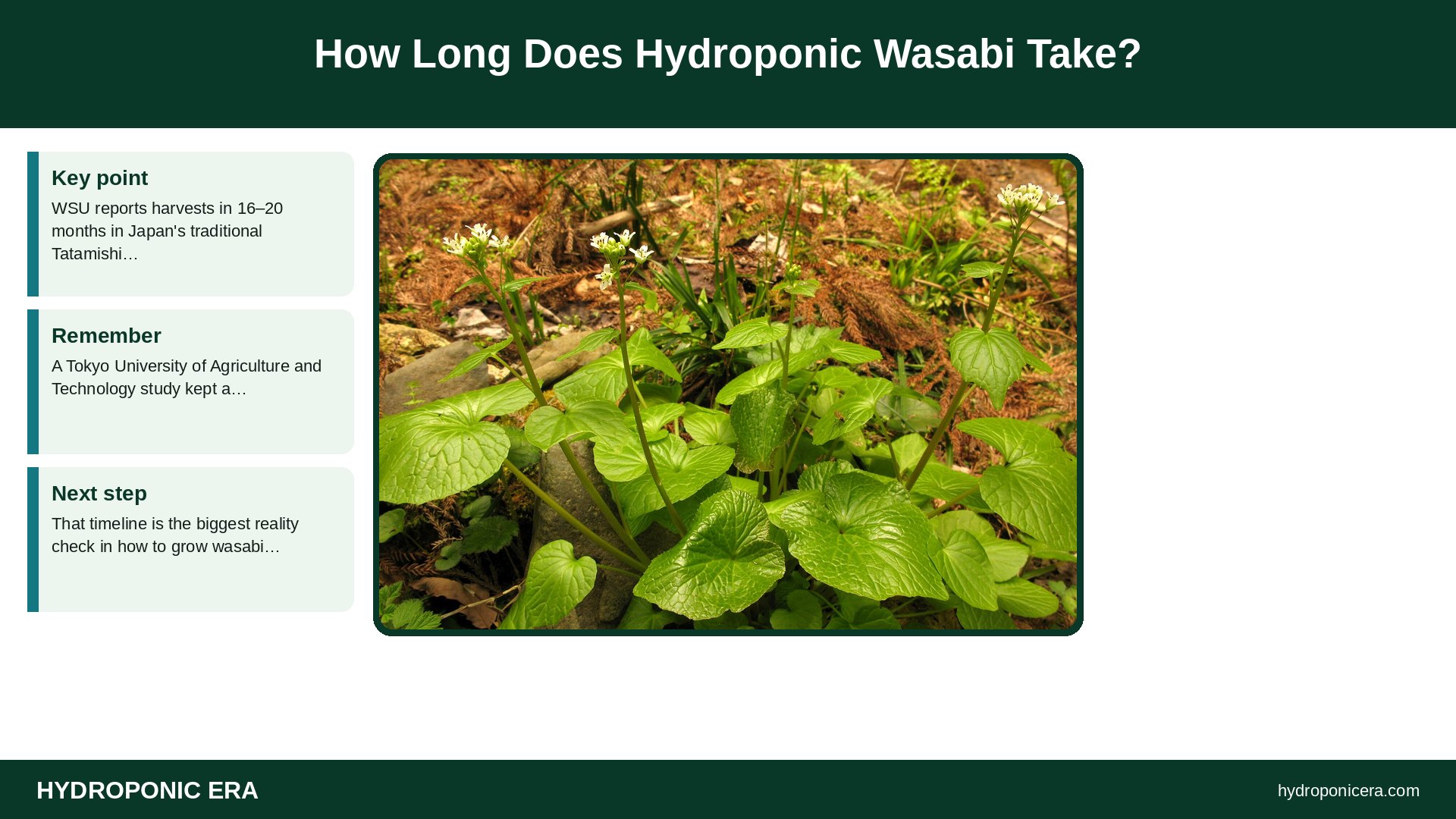
Plan on years, not weeks. WSU reports harvests in 16–20 months in Japan’s traditional Tatamishi water beds and says marketable stems should be about 6 inches long and 2 inches across. A Tokyo University of Agriculture and Technology study kept a nutrient solution system running year-round and found stems reached about 60 grams within two years.
That timeline is the biggest reality check in how to grow wasabi hydroponically. While you wait, you can harvest a few leaves and stalks.
How Do You Propagate More Wasabi?
WSU says each mother plant can produce up to 20 plantlets around the crown. Plantlets at least 1½ inches tall with 4–5 healthy leaves can be replanted at harvest. WSU suggests limiting this to about three generations, then restarting from disease-free tissue-culture plants or seed. Seeds are tricky: WSU says fresh seed is highly dormant, and one study found 41°F for two months worked best to break dormancy.
What Mistakes Happen When You Grow Wasabi Hydroponically?

| Mistake | Result | Fix |
|---|---|---|
| Warm reservoir | Low oxygen, slow growth, rot | Chill to the mid-50s °F |
| Direct sun or hot room | Leaf burn, soft rot (WSU) | Heavy shade, cool location |
| Stagnant water | Root decline | Circulate or use ebb and flow |
| Overfeeding | Salt stress | Low EC, around 0.5 dS/m |
| Ignoring pests | Aphid and slug damage (WSU) | Inspect weekly; see aphids and mites |
| Reusing sick plantlets | Disease buildup | Restart with tissue-culture plants |
Root rot is the biggest threat; see Pythium root rot. Most failures in how to grow wasabi hydroponically start with warm water.
FAQs: How to Grow Wasabi Hydroponically
Is it hard to learn how to grow wasabi hydroponically?
Yes. It needs cool water, shade and patience. If you can hold your solution in the mid-50s °F, it’s doable.
How long does it take to grow wasabi hydroponically?
About 16–20 months for full stems, based on WSU’s report from traditional water beds. Leaves can be picked sooner.
Can I learn how to grow wasabi hydroponically from grocery store stems?
WSU describes propagating from mature stems cut into pieces, but it requires careful sanitation and cool, humid conditions. Buying plantlets is easier.
Can wasabi grow indoors under LED lights?
Yes. Gifu University grew it indoors under artificial light at a modest intensity for 12 hours a day.
What’s a good first step in how to grow wasabi hydroponically?
Measure your water temperature for a week. If it stays above 60°F, plan for a chiller before buying plants. Watercress is an easier cool-water crop to practice with; see watercress.
Related HydroponicEra Guides
Sources
- Pacific Northwest Extension (WSU, OSU, UI) — Growing Wasabi in the Pacific Northwest (PNW0605, PDF)
- Environmental Control in Biology (Tokyo University of Agriculture and Technology) — Growth of Wasabi in a Nutrient Solution Cultivation System
- Shokubutsu Kankyo Kogaku (Gifu University) — Indoor Cultivation of Japanese Horseradish Using Artificial Light
- Washington State University — Dr. Universe: How Is Wasabi Made?
- Photo credits (Wikimedia Commons, edited with titles): Wasabia japonica 4 by Qwert1234 (CC BY-SA 3.0); Daio wasabi farm02c by 663highland (CC BY 2.5)