
Yes, you can use hydroponic nutrients in soil. They’re complete, water-soluble fertilizers, and plants take up the same mineral ions either way. The catch is that soil and potting mix already hold nutrients and trap salts, so full hydroponic strength fed every watering can cause salt buildup and tip burn. Follow any soil directions on the label, feed once or twice a week with plain water between, and leach pots every two to three months.
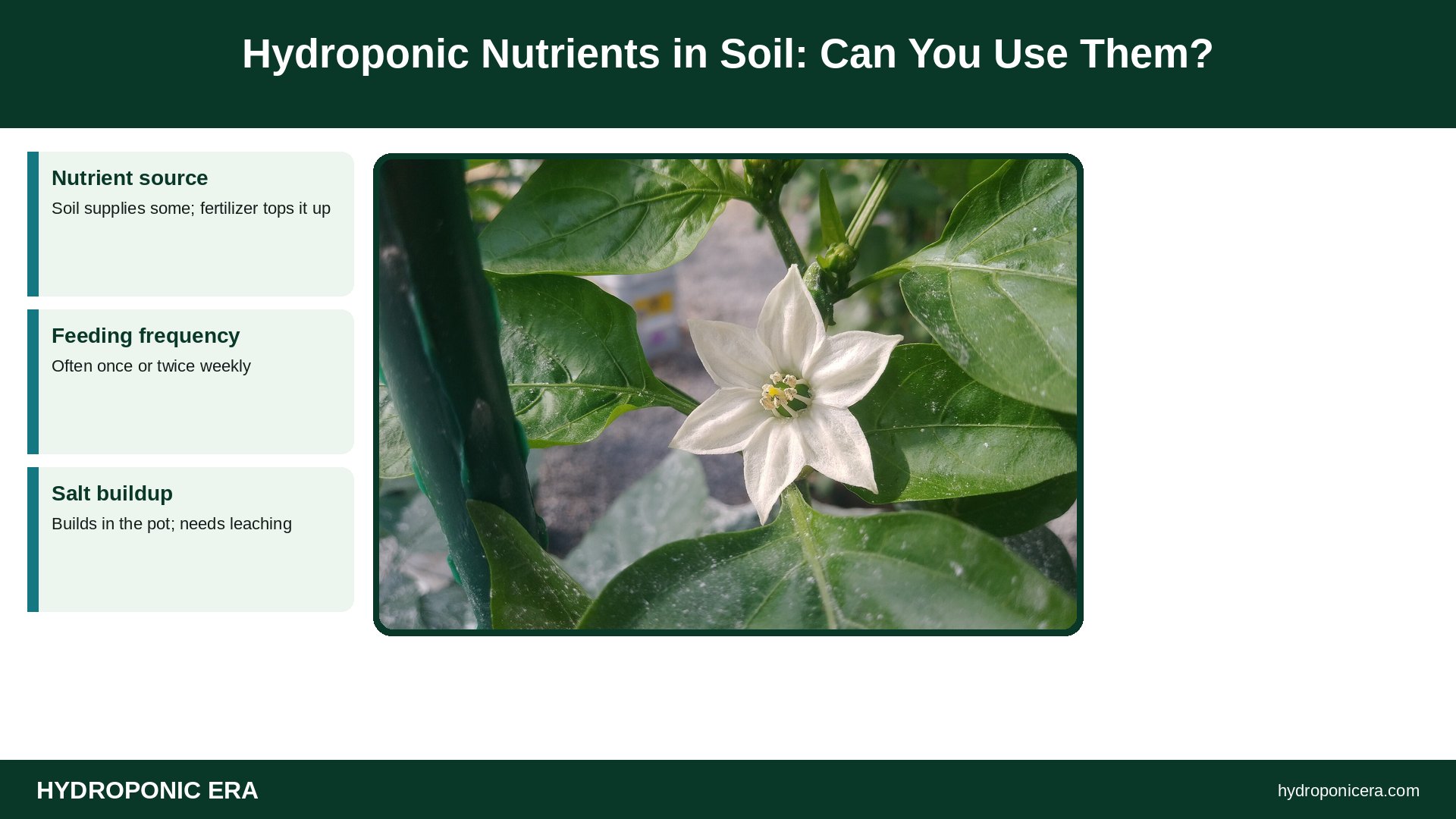
| Factor | Hydroponics | Soil or potting mix |
|---|---|---|
| Nutrient source | Solution supplies everything | Soil supplies some; fertilizer tops it up |
| Feeding frequency | Constant (every watering or continuous) | Often once or twice weekly |
| Salt buildup | Managed by reservoir changes | Builds in the pot; needs leaching |
| Main test | Reservoir EC and pH | Pour-through (leachate) EC and pH, or a soil test |
| Typical label example | MaxiGro: change reservoir weekly | MaxiGro: feed once or twice weekly, plain water between |
Why Hydroponic Nutrients in Soil Can Work

Roots absorb nutrients as dissolved ions, such as nitrate, potassium and calcium, whether those ions come from compost, granular fertilizer or a hydroponic bottle. Hydroponic nutrients are formulated to be complete, with macronutrients, secondary nutrients and micronutrients, because there’s no soil to fill gaps.
Some products say so directly. The General Hydroponics MaxiGro label states that “the Maxi Series is excellent for hydroponics as well as soil gardening,” and gives separate soil directions. Our MaxiGro feeding schedule guide covers those rates.
The Main Risk: Salt Buildup
UC Cooperative Extension explains that fertilizer dissolved in water “turns into a soluble salt,” and that when water evaporates from potting soil, “the salts stay behind.” Over time, roots absorb too much salt, leaves develop tip burn, and in severe cases root tips die and plants wilt and drop leaves.
In a hydroponic system, you dump the old solution and start fresh. In a pot, salts accumulate unless you flush them out. That’s the single biggest difference when using hydroponic nutrients in soil.
How to Use Hydroponic Nutrients in Soil: 7 Steps
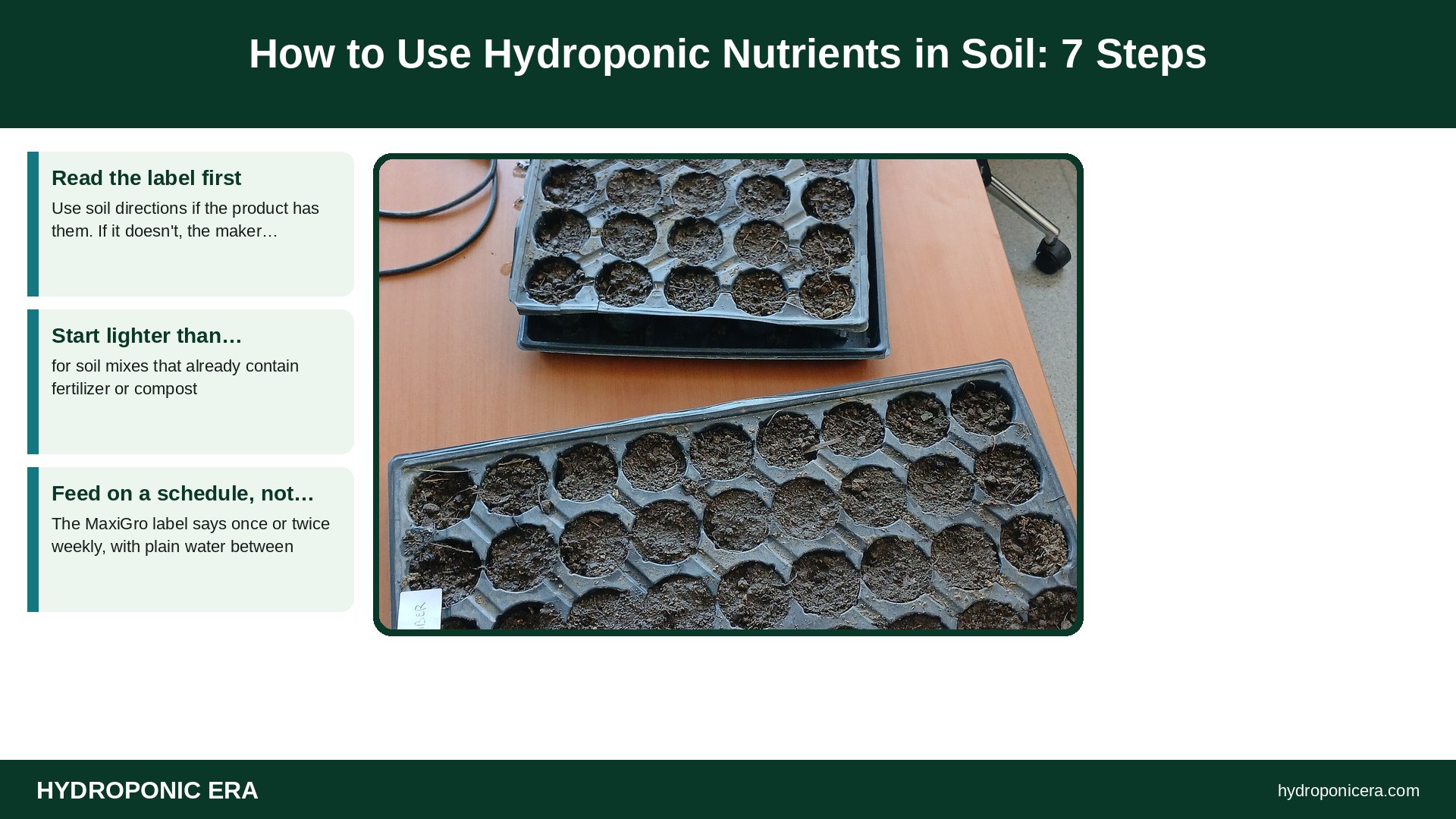
- Read the label first. Use soil directions if the product has them. If it doesn’t, the maker hasn’t given soil rates, so start conservatively.
- Start lighter than hydro strength for soil mixes that already contain fertilizer or compost.
- Feed on a schedule, not every watering. The MaxiGro label says once or twice weekly, with plain water between.
- Water until some drains out. UC advises watering enough that water exits the drain hole, then emptying the saucer.
- Never let pots sit in runoff. If drained water is reabsorbed, so are the salts.
- Leach every two to three months. Water thoroughly, wait about five minutes, then water again so excess flows out.
- Watch new growth. Pale leaves may need more feed; brown tips usually mean less.
Test Salts With the Pour-Through Method
Rutgers Cooperative Extension describes the pour-through method, developed at Virginia Tech, as a simple way to check container salts without disturbing roots:
- Water as normal and let pots finish draining.
- Wait 30 minutes to 2 hours, and use the same timing each test.
- Set the pot on a saucer that catches all runoff.
- Pour enough water on the surface to collect about 50 ml (2 fl oz) of leachate. Rutgers says about 150 ml (6 fl oz) for a 1-gallon pot and 350 ml (12 fl oz) for a 3-gallon pot is usually enough.
- Measure the leachate EC and pH, and test your plain water too for a baseline.
Rutgers cautions that interpretation guidelines come from a limited number of species and media, so track your own trend over time. Our runoff and leach EC guide explains how to read the numbers.
Hydroponic Nutrients in Soil vs Regular Fertilizer
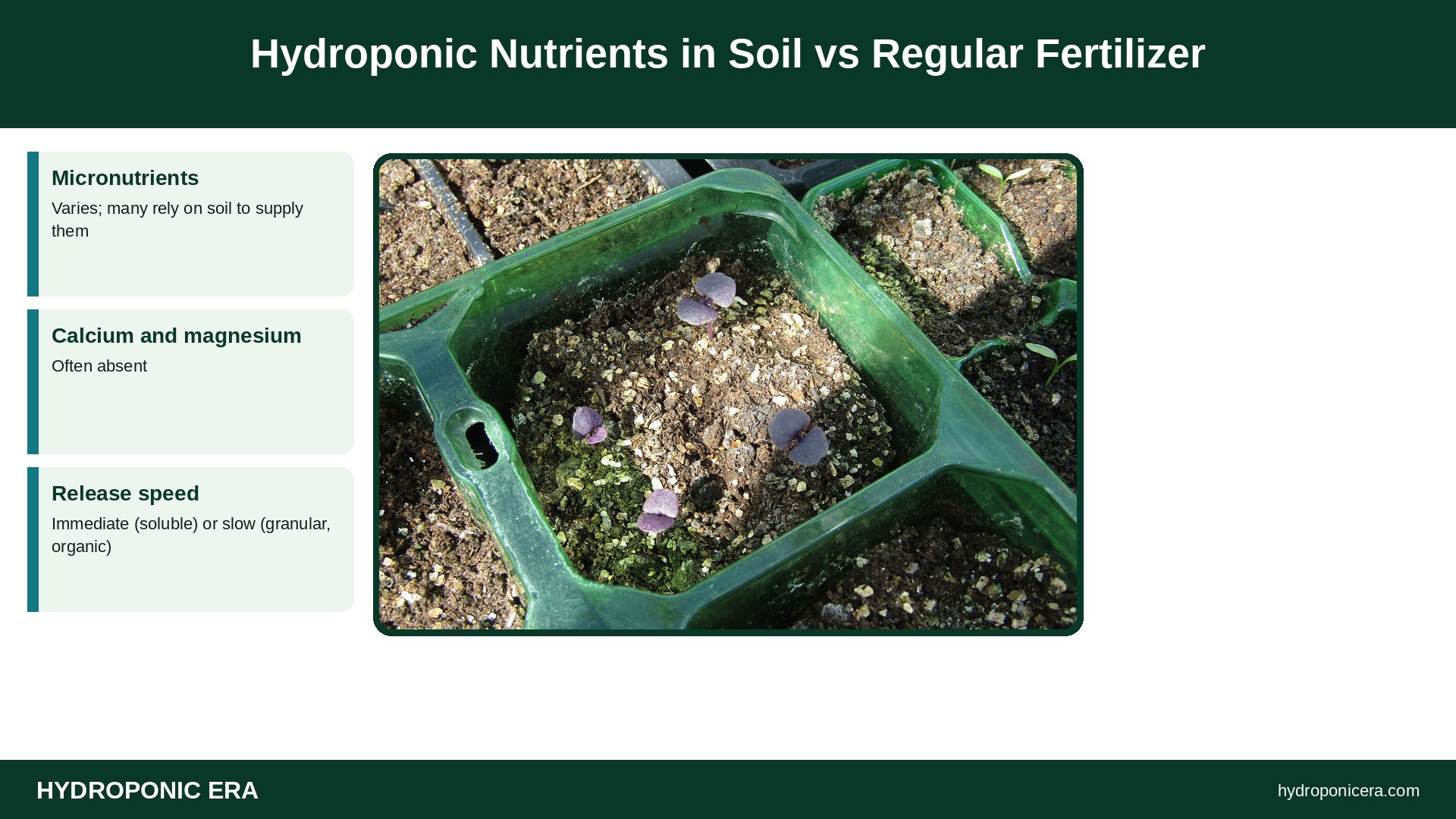
| Feature | Hydroponic nutrient | Typical soil fertilizer |
|---|---|---|
| Micronutrients | Usually complete | Varies; many rely on soil to supply them |
| Calcium and magnesium | Often included or in a separate part | Often absent |
| Release speed | Immediate | Immediate (soluble) or slow (granular, organic) |
| Cost per plant | Can be higher | Often lower |
| Best fit | Container plants, soilless mixes, coco | Garden beds and lawns |
Hydroponic nutrients in soil make the most sense for container plants and soilless mixes, which behave more like hydroponic media. In garden beds, a soil test and a regular fertilizer are usually simpler and cheaper.
pH: Don’t Copy Hydroponic Targets Blindly
Hydroponic growers often adjust solution pH to around 5.5–6.5. Soil and potting mix have their own buffering, and target ranges vary by crop and medium. Rutgers’ general guideline table for growing media lists a pH of 5–6 as adequate for ornamental production media; garden soils are best managed with a soil test. Don’t automatically acidify water for soil plants just because a hydroponic chart says so.
Where Hydroponic Nutrients in Soil Work Best
Hydroponic nutrients in soil suit some setups far better than others. Using hydroponic nutrients in soil makes the most sense here:
- Houseplants in peat or coco-based mixes: these mixes hold few nutrients, so a complete feed helps. Leach on schedule.
- Container vegetables: tomatoes, peppers and herbs in pots use a lot of nutrients during active growth.
- Seedlings moving from hydro to soil: keeping the same nutrient brand makes the switch less confusing.
- Leftover bottles: using up hydroponic nutrients in soil pots beats letting them expire on a shelf.
Be more cautious with salt-sensitive plants. Rutgers notes woody ornamentals are generally more sensitive to salinity than herbaceous perennials, and that some plants, like azaleas, are salt-sensitive.
A Simple Weekly Routine
Here’s a practical routine for hydroponic nutrients in soil pots: mix one batch of nutrient water per week at the soil rate on your label, use it for one watering, and use plain water for the rest. Check runoff EC once a month with the pour-through test. If the reading climbs month after month, feed less or leach sooner. This keeps hydroponic nutrients in soil helpful rather than harmful.
Signs You’re Overdoing Hydroponic Nutrients in Soil

- Brown leaf tips and margins. See our nutrient burn guide.
- White crust on the soil surface or clay pot. UC suggests removing about an inch of crusted soil before leaching. See our salt crust guide.
- Wilting even though the soil is moist.
- Lower leaves dropping and little new growth.
FAQs: Hydroponic Nutrients in Soil
Can hydroponic nutrients in soil burn plants?
Yes, if used at full hydro strength every watering. Salts build up in pots, so feed less often and leach regularly.
Do I need Cal-Mag in soil?
Often not. Many soils and potting mixes supply calcium and magnesium, and some tap water does too. A soil test tells you.
Can I switch a soil plant to hydroponics?
Yes, with careful root washing. See our guide to converting soil plants to hydroponics.
Are hydroponic nutrients better than soil fertilizer?
Not better, just different. They’re precise and complete, which suits containers and soilless mixes.
Related HydroponicEra Guides
Sources
- UC Cooperative Extension, Stanislaus County — Leach Your Houseplants to Avoid Salt Problems
- Rutgers NJAES — FS848: Monitoring and Managing Soluble Salts in Ornamental Plant Production
- NC State Extension — The Pour-Through Extraction Procedure (PDF)
- General Hydroponics — MaxiGro product label (PDF)
- Photo credits (Wikimedia Commons, edited with titles): PepperFlower4K by Bst9jkj (CC0); PH- und Leitfähigkeitsmessgeräte by Rotkaeppchen68 (CC0); Pepper and tomato seedling trays at Boğaziçi University 2026 by Furkan Akkurt (CC BY-SA 4.0); -2020-07-10 Purple basil (Ocimum basilicum) seedlings, Trimingham by Kolforn (Kolforn)
I’d appreciate if you could mail me (Kolforn@gmail.com) if you want to use this picture out of the Wikimedia project scope.This file is licensed under the Creative Commons Attribution-Share Alike 4.0 International license.
You are free:
to share – to copy, distribute and transmit the work
to remix – to adapt the work
Under the following conditions:
attribution – You must give appropriate credit, provide a link to the license, and indicate if changes were made. You may do so in any reasonable manner, but not in any way that suggests the licensor endorses you or your use.
share alike – If you remix, transform, or build upon the material, you must distribute your contributions under the same or compatible license as the original.https://creativecommons.org/licenses/by-sa/4.0CC BY-SA 4.0 Creative Commons Attribution-Share Alike 4.0 truetrue (CC BY-SA 4.0); Avocado seed transplanting in pot by Alif Arefur (CC BY-SA 4.0)