
Snake plant in water can work, but it is riskier than with most houseplants. Snake plants (Dracaena trifasciata, formerly Sansevieria) are succulent and store water in their leaves, so they rot easily if the base sits in stagnant water. Leaf cuttings and small divisions do root in water, often slowly, and some people keep a snake plant in water for a long time. The safest approach is shallow water, frequent changes, warmth, and moving rooted cuttings to a fast-draining mix.
Key takeaway: Roots in water are fine. A soggy, rotting base is not. Keep water shallow, warm, and fresh.
| Question | Short answer |
|---|---|
| Can snake plant live in water? | Sometimes, but rot risk is higher than for pothos or philodendron |
| What roots in water? | Leaf cuttings and small divisions with roots |
| Rooting speed | Slow; often several weeks to a couple of months |
| Water depth | Just the bottom inch of the cutting |
| Temperature | Warm, about 65–85°F; avoid cold rooms |
| Pets | Toxic to cats and dogs (ASPCA) |

Why Snake Plant in Water Is Tricky

Snake plants evolved in dry regions of Africa. Their thick leaves store water and their roots expect to dry out between drinks. That makes them tolerant of drought but sensitive to soggy conditions. In water, the cut end or crown can turn soft and mushy if oxygen drops, the water warms and goes stale, or the room is cold.
Still, plenty of growers root snake plant leaves in water because it is easy to watch progress. The trick is treating water as a rooting stage, or as a carefully managed display, not a set-and-forget vase.
How to Root a Snake Plant in Water
- Cut a healthy leaf into sections 3–4 inches long, or use a whole leaf.
- Mark which end is down. Leaf sections only root from the end that was closest to the soil.
- Let the cut end callus for a day or two in open air.
- Stand the cutting in about an inch of water.
- Keep it warm and bright, out of hot direct sun.
- Change the water weekly and trim any soft, translucent tissue.
- Be patient. Roots, then a pup, can take weeks to months.
Variegated cultivars like ‘Laurentii’ often lose their yellow edge when grown from leaf cuttings. Divide the plant instead if you want to keep the pattern.
Keeping a Snake Plant in Water Long-Term

If you want a permanent snake plant in water display, set it up like a semi-hydro planter rather than a bare vase:
- Support the base on clay pebbles or a vase insert so only roots touch water.
- Keep water shallow. The crown should never sit underwater.
- Feed very lightly with a diluted complete fertilizer every few weeks in spring and summer.
- Refresh water every 1–2 weeks.
Semi-hydro media like clay pebbles give more air around roots than plain water, which suits a succulent better.
Signs of Rot and What to Do
| Symptom | Likely cause | Fix |
|---|---|---|
| Soft, translucent cut end | Rot starting | Cut above it, let callus, restart in fresh water |
| Mushy base on a division | Crown underwater or cold water | Remove rot, lower water, move somewhere warmer |
| Bad smell | Bacterial decay | Discard rotten tissue, clean container |
| Wrinkled leaves | No roots taking up water yet, or root loss | Check roots; be patient with new cuttings |
| No roots for months | Cold room or upside-down cutting | Warmer spot; check orientation |
Moving a Water-Rooted Snake Plant to Soil
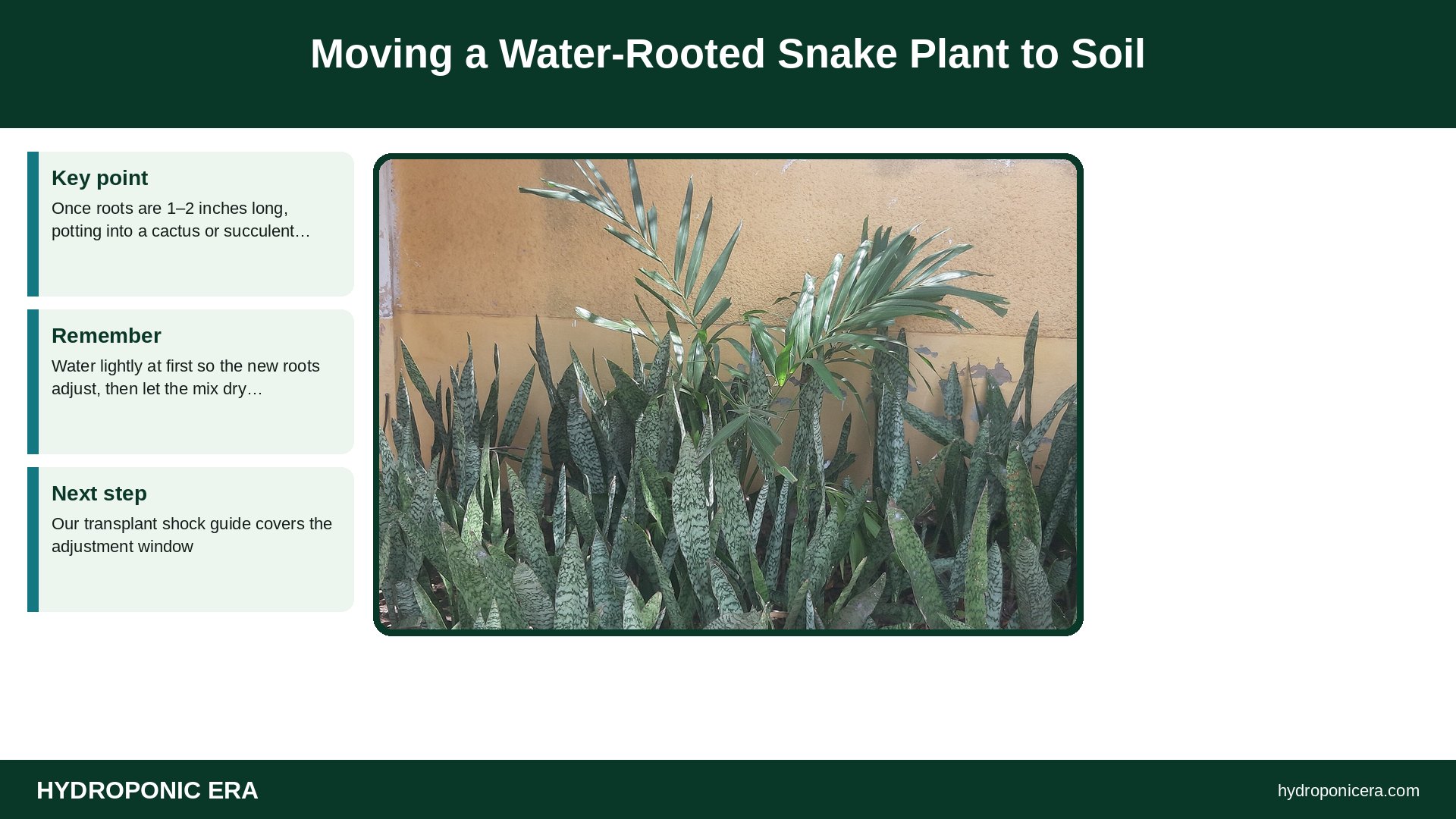
Once roots are 1–2 inches long, potting into a cactus or succulent mix usually gives the best long-term result. Water lightly at first so the new roots adjust, then let the mix dry between waterings. Our transplant shock guide covers the adjustment window.
Common Mistakes With Snake Plant in Water

- Deep water that covers the crown or most of the leaf.
- Skipping the callus step on fresh cuts.
- Planting leaf sections upside down.
- Cold windowsills in winter.
- Heavy feeding. Snake plants are light feeders.
If you want a truly low-maintenance plant in water, pothos is more forgiving. Our list of plants that struggle in home hydroponics explains why succulents are harder.
Weekly Checklist for a Snake Plant in Water
- Look at the cut end or base. Firm and pale is good; soft or translucent is rot.
- Check the water depth. Only the bottom inch should be wet.
- Change the water weekly and rinse the container.
- Keep it warm. Below the mid-60s °F, rooting slows and rot risk rises.
- Be patient. Don’t pull cuttings out to check roots every day.
Variables That Change Results
| Variable | Effect on snake plant in water | Adjustment |
|---|---|---|
| Room temperature | Warm rooms root faster | Place near (not on) a warm spot |
| Cutting length | Longer leaf sections hold more energy | Use 3–4 inch or longer sections |
| Variegated cultivars | Leaf cuttings may revert to plain green | Divide the plant to keep the pattern |
| Season | Rooting is slower in winter | Start cuttings in spring or summer |
A snake plant in water is a fun experiment and a good way to make new plants, but it’s rarely the best permanent home. Many growers treat water as the rooting stage and soil or semi-hydro as the growing stage. That approach plays to the plant’s strengths: easy rooting in water and long-term health in a fast-draining medium.
Best Snake Plant Varieties for Water Rooting
Most common Dracaena trifasciata (formerly Sansevieria) types can be rooted from leaf sections or divisions. Be aware that leaf cuttings of variegated forms, such as those with yellow edges, often lose the variegation in the new plants; divisions keep it. Cylindrical types root the same way but can be slower. Whatever the variety, a snake plant in water roots best in warm rooms, around 70°F or higher, where growth is active.
FAQs: Snake Plant in Water
Can a snake plant live in water forever?
Some do, but rot risk is high. A snake plant in water needs shallow, fresh water and warmth. Most growers move rooted cuttings to a gritty mix.
How long does a snake plant take to root in water?
Often several weeks to a couple of months, depending on warmth and light.
Is snake plant toxic to cats?
Yes. The ASPCA lists snake plant as toxic to cats and dogs.
Why is my snake plant cutting mushy?
The water was too deep, too cold, or not changed often enough. Cut off the soft part, let it callus, and restart.
Related HydroponicEra Guides
- Plants that grow in water
- Plants that struggle in home hydroponics
- Pythium root rot
- Hydroponic cuttings and cloning
Sources
- NC State Extension Plant Toolbox — Dracaena trifasciata
- ASPCA — Snake Plant toxicity
- Photo credits (Wikimedia Commons, edited with titles): Sansevieria trifasciata (36268) by Nativeplants garden (CC BY-SA 4.0); Dracaena Trifasciata Plant by Fanti Salms (CC BY-SA 4.0)