
A hydroponics science fair project works best when it tests one variable at a time, such as nutrient strength, light hours, pH, or soil versus hydroponics, and measures a clear result like plant height, leaf count, or fresh weight. Lettuce, basil, and radish are ideal test plants because they grow quickly. A simple Kratky setup made from cups or plastic tubs is cheap, safe, and easy to replicate, so students can run several identical containers per group for fair, repeatable results.
Key takeaway: Change one thing, keep everything else the same, and use at least three plants per group. That’s the core of a strong hydroponics science fair project.
| Element | Recommendation |
|---|---|
| Best plants | Lettuce, basil, radish, bok choy, wheatgrass |
| Best system | Kratky cups or tubs (no pumps) |
| Duration | 3–5 weeks for most leafy plants |
| Replicates | At least 3 plants per group, more if possible |
| Measurements | Height, leaf count, fresh weight, root length |
| Safety | Gloves and goggles for nutrients and pH adjusters |
10 Hydroponics Science Fair Project Ideas
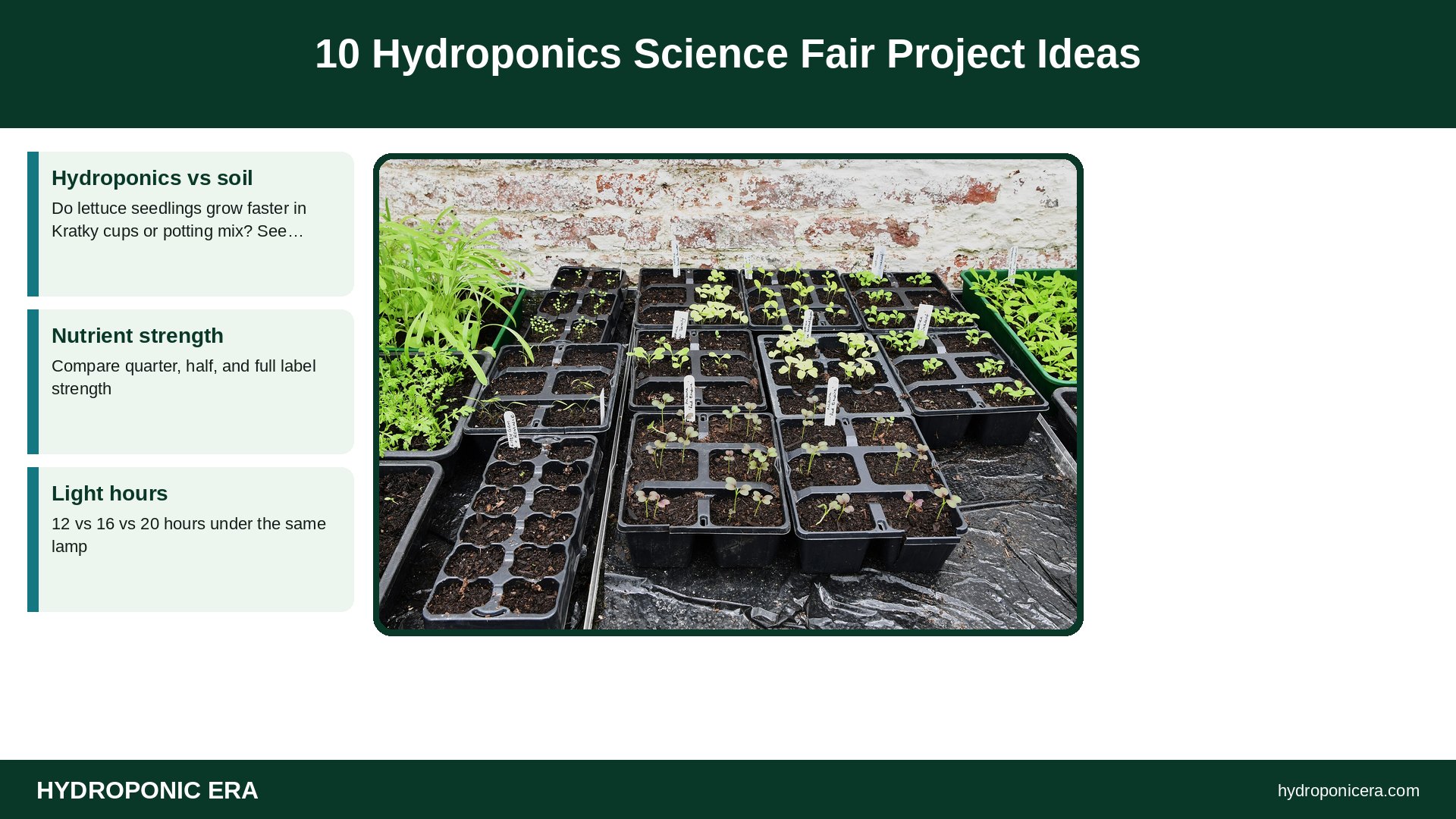
- Hydroponics vs soil: Do lettuce seedlings grow faster in Kratky cups or potting mix? See hydroponics vs soil.
- Nutrient strength: Compare quarter, half, and full label strength.
- Light hours: 12 vs 16 vs 20 hours under the same lamp.
- Light color: White vs red vs blue LEDs at similar intensity (needs a light meter for fairness).
- pH: Solutions adjusted to 5.0, 6.0, and 7.0.
- Growing media: Rockwool, coco coir, clay pebbles, or sponge.
- Aeration: Air stone vs no air stone (DWC vs Kratky).
- Water source: Tap, distilled, and rainwater with the same nutrients.
- Water temperature: Cool vs warm reservoirs.
- Plant spacing: 2, 4, or 6 plants in the same size container.
Writing a Testable Hypothesis
A hypothesis predicts how the independent variable affects the dependent variable. Use an “If… then… because…” format:
- “If lettuce is grown with 16 hours of light instead of 12, then it will have greater fresh weight after four weeks, because it receives more light for photosynthesis each day.”
- “If nutrient solution pH is 6.0 rather than 7.0, then basil will grow taller, because many nutrients are more available in slightly acidic solution.”
- “If lettuce is grown hydroponically instead of in soil, then it will reach harvest size sooner, because roots have constant access to water and nutrients.”
It’s fine if the results don’t support your hypothesis. A careful explanation of why is good science.
Variables: Independent, Dependent, Controlled

- Independent variable: the one thing you change (light hours, pH, nutrient strength).
- Dependent variable: what you measure (height, leaf count, mass).
- Controlled variables: everything kept the same, such as plant variety, container size, light distance, temperature, starting age, and water volume.
- Control group: the “normal” condition you compare against, such as label-strength nutrients.
Simple Kratky Setup for Students
- Use identical opaque cups or small tubs. Wrap clear ones in foil or paint them.
- Cut a hole in each lid for a 2-inch net cup.
- Start seeds in rockwool cubes or sponge; transplant when roots poke out.
- Fill containers with nutrient solution so it touches the bottom of the net cup.
- Label each container clearly with group and number.
- Place all containers under the same light at the same height.
Our Kratky method guide has more details, and hydroponics with kids offers age-friendly tips.
Measuring and Recording Science Fair Data
- Measure plant height with a ruler from the cup rim to the tallest leaf tip, on the same days each week.
- Count true leaves.
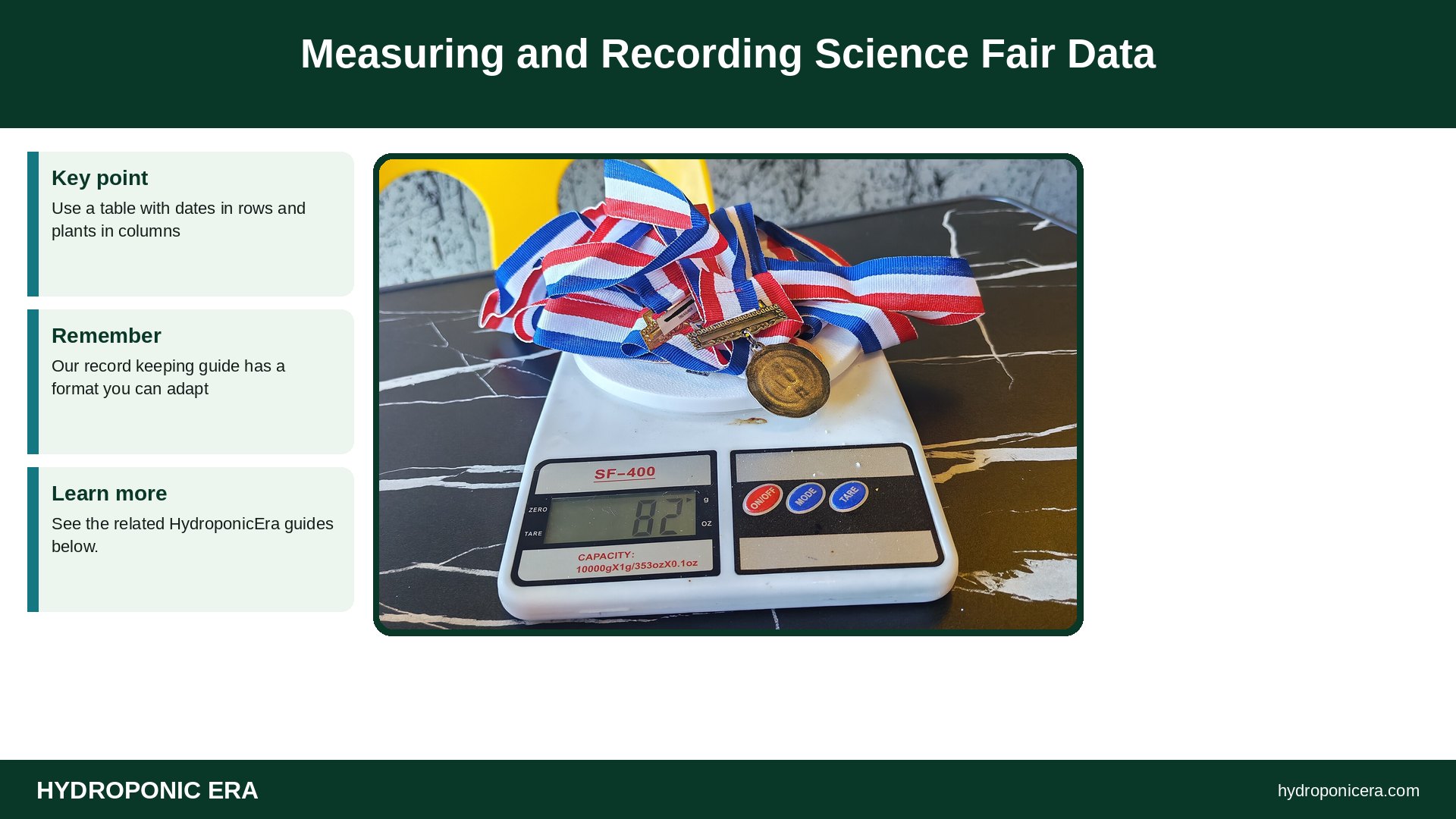
- At the end, weigh each plant’s fresh mass on a kitchen scale (grams).
- Measure the longest root.
- Take photos from the same angle and distance each time. See photo checklist.
- Record pH and EC if you have meters. See pH and EC meters.
Use a table with dates in rows and plants in columns. Our record keeping guide has a format you can adapt.
Analyzing Science Fair Results
Calculate the average for each group, then make a bar graph of final averages and a line graph of growth over time. Note the range (highest and lowest) to show variation. Older students can calculate standard deviation or run a t-test to see whether differences are likely real. Discuss sources of error, such as uneven light, a plant that germinated late, or a container that leaked.
Science Fair Safety Notes

- Wear gloves and eye protection when handling concentrated nutrients and pH up/down; follow label directions.
- Have an adult help with mixing and with any electrical equipment.
- Keep water and electrical cords apart.
- Don’t eat experimental plants grown with non-food-grade materials.
Science Fair Display Board Tips
- Title as a question, such as “Does Light Duration Affect Lettuce Growth in Hydroponics?”
- Show the hypothesis, materials, procedure, data table, graphs, and conclusion.
- Include photos from week 1 to the end.
- Bring a sample plant or a small model of your setup if allowed.
- Explain real-world connections, such as vertical farms and space farming.
Science Fair Project Timeline
- Week 0: research, hypothesis, gather materials.
- Week 1: start seeds.
- Weeks 2–5: transplant, run the experiment, measure weekly.
- Week 6: final measurements, analysis, and board.
Making the Experiment Fair
- Randomize container positions under the light, or rotate them every few days, so no group always gets the brightest spot.
- Start all seeds on the same day and discard seedlings that are much smaller at transplant.
- Use the same nutrient batch for every group except the variable you’re testing.
- Write down anything unusual, like a spill or a temperature change.
Judges notice careful methods. A clear explanation of how you kept things fair can matter as much as the result.
Questions Science Fair Judges Often Ask
- Why did you choose this variable, and what did you expect to happen?
- How did you keep the other conditions the same?
- How many plants were in each group, and why?
- What would you change if you repeated the experiment?
- How does your result connect to real farms or space research?
Practicing short answers to these questions helps students feel confident at the science fair. Bringing a notebook with daily records also shows judges the work behind the board.
FAQs: Hydroponics Science Fair Projects
What is the easiest hydroponic plant for a science fair project?
Lettuce is fast, compact, and forgiving. Radish and wheatgrass are also quick.
How long should a science fair hydroponics experiment run?
Three to five weeks is usually enough to see clear differences in leafy plants.
How many plants do I need?
At least three per group, and more if space allows, so one odd plant doesn’t skew the results.
Do I need a pump?
No. Kratky setups need no pumps, which keeps the project simple and safe.
Can I compare hydroponics and soil fairly?
Yes. Use the same variety, light, and starting age, and give soil plants a comparable fertilizer.
Sources
- NASA — Growing Plants in Space
- University of Florida IFAS Extension — Leafy Greens in Hydroponics and Protected Culture for Florida
- Photo credits (Wikimedia Commons, edited with titles): Somers Middle School Planting Native Garden (8952713158) by Forest Service Northern Region from Missoula, MT, USA (Public domain); Temple Sowerby, Acorn Bank, Mizuna and lettuce seedlings – geograph.org.uk – 7625183 by Michael Garlick (CC BY-SA 2.0); Lettuce Plugs by Apapac at English Wikipedia (Public domain); Medals weighed in digital scale by Kpubkalanami (CC BY-SA 4.0); -2020-07-10 Purple basil (Ocimum basilicum) seedlings, Trimingham by Kolforn (Kolforn) I’d appreciate if you could mail me (Kolforn@gmail.com) if you (CC BY-SA 4.0)