
Whether a hydroponic farm profit is realistic depends on four numbers you can estimate before you build: what each unit of growing space yields per year, what you can sell that yield for, what it costs to produce (including electricity, labor, and losses), and how much capital you have to pay back. No single profit figure applies to every farm. Small farms that sell high-value crops such as microgreens, herbs, and specialty greens directly to customers usually have the best chance, while commodity lettuce sold wholesale has thin margins. Build a simple per-unit budget, test it with a small pilot, and only scale once real sales match your projections.
Key takeaway: Profit comes from the gap between price and cost per unit, multiplied by how much you can actually sell. Know your cost of goods, your price floor, and your market before you scale.
| Driver | Question to answer | Where to get the number |
|---|---|---|
| Yield | How much sellable product per tray, raft, or tower per year? | Pilot trials, crop records |
| Price | What will buyers pay per unit? | Local markets, USDA AMS Market News, buyer quotes |
| Variable costs | Seed, media, nutrients, packaging, electricity per unit | Receipts, utility bills |
| Labor | Hours per harvest, delivery, sales | Time tracking |
| Fixed costs | Rent, insurance, equipment payback | Leases, quotes, loan terms |
| Losses | Unsold or failed product | Sales and crop records |

The Basic Hydroponic Farm Profit Equation

Profit per year = (units sold × price per unit) − (variable cost per unit × units produced) − fixed costs. Units produced is higher than units sold because some product always goes unsold or fails. Many beginners overestimate units sold and underestimate labor. Track all three columns honestly. A cost of goods worksheet makes this concrete; see COGS worksheet for herbs and microgreens and cost tracking framework.
Crop Choice Drives Margin
Crop selection has a direct effect on hydroponic farm profit. Crops differ widely in value per square foot and in how fast they turn over. Microgreens cycle quickly and command high prices in small quantities but need more labor per pound. Herbs like basil sell well to restaurants. Lettuce is easy to grow but often competes with low wholesale prices. See hydroponic farm crop selection.
Sales Channels Matter as Much as Growing
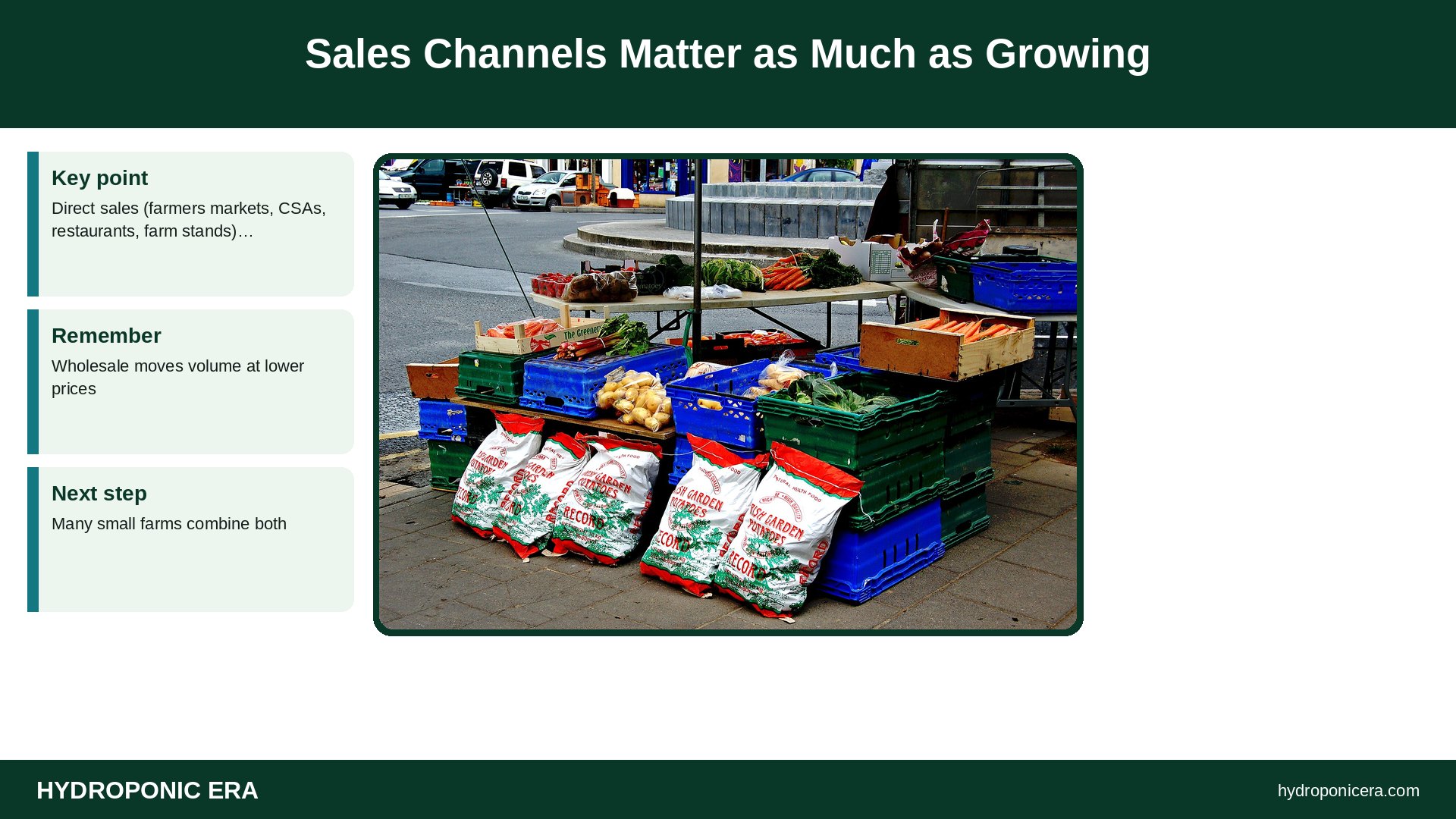
Direct sales (farmers markets, CSAs, restaurants, farm stands) usually bring higher prices than wholesale but take more time. Wholesale moves volume at lower prices. Many small farms combine both. See wholesale vs retail price floors, farmers market pricing, and selling microgreens to restaurants.
Energy Costs
Indoor farms using grow lights and climate control carry significant electricity costs. Greenhouses use sunlight but may need heating and cooling. Estimate energy per unit of product, not just per month. University economic analyses, such as Oklahoma State’s hydroponic budgets and the OptimIA project’s work on indoor lettuce economics, show how energy, labor, and capital weigh on cost per unit. See electricity cost framework.
Labor Is Usually the Biggest Surprise
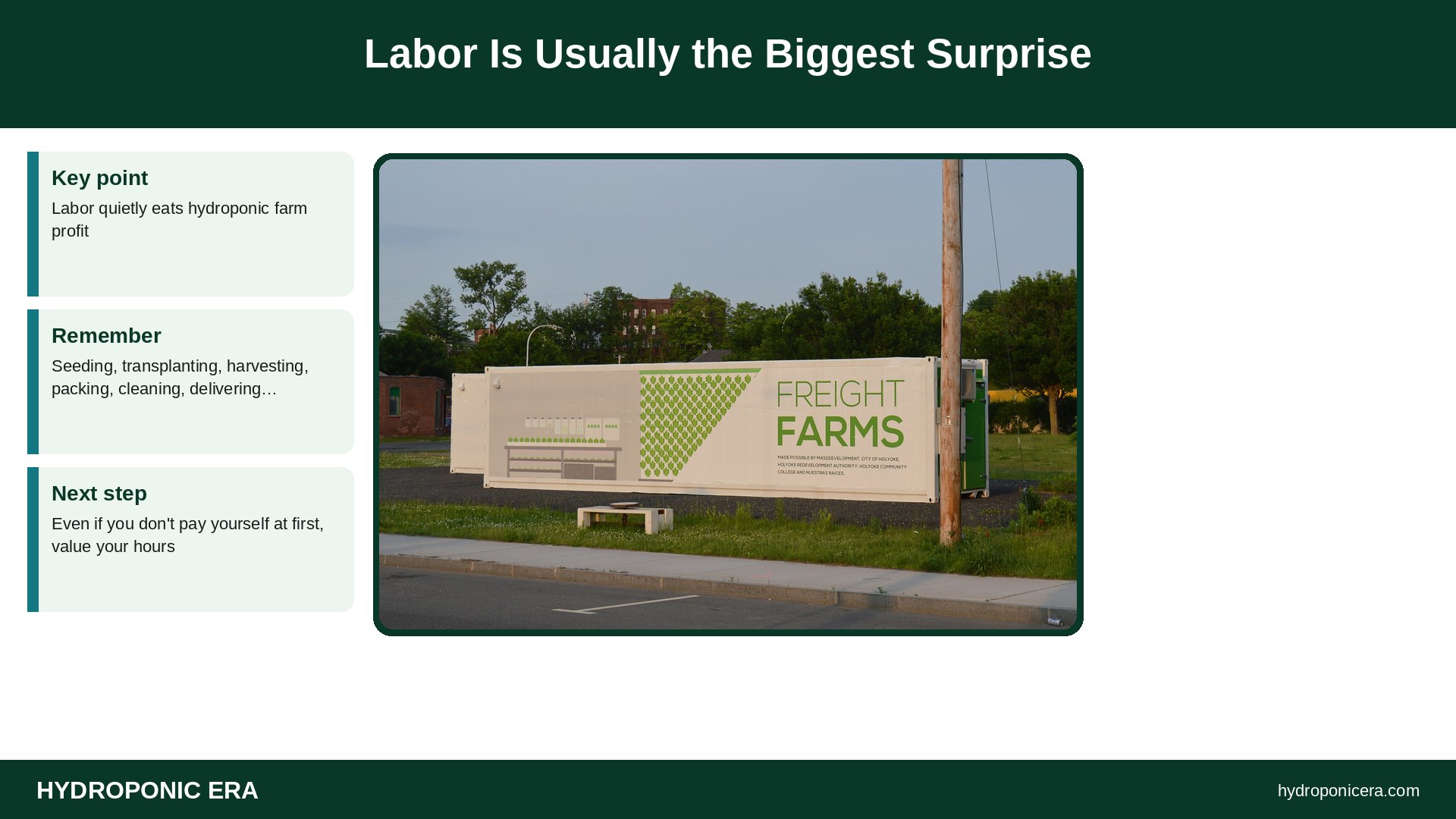
Labor quietly eats hydroponic farm profit. Seeding, transplanting, harvesting, packing, cleaning, delivering, and selling all take time. Even if you don’t pay yourself at first, value your hours. A farm that only works because the owner works for free isn’t truly profitable yet.
Startup Capital and Payback
Equipment, buildout, and working capital need to be paid back from profit. Calculate how many months of profit it takes to recover startup costs. Container farms and large indoor builds carry high upfront costs; see container farming cost and why vertical farms fail for lessons from larger operations. Funding options include grants for hydroponic farming.
Start Small and Pilot
- Pick one or two crops with clear buyers.
- Run a small system for several cycles and record yield.
- Sell real product and record real prices.
- Track every cost and every hour.
- Compare actual numbers to your plan.
- Scale only what’s proven.
See how to start a small hydroponic farm, scaling to a garage micro-farm, and hydroponic farm business plan.
Common Reasons Hydroponic Farm Profit Disappears

- Growing before securing buyers.
- Underpricing to compete with grocery stores.
- Ignoring labor and energy.
- Crop failures from pests, disease, or equipment.
- Scaling too fast with borrowed money.
A Sample Hydroponic Farm Profit Worksheet
Here is a structure you can fill in with your own numbers. Don’t use anyone else’s figures; build yours from quotes, utility rates, and trial yields.
| Line | Your number |
|---|---|
| Sellable units per month | From pilot trials |
| Average price per unit | From real sales or buyer quotes |
| Monthly revenue | Units × price |
| Variable costs per month | Seed, media, nutrients, packaging, energy |
| Labor per month | Hours × wage |
| Fixed costs per month | Rent, insurance, equipment payback |
| Monthly hydroponic farm profit | Revenue − all costs |
Run three versions: an expected case, a slow-sales case, and a crop-failure month. If hydroponic farm profit only appears in the best case, the plan needs work before you invest.
How to Improve Hydroponic Farm Profit
- Raise sell-through by growing to orders and standing accounts.
- Shift sales toward higher-paying direct channels.
- Cut labor with better workflow, not cheaper inputs alone.
- Track energy per unit and upgrade inefficient lights.
- Add value with mixes, bundles, or living produce.
Small gains on each line add up. A modest price increase and a cut in unsold product often improve hydroponic farm profit more than doubling production. See value-added herb products.
Track It Monthly
Review your hydroponic farm profit every month, not once a year. Monthly numbers show which crops and channels carry the business and which drag it down.
FAQs: Hydroponic Farm Profit
Are hydroponic farms profitable?
Some are and many aren’t. Profit depends on crop, market, costs, and management, not on hydroponics itself.
What is the most profitable hydroponic crop?
It depends on your market. Microgreens, herbs, and specialty greens often have higher value per square foot, but only if you can sell them.
How much does a small hydroponic farm make?
There’s no reliable average. Build your own estimate from yield, price, and cost per unit.
How long until a hydroponic farm is profitable?
It varies with startup costs and sales. Calculate payback from your own budget.
Is greenhouse or indoor hydroponics more profitable?
Greenhouses use free sunlight but need climate control; indoor farms control everything but use more electricity. The better choice depends on your climate, crop, and market.
Sources
- USDA Agricultural Marketing Service — Market News
- USDA National Agricultural Library — Hydroponics
- Photo credits (Wikimedia Commons, edited with titles): AeroFarms Danville Location by Kristian Bottini (CC0); 20220525-FPAC-PJK-1302 TONED by USDAgov (Public domain); Ennis – Market Place – Farmers’ Market – Vegetable Stand – geograph.org.uk – 3038450 by Joseph Mischyshyn (CC BY-SA 2.0); Freight Farms project, Holyoke, Massachusetts by Simtropolitan (CC BY-SA 4.0); Hydroponic lettuce @ Plaine des Cafres 03 by Rémih (CC BY-SA 4.0)