
Why vertical farms fail usually comes down to money: high capital costs, heavy electricity and labor bills, and leafy greens that sell for supermarket prices. From 2023 to 2026, Bowery, AeroFarms, Plenty, 80 Acres Farms and Freight Farms all closed or went through bankruptcy. Survivors narrowed their crops, sold premium products, or found new owners.
| Company | What happened | When | Source |
|---|---|---|---|
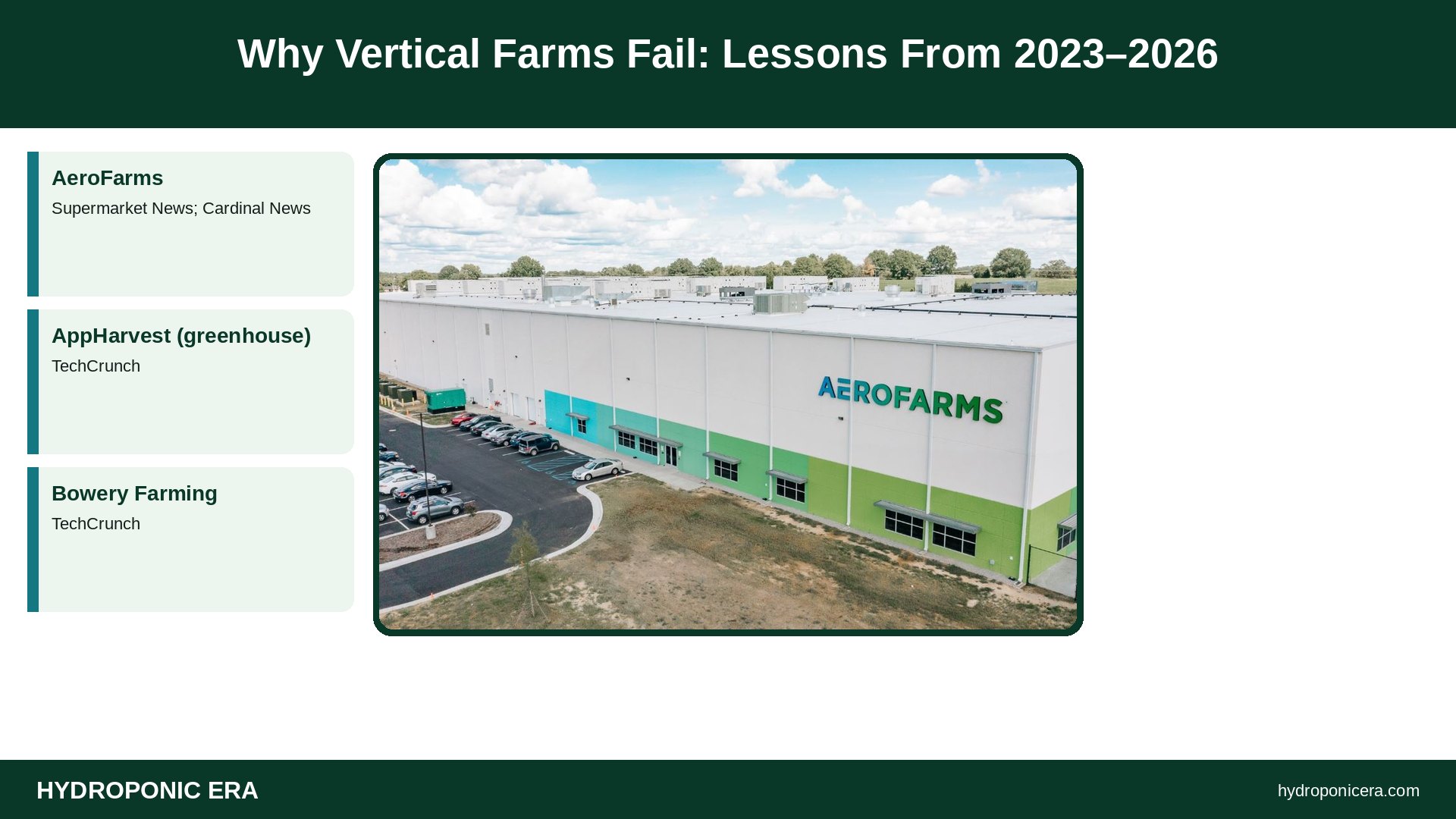
| AeroFarms | Chapter 11; emerged; later sold to a Palm Ventures affiliate | June 2023; Sept 2023; April 2026 | Supermarket News; Cardinal News |
| AppHarvest (greenhouse) | Chapter 11 | 2023 | TechCrunch |
| Bowery Farming | Ceasing operations | Nov 2024 | TechCrunch |
| Plenty | Chapter 11; emerged focused on strawberries | Mar–May 2025 | Plenty press releases |
| Freight Farms | Ceased operations; Chapter 7 | Apr 30, 2025 | Boston Globe |
| 80 Acres Farms | Abrupt closure; Chapter 7 | Aug 2026 | Cincinnati Business Courier; Food Trade News |
Why Vertical Farms Fail: The Short Answer
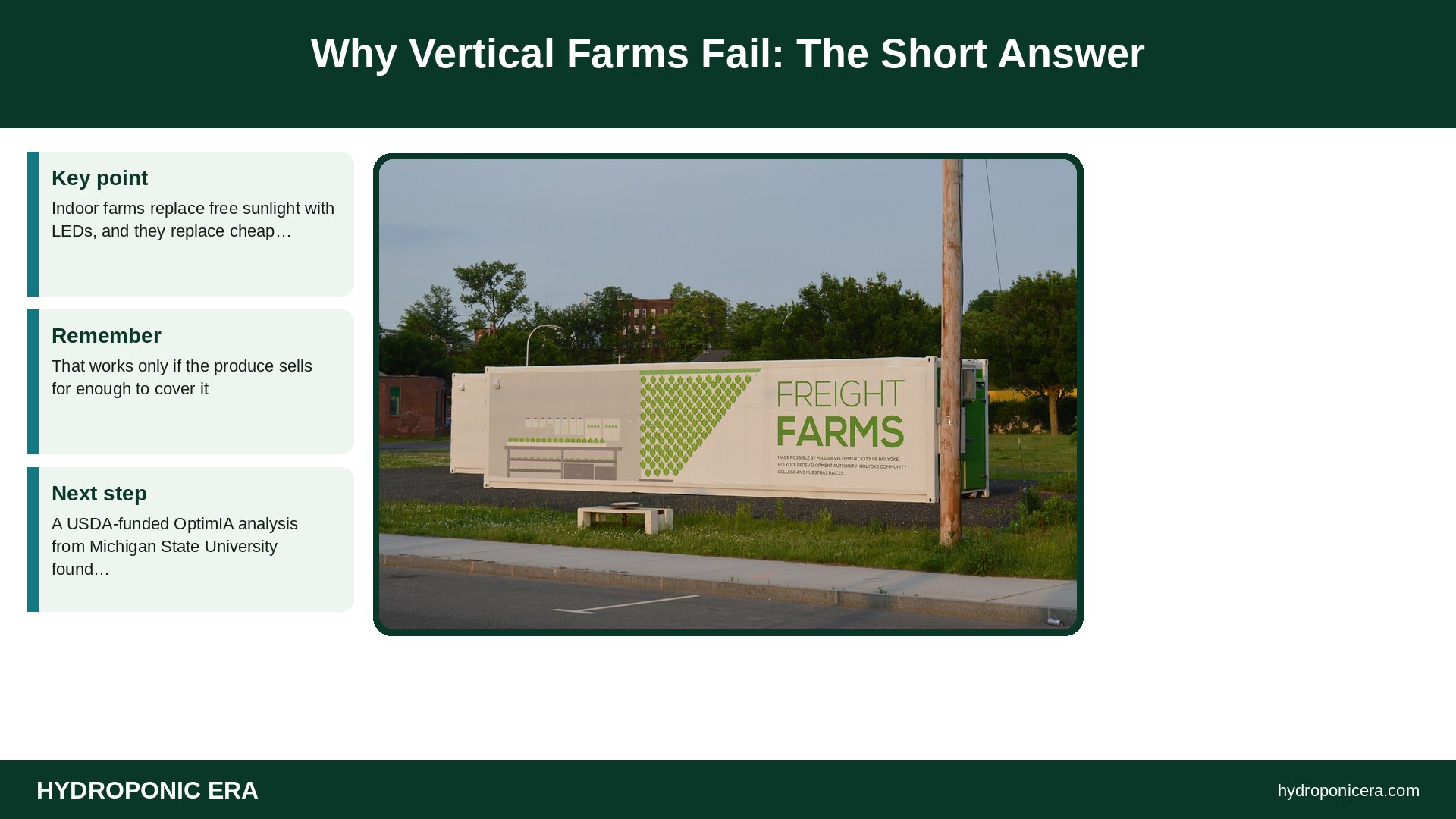
Indoor farms replace free sunlight with LEDs, and they replace cheap land with expensive buildings, climate control and automation. That works only if the produce sells for enough to cover it. A USDA-funded OptimIA analysis from Michigan State University found labor was 41% of variable operating costs for indoor leafy-green farms and electricity 29%. Companies that hadn’t reached profitable scale depended on raising more money, and when that money didn’t come, they ran out of runway. That’s the core of why vertical farms fail.
Why Vertical Farms Fail: What Happened to the Big Names?
Bowery Farming. TechCrunch reported on November 4, 2024 that Bowery was shutting down, citing PitchBook. Bowery had raised more than $700 million, and its 2021 round valued it at more than $2 billion. PitchBook had reported multiple layoff rounds in 2023.
AeroFarms. AeroFarms filed for Chapter 11 on June 8, 2023 and emerged that September, halting R&D that didn’t support its Danville-area farm, according to Supermarket News. In 2026, Cardinal News reported the company had sent notices of a possible shutdown between December and late March, then was acquired by an affiliate of Palm Ventures in a deal that closed in April. It grows microgreens in a 140,000-square-foot facility near Danville, Virginia.
Plenty. Plenty filed for Chapter 11 on March 23, 2025, with $20.7 million in debtor-in-possession financing, to focus on premium strawberries. It announced on May 29, 2025 that it had emerged, with plans to expand its Richmond-area strawberry farm.
80 Acres Farms. The Cincinnati Business Courier reported that 80 Acres filed for Chapter 7 on August 25, 2026, three weeks after an abrupt closure. Food Trade News said the company had been unable to secure the additional capital needed and that its products had reached more than 17,000 retail locations.
7 Lessons on Why Vertical Farms Fail
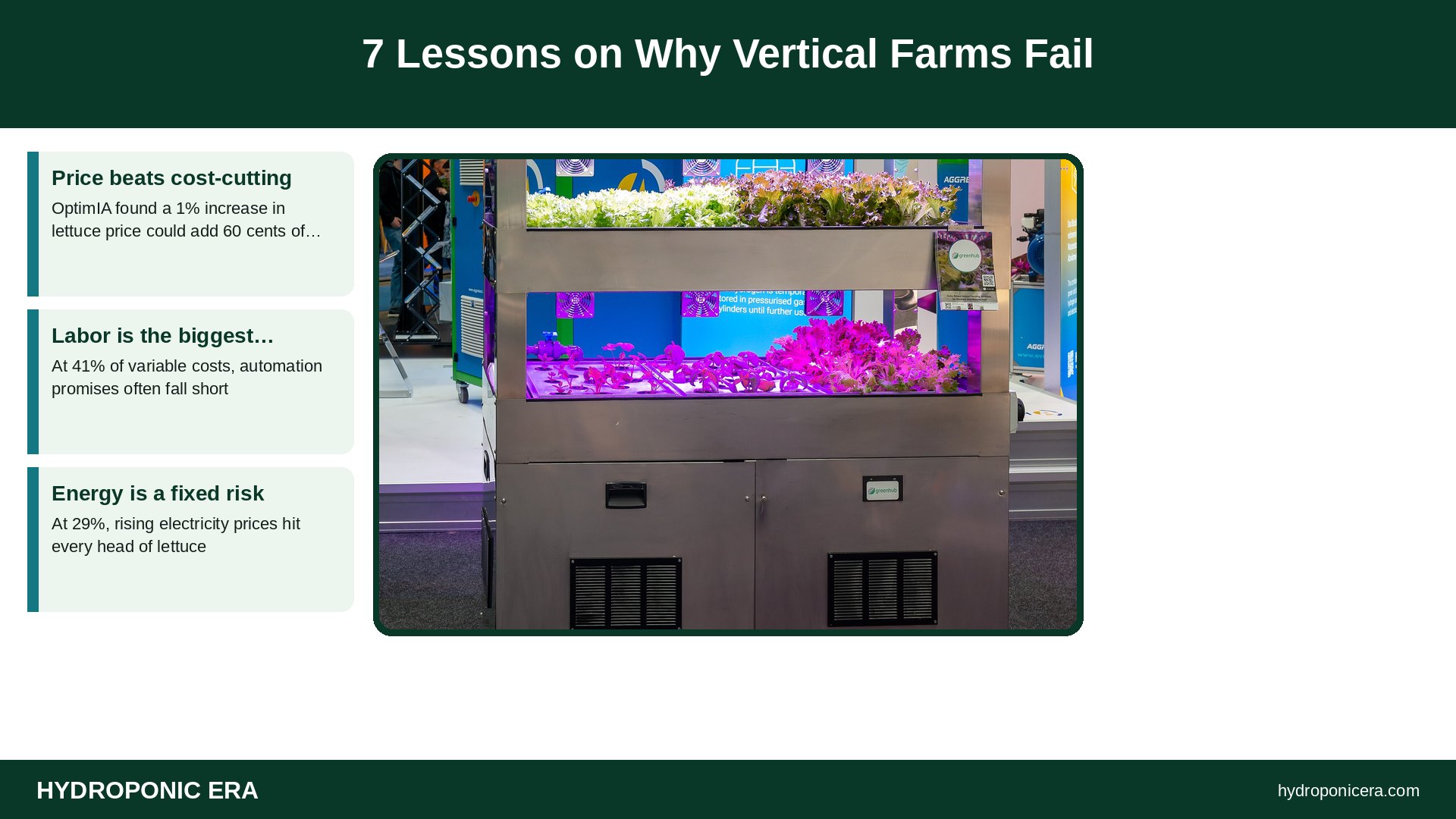
- Price beats cost-cutting. OptimIA found a 1% increase in lettuce price could add 60 cents of profit per square meter per day, versus 6 cents for a 1% wage change and 5 cents for electricity.
- Labor is the biggest bill. At 41% of variable costs, automation promises often fall short.
- Energy is a fixed risk. At 29%, rising electricity prices hit every head of lettuce.
- Capital burns fast. Bowery raised more than $700 million and still closed, per TechCrunch.
- Scale before profit is dangerous. 80 Acres reached more than 17,000 stores but couldn’t raise the capital to keep going.
- Commodity greens are tough. Survivors moved toward higher-value products, like Plenty’s strawberries and AeroFarms’ microgreens.
- Customers depend on vendors. When Freight Farms closed, the Boston Globe reported more than 800 container farms in its network, and customers were warned services might stop.
Why Vertical Farms Fail: Technology or Business?
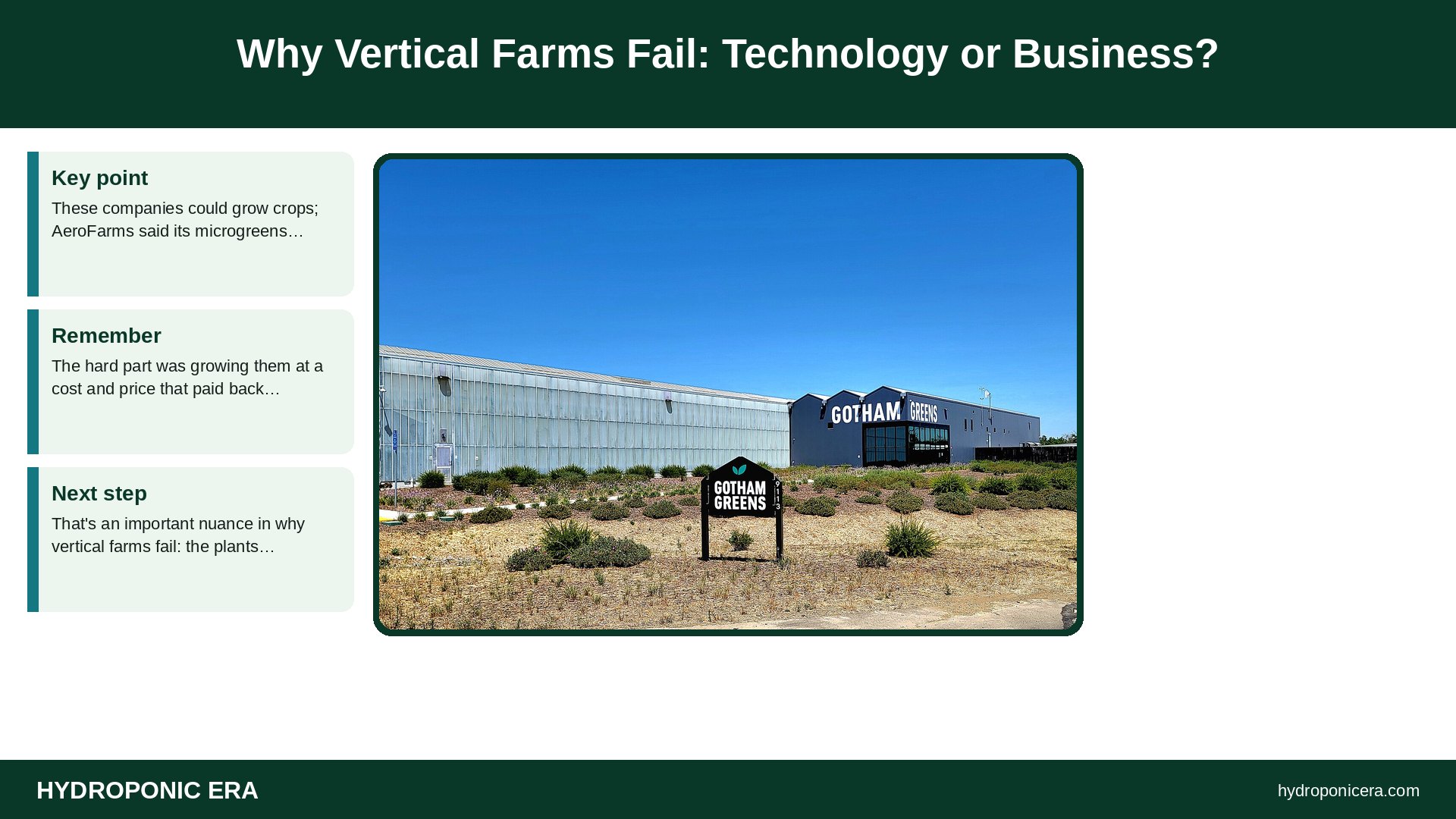
Mostly business. These companies could grow crops; AeroFarms said its microgreens sales were strong when it emerged in 2023. The hard part was growing them at a cost and price that paid back huge investments. That’s an important nuance in why vertical farms fail: the plants usually weren’t the problem.
It also helps to separate vertical farms from greenhouses. AppHarvest, often grouped with vertical farms, ran large greenhouses. Meanwhile, many hydroponic greenhouse companies keep operating; see hydroponic farms in the US. Sunlight is a large cost advantage.
What Do Surviving Indoor Farms Do Differently?
- Pick premium crops: strawberries, microgreens and specialty herbs over basic lettuce.
- Grow into demand: secure buyers before building capacity.
- Control debt: fund growth with revenue where possible.
- Right-size: small farms serving restaurants or local stores can avoid the cost of mega-facilities.
If you’re planning a small operation, our hydroponic farm business plan and container farming cost guides help you test the numbers first.
What Warning Signs Should Investors and Buyers Watch?
Understanding why vertical farms fail helps you spot risk early, whether you’re investing, buying equipment or signing a supply contract. Watch for:
- Repeated layoffs or WARN notices, as AeroFarms filed before its sale.
- Growth funded mainly by new equity rather than sales.
- Rapid expansion into many stores without clear unit profits.
- A single commodity crop sold at grocery-shelf prices.
- Equipment that depends on one vendor’s cloud software.
None of these guarantees failure, but together they match the pattern behind why vertical farms fail in recent years.
What Does This Mean for Small Growers?

Big failures don’t mean hydroponics fails. They show that why vertical farms fail is mostly about matching cost to price. A small farm with low overhead, direct sales and premium products can work where a venture-funded giant didn’t. Start small, sell before you scale, and track cost per head or pound from day one.
Common Misreadings of Why Vertical Farms Fail
| Myth | Reality |
|---|---|
| Vertical farming is dead | Some companies restructured and continue, like Plenty and AeroFarms |
| The technology didn’t work | The economics were the main problem |
| Hydroponic greenhouses are failing too | Many large hydroponic greenhouse growers keep operating |
| Bigger is safer | Large, fast-scaling firms were among the biggest failures |
FAQs: Why Vertical Farms Fail
What is the main reason why vertical farms fail?
High electricity and labor costs combined with low produce prices and heavy capital needs.
Did Bowery Farming shut down?
Yes. TechCrunch reported it was ceasing operations in November 2024.
Is AeroFarms still operating?
Yes, as of mid-2026 reports, under a Palm Ventures affiliate, growing microgreens in Virginia.
What happened to 80 Acres Farms?
It closed abruptly in August 2026 and filed for Chapter 7 liquidation on August 25.
Can a small vertical farm succeed?
It can, with premium crops, local buyers and tight cost control, though there are no guarantees.
Related HydroponicEra Guides
- Container farming cost
- Hydroponic farm business plan
- Hydroponic farms in the US
- Vertical farming for beginners
Sources
- TechCrunch (Nov. 4, 2024) — Bowery Farming is ceasing operations
- Supermarket News (Sept. 18, 2023) — AeroFarms emerges from bankruptcy, names new CEO
- Cardinal News (May 5, 2026) — AeroFarms avoids shutdown
- Cardinal News (June 11, 2026) — Microgreens grower AeroFarms acquired by investment firm
- Plenty via PR Newswire (Mar. 23, 2025) — Plenty undertakes restructuring process
- Plenty via PR Newswire (May 29, 2025) — Plenty completes restructuring, emerges from Chapter 11
- Cincinnati Business Courier via Local 12 (Aug. 26, 2026) — Former Cincinnati startup 80 Acres Farms files for bankruptcy
- Food Trade News (Aug. 27, 2026) — 80 Acres Farms Files Chapter 7, Will Liquidate
- Boston Globe (May 12, 2025) — Freight Farms shuts down, files for bankruptcy
- Urban Ag News / OptimIA (June 6, 2023) — Can Leafy Greens Be Profitably Grown In Indoor Farms?
- Photo credits (Wikimedia Commons, edited with titles): AeroFarms Danville Location by Kristian Bottini (CC0); Freight Farms project, Holyoke, Massachusetts by Simtropolitan (CC BY-SA 4.0); Greenhub, Agritechnica 2023, Hanover (P1140976) by Matti Blume (CC BY-SA 4.0); Gotham Greens in Davis, California by Cullen328 (CC BY-SA 4.0)
2 thoughts on “Why Vertical Farms Fail: Lessons From 2023–2026”