
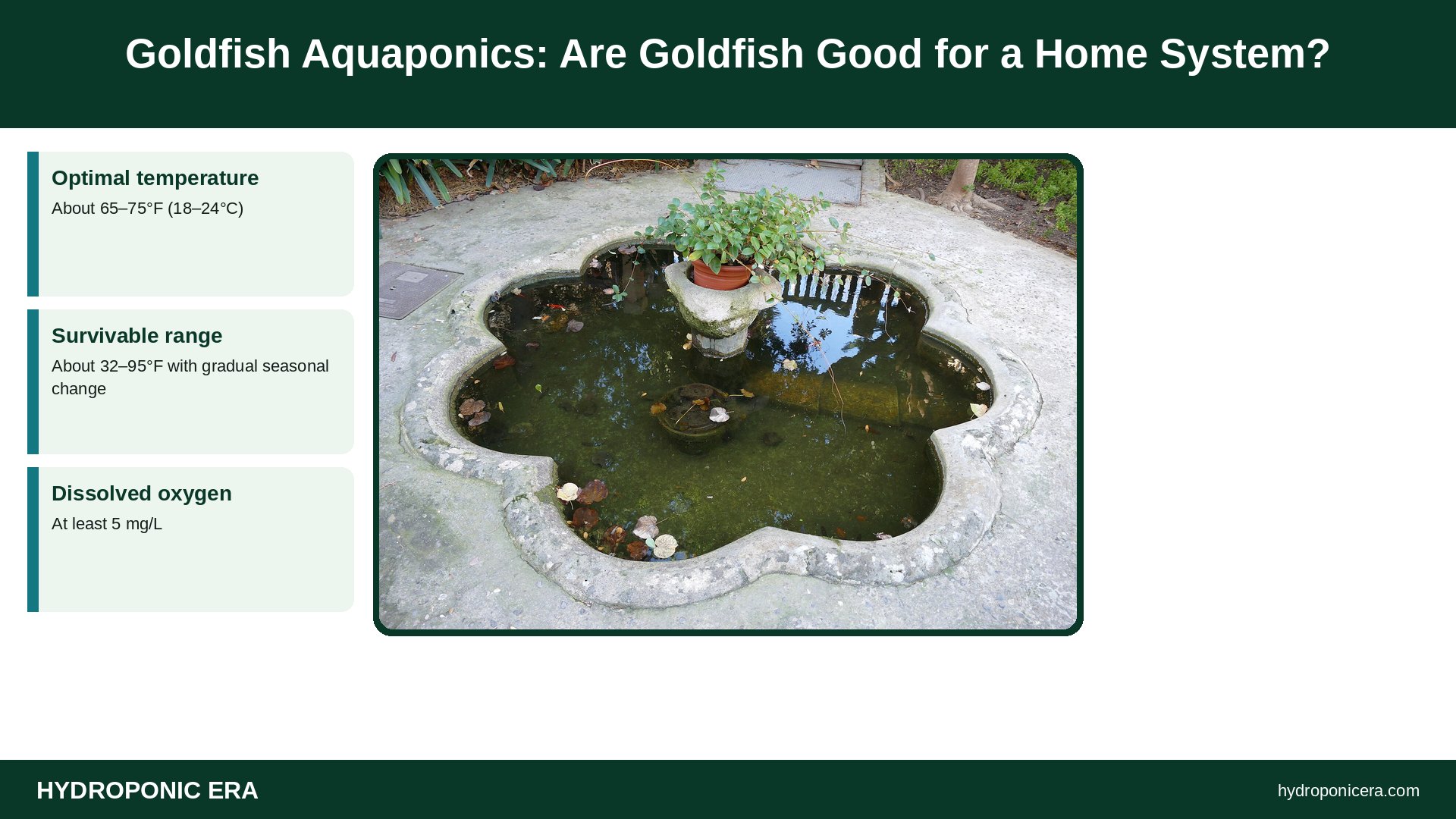
Goldfish aquaponics is one of the easiest ways to start, because goldfish are hardy, cheap, widely available, and tolerate the room temperatures most US homes already have. The Southern Regional Aquaculture Center puts their optimum at about 65–75°F, with survival from near freezing to about 95°F when changes are gradual. They produce plenty of waste for leafy greens and herbs. The catches: goldfish are ornamental rather than food fish, they grow bigger and messier than many people expect, and small tanks overload quickly. Give them enough water, strong filtration and aeration, and a planted area sized to how much you feed.
Key takeaway: Are goldfish good for aquaponics? Yes, for ornamental and learning systems. Size the tank for adult fish, not the tiny ones in the store.
| Factor | Goldfish aquaponics guideline |
|---|---|
| Optimal temperature | About 65–75°F (18–24°C) |
| Survivable range | About 32–95°F with gradual seasonal change |
| Dissolved oxygen | At least 5 mg/L |
| pH | Close to 7; system compromise 6–7 |
| Un-ionized ammonia and nitrite | Below 0.05 mg/L for fish health |
| Purpose | Ornamental, learning, small home systems |
| Main risks | Overstocking, heavy waste, disease from new fish |
Why Goldfish Aquaponics Works Well

Goldfish are temperate members of the carp family. SRAC’s species profile on koi and goldfish describes them as hardy fish that can survive poor water quality, although they do best when it’s good. FAO’s aquaponics manual notes that ornamental carp tolerate a wide variety of water conditions and are a popular choice for growers who don’t want to harvest fish. For a home grower, that means:
- No heater needed in most heated homes.
- Low-cost fish that are easy to replace.
- Steady waste production that feeds plants.
- Fish that accept common flake and pellet foods.
The Downsides to Plan For
They Grow Bigger Than You Think
Many goldfish varieties can grow several inches long, and common or comet goldfish get larger still. A fish that fits in a bowl at the store may outgrow a small tank within a year. Plan the tank for the adult size and number you’ll keep.
They’re Messy
Goldfish eat a lot and produce a lot of waste. That’s good for plants, but it means ammonia can rise fast in small or new systems. A mature biofilter and regular testing matter.
They’re Not Food Fish
Goldfish aquaponics is about growing plants, not harvesting fish. If you want to eat fish, choose a food species such as tilapia, catfish, bluegill, or perch. See best fish for aquaponics.
Goldfish Aquaponics Tank Size and Stocking

Stock by weight and feed, not by an “inch per gallon” rule. FAO recommends small-scale aquaponics stay below about 20 kg of fish per 1,000 liters (about 0.17 pounds per gallon), and goldfish systems are usually far below that. A practical approach for a home system is:
- Start with a few small fish in at least a few dozen gallons of water.
- Let the system cycle and watch ammonia and nitrite.
- Add plants as feeding increases.
- Add fish slowly only if water quality stays stable.
A larger volume of water is more stable. Tiny desktop kits can work for a single betta-sized fish, but they’re less forgiving with goldfish. Bigger tanks give you more room for error.
Fancy vs Common Goldfish
Common and comet goldfish are hardier and handle cooler water, but grow larger and swim fast. Fancy goldfish, with round bodies and long fins, stay smaller but are more delicate and sensitive to poor water quality and cold. For a beginner aquaponics system, common goldfish are usually more forgiving.
Feeding Fish in Goldfish Aquaponics
Feed a quality goldfish pellet or flake once or twice a day, only what they eat in a couple of minutes. Overfeeding is the most common problem in goldfish aquaponics because extra food rots and raises ammonia. Feeding amount also sets how many plants you can grow; FAO’s rule of thumb is about 40–50 grams of feed per square meter of leafy greens per day in balanced systems, though small hobby systems run far lower.
Goldfish Aquaponics Water Quality and Testing
- Test ammonia, nitrite, nitrate, and pH weekly once cycled.
- Keep pH between 6 and 7 as a compromise for fish, bacteria, and plants.
- Aerate constantly; goldfish need at least 5 mg/L dissolved oxygen for good health. See dissolved oxygen.
- Use dechlorinated water for top-offs.
Best Plants for Goldfish Aquaponics
Low- to moderate-feeding plants suit most goldfish systems: lettuce, basil, mint, watercress, pothos, and other leafy greens and houseplants. Heavy feeders like tomatoes need more fish and more feed. Houseplants grown in aquarium water are another option; see using aquarium water for plants.
Health and Biosecurity

Quarantine new fish in a separate tank for a few weeks before adding them, since new fish can bring parasites or disease. SRAC notes that koi and goldfish can carry serious viral diseases, so buy from reputable sources. Never release goldfish into ponds, lakes, or streams. Released goldfish can become invasive, and many states prohibit releasing aquarium animals.
Indoor Goldfish Aquaponics Setup Example
- Choose a tank sized for adult goldfish, with a sturdy stand.
- Add a grow bed above or beside the tank with clay pebbles. See clay pebbles.
- Install a small pump and timer or bell siphon.
- Run an air pump and air stone in the tank.
- Cycle the system before adding most fish.
- Plant leafy greens and herbs.
Bringing New Goldfish Home Safely
Goldfish are hardy, but the move into a new system is still the most stressful moment of their lives. FAO’s aquaponics manual names temperature and pH differences between the old and new water as the two main stress factors during acclimation. Its method works well for goldfish:
- Float the sealed bag in your tank for at least 15 minutes so the temperatures match.
- Add small amounts of tank water to the bag over at least another 15 minutes.
- If the pH of the bag water and tank water differs by more than 0.5, FAO says the fish need at least 24 hours: hold them in a small aerated tub of their original water and slowly add system water over a day.
- Net the fish into the tank and discard the bag water rather than pouring it in.
FAO also suggests quarantining new fish in a separate tank, in some cases for up to 45 days, before adding them to the main system. That matters with feeder goldfish from pet stores, which are often kept crowded. If parasites show up, FAO describes a short salt bath in a separate container (1 kg of salt per 100 liters for 20–30 minutes), but never add salt to the aquaponics system itself because it harms plants.
FAQs: Goldfish Aquaponics
Is goldfish aquaponics good for beginners?
Yes. They’re hardy, cheap, and produce plenty of waste for plants, making them great for ornamental and beginner systems.
What temperature do goldfish need?
About 65–75°F is optimal, though they tolerate much cooler and warmer water if changes are gradual.
Can you eat goldfish from aquaponics?
They’re kept as ornamental fish. Choose a food species if you want to harvest fish.
How many goldfish can I keep?
It depends on tank volume, filtration, and feed. Start with a few and add slowly while water tests stay good.
Does goldfish aquaponics need a heater?
Usually not in a heated home, since they’re temperate fish.
Sources
- Southern Regional Aquaculture Center (via UF/IFAS) — Species Profile: Koi and Goldfish
- FAO — Small-scale aquaponic food production
- Photo credits (Wikimedia Commons, edited with titles): Fountain with goldfish in Jardí del Bisbe 03 by Kritzolina (CC BY-SA 4.0); AQUAPONIE by Hopeballa (CC BY-SA 4.0); 2009-03-30 Lettuce roots by Ildar Sagdejev (Specious) (CC BY-SA 4.0); Fish Feed Pellets by Narek75 (CC BY-SA 4.0); Solanum lycopersicum in aquaponics at the NC Greenhouse Nursery by Gogerr (CC BY-SA 4.0)