
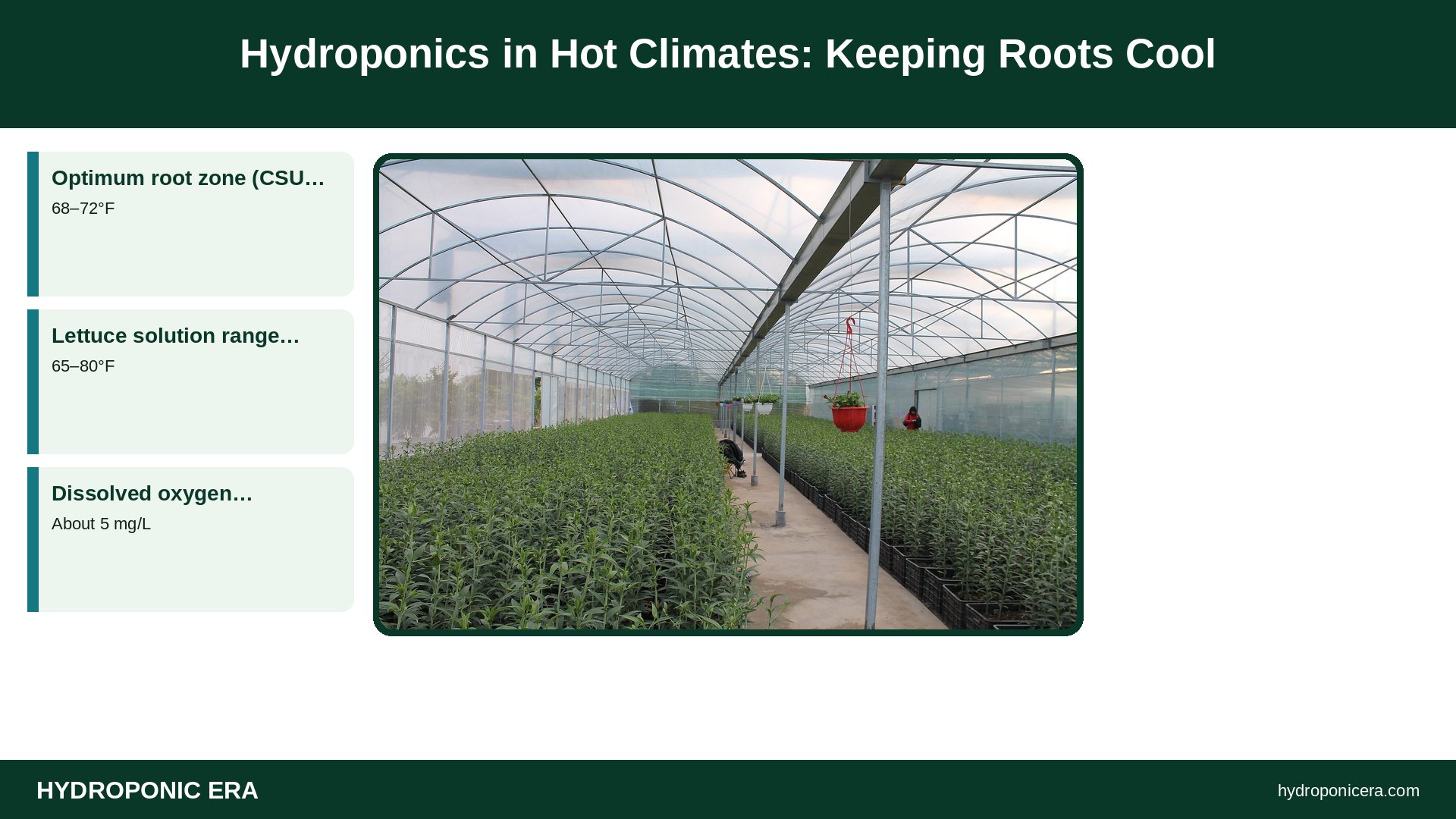
Hydroponics in hot climates succeeds when you keep the root zone cool and oxygenated, because warm nutrient solution holds less dissolved oxygen and favors root rot. Colorado State’s PlantTalk calls 68–72°F the optimum root zone temperature, and UF/IFAS Extension suggests keeping lettuce solutions between 65 and 80°F with dissolved oxygen around 5 mg/liter. In hot US regions like Texas, Arizona, and Florida, that means shading and insulating reservoirs, burying or enlarging them, aerating heavily, choosing heat-tolerant crops in summer, and saving lettuce for cooler months.
Key takeaway: In hot climates, protect the reservoir from heat, add oxygen, and switch to heat-loving crops in summer.
| Target (source) | Value |
|---|---|
| Optimum root zone (CSU PlantTalk) | 68–72°F |
| Lettuce solution range (UF/IFAS) | 65–80°F |
| Dissolved oxygen (UF/IFAS) | About 5 mg/L |
| Lettuce max day air temp (UK) | About 75°F |
| Leafy greens bolt in water above (FAO) | About 79°F |
Why Hot Climates Are Hard on Hydroponics
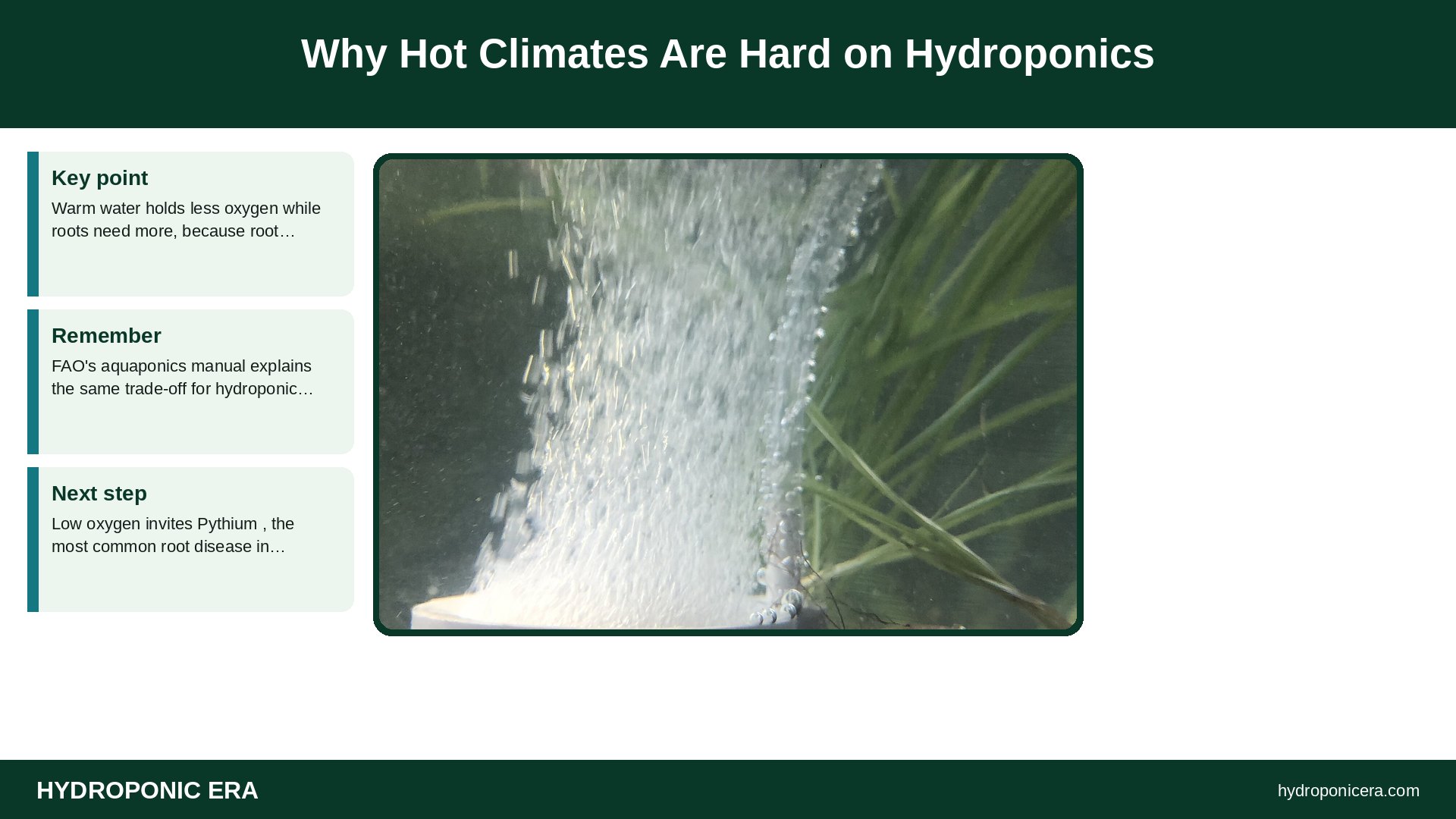
Warm water holds less oxygen while roots need more, because root respiration increases with temperature. FAO’s aquaponics manual explains the same trade-off for hydroponic beds: high temperatures mean less dissolved oxygen and can restrict calcium uptake in plants. Low oxygen invites Pythium, the most common root disease in hydroponics according to Colorado State. Symptoms include wilting, tip burn, and brown roots with sparse root hairs. See Pythium root rot and dissolved oxygen.
Cool the Reservoir in Hot Climates
- Shade: keep reservoirs out of direct sun, especially afternoon sun.
- Insulate: wrap with foam board or reflective insulation.
- Go white: FAO notes white tanks reflect sunlight and keep water cool.
- Bury: sinking the reservoir into the ground uses cooler soil temperatures.
- Bigger volume: more water changes temperature more slowly.
- Chiller: for valuable crops, a water chiller holds a set temperature. See reservoir chillers.
Add Oxygen
Use air stones sized for the reservoir, and keep the air pump in a cooler, shaded spot. Systems where water falls through air, like towers and NFT, gain oxygen naturally, but their thin channels also heat quickly. FAO warns that NFT pipes are prone to high water temperatures in hot seasons because of constant sun exposure. Deep water culture holds temperature better but needs strong aeration. See DWC for beginners.
Choose Systems That Suit Hot Climates
- Dutch buckets with perlite or coco: media buffers temperature.
- Large DWC tanks: more water mass, if aerated.
- Kratky with large, shaded containers: simple but watch water heat.
- Avoid exposed thin NFT channels in full summer sun.
Best Crops for Hydroponics in Hot Climates

FAO notes warm-water crops like okra, Asian cabbages, and basil thrive at higher water temperatures, while lettuce, Swiss chard, and cucumbers prefer cooler water. Leafy greens bolt and turn bitter around 79°F. In summer, grow:
- Basil, okra, peppers, and eggplant.
- Heat-tolerant greens such as water spinach and Malabar spinach.
- Tomatoes, with shade cloth to prevent blossom drop. See blossom drop.
Save lettuce for fall, winter, and spring. The University of Kentucky says hydroponic lettuce air temperatures shouldn’t exceed about 75°F by day.
Shade Cloth and Ventilation in Hot Climates
Shade cloth lowers leaf and air temperature. FAO notes that in hot, tropical areas, net houses with mesh walls and a plastic roof can work better than closed greenhouses because they ventilate. Fans and evaporative cooling help indoor or greenhouse setups.
Water and Nutrients in Hot Climates

Plants drink more in heat, so reservoirs drop fast and EC can climb as water evaporates. Top up with plain water daily and check EC. See EC climbing too fast. Many growers run a slightly lower EC in hot weather to reduce salt stress.
Hot Climates Checklist
- Measure water temperature at the hottest time of day.
- Shade and insulate the reservoir.
- Add aeration.
- Switch to heat-loving crops.
- Top up and check EC daily.
- Inspect roots weekly for browning.
Planning Hydroponics in Hot Climates
Warm nutrient is the core problem in hot climates. Warm water holds less dissolved oxygen, and root diseases like Pythium favor heat. Bury or insulate the reservoir, keep it out of direct sun, add an air stone, and top off with cool water. Running pumps on a timer in the cooler morning and evening hours can also help in small systems.
Choose heat-tolerant crops for the hottest months, such as basil, peppers, okra, and Malabar spinach, and save lettuce and spinach for cooler seasons.
Weekly Routine for Hydroponics in Hot Climates
- Check pH and EC, and record them.
- Top off the reservoir with plain, pH-adjusted water.
- Look at roots for color and smell.
- Check leaves, especially undersides, for pests.
- Clean filters, emitters, and pump intakes.
- Change the nutrient fully every two to three weeks, or sooner if EC drifts.
Beginner Mistakes With Hydroponics in Hot Climates
The most common mistakes are skipping pH testing, using nutrient that’s too strong, letting light reach the water, and ignoring water temperature. Each one is easy to fix once you know to check for it. Start with fewer plants than you think you need, learn the routine, and expand once the system runs smoothly.
Shade and Airflow in Hot Climates
Shade cloth over the growing area cuts heat on plants and reservoirs, and fans or open sides move hot air out of a greenhouse. Evaporative cooling pads work well in dry heat but less well in humid climates. Grow in the cooler season where possible, and treat the hottest months as a time for heat-loving crops.
Monitoring in Hot Climates
Check water temperature every day with an inexpensive thermometer, and check EC more often, since plants drink faster in heat and concentrate the nutrient. See hydroponic reservoir chillers and reservoir temperature.
FAQs: Hydroponics in Hot Climates
What water temperature is too hot?
Above about 80°F is risky for lettuce; 68–72°F is ideal for roots.
How do I cool my reservoir cheaply?
Shade, insulate, bury it, and use a larger volume.
Can I grow lettuce in summer in hot climates?
It’s difficult; it tends to bolt. Grow it in cooler months.
Do frozen water bottles work?
They give short relief but must be swapped often.
Which system is best for heat?
Media-based Dutch buckets or large, aerated DWC tanks.
Do chillers help in hot climates?
Yes. A water chiller is the most reliable way to cool a reservoir, though it adds cost and power use.
Sources
- Colorado State University PlantTalk — Root Disease Problems and Management
- UF/IFAS Extension — Growing Lettuce in Small Hydroponic Systems
- University of Kentucky — Hydroponic Lettuce Production
- FAO — Small-scale aquaponic food production
- Photo credits (Wikimedia Commons, edited with titles): Net house by vi:User:Goodmorninghpvn (CC BY-SA 3.0); Air Stone Disk aquarium Germany 2024 by Nimmerwelk (CC BY-SA 4.0); Somers Middle School Planting Native Garden (8952728708) by Forest Service Northern Region from Missoula, MT, USA (Public domain); Greenhouse in Kazakhstan by Gakon Netafim (CC BY-SA 4.0); 2009-03-30 Lettuce roots by Ildar Sagdejev (Specious) (CC BY-SA 4.0)