
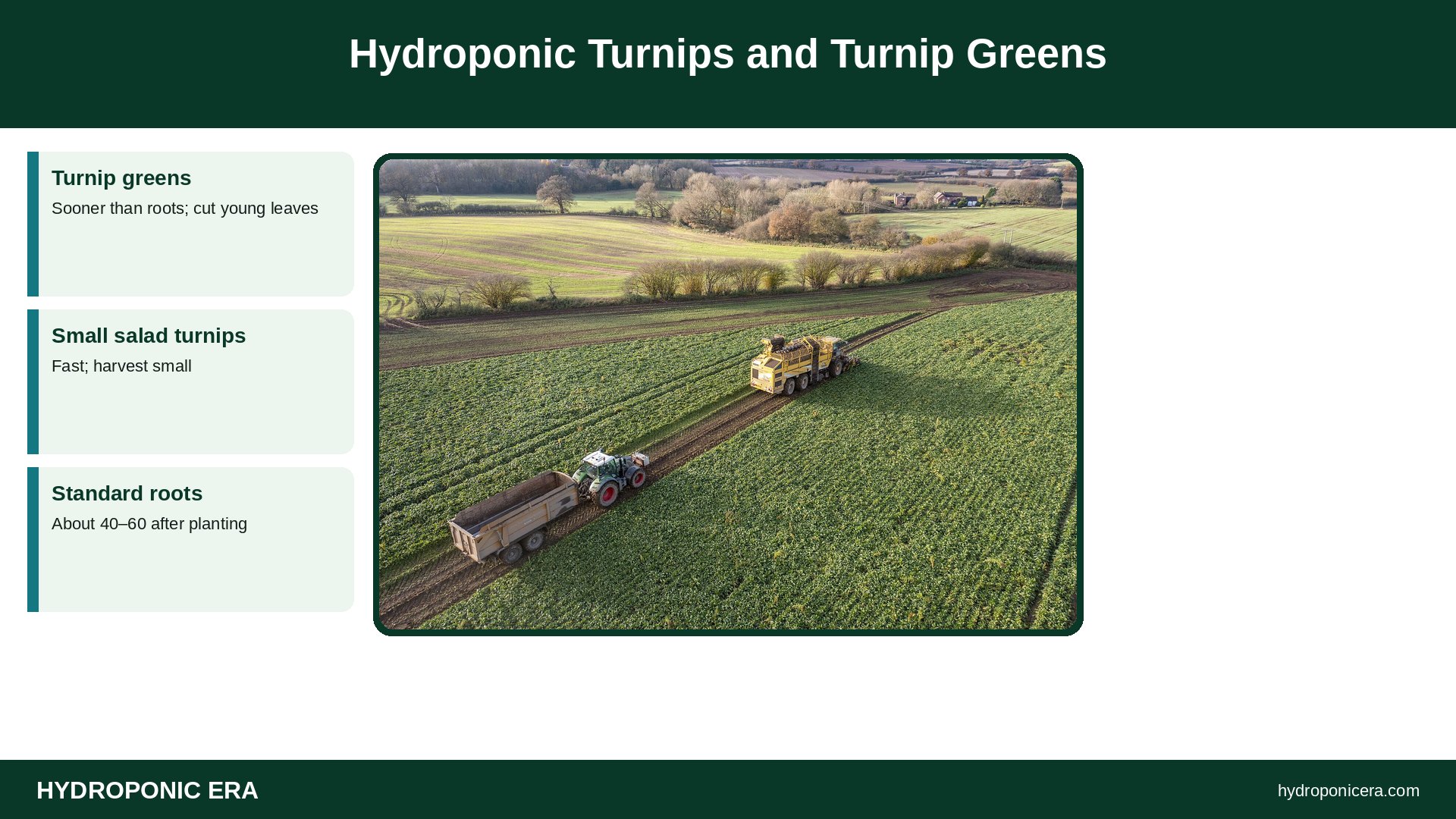
Hydroponic turnips are easy if you grow them for greens, and possible for roots with the right system. Turnips are a fast, cool-season crop: Texas A&M AgriLife lists turnips as a cool-season crop harvested about 40–60 days after planting, and notes temperatures above 75°F reduce yield and quality. Greens can be cut sooner. For greens, any lettuce-style system works, including raft, NFT, or Kratky. For roots, use a deep media bed or Dutch bucket filled with perlite, coco, or a perlite-vermiculite mix so the root has something to swell in and stays out of standing water.
Key takeaway: Grow turnip greens in any leafy-green system; grow roots in deep, well-drained media, and keep it cool.
| Goal | Best system | Timing |
|---|---|---|
| Turnip greens | Raft, NFT, Kratky, towers | Sooner than roots; cut young leaves |
| Small salad turnips | Deep media bed or Dutch bucket | Fast; harvest small |
| Standard roots | Media bed 8+ inches deep | About 40–60 after planting |
Why Grow Hydroponic Turnips?
Turnips are one of the fastest root crops, and the greens are a Southern favorite with a mild mustard bite. In hydroponics, you can harvest greens repeatedly or pull whole young plants. Because they like cool conditions, hydroponic turnips are a good fall, winter, and spring crop, especially indoors. See hydroponic radishes for a similar fast root crop.
Best Varieties for Hydroponic Turnips
- Salad turnips (Japanese types like ‘Hakurei’): small, sweet, fast; best for hydroponic roots.
- Greens varieties (‘Seven Top’, ‘Alamo’): grown for leaves, not roots.
- Purple Top White Globe: classic, but larger roots need deep media.
Hydroponic Turnips for Greens

Start seeds in plugs and transplant to a raft, NFT channel, or tower when they have a couple of true leaves. Harvest outer leaves when 4–8 inches long, or cut the whole plant. Turnip greens need a lettuce-style nutrient solution. UF/IFAS gives EC 1.2–1.8 mS/cm and 65–80°F for small lettuce systems, which suits turnip greens too. See DWC for beginners.
Hydroponic Turnips for Roots
Roots need loose, airy media to expand evenly:
- Fill a container or bed at least 8 inches deep with perlite, coco coir, or a perlite-vermiculite mix.
- Direct sow seeds about ½ inch deep, then thin to 2–4 inches apart for salad turnips.
- Feed with drip or flood-and-drain so media stays moist but not waterlogged.
- Keep the root shoulder covered lightly with media to avoid greening and splitting.
Avoid sinking roots directly into nutrient solution, which leads to rot and misshapen roots.
Temperature for Hydroponic Turnips
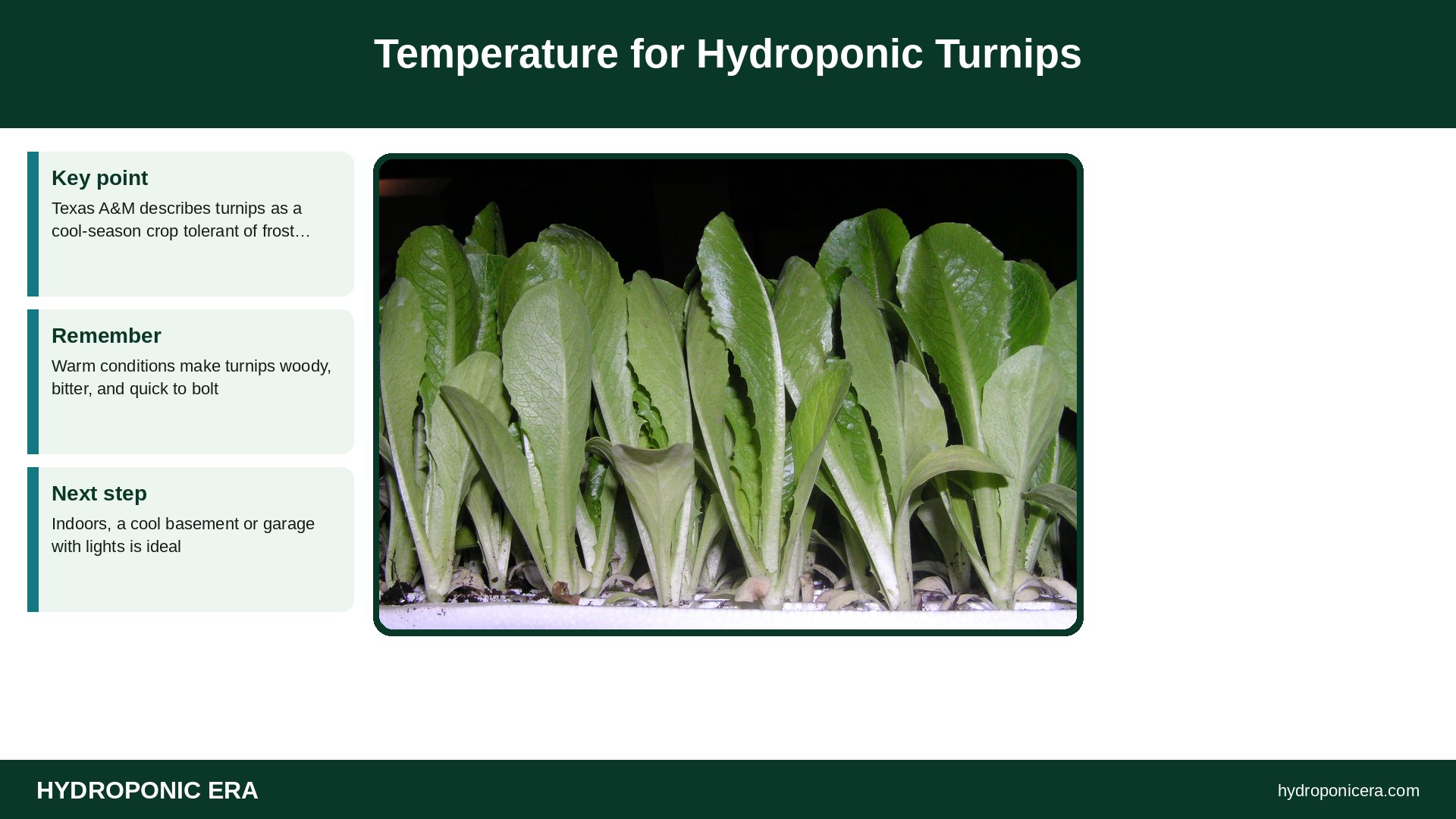
Texas A&M describes turnips as a cool-season crop tolerant of frost and light freezes, and notes temperatures above 75°F decrease yield and quality. Warm conditions make turnips woody, bitter, and quick to bolt. Indoors, a cool basement or garage with lights is ideal. Outdoors, grow in spring and fall. See heat and cold stress.
Light for Hydroponic Turnips
Give turnips full sun outdoors or bright LED light indoors. Low light produces leggy leaves and small roots. A 14–16 hour photoperiod works well indoors. See light schedules.
Common Problems With Hydroponic Turnips
- No root swelling: too warm, too crowded, or media too shallow.
- Split roots: uneven watering.
- Bitter roots: heat or late harvest.
- Bolting: long, warm days.
- Aphids and flea beetles: scout and use row covers outdoors.
Harvesting Hydroponic Turnips
Harvest salad turnips at 1–2 inches across, and standard turnips at 2–3 inches. Larger roots tend to get woody. Greens are best young and tender. Rinse, remove leaves from roots for storage, and refrigerate.
Planning Tips: Hydroponic Turnips
Hydroponic turnips need room for the root to swell, which suits media beds, deep containers, or Dutch buckets filled with perlite or coco better than shallow NFT. Thin seedlings early so each root has space, and harvest on time, since turnips grown too long or too warm get woody and strong-flavored.
Don’t forget the greens. Turnip leaves are edible and can be harvested lightly while roots grow.
Weekly Routine for Hydroponic Turnips
- Check pH and EC, and record them.
- Top off the reservoir with plain, pH-adjusted water.
- Look at roots for color and smell.
- Check leaves, especially undersides, for pests.
- Clean filters, emitters, and pump intakes.
- Change the nutrient fully every two to three weeks, or sooner if EC drifts.
Beginner Mistakes With Hydroponic Turnips
The most common mistakes are skipping pH testing, using nutrient that’s too strong, letting light reach the water, and ignoring water temperature. Each one is easy to fix once you know to check for it. Start with fewer plants than you think you need, learn the routine, and expand once the system runs smoothly.
Best Hydroponic Turnips Varieties
Quick, small varieties suit hydroponic turnips best, such as salad or Tokyo-type turnips harvested small and tender. Larger storage turnips need more root space and time. Many growers also grow turnips purely for greens, which fit NFT and DWC better than root crops.
Light and Temperature for Hydroponic Turnips
Turnips are a cool-season crop. Texas A&M notes temperatures over 75°F reduce quality, so indoor growers should keep the room cool and avoid placing systems near heaters. Give bright light, like other leafy and root crops.
Harvesting Hydroponic Turnips
Texas A&M gives turnips about 40–60 days to harvest. Pull small salad types when roots are about golf-ball size, and larger types before they get woody. Twist off the tops, leaving a short stem, and store roots cool and humid in the fridge. Use greens within a few days for the best flavor.
Hydroponic Turnips Problems
Common issues include roots that crack from uneven watering, woody roots from heat or late harvest, and aphids on leaves. Keep feeding steady, keep the room cool, and check leaf undersides regularly.
FAQs: Hydroponic Turnips
Can turnips grow hydroponically?
Yes. Greens are easy; roots need deep media.
How fast do hydroponic turnips grow?
Texas A&M lists harvest about 40–60 days after planting; greens can be cut earlier.
What is the best system for turnip roots?
A deep media bed or Dutch bucket with perlite or coco.
What temperature is best?
Cool. Quality drops above about 75°F.
Which turnip is best indoors?
Small Japanese salad turnips.
Can I eat turnip greens from hydroponics?
Yes; harvest a few outer leaves at a time.
Sources
- Texas A&M AgriLife Extension — Turnip crop guide
- UF/IFAS Extension — Growing Lettuce in Small Hydroponic Systems
- Photo credits (Wikimedia Commons, edited with titles): Harvesting the turnips – geograph.org.uk – 7951757 by TCExplorer (CC BY-SA 2.0); Pile of Carrots by Adimora chidinma (CC BY-SA 4.0); Romaine lettuce by Rainer Zenz (CC BY-SA 3.0); Lettuce Plugs by Apapac at English Wikipedia (Public domain); Ennis – Market Place – Farmers’ Market – Vegetable Stand – geograph.org.uk – 3038450 by Joseph Mischyshyn (CC BY-SA 2.0)