
Can vanilla hydroponics work? You can keep a vanilla orchid (Vanilla planifolia) alive and growing in a semi-hydroponic setup, such as clay pebbles (LECA) with a reservoir, much like other orchids. But growing vanilla for beans at home is a long project, hydroponic or not.
UF/IFAS Extension describes vanilla as a fleshy, climbing vine that can reach 200 feet in the wild, is sensitive to chilling, can be killed by freezing, and needs a trellis. Each flower lasts only one day and must usually be hand-pollinated, and a pollinated bean takes eight to nine months to ripen. Treat vanilla as a long-term houseplant or greenhouse vine first, and a spice plant second.
Key takeaway: Vanilla can grow in semi-hydro LECA with a climbing support, warmth, humidity, and bright indirect light; beans take years and hand pollination.
| Need (UF/IFAS) | Detail |
|---|---|
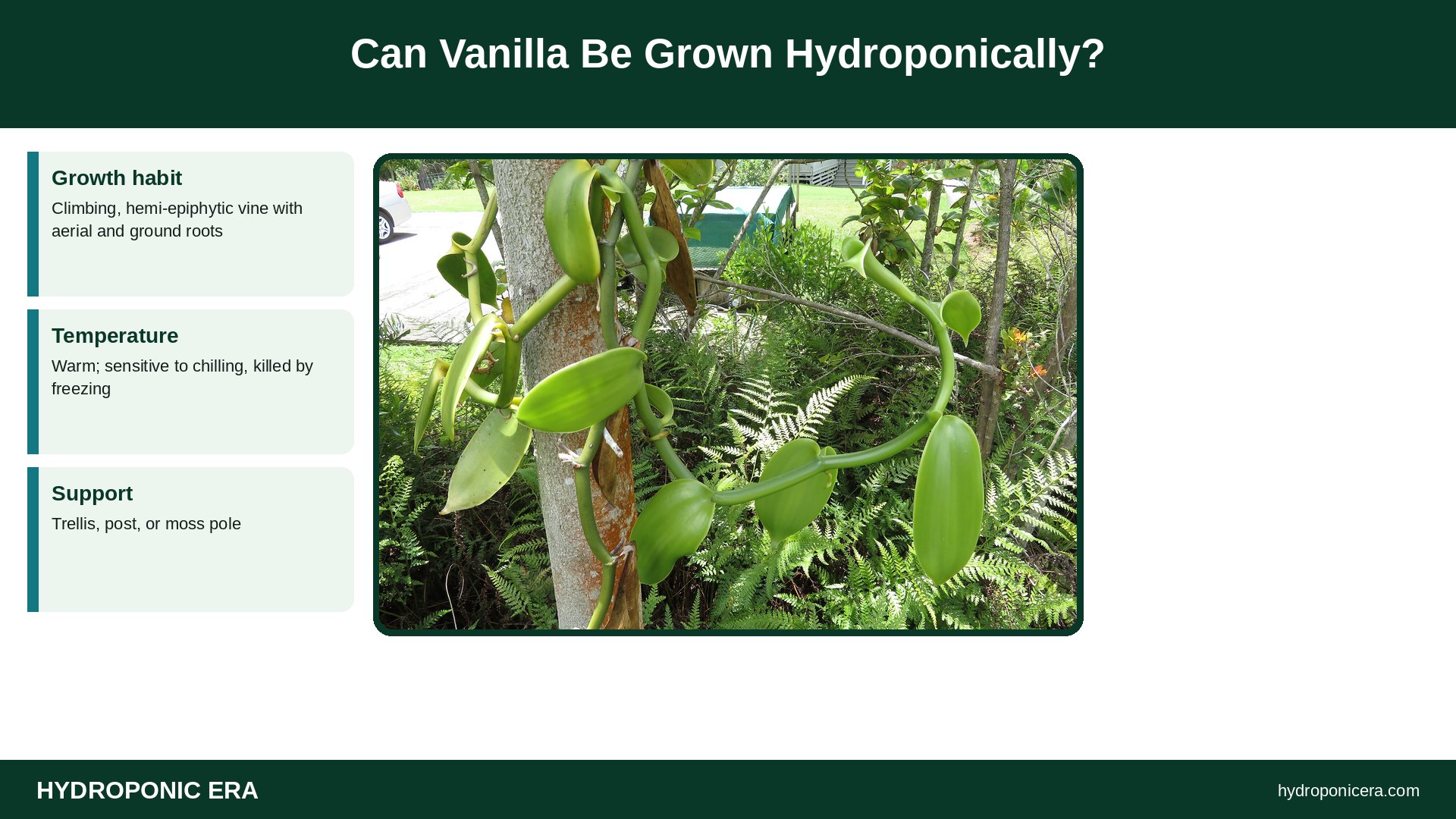
| Growth habit | Climbing, hemi-epiphytic vine with aerial and ground roots |
| Temperature | Warm; sensitive to chilling, killed by freezing |
| Support | Trellis, post, or moss pole |
| Flowering | Once a year; each flower lasts one day |
| Pollination | Usually by hand outside its native range |
| Bean ripening | About 8–9 months after pollination |
Is Vanilla Hydroponics Realistic?
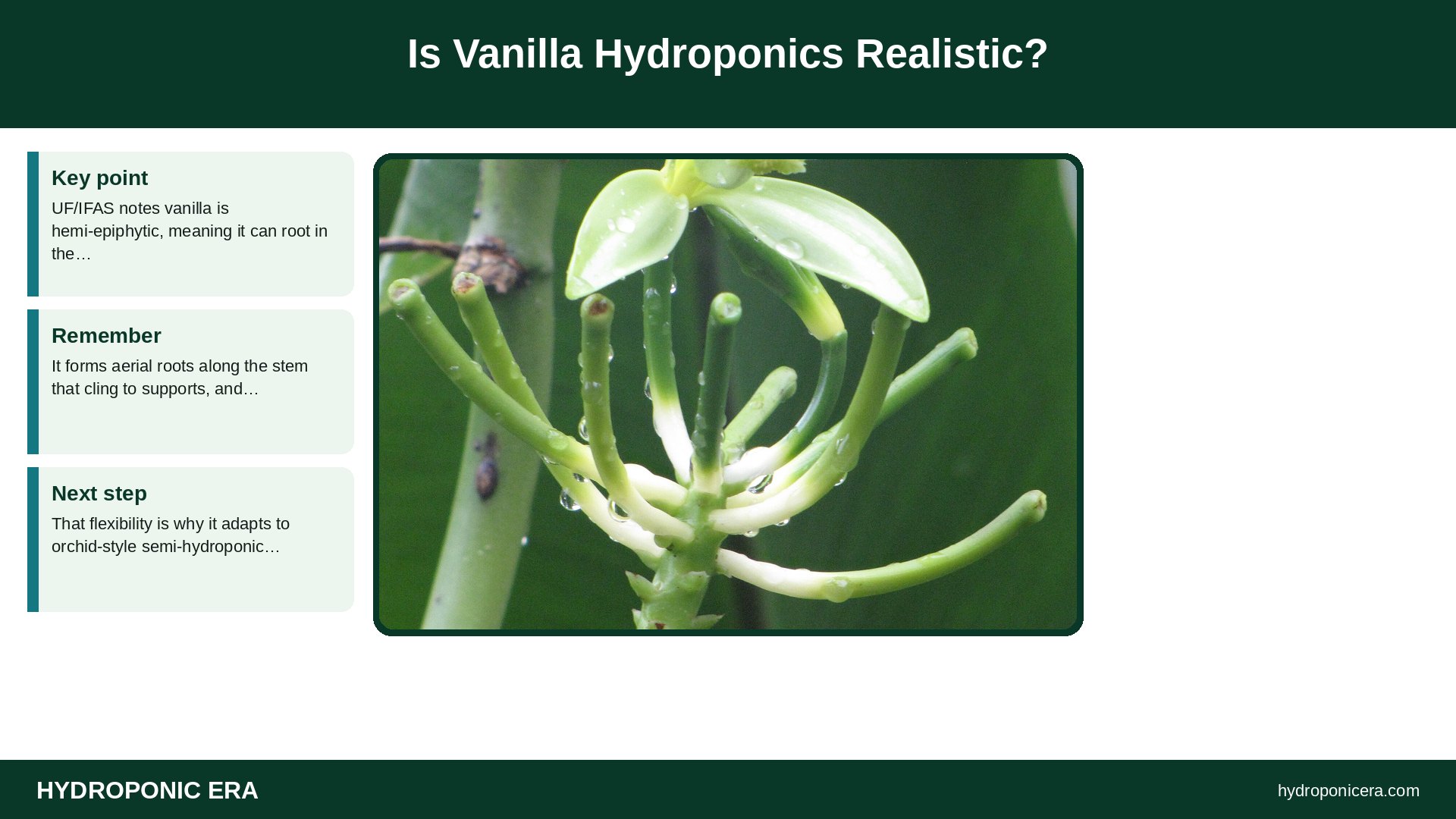
UF/IFAS notes vanilla is hemi-epiphytic, meaning it can root in the ground or grow on other plants without direct soil contact. It forms aerial roots along the stem that cling to supports, and branched ground roots that are often associated with mycorrhizae. That flexibility is why it adapts to orchid-style semi-hydroponic culture. In commercial growing, though, UF/IFAS says vines are kept on 6–8 inches of mulch substrate, not in water. So vanilla hydroponics is mainly a hobby approach for indoor plants. See water culture orchids.
Best Vanilla Hydroponics Setup: Semi-Hydro LECA
- Container: a pot without drainage holes in the bottom, with a side hole about 1 inch up to form a small reservoir.
- Media: rinsed clay pebbles. See clay pebbles.
- Support: a moss pole or trellis for aerial roots to grab.
- Water: keep the reservoir filled with dilute orchid-strength nutrient solution; flush with plain water monthly.
- Cutting: start from a rooted cutting with several nodes.
Fully submerged deep water culture isn’t recommended, because vanilla’s thick roots need air.
Light, Warmth, and Humidity for Vanilla Hydroponics
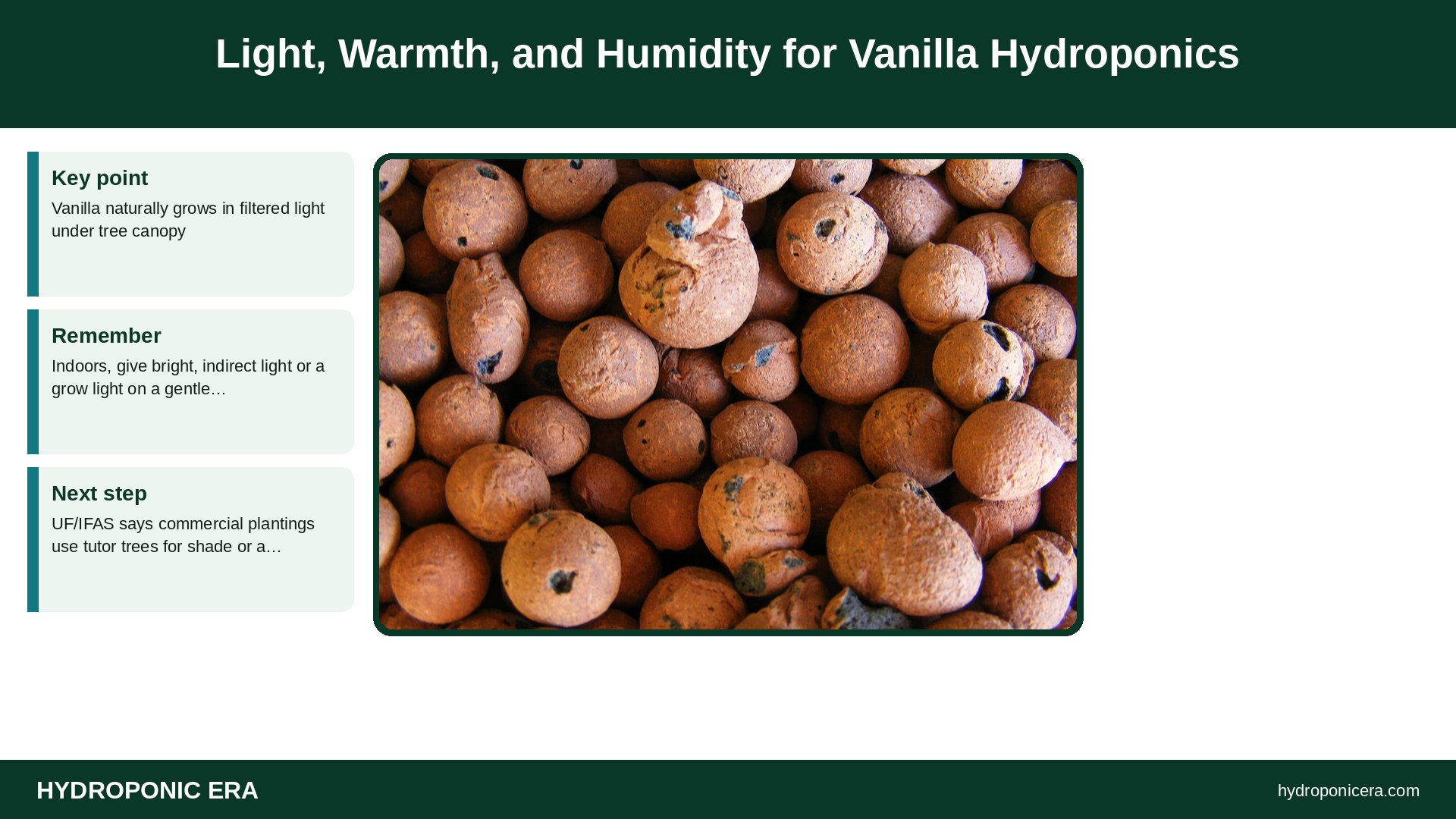
Vanilla naturally grows in filtered light under tree canopy. Indoors, give bright, indirect light or a grow light on a gentle setting. UF/IFAS says commercial plantings use tutor trees for shade or a post-and-wire system. Keep the plant warm year-round and away from cold drafts, since vanilla is chilling-sensitive. High humidity helps; a greenhouse, sunroom, or humidifier near the plant is ideal.
Will Hydroponic Vanilla Flower?
Flowering requires a mature vine, often several feet long and climbing. UF/IFAS notes vanilla flowers once a year, in southern Florida usually February to April. Flowers open early in the morning, usually one at a time per cluster, and each lasts only one day. Indoor plants often take years to reach flowering size, and many never flower in typical home conditions.
Hand-Pollinating Vanilla
UF/IFAS explains that vanilla wasn’t productive outside its native range until manual pollination methods were developed in the 1800s. To pollinate, open the flower gently, lift the thin flap (rostellum) that separates the male and female parts, and press the pollen mass onto the stigma with a toothpick, on the morning the flower opens. A successful pollination produces a green bean that swells and ripens over about eight to nine months.
Curing Vanilla Beans
Fresh green beans have little aroma. Vanilla flavor develops through a curing process of heating, sweating, and slow drying over weeks to months. Harvest when the tip begins to yellow, before the bean splits; UF/IFAS notes beans split along two seams at full maturity, which ruins them for commercial use.
Vanilla Hydroponics Problems
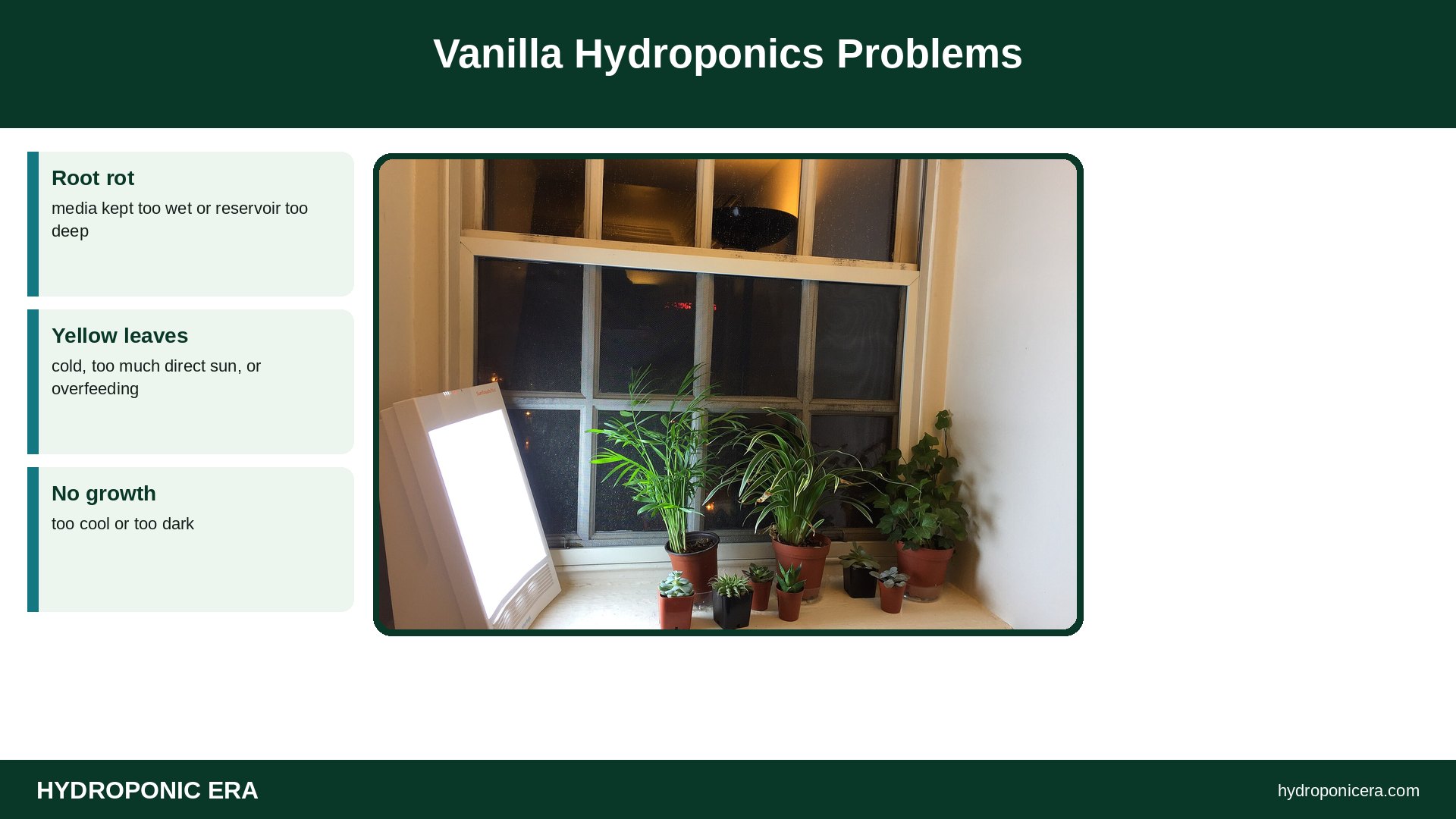
- Root rot: media kept too wet or reservoir too deep.
- Yellow leaves: cold, too much direct sun, or overfeeding.
- No growth: too cool or too dark.
- Sap irritation: vanilla sap can irritate skin; wear gloves when pruning.
Is Vanilla Hydroponics Worth It?
As a lush, climbing orchid in a warm room, yes. As a reliable spice source at home, not really; it’s slow and labor-intensive. If you enjoy challenging plants, it’s a rewarding project. See plants that struggle in home hydroponics.
Planning Tips: Vanilla Hydroponics
Vanilla hydroponics is a long-term project. Vanilla is a climbing orchid that needs a support pole, warmth, humidity, and filtered light, and it takes years to reach flowering size. Indoors, it needs a large space, and blooms must be hand-pollinated to set beans.
Because vanilla roots need air, use coarse media such as bark or clay pebbles with drip feeding rather than deep water culture.
Weekly Routine for Vanilla Hydroponics
- Check pH and EC, and record them.
- Top off the reservoir with plain, pH-adjusted water.
- Look at roots for color and smell.
- Check leaves, especially undersides, for pests.
- Clean filters, emitters, and pump intakes.
- Change the nutrient fully every two to three weeks, or sooner if EC drifts.
Beginner Mistakes With Vanilla Hydroponics
The most common mistakes are skipping pH testing, using nutrient that’s too strong, letting light reach the water, and ignoring water temperature. Each one is easy to fix once you know to check for it. Start with fewer plants than you think you need, learn the routine, and expand once the system runs smoothly.
Vanilla Hydroponics Environment
UF/IFAS describes vanilla as a tropical vine that grows best with warmth, humidity, and partial shade. Indoors, a greenhouse or large grow tent with a humidifier and LED lights is closest to those conditions. Give the vine a moss pole or post to climb, and loop long vines back down to encourage flowering.
Is Vanilla Hydroponics Worth It?
For most home growers, vanilla is a hobby plant rather than a reliable bean crop. It needs years, space, and hand pollination. If you enjoy orchids and have the room, it’s a rewarding challenge, but expect to grow the vine for its own sake first.
FAQs: Vanilla Hydroponics
Can vanilla grow hydroponically?
It can grow in semi-hydro LECA; commercial growers use mulch.
How long until vanilla flowers?
Usually years, once the vine is large and mature.
Does vanilla need hand pollination?
Yes, outside its native range, according to UF/IFAS.
How long do beans take to ripen?
About eight to nine months after pollination.
What temperature does vanilla need?
Warm; it’s sensitive to chilling and freezing kills it.
Can vanilla grow in water only?
Its roots need air; use coarse media.
Sources
- UF/IFAS Extension — Vanilla Growing in South Florida (HS1348)
- Photo credits (Wikimedia Commons, edited with titles): Starr-190807-6788-Vanilla planifolia-vine and growing tip-Hawea Pl Olinda-Maui (49254133228) by Forest and Kim Starr (CC BY 2.0); Starr-130316-2534-Vanilla planifolia-flower-Huelo-Maui (25207531365) by Forest and Kim Starr (CC BY 3.0 us); Hydroton by Lucis (CC BY-SA 3.0); New Monstera Deliciosa Leaf by Kittykittymaomao (CC BY-SA 4.0); Potted plants succulents under grow light Nov 2016 by Asdfjrjjj (CC BY-SA 4.0)