
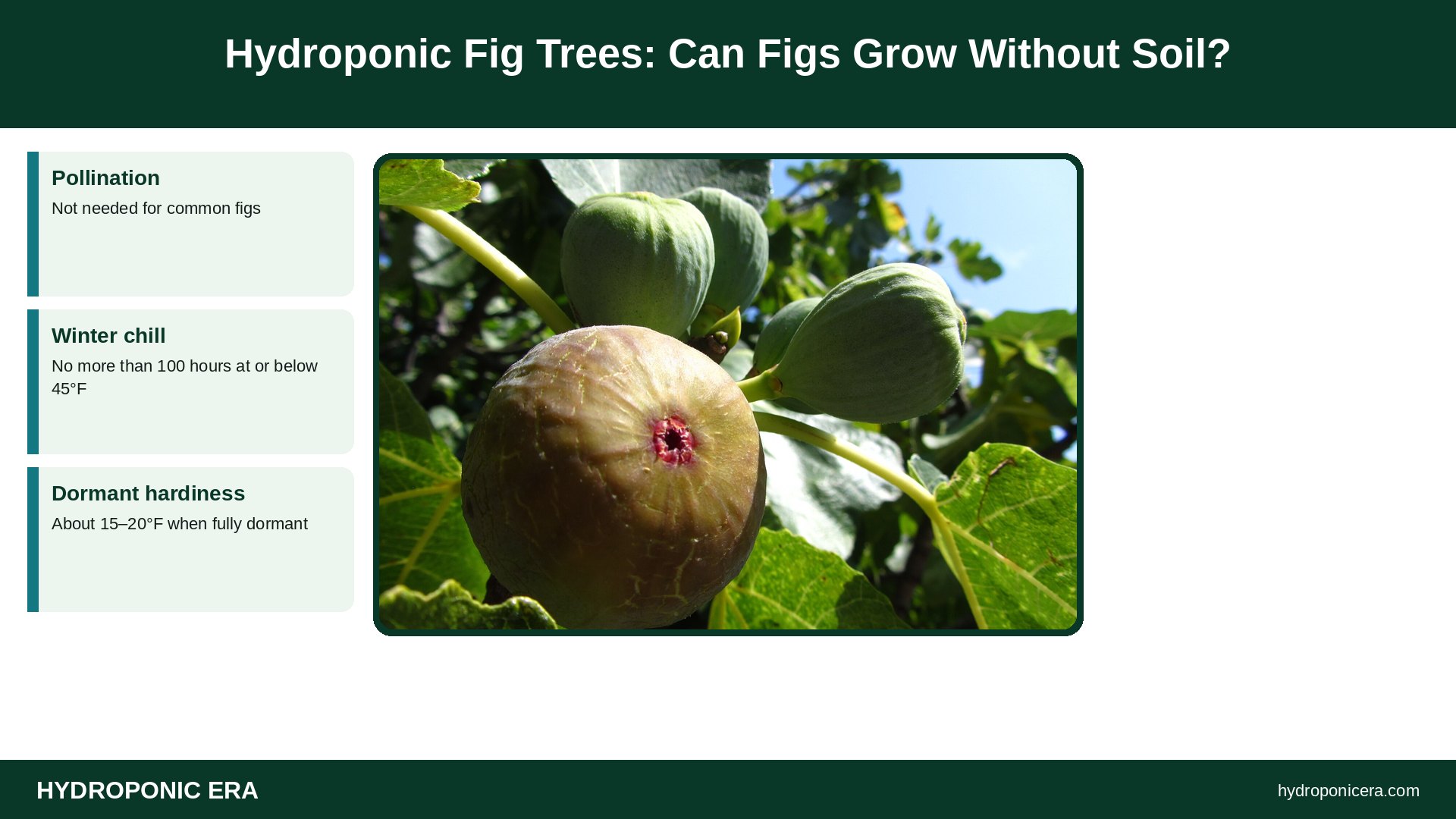
A hydroponic fig tree is one of the more practical fruit-tree projects, because figs stay manageable in containers, common fig varieties set fruit without pollination, and their winter chilling needs are low. UF/IFAS says common fig cultivars have only female flowers and don’t require pollination, that figs need no more than 100 hours at or below 45°F in winter, and that fully dormant trees are hardy to about 15–20°F. Grow a compact common fig such as ‘Celeste’ or ‘Brown Turkey’ in a large container of coarse media with drip feeding, full sun or strong light, and a cool winter rest.
Key takeaway: Pick a common (self-fruiting) fig, grow it in drip-fed coarse media, give it full sun, and let it rest in winter.
| Need | UF/IFAS guidance |
|---|---|
| Pollination | Not needed for common figs |
| Winter chill | No more than 100 hours at or below 45°F |
| Dormant hardiness | About 15–20°F when fully dormant |
| Light | Full sun |
| Good cultivars | ‘Celeste’, ‘Brown Turkey’ (common types) |
Can You Grow a Hydroponic Fig Tree?
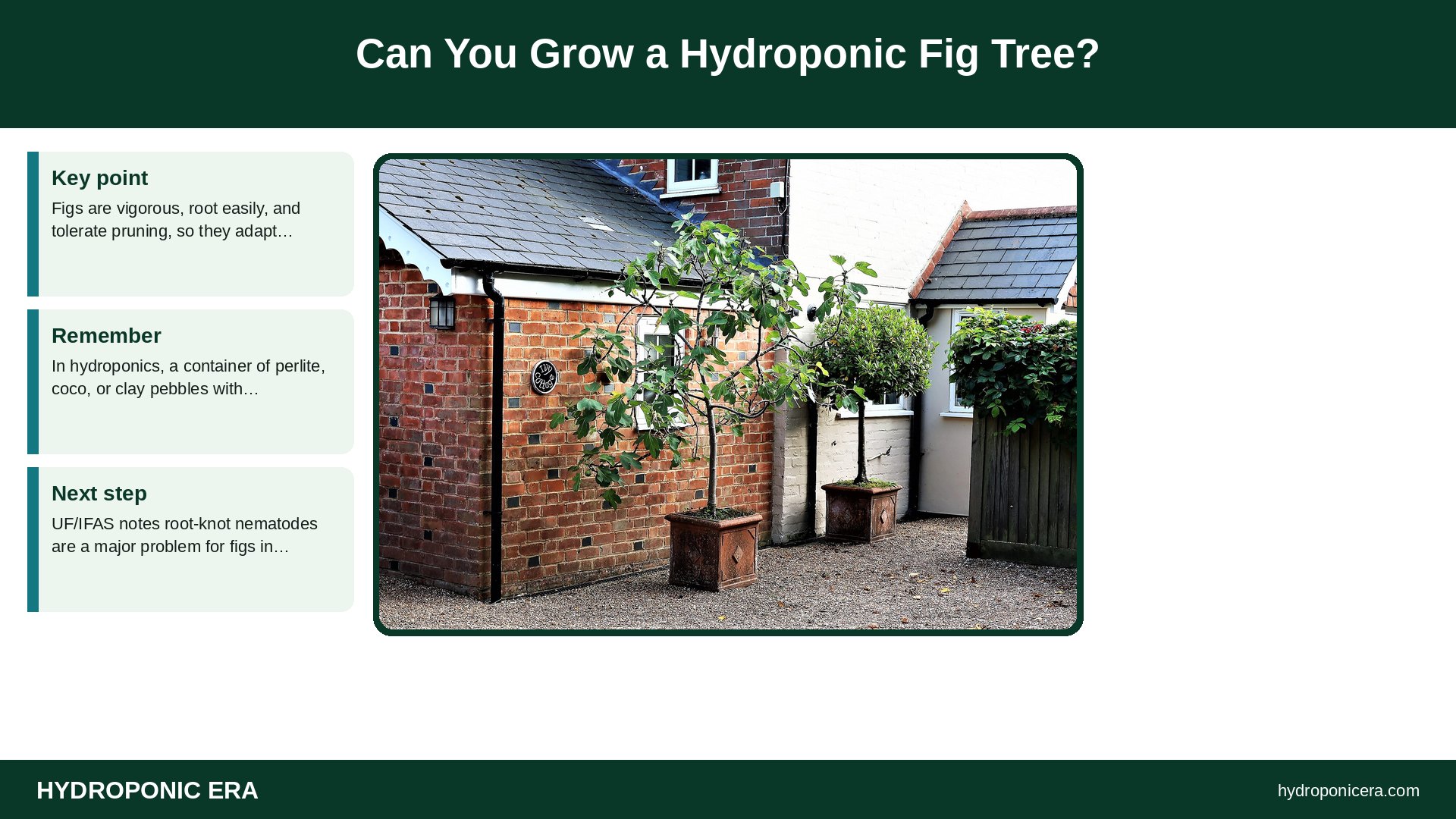
Yes. Figs are vigorous, root easily, and tolerate pruning, so they adapt well to containers. In hydroponics, a container of perlite, coco, or clay pebbles with drip irrigation gives roots air and steady moisture. UF/IFAS notes root-knot nematodes are a major problem for figs in sandy soil, which soilless containers avoid. See hydroponic dwarf fruit trees.
Best Varieties for a Hydroponic Fig Tree
UF/IFAS explains that Smyrna-type figs need a caprifig and the fig wasp for pollination, while common types set fruit without it. Indoors and in most of the US, choose common types. UF describes ‘Celeste’ as fairly cold hardy and probably the second most common fig in the Southeast, and ‘Brown Turkey’ as a widely grown common fig. Closed-eye fruit, which UF recommends, resists insects and souring.
Best Systems for a Hydroponic Fig Tree
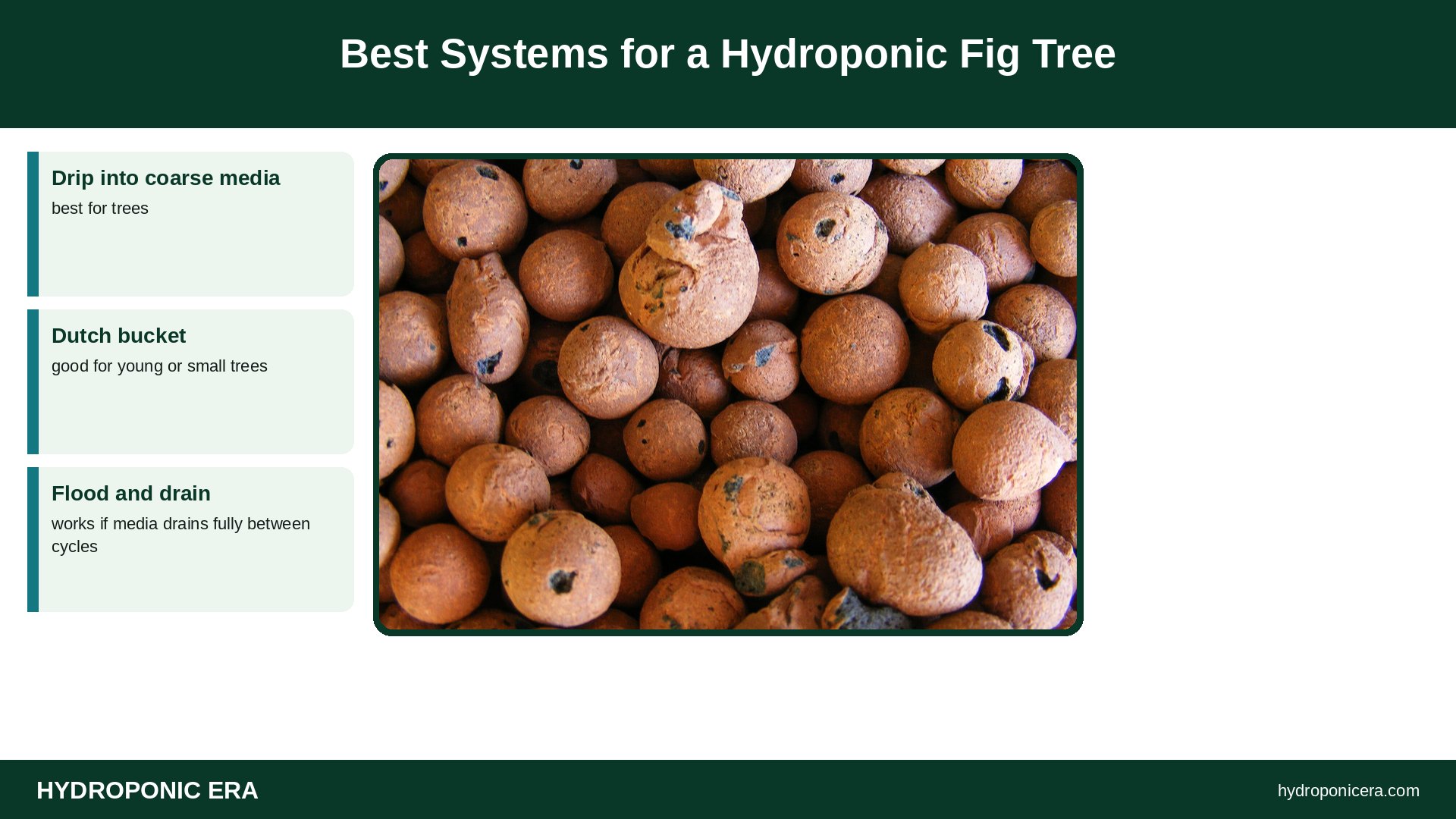
- Drip into coarse media: best for trees.
- Dutch bucket: good for young or small trees.
- Flood and drain: works if media drains fully between cycles.
- DWC: risky for woody roots in warm water.
Use a 10–20 gallon container for a fruiting tree. See Dutch bucket hydroponics.
Hydroponic Fig Tree: Light and Temperature
Figs fruit best in full sun. Indoors, they need strong LED light or a sunny greenhouse; outdoors in summer is easiest. Hot, dry conditions suit figs; UF notes Florida’s humid season increases insect and disease pressure and rain can split fruit. See LED watts per square foot.
Hydroponic Fig Tree: Winter Rest
UF/IFAS says figs need no more than 100 hours at or below 45°F to develop buds normally, a low requirement that an unheated garage or cool room can meet. Let leaves drop, cut feeding to a minimum, and keep media just barely moist. Fully dormant trees are hardy to about 15–20°F, according to UF, but container roots are more exposed than roots in the ground, so protect pots from hard freezes.
Nutrients for a Hydroponic Fig Tree
Use a complete fruiting-crop nutrient, keep pH around 5.5–6.5, and feed moderately during active growth. Too much nitrogen gives lush leaves and fewer figs. Flush media with plain water every few weeks to avoid salt buildup. See how to lower EC.
Harvesting Figs
Figs don’t ripen much after picking, so harvest when fruit is soft, droops on its stem, and has full color. UF describes some cultivars bearing an early “breba” crop on old wood and a main crop on new growth. Wear gloves if the milky sap irritates your skin.
Pruning
Prune in late winter while dormant to keep the tree compact, remove crossing branches, and open the center to light. Container figs can be kept to a few feet tall.
Common Problems
- Fruit drops unripe: water stress or too little light.
- Split fruit: sudden heavy watering or humidity.
- Spider mites: common indoors in dry air.
- Root rot: media too wet.
Hydroponic Fig Tree Propagation
Figs root easily from hardwood cuttings taken in winter. Stick cuttings in moist perlite or coco, keep them warm, and they usually root in a few weeks. This lets you start new trees from a variety you like. UF/IFAS describes many named cultivars, so take cuttings from trees with fruit you know you enjoy.
Moving a Fig Outdoors
A fig in a container can spend summer outdoors in full sun and winter in a cool garage during dormancy. Move it gradually to avoid leaf scorch, and pause drip feeding during dormancy.
Equipment Checklist for Hydroponic Fig Tree
- A large container (15–25 gallons) with drain holes.
- Coarse media: perlite, coco, or clay pebbles.
- A drip pump, timer, and emitters.
- A pH and EC meter.
- A complete fruiting-crop nutrient.
- A stake or trellis for support.
Most of this gear is reusable from crop to crop, so the first setup costs the most. Buy reliable meters first; they prevent the majority of problems.
Beginner Mistakes With Hydroponic Fig Tree
Common mistakes are choosing a fig that needs pollination, skipping the winter rest, overfeeding nitrogen, and keeping media too wet.
Getting Started With Hydroponic Fig Tree
Start small, change one thing at a time, and keep a simple log of pH, EC, temperature, and what you changed. Most hydroponic problems show up as patterns in those numbers before they show on the plant. Compare your notes with the sources below, and adjust slowly rather than chasing every small swing. A steady routine matters more than any single product or setting.
FAQs: Hydroponic Fig Tree
Do figs need pollination?
Common figs don’t, according to UF/IFAS.
Can a fig tree grow indoors?
Yes, with strong light and a winter rest.
How cold does a fig need in winter?
No more than 100 hours at or below 45°F.
What size container?
About 10–20 gallons for a fruiting tree.
Which fig is best?
Common types like ‘Celeste’ or ‘Brown Turkey’.
Can figs grow in DWC?
It’s risky for woody roots; drip into media is safer.
Sources
- UF/IFAS — The Fig (MG214)
- UF/IFAS — Nematodes of Backyard Deciduous Fruit and Nut Crops in Florida
- Photo credits (Wikimedia Commons, edited with titles): Ripe fig fruit on tree (Ficus Carica) in Southern France by Stefan Thiesen (CC BY-SA 3.0); Potted fig and bay trees at Ivy Cottage, New Cut, Westfield – geograph.org.uk – 6978632 by Patrick Roper (CC BY-SA 2.0); Hydroton by Lucis (CC BY-SA 3.0); Drip irrigation (2552390830) by Dwight Sipler from Stow, MA, USA (CC BY 2.0); Greenhouse in Qingjing Small Swiss Garden 清境小瑞士花園溫室 – panoramio by lienyuan lee (CC BY 3.0)