
Yes, Chinese evergreen in water works: University of Illinois Extension says Aglaonema can be grown in water or in humus-rich potting soil. To root one, take a healthy stem tip with four or five leaves, cut just below a node, remove any leaves that would sit underwater, and stand it in a jar of room-temperature water in bright, indirect light. Keep it above 65°F (18°C), never below 55°F (13°C), and change the water weekly. Roots typically take several weeks. You can leave it in water long term with dilute fertilizer, or pot it once roots are a few inches long.
Key takeaway: Chinese evergreen is cold-sensitive and slow, not fussy. Warmth matters more than anything: UF/IFAS research warns that air below 55°F (13°C) can cause chilling injury, which shows up 3–7 days after exposure.
| Factor | Recommendation | Source |
|---|---|---|
| Cutting | Tip cutting with 4–5 leaves | UF/IFAS EP160 |
| Light | Shadowless light such as a north window; never full sun | Illinois, UF/IFAS |
| Temperature | 70–80°F (21–27°C) daytime; avoid below 55°F (13°C) | N.C. State, UF/IFAS |
| Water | Room-temperature, never cold; change weekly | N.C. State |
| Long-term | Can be grown in water | Illinois |
| Safety | Calcium oxalate; toxic if eaten, sap irritates skin | N.C. State |
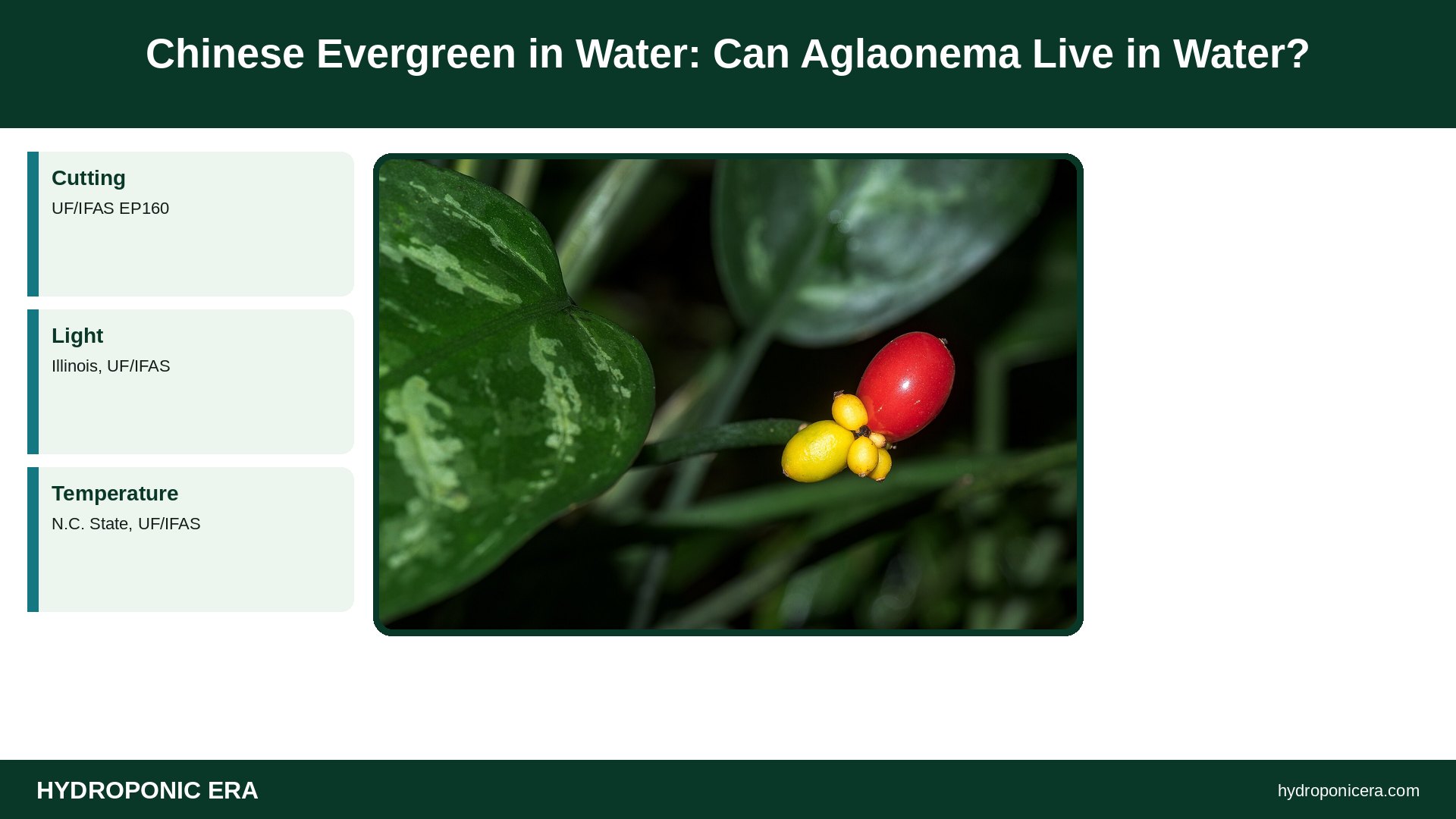
Can Chinese Evergreen Live in Water?
University of Illinois Extension’s houseplant guide states that Chinese evergreens grow in water or in humus potting soil, flourish for years, and need minimal care. That makes Aglaonema a good choice for jars, vases and simple hydroponic setups. It’s in the arum family (Araceae), the same family as pothos and philodendron, which are also known for living in water.
There is a trade-off. Illinois Extension’s propagation page cautions that roots formed in water are often weaker and don’t adapt as easily to potting mix as roots formed in a rooting medium. So decide early: if the plant will stay in water, root it in water; if you want a potted plant, consider rooting in a moist, airy medium.
How to Root Chinese Evergreen in Water
- Pick a leggy stem. Illinois Extension recommends tip cuttings when stems become too long.
- Take a full tip. UF/IFAS commercial guidelines call for cuttings with four or five leaves.
- Wear gloves. N.C. State Extension notes the sap contains calcium oxalate crystals that can cause dermatitis.
- Cut below a node. Remove any lower leaves that would be submerged.
- Use room-temperature water. N.C. State advises avoiding cold water with this plant.
- Keep it warm and bright. Diffuse sun or good indirect light; a north window works well.
- Change water weekly. Rinse the jar to limit slime and algae.
How Long Does Chinese Evergreen Take to Root in Water?
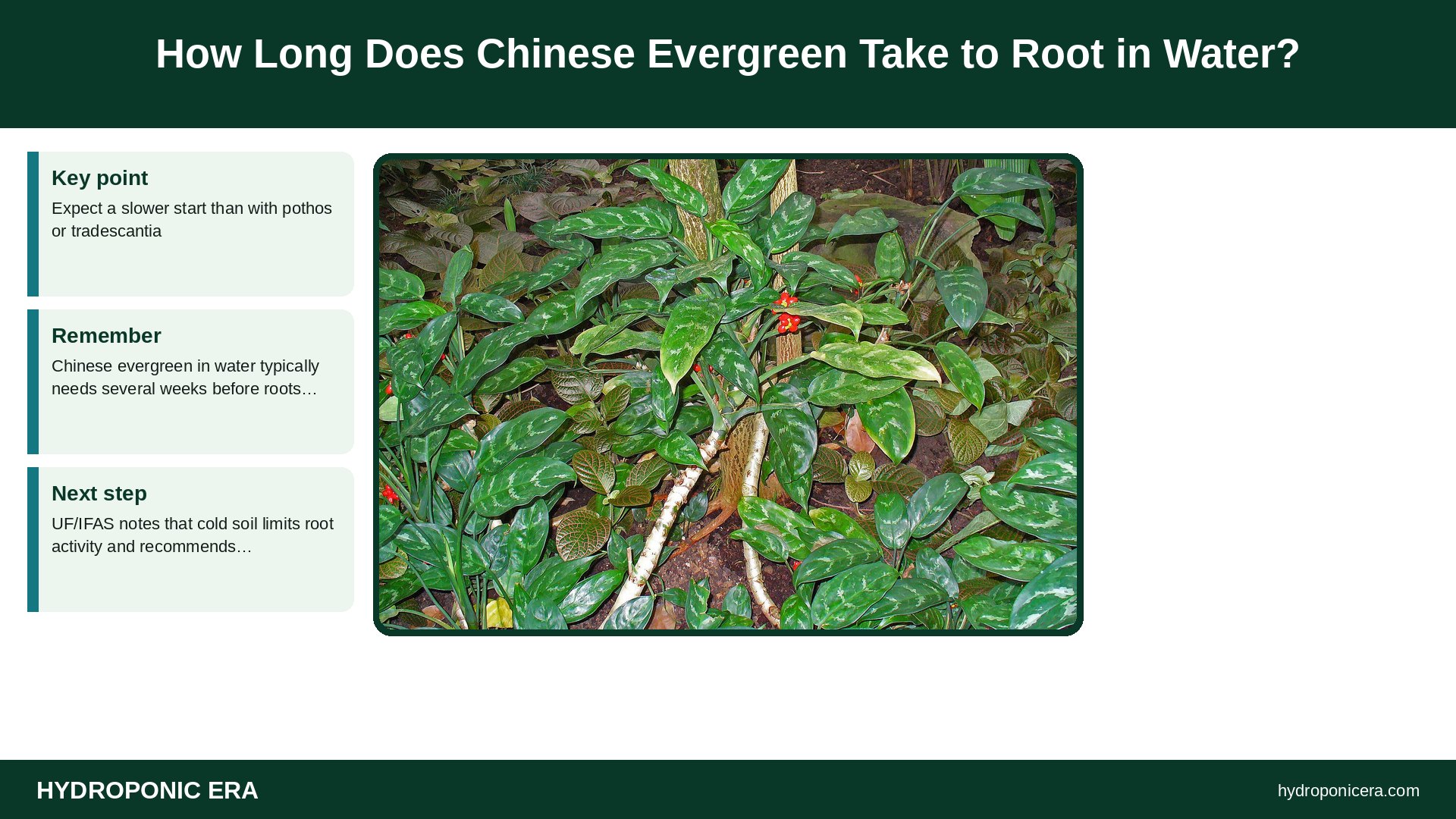
Expect a slower start than with pothos or tradescantia. Chinese evergreen in water typically needs several weeks before roots are well developed, and cool rooms slow it further. UF/IFAS notes that cold soil limits root activity and recommends keeping root-zone temperatures above 65°F (18°C) in production. A warm spot away from drafts and cold windows is the best way to speed rooting.
Growing Chinese Evergreen in Water Long Term
To keep Chinese evergreen in water for years, treat the container like a small hydroponic system:
- Feed lightly. Plain water has almost no nutrients. Add a dilute liquid houseplant or hydroponic fertilizer.
- Refresh water. Change it fully every week or two, topping off in between.
- Keep the crown dry. Only stems and roots should be submerged.
- Watch salts. UF/IFAS recommends moderate soluble salts for Aglaonema in production, so don’t overdose fertilizer.
Our guides to plants that grow in water and philodendron in water cover the same long-term jar setup.
Moving Chinese Evergreen in Water to Soil
If you move a cutting to soil, use a well-drained mix and allow it to dry between waterings, as N.C. State recommends, since overwatering causes root rot. Water less in winter. Expect a short adjustment period, because water roots are weaker, according to Illinois Extension. Keep humidity reasonably high; N.C. State says the plant prefers high humidity but tolerates drier air.
Light and Temperature for Chinese Evergreen in Water
- Light: UF/IFAS says Aglaonema tolerates very low light, down to about 270 lux, but full sun scorches leaves. N.C. State calls it an excellent low-light plant.
- Temperature: N.C. State lists a preferred daytime range of 70–80°F (21–27°C). UF/IFAS notes chilling injury below 50–55°F (10–13°C), starting on older leaves.
- Cultivars: UF/IFAS notes cultivars vary in chilling tolerance; ‘Silver Queen’ is especially sensitive.
Troubleshooting Chinese Evergreen in Water
- Yellow, damaged older leaves after a cold night: Chilling injury. Move away from cold glass.
- Mushy stem: Rot from dirty water. Recut above the damage.
- Scorched patches: Too much direct sun.
- No roots after many weeks: Too cool. Move to a warmer spot.
Choosing a Container for Chinese Evergreen in Water
Pick a container heavy enough to hold a top-heavy stem upright. A narrow-necked vase supports the cutting so leaves stay out of the water, while a wide jar fits several cuttings. Opaque or tinted glass keeps light off the roots and slows algae; clear glass lets you watch roots grow but needs more frequent rinsing. Some growers add a layer of clay pebbles or glass stones at the bottom to anchor stems, similar to how lucky bamboo is grown in water. Whatever you use, wash it at every full water change, and refill with room-temperature water rather than cold water from the tap.
Division: The Other Easy Method
If your plant is a thick clump, division may be faster than rooting a cutting. UF/IFAS explains that rooting cuttings and dividing basal shoots, or suckers, are the main ways Aglaonema is propagated, because tissue culture hasn’t worked well for this genus. Cultivars differ: some produce more than four suckers, while others produce none.
To divide, slide the plant out of its pot, gently separate a shoot that already has its own roots, and either pot it or rinse the roots clean and place it straight into water. Because a division already has roots, it skips the slow rooting stage entirely, making it the quickest route to a new Chinese evergreen in water.
FAQs
Can Chinese evergreen grow in water permanently?
Yes; Illinois Extension says it can be grown in water.
How long does Aglaonema take to root in water?
Usually several weeks; warmth speeds it up.
Is Chinese evergreen toxic to pets?
Yes; N.C. State says it contains calcium oxalate and is poisonous if eaten.
Can I propagate Chinese evergreen by division?
Yes; UF/IFAS lists division of basal shoots as a main method.
What temperature is too cold?
Below 55°F (13°C) risks chilling injury.
Does it need fertilizer in water?
Yes, a dilute dose for long-term growth.
Why are my Chinese evergreen leaves drooping?
UF/IFAS notes tall-leaved cultivars can droop in low light; move the plant somewhere brighter, out of direct sun.
Sources
- University of Illinois Extension — Chinese Evergreen and Propagation
- N.C. State Extension Plant Toolbox — Aglaonema
- Chen, J., Henny, R. J., et al. UF/IFAS Extension — Cultural Guidelines for Commercial Production of Interiorscape Aglaonema (ENH957/EP160)
- Photo credits (Wikimedia Commons, edited with titles): 20260317 Aglaonema commutatum by Flocci Nivis (CC BY 4.0); Aglaonema costatum 001 by H. Zell (CC BY-SA 3.0); Peace lily – 2 by W.carter (CC BY-SA 4.0); Philodendron hederaceum, Singapore Botanic Gardens (141542) by Moheen Reeyad (CC BY-SA 4.0); Dracaena sanderiana 132158060 by Beah Vega (CC BY 4.0)