
What is pond aquaponics? Pond aquaponics uses a backyard fish pond as the nutrient source for plants. Water is pumped from the pond through a solids filter and a planted bed or floating raft, where bacteria turn fish waste into nitrate that plants absorb, then returns cleaner. It’s an easy way to clear green water and grow herbs or ornamentals.
Key takeaway: Pond aquaponics works best as a filter that also grows plants. Keep stocking light, remove solids first and keep pond water off the edible parts of food crops.
| Setup | How it works | Best for |
|---|---|---|
| Floating rafts on the pond | Plants on foam or floating islands, roots in pond water | Simplest; ornamentals and herbs |
| Gravel bed beside the pond | Pump feeds a media bed that drains back | Filtration plus vegetables |
| Stream or waterfall planter | Plants in the return channel | Looks natural; strong filtering |
| Separate planted refugium | Side tank fish can’t reach | Koi ponds, where fish uproot plants |

How Does Pond Aquaponics Work?
It runs on the nitrogen cycle. University of Arizona Extension explains that aquaponics combines fish, plants and microorganisms: fish release waste, bacteria convert ammonia to nitrite and then nitrate in the presence of oxygen, and plants remove nitrate as they grow. Kansas State University describes the same process in water gardens, noting that beneficial bacteria turn toxic ammonia and nitrite into nitrate that plants and algae use. In pond aquaponics, you simply give plants more of that nitrate, so less is left for algae.
Does Pond Aquaponics Clear Green Water?
It helps a lot. Kansas State says plant competition for nutrients ultimately starves green-water algae, and that floating plants and lilies shade the surface and keep water cool. It recommends 50–75% coverage of the water surface, with more plants for small ponds under 1,000 gallons (3,800 L) and sunny sites. A planted aquaponic bed adds that nutrient competition without covering your view of the fish. See our guide to algae in reservoirs for the light-and-nutrient side.
What Equipment Does Pond Aquaponics Need?
Arizona Extension lists the core components of any aquaponic system: fish tank, solids filtration, biofiltration, plant growing area, pumps and plumbing, aeration and monitoring equipment. For a pond:
- Pump: Sized to move the pond volume through the bed regularly; see pump sizing.
- Prefilter: A sponge, settling bucket or skimmer so solids don’t clog the bed.
- Grow bed or rafts: Gravel, expanded clay or floating foam.
- Aeration: An air pump and stones; oxygen supports fish and bacteria.
- Test kit: Ammonia, nitrite, nitrate, pH and carbonate hardness (KH).
- GFCI-protected outlet for all electrical gear.

How Do You Set Up Pond Aquaponics Step by Step?
- Dechlorinate. Kansas State says to treat new water before adding life, since city and well water can contain chemicals toxic to fish and microorganisms.
- Test KH and pH. Kansas State lists ideal KH at 90–180 ppm and pH at 6.8–8.2, with no more than 0.8 pH swing per day.
- Place the bed beside or above the pond so it drains back by gravity.
- Add a prefilter on the pump intake or before the bed.
- Fill the bed with rinsed gravel or clay pebbles.
- Run water for a few weeks so bacteria colonize; test ammonia and nitrite.
- Plant once ammonia and nitrite read near zero.
- Add fish after plants. Kansas State advises adding fish after plants so they have hiding places.
How Many Fish Can a Pond Aquaponics System Support?
Stock lightly. Kansas State recommends less than 1 inch of fish per square foot (about 2.5 cm per 0.09 m²) of pond surface for water gardens. That low density keeps waste manageable without the heavy filtration of commercial aquaponics. More fish means more nutrients but greater risk of ammonia spikes and low oxygen. Arizona Extension warns that system failures like pump or oxygen loss can quickly harm fish.
| Pond surface | Fish length limit (Kansas State guideline) |
|---|---|
| 50 sq ft (4.6 m²) | Under 50 in (127 cm) total |
| 100 sq ft (9.3 m²) | Under 100 in (254 cm) total |
| 200 sq ft (18.6 m²) | Under 200 in (508 cm) total |
Which Fish Work Best for Pond Aquaponics?
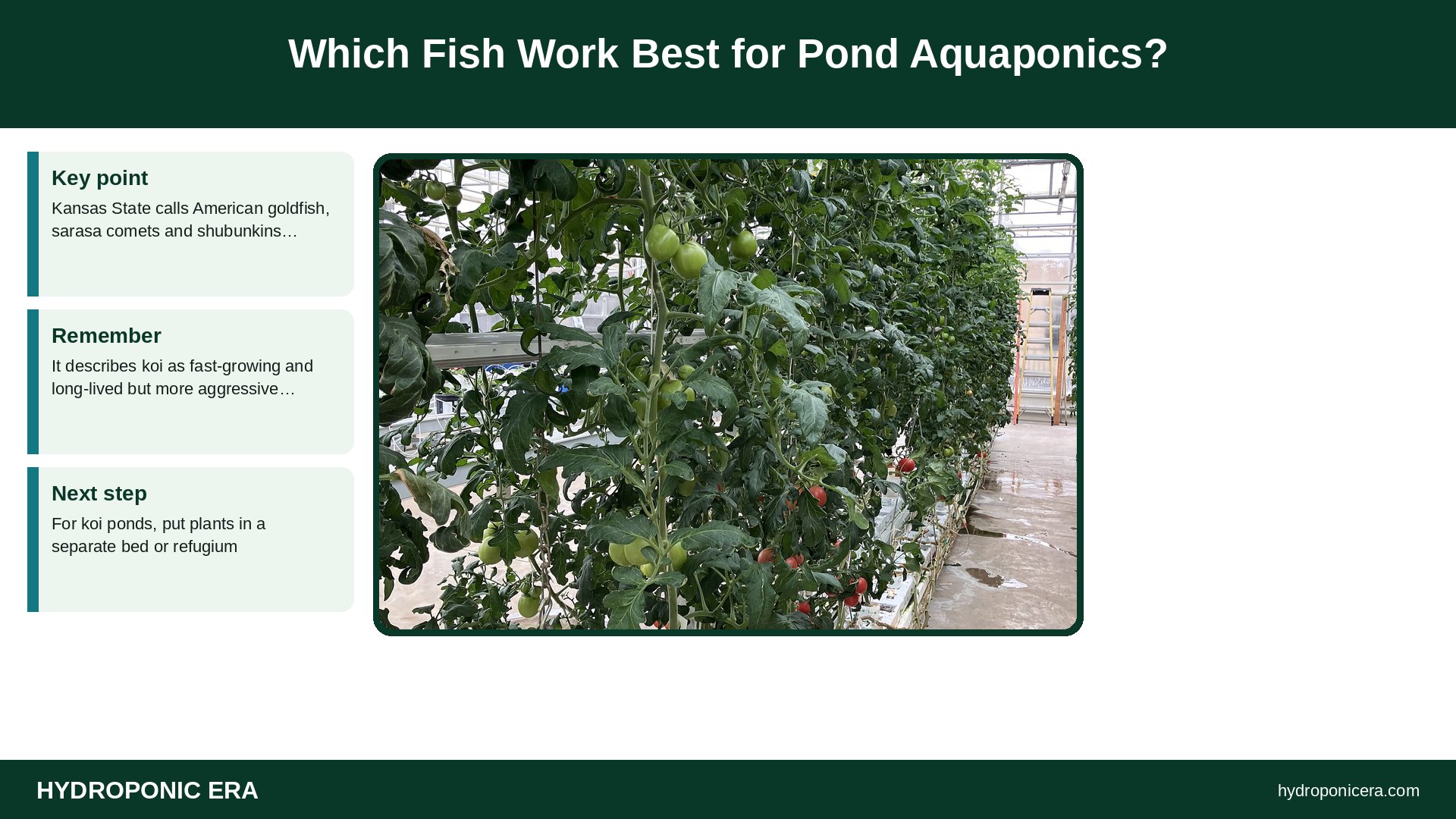
Kansas State calls American goldfish, sarasa comets and shubunkins practical choices: they’re compatible with plants and eat pests. It describes koi as fast-growing and long-lived but more aggressive, noting they love to burrow and uproot potted plants, so plants must be protected or separated. For koi ponds, put plants in a separate bed or refugium. Our aquaponics for beginners guide covers food fish options.
What Plants Grow Well in Pond Aquaponics?
- Leafy herbs: Watercress, mint and basil handle wet roots.
- Lettuce and greens: Good on rafts in mild weather.
- Ornamentals: Canna, iris and pickerel rush in gravel beds or margins.
- Floating plants: Kansas State notes floating plants’ suspended roots compete with algae for nutrients. Check your state’s invasive species list before buying any floating plant.
Fast-growing leafy plants remove the most nitrate. Fruiting crops need more nutrients than a lightly stocked pond usually provides.
Is Pond Aquaponics Safe for Growing Food?
It can be, with care. Pond water may contain bacteria from fish, birds and wildlife. Reduce risk by:
- Growing crops whose edible parts stay above the water.
- Keeping pond water off leaves; don’t splash or spray it.
- Washing hands after handling pond water.
- Washing produce well and skipping raw eating of anything that touched pond water.
Arizona Extension also notes aquaponics isn’t automatically organic and doesn’t always eliminate the need for added fertilizers. See hydroponic food safety at home.
How Do You Maintain Pond Aquaponics?
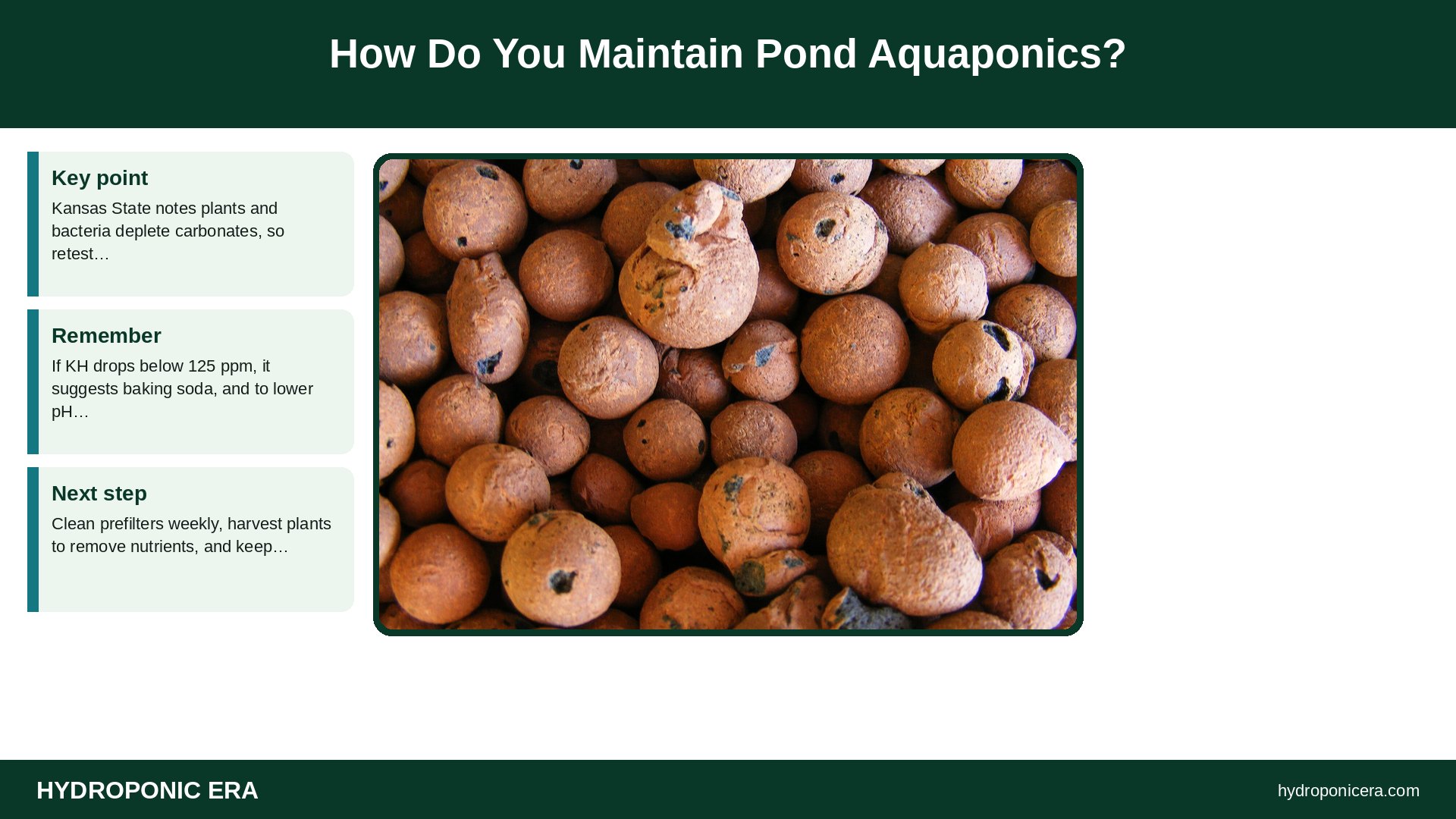
Test monthly. Kansas State notes plants and bacteria deplete carbonates, so retest KH monthly in the growing season. If KH drops below 125 ppm, it suggests baking soda, and to lower pH it advises no more than a 0.2-point drop per day. Clean prefilters weekly, harvest plants to remove nutrients, and keep air running. A backup power plan protects fish during outages.
FAQs
Can pond aquaponics run in winter?
Plants slow or die in cold. Many growers pause beds in winter while keeping the pond aerated.
Do I still need a pond filter?
Yes. Arizona Extension says solids removal and biofiltration are essential.
Can I add snails?
Kansas State advises against snails and clams, which can host parasites.
Does barley straw help?
Kansas State says barley releases compounds that slow algae.
How much sun does a pond aquaponics bed need?
Leafy crops grow best with at least six hours of direct sun. Kansas State notes water lilies also need at least six hours a day to bloom.
How big should the grow bed be?
Start small relative to the pond, then expand if nitrate stays high and algae persist. Test before and after changes.
Will plants hurt fish?
No; plants add oxygen in daylight and shelter fish.
Sources
- Kansas State University Research and Extension — Water Gardening: Biological Balance, MF2911 (PDF)
- University of Arizona Cooperative Extension — Aquaponics Basics: How Fish, Plants, and Microbes Work Together (AZ2215)
- Photo credits (Wikimedia Commons, edited with titles): Pond-edge plants at Achamore Garden – geograph.org.uk – 5446824 by M J Richardson (CC BY-SA 2.0); Koi in a garden pond in Tuntorp 3 by W.carter (CC BY-SA 4.0); Solanum lycopersicum in aquaponics at the NC Greenhouse Nursery by Gogerr (CC BY-SA 4.0); Hydroton by Lucis (CC BY-SA 3.0); Deepwater Aquaponics Floating Rafts Growing Lettuce, Basil and Arugula by Alabama Extension (CC0)