
Can you propagate dieffenbachia in water? Yes. Illinois Extension says a leggy dieffenbachia top can be cut off and rooted in sand or water. Cut a 4–6 inch (10–15 cm) top or a 2–3 inch (5–8 cm) cane section with at least two nodes, stand it in water in bright, indirect light at 70–80°F (21–27°C), wear gloves and change the water weekly.
Key takeaway: Dieffenbachia in water roots from tops and cane pieces with nodes. Always wear gloves, because the sap irritates skin and eyes and the plant is toxic to people and pets.
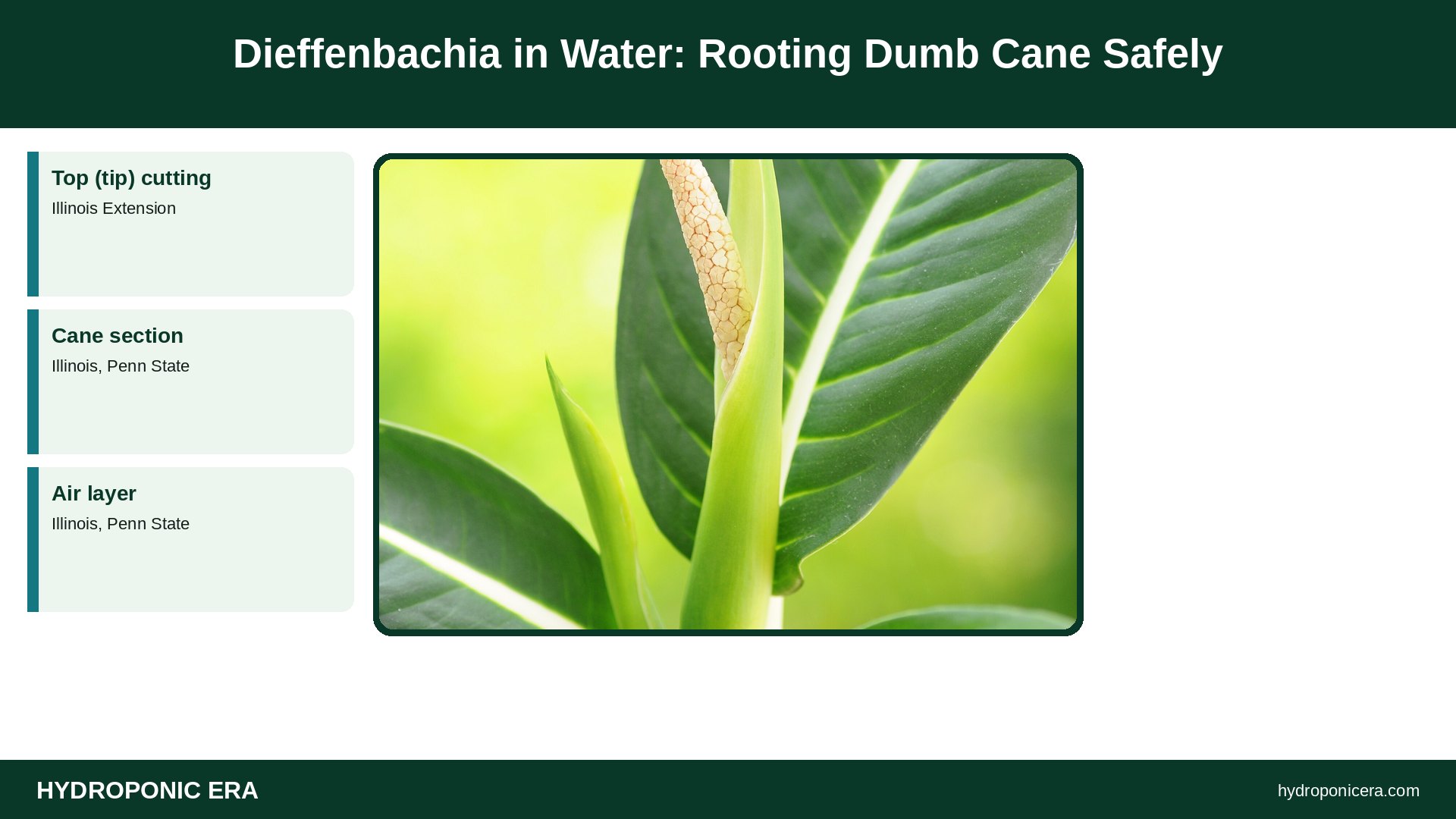
| Cutting type | Size | What grows | Source |
|---|---|---|---|
| Top (tip) cutting | 4–6 in (10–15 cm) | Roots at submerged nodes | Illinois Extension |
| Cane section | 2–3 in (5–8 cm), 2+ nodes | Roots below, new shoot above | Illinois, Penn State |
| Air layer | On the plant | Rooted top, cut free later | Illinois, Penn State |
| Division | Split clumps | Instant small plant | NC State |
Why Grow Dieffenbachia in Water From Cuttings?
Dieffenbachia, often called dumbcane, grows 3–8 feet (0.9–2.4 m) tall and is scarcely branched, according to NC State Extension. Older plants drop lower leaves and become bare, leggy canes. Illinois Extension’s fix is simple: cut off the top and root it in sand or water. The leftover cane can be cut into sections that sprout new plants, so one leggy plant becomes several.
Is Dieffenbachia in Water Toxic to Handle?
Yes, take this seriously. NC State says the sap contains needle-like calcium oxalate crystals that cause burning and swelling of the lips, tongue and throat if chewed, and sap in the eyes can damage the cornea. It may be fatal to pets and livestock. Illinois warns the sap is toxic to open cuts.
- Wear gloves and eye protection when cutting.
- Wash tools and hands afterward.
- Keep jars away from children and pets.
How Do You Root Dieffenbachia in Water Step by Step?
- Put on gloves and lay down newspaper.
- Cut the top 4–6 inches (10–15 cm) just below a node with a clean, sharp knife.
- Remove the lowest leaves so one or two nodes are bare.
- Let the cut end dry for a few hours to slow rot.
- Stand it in a jar with the bare nodes underwater.
- Place it in bright, indirect light, away from direct sun and cold drafts, as NC State advises.
- Keep it warm, ideally 75–80°F (24–27°C), the rooting range Illinois and Penn State recommend.
- Change the water weekly or whenever it clouds.
- Pot it when roots are about 1 inch (2.5 cm) long, per Illinois Extension.

How Do You Root Cane Pieces of Dieffenbachia in Water?
Illinois Extension says dieffenbachia and dracaena can be propagated from 2–3 inch (5–8 cm) cane sections, each with at least two nodes. In media, you stand them upright or lay them half-buried; roots form at buried nodes and shoots at exposed ones. Penn State agrees dumbcane responds well to this method. In water, stand the section upright so the lower node is submerged and the upper node stays dry, keeping track of which end was the bottom. Cane pieces are slower than tops because they must grow both roots and leaves.
How Long Does Dieffenbachia in Water Take to Root?
Tops usually show roots within a few weeks in warm rooms, while cane pieces take longer. Illinois Extension notes tender stems can root within a week and tougher stems take 10–14 days in rooting media; thick dieffenbachia canes are at the slow end. Vermont Extension says cuttings can take days, weeks or sometimes months, so don’t give up in winter.
Why Is My Dieffenbachia in Water Rotting?
- Stale water: Refresh weekly and rinse the jar.
- Too deep: Submerge only the bottom node or two.
- Cold: NC State says protect it from cold drafts.
- Wet cut end: Let fresh cuts dry before submerging.
Illinois notes potted dieffenbachia is often overwatered, which rots roots and cane bases quickly. Cut away mushy tissue and restart in clean water. Our guide to pythium root rot explains brown, slimy roots.
When Should You Move Dieffenbachia in Water to Soil?
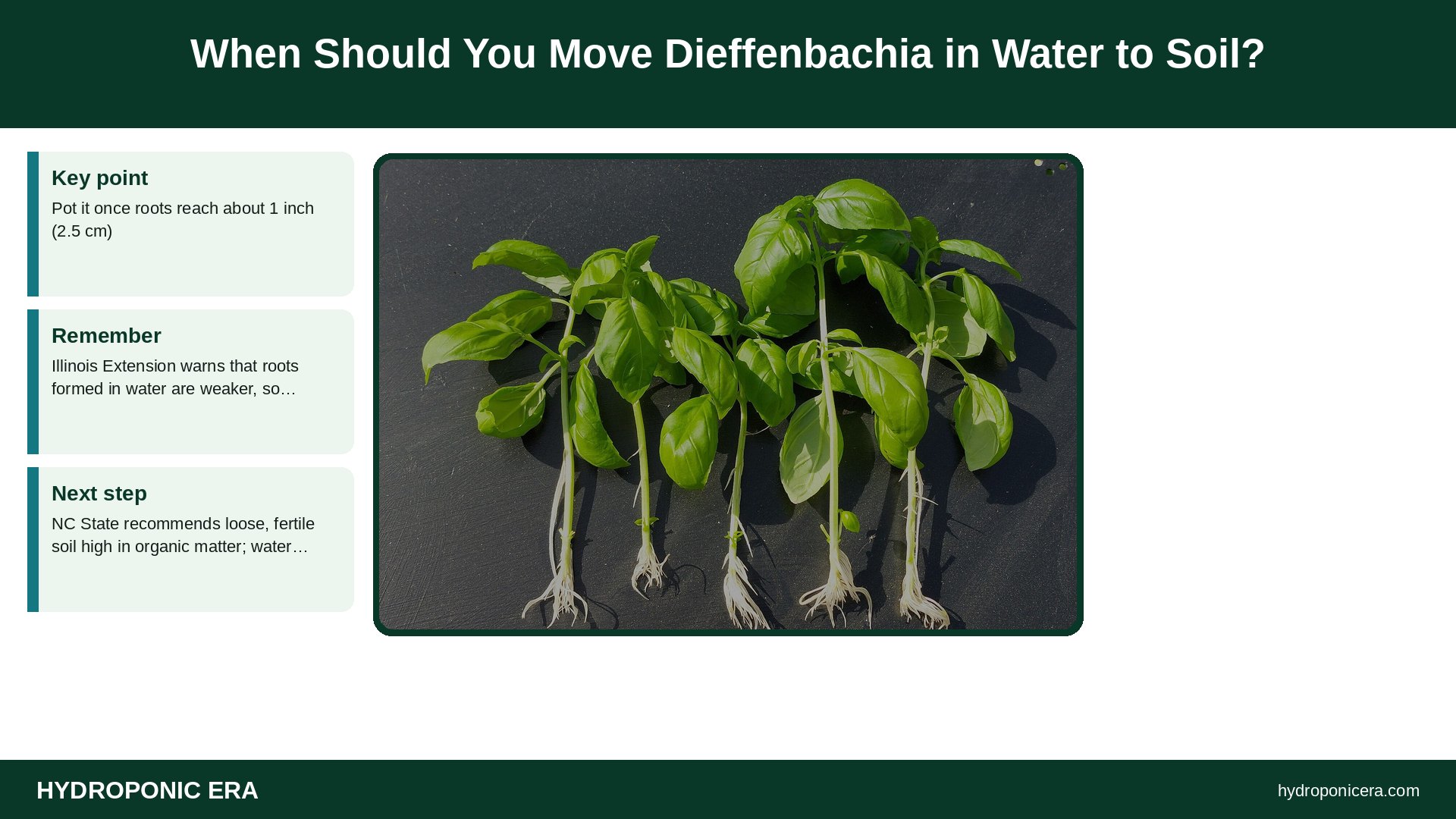
Pot it once roots reach about 1 inch (2.5 cm). Illinois Extension warns that roots formed in water are weaker, so don’t wait too long. NC State recommends loose, fertile soil high in organic matter; water thoroughly, then let the top 1 inch (2.5 cm) dry before watering again to prevent root rot. Illinois also advises bright, indirect light and warm temperatures.
Can Dieffenbachia Live in Water Permanently?
It can grow in water for a long time, but it needs nutrients and fresh water to stay healthy. Use a weak, complete fertilizer and change the solution every one to two weeks. Many growers move rooted cuttings into clay pebbles for semi-hydro. Our plants that grow in water list covers similar options.
Which Varieties of Dieffenbachia in Water Root Best?
All common cultivars root the same way. NC State notes that plants once sold as D. amoena, D. maculata and D. picta are now grouped under D. seguine, and lists cultivars such as these:
| Cultivar | Leaves (NC State) |
|---|---|
| ‘Camille’ | Pale yellow with white margins; up to 3 ft (0.9 m) |
| ‘Tropic Snow’ | Heavily variegated cream and green; about 6 ft (1.8 m) |
| ‘Tropic Marianne’ | Green and white variegation |
| ‘Rudolph Roehrs’ | Yellow with cream blotches, green midrib and margins |
Heavily variegated types have less green tissue, so cuttings may root a little more slowly. Give them the brightest indirect light you have.
What Is the Best Jar Setup for Dieffenbachia in Water?
Dieffenbachia tops are heavy, so pick a sturdy, wide-based jar or vase that won’t tip. Submerge only the bottom node or two, about 1–2 inches (2.5–5 cm), and keep leaves out of the water. Tinted glass slows algae. Vermont Extension advises replacing cloudy water with fresh, room-temperature water. If your tap water is heavily treated, see our guide to chlorine and chloramine. Label the jar as toxic if kids are in the house.
Is Air Layering Better Than Dieffenbachia in Water?
Penn State lists dumbcane among plants easily propagated by air layering: wound the stem, wrap it in moist sphagnum moss and plastic, then cut below the new roots and plant immediately. It’s the safest route for very tall plants, because the parent supports the top until roots form.
What Pests Affect Dieffenbachia in Water?

NC State lists spider mites, scale, whiteflies, fungus gnats and aphids, plus leaf spot, root rot and blight. Check leaf undersides before cutting. See our guide to spider mites.
FAQs
Can I root a single dieffenbachia leaf?
No; you need a piece of cane with a node.
Will the cut parent regrow?
Usually; new shoots often sprout below the cut.
Does dieffenbachia in water need rooting hormone?
No, but Penn State says it can speed rooting.
How much light do cuttings need?
Bright, indirect light; avoid direct sun.
Is dieffenbachia hardy outdoors?
Only in USDA Zones 10–11, per NC State.
Sources
- University of Illinois Extension — Dieffenbachia
- University of Illinois Extension — Cuttings
- North Carolina State Extension — Dieffenbachia seguine (Dumbcane)
- Penn State Extension — Propagating Houseplants
- University of Vermont Extension — More, Please: Propagating Houseplants
- Photo credits (Wikimedia Commons, edited with titles): Dieffenbachia inflorescence by Simon A. Eugster (CC BY-SA 3.0); Ficus cuttings with roots in a bottle, White background by Biusch (CC BY-SA 3.0); Basilikum (Ocimum basilicum) Stecklinge — Josef Schlaghecken by Schlaghecken Josef (CC BY-SA 4.0); Ficus cuttings with roots in a bottle, White background by Biusch (CC BY-SA 3.0); Hydroton by Lucis (CC BY-SA 3.0)