
What is the average microgreens yield per tray? Most crops yield 2–8 oz (57–227 g) per tray. Mississippi State Extension lists radish and pea shoots at 6–8 oz (170–227 g), brassicas at 3–7 oz (85–198 g) and herbs like basil, carrot and parsley at 2–4 oz (57–113 g). A Northeast SARE farm trial averaged 7.31 ounces (207 g) per 10×20 inch (25×51 cm) tray.
Key takeaway: Microgreens yield per tray depends mostly on crop, seeding rate and harvest timing. Fast, large-seeded crops like peas and radish weigh the most; slow herbs weigh the least.
What Is the Microgreens Yield Per Tray by Crop?
The table below lists Mississippi State Extension’s expected yields and seeding rates per tray, grouped by how fast each crop grows from sowing.
| Crop | Days to harvest | Seeding rate | Expected yield |
|---|---|---|---|
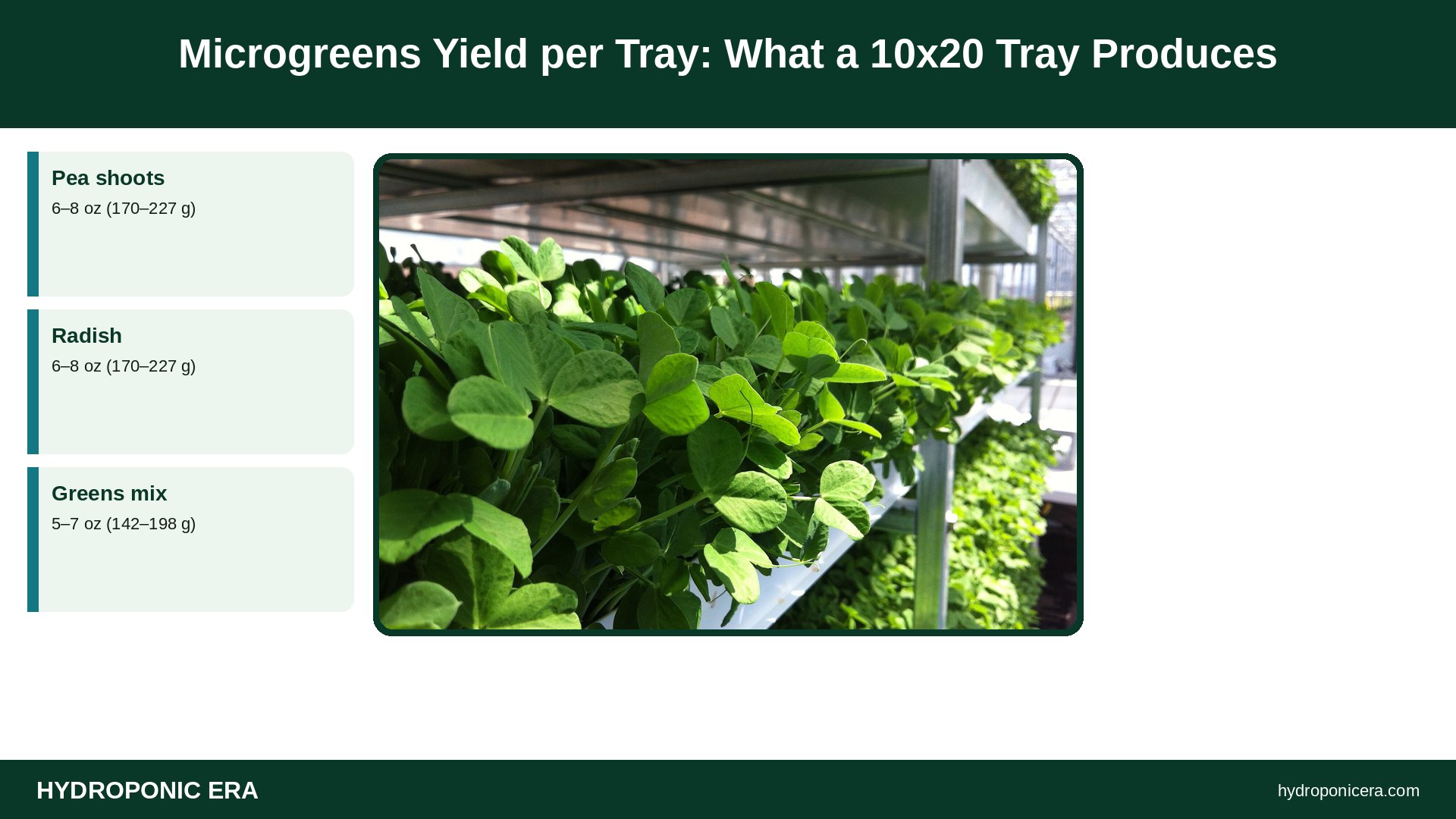
| Pea shoots | 7–10 | 6 oz (170 g) | 6–8 oz (170–227 g) |
| Radish | 7–10 | 2 Tbsp | 6–8 oz (170–227 g) |
| Greens mix | 10–15 | 2–3 tsp | 5–7 oz (142–198 g) |
| Cabbage, kale, mustard, pac choi | 10–15 | 2–3 tsp | 4–6 oz (113–170 g) |
| Arugula, broccoli, cress | 10–15 | 2–3 tsp | 3–5 oz (85–142 g) |
| Purple kohlrabi | 10–15 | 3 tsp | 2–4 oz (57–113 g) |
| Beet, Swiss chard | 16–25 | 3–5 Tbsp | 3–6 oz (85–170 g) |
| Cilantro | 16–25 | 1 Tbsp | 4–5 oz (113–142 g) |
| Basil | 16–25 | ½–1 tsp | 2–4 oz (57–113 g) |
| Amaranth, carrot, parsley, scallions | 16–25 | 1 tsp–2 Tbsp | 2–3 oz (57–85 g) |
What Did a Real Farm Trial Find for Microgreens Yield Per Tray?
A Northeast SARE farmer grant (FNE20-966) grew kale, broccoli, a mild salad mix and pea shoots in standard 10×20 inch (25×51 cm) trays inside a farm cold-storage room during winter. Key results:
- Microgreens averaged 7.31 oz (207 g) per tray across varieties, which the growers noted was well below a Johnny’s Seeds 2017 microgreens trial.
- Pea shoots averaged 17.28 oz (490 g) per tray.
- Seed per tray: 0.4 oz (11 g) for each microgreen variety and 6.8 oz (193 g) for peas.
- Labor: about 15 minutes per microgreen tray and 5 minutes per pea shoot tray for harvest and packing.
- Lighting: fluorescent fixtures 17 inches (43 cm) above trays, 14 hours per day after germination.
The gap between Mississippi’s home-garden figures and the SARE pea shoot number shows how much seeding rate and harvest height change results. Heavier seeding and taller harvests weigh more.
Why Does Microgreens Yield Per Tray Vary So Much?
- Seed size: Big seeds like peas and sunflower produce thick, heavy shoots.
- Seeding density: More seed means more stems, up to the point where crowding causes mold.
- Harvest stage: Mississippi State says harvest ranges from 7 to 21 days after germination; waiting a few extra days adds weight.
- Light: Weak light gives thin, leggy stems that weigh less.
- Germination rate: Mississippi recommends priming peas, beets, chard, cilantro and scallions for even germination.
- Recuts: Pea shoots can be recut once and scallions several times, per Mississippi.
How Do You Calculate Microgreens Yield Per Tray at Home?
Weigh every harvest with a kitchen scale and divide by the number of trays. Track seed weight in, too, so you can compare seed cost to output. A simple log looks like this:
| Record | Example entry |
|---|---|
| Crop and seed lot | Radish, lot A |
| Seed weight | Grams or ounces sown |
| Sow and harvest dates | Days to harvest |
| Harvest weight | Grams or ounces cut |
| Notes | Mold, light height, temperature |
Our cost of goods worksheet for herbs and microgreens turns these numbers into cost per ounce, and the labor minutes worksheet tracks time.
How Can You Increase Microgreens Yield Per Tray?
- Sow evenly. Illinois Extension suggests about ½–1 tablespoon of small seed per flat; spread it uniformly.
- Soak large seeds. Maryland Extension recommends soaking pea, sunflower, beet, chard and similar seeds 6–12 hours.
- Use a blackout period. Cover trays until germination to keep seeds moist and in contact with the medium.
- Give strong light. Maryland suggests 16 hours with fixtures 6–12 inches (15–30 cm) above the plants.
- Bottom-water to keep leaves dry and reduce damping-off.
- Keep air moving with a small fan.
Does Seed Cost Affect Microgreens Yield Per Tray Economics?
Yes. Mississippi State advises buying microgreen seed in bulk, noting garden-center packets aren’t economical. Since a pea tray needs about 6 oz (170 g) of seed, seed is a major cost for heavy crops. Small-seeded crops need only teaspoons, so their cost per tray is low even though yield is lighter. If you plan to sell, see our guide on selling microgreens to restaurants.
How Many Trays Do You Need Based on Microgreens Yield Per Tray?
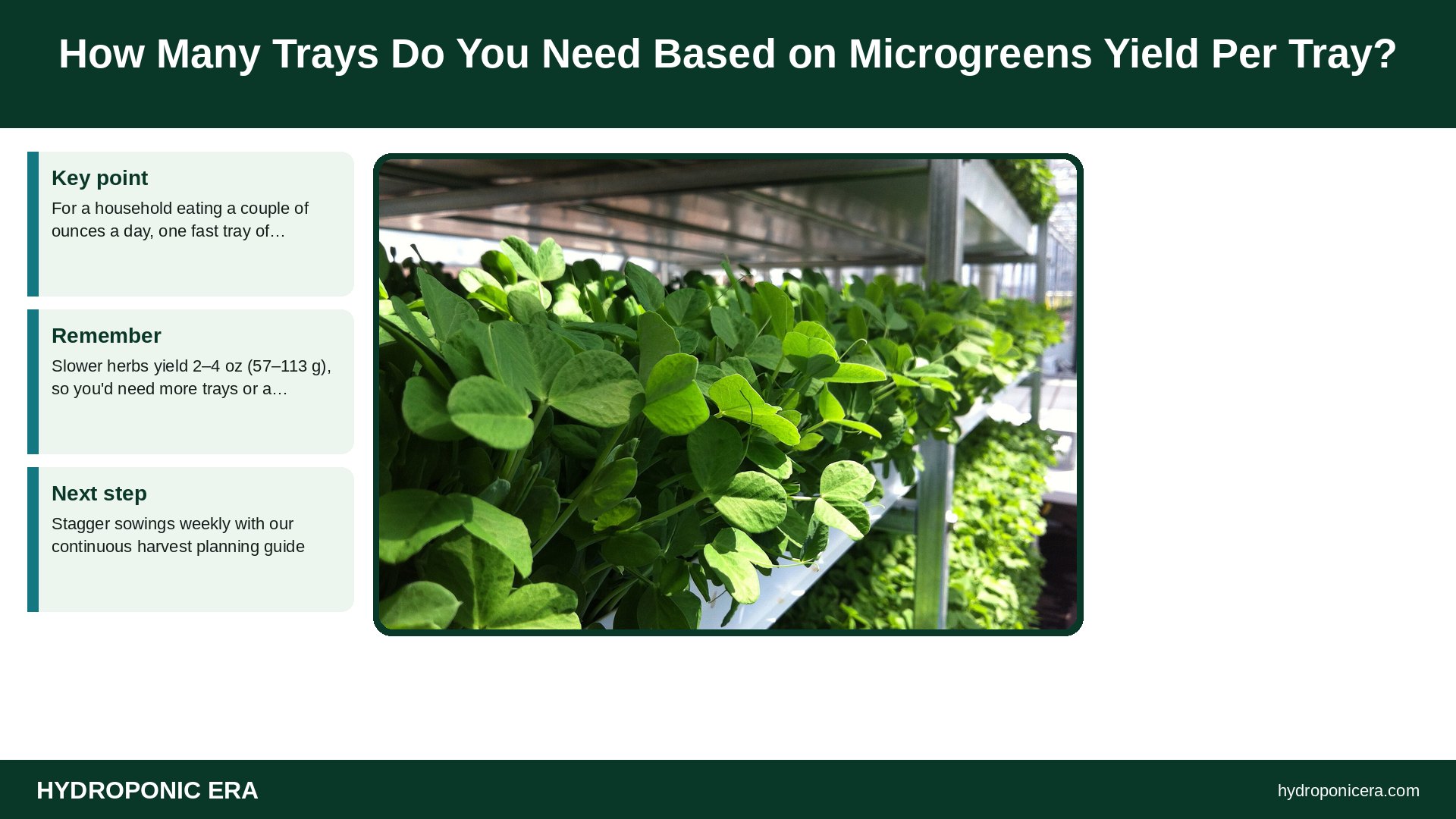
For a household eating a couple of ounces a day, one fast tray of radish or a greens mix per week is often enough, since Mississippi’s figures put those at 5–8 oz (142–227 g) each. Slower herbs yield 2–4 oz (57–113 g), so you’d need more trays or a smaller garnish role. Stagger sowings weekly with our continuous harvest planning guide.
Does Growing Method Change Microgreens Yield Per Tray?
Soil-based mixes, coco and fiber mats all work. The SARE trial used a compost-based potting mix and bottom-watered perforated trays set in larger rack trays. Mats are cleaner but dry out faster. Whatever the method, keep moisture even. The SARE growers found consistent moisture was the key to even germination. Our hydroponic microgreens guide covers soil-free setups.
How Do Yield Figures Convert to Grams Per Square Foot?
A 10×20 inch (25×51 cm) tray covers about 1.4 square feet (0.13 m²). Dividing by that area turns the per-tray figures into a density you can compare across tray sizes. For example, the SARE average of 7.31 oz (207 g) per tray works out to roughly 5.3 oz per square foot (about 1.6 kg/m²). Radish at 6–8 oz (170–227 g) per tray is about 4.3–5.8 oz per square foot (1.3–1.8 kg/m²). Use the same math for a smaller 10×10 inch (25×25 cm) tray, which holds half the area and should yield about half as much. These are estimates, so weigh your own harvests to find your real numbers.
What Lowers Microgreens Yield Per Tray?
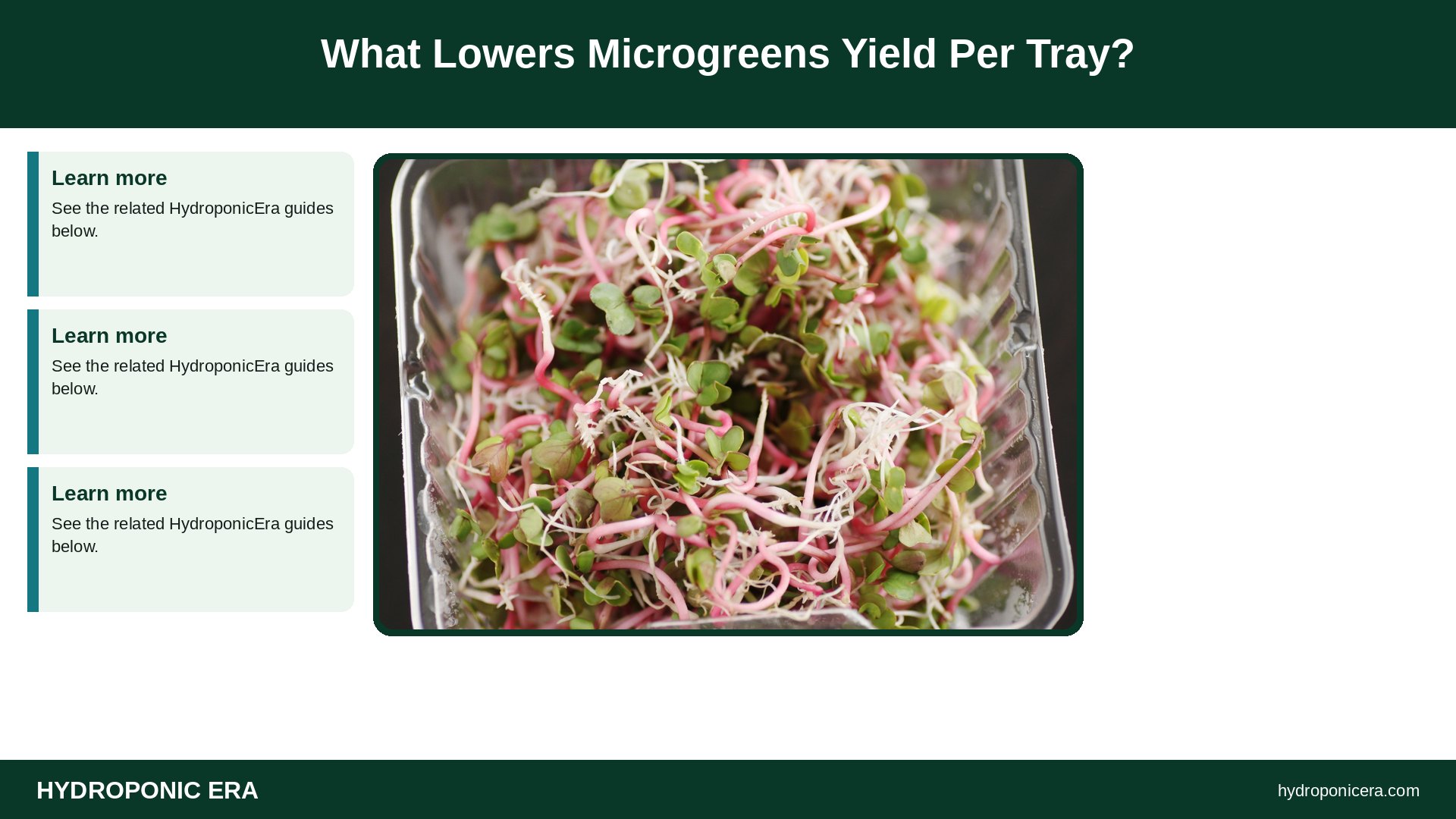
- Mold and damping-off from overcrowding or poor airflow.
- Uneven germination from dry spots.
- Old seed with poor germination.
- Low light causing thin, flopping stems.
- Harvesting too early.
FAQs
Which crop has the highest microgreens yield per tray?
Pea shoots, per both Mississippi State and the SARE trial.
Which yields the least?
Slow herbs like amaranth, carrot and parsley, at 2–3 oz (57–85 g).
Is microgreens yield per tray measured fresh or dry?
Fresh, cut weight.
Does a second cut add yield?
Only for peas and scallions, per Mississippi.
Do microgreens weigh more if I wait longer?
Usually, until stems get tough and flavor fades.
What size is a standard tray?
10×20 inches (25×51 cm), as in the SARE trial.
Sources
- Mississippi State University Extension — Microgreen Varieties for the Mississippi Gardener (Publication 2884)
- Northeast SARE — Final Report for FNE20-966
- University of Maryland Extension — Growing Microgreens and Baby Greens Indoors
- University of Illinois Extension — Growing Microgreens
- Photo credits (Wikimedia Commons, edited with titles): Lufa Farms Microgreens in Trays by Lufa Farms (CC BY-SA 2.0); Liping Kou observes microgreens by Peggy Greb (Public domain); Lufa Farms Microgreens in Trays by Lufa Farms (CC BY-SA 2.0); 11 microgreens by Stacy Spensley (CC BY 2.0); 20160617-AMS-LSC-9000 (61-sec.) (27334710733) by U.S. Department of Agriculture (Public domain)