
How do you grow spinach microgreens? Sow spinach seed thickly on moist mix, keep it cool, about 60–70°F (16–21°C), and covered until most seeds sprout, then give it bright light. Spinach is slower and patchier than most microgreens. Cut at 1–3 inches (2.5–8 cm) when the seed leaves open, or wait about 20–25 days for the first true leaves.
Key takeaway: Spinach microgreens reward patience and cool temperatures. Avoid heat during germination, water from below, and expect a thinner, slower tray than radish or broccoli.
| Factor | Spinach microgreens | Source |
|---|---|---|
| Germination range | 45–75°F (7–24°C); optimum 70°F (21°C) | Oregon State |
| Germination maximum | 85°F (29°C) | Oregon State |
| Growing temperature | 60–70°F (16–21°C) for microgreens | Virginia Tech |
| Soaking | Optional, 6–24 hours for slow seeds | University of Illinois |
| Harvest height | 1–3 inches (2.5–8 cm) | University of Illinois |
| Days to true leaves | 20–25 in a controlled study | Petropoulos et al. 2021 |
Why Are Spinach Microgreens Harder to Grow?
University of Illinois Extension lists spinach among the slower-germinating microgreens, alongside beet, Swiss chard, cilantro and basil. Spinach is a cool-season crop, and its seed is fussy about heat. Oregon State’s germination data list a maximum of 85°F (29°C), well below crops like chard. A warm closet that works for radish can leave spinach patchy.
What Temperature Do Spinach Microgreens Need?
Oregon State Extension gives spinach a useful germination range of 45–75°F (7–24°C) with an optimum around 70°F (21°C). Seedlings emerge in about 6 days at 68°F (20°C) and about 5 days at 77°F (25°C). After germination, Virginia Tech recommends 60–70°F (16–21°C) for microgreens in general. Skip the heat mat unless your room is cold.
How Do You Grow Spinach Microgreens Step by Step?
- Choose untreated seed sold for microgreens or sprouting.
- Soak if you like. Illinois notes soaking slow seeds 6–24 hours can speed germination; drain well.
- Fill a tray with 1–1.5 inches (2.5–4 cm) of moist, soilless mix and tamp it flat.
- Sow thickly and evenly, then press seed into firm contact with the mix.
- Mist and cover to hold moisture; keep it near 60–70°F (16–21°C).
- Uncover when most seeds have sprouted. Virginia Tech says this is usually 2–5 days for microgreens, but spinach often takes longer.
- Move under light and bottom-water from here on.
- Harvest at 1–3 inches (2.5–8 cm) with clean scissors.
How Long Do Spinach Microgreens Take to Harvest?
It depends on the stage you want. Virginia Tech says microgreens are generally harvested 1–3 weeks after germination, between the first true leaves forming and fully emerging. In a peer-reviewed study, Petropoulos and colleagues harvested spinach microgreens at the first two fully expanded true leaves, 20 days after sowing when fed nutrient solution for 10–20 days and 25 days when fed for 0–5 days. Cut earlier, at open seed leaves, for a milder, more tender green.
How Much Light Do Spinach Microgreens Need?
Virginia Tech notes the general recommendation for microgreens is a daily light integral of 9–16 mol/m²/day. The spinach study used 12 hours at about 300 µmol/m²/s, a DLI near 13. At home, a basic LED about 6–12 inches (15–30 cm) above the tray for around 16 hours, as Maryland Extension suggests for microgreens, works well. See our PPFD and DLI guide.
Should You Feed Spinach Microgreens?
Most home trays don’t need it, since Illinois notes microgreens up to about 15 days old need very little to no nutrients. Spinach is slower, so a weak feed can help. In the Petropoulos study, 20 days of quarter-strength nutrient solution produced the highest yield, 1.59 kg/m² (about 5.2 oz per square foot). Feeding for 10 days instead cut nitrate by about 71% with only about 12.5% less fresh yield. Spinach accumulates nitrate, so lighter feeding is a sensible trade. See how to use hydroponic nutrients.
Why Are My Spinach Microgreens Patchy?
- Too warm. Heat near 85°F (29°C) slows or stops spinach germination.
- Poor seed contact. Press seed firmly into level mix.
- Dry spots. Keep the surface evenly moist until germination.
- Old seed. Run a quick germination test on a damp paper towel.
Some thinness is normal. Spinach trays rarely look as dense as broccoli trays.
How Do You Prevent Mold on Spinach Microgreens?
Spinach sits covered longer than most crops, so moisture management matters. Illinois advises watering from the bottom after germination and never letting water puddle in the tray. Virginia Tech lists 50–70% humidity as a common range and recommends airflow fans. Read our guide to damping-off if seedlings collapse at the base.

Are Spinach Microgreens Nutritious?
They can be. Petropoulos and colleagues cite earlier work finding spinach microgreens had a 2.5–3.0 times higher nutrient quality score than mature spinach. In their own trays, nutrient feeding changed vitamin C, chlorophyll, carotenoid and nitrate levels, so how you grow them affects what you eat. Treat any single number as one trial, not a guarantee.
How Do Spinach Microgreens Compare With Other Microgreens?
Spinach belongs to the amaranth family with beet and chard, and it behaves like them: slow and uneven. Virginia Tech’s harvest table shows how much faster the common brassicas are.
| Microgreen | Days from sowing to harvest (Virginia Tech) |
|---|---|
| Radish | 6–10 |
| Broccoli | 8–13 |
| Kale | 8–14 |
| Amaranth | 10–17 |
| Beet | 12–23 |
| Spinach (study, true-leaf stage) | 20–25 |
If you want a quick first success, start with radish or broccoli, then add spinach once you know your setup. Grow spinach in its own tray rather than mixing it with fast crops, because the brassicas will be past their best before spinach is ready.
How Do You Harvest and Store Spinach Microgreens?
Harvest in the morning when the greens are crisp. Cut just above the mix with clean, sharp scissors, keeping stems and leaves and leaving roots behind, as Virginia Tech describes. Spinach seed coats sometimes cling to the leaves, so pick them off or swish the greens in cool water. Dry them thoroughly on paper towels before storing, since wet microgreens decay quickly in the refrigerator.
Can You Grow Spinach Microgreens Hydroponically?
Yes. Use a hemp or fiber mat over a shallow reservoir and keep the mat damp, not flooded. Because spinach grows longer than most microgreens, a dilute nutrient solution after germination can help, as the study above shows. Change the water every few days. For mat setups, see our hydroponic microgreens guide.
FAQs
Is water spinach the same as spinach microgreens?
No. Water spinach is a different plant, Ipomoea aquatica.
Do spinach microgreens regrow?
Generally no; sow a new tray.
Can I use garden spinach seed?
Yes, if it’s untreated.
What do they taste like?
Mild and spinach-like, more tender than mature leaves.
How should I store them?
Refrigerate dry in a covered container; Penn State recommends dark storage near 41°F (5°C).
Sources
- Petropoulos, S.A. et al. (2021) — The Effects of Nutrient Solution Feeding Regime on Yield, Mineral Profile, and Phytochemical Composition of Spinach Microgreens, Horticulturae 7:162
- Virginia Cooperative Extension — Introduction to Microgreen Production in Indoor Vertical Farms and Greenhouses (SPES-756)
- University of Illinois Extension — Microgreens: Year-Round Edible Greens to Grow at Home
- Oregon State University Extension — Soil Temperature Conditions for Vegetable Seed Germination
- University of Maryland Extension — Growing Microgreens and Baby Greens Indoors
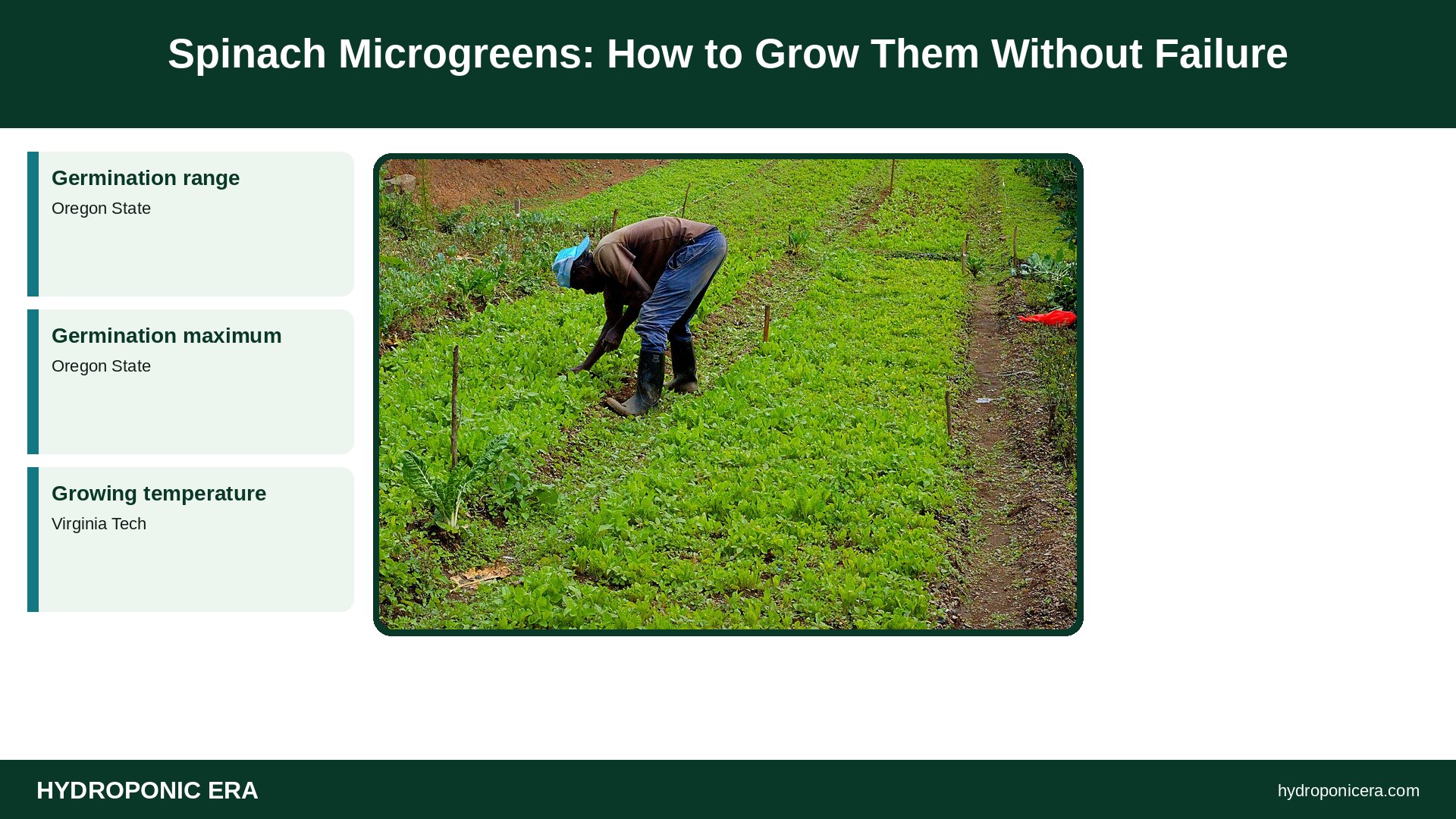
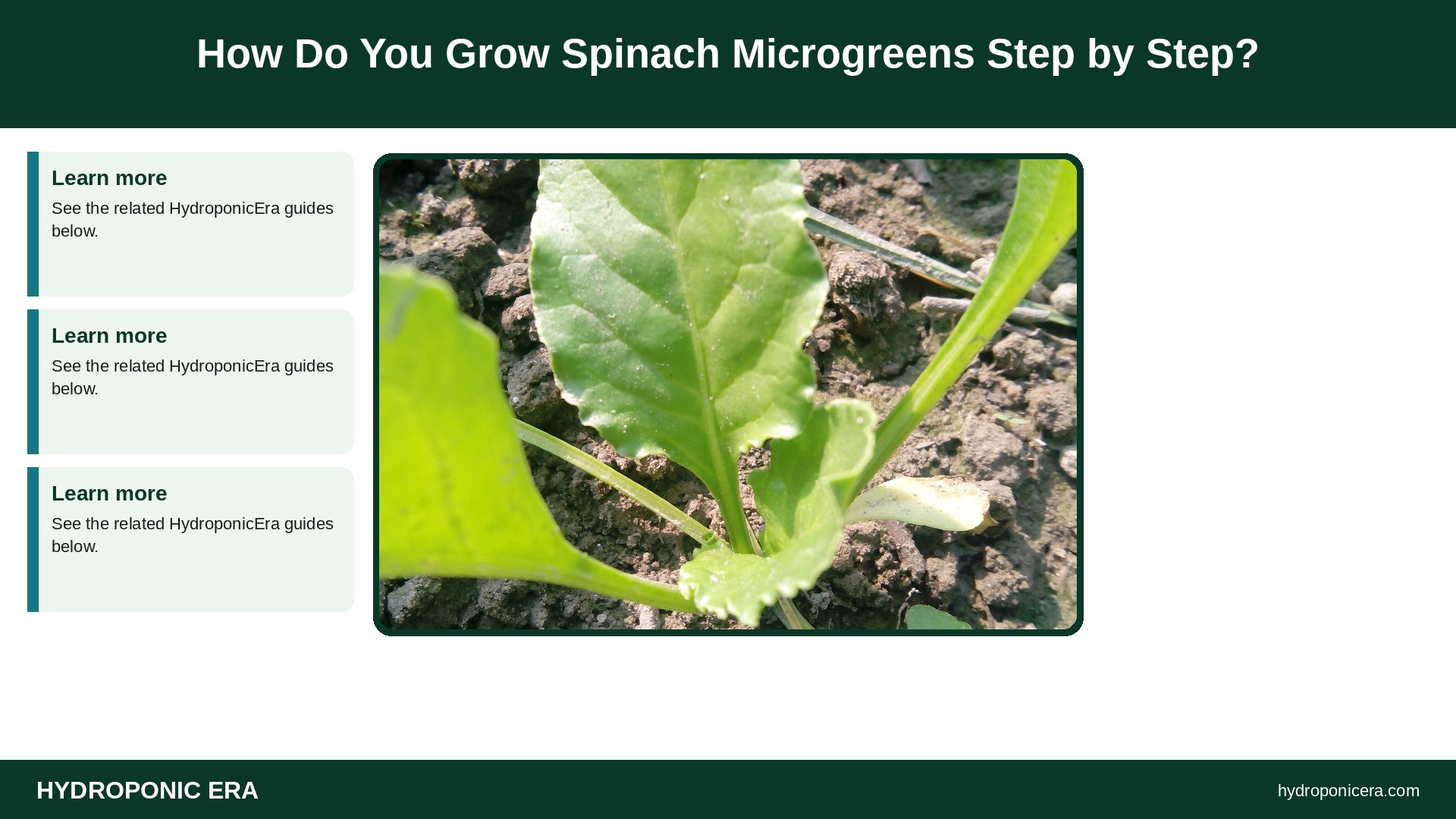
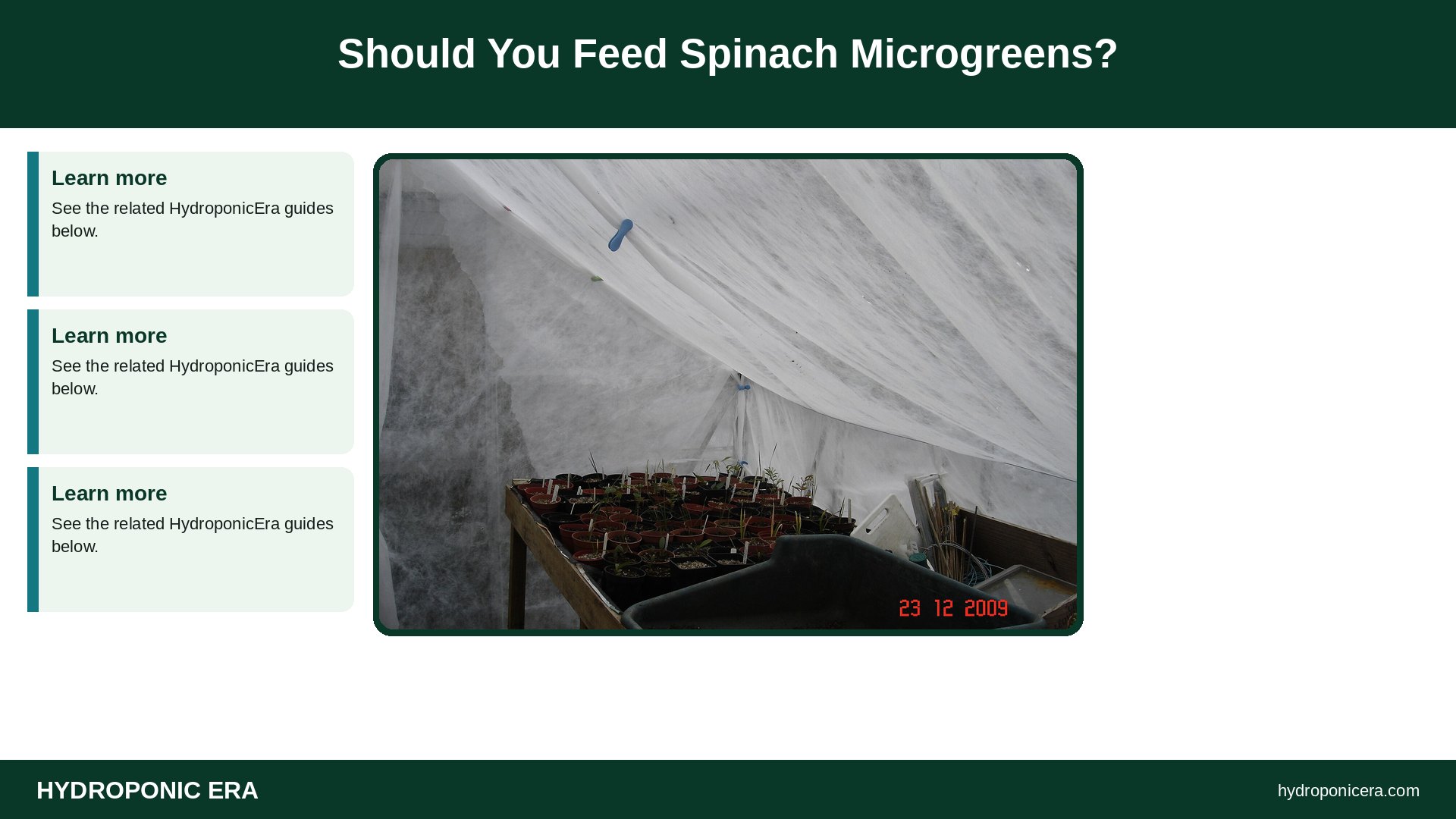
- Photo credits (Wikimedia Commons, edited with titles): Man tending to seedlings of spinach by Cut angles (CC BY-SA 4.0); Spinacia oleracea bd-1 by Kayser Ahmad (CC BY-SA 4.0); Fleece lined greenhouse potting tray and seed pots – Flickr – peganum by peganum from Small Dole, England (CC BY-SA 2.0); Liping Kou observes microgreens by Peggy Greb (Public domain); 20170404-AMS-PJK-0484 (33725727291) by U.S. Department of Agriculture Preston Keres/Office of Communications-Photograph (Public domain)