
How do you grow carrot microgreens? Sow about 1 teaspoon of carrot seed over a moist tray, keep it at roughly 68–80°F (20–27°C) until seedlings emerge in about a week, then grow under lights and harvest at 14–25 days. Expect a modest 2–3 oz (57–85 g) per tray of feathery, mild carrot-flavored greens.
Key takeaway: Carrot microgreens are slow and low-yielding compared with radish or broccoli, so the payoff is flavor and delicate texture, not volume. Warmth speeds germination the most.
| Factor | Carrot microgreens | Source |
|---|---|---|
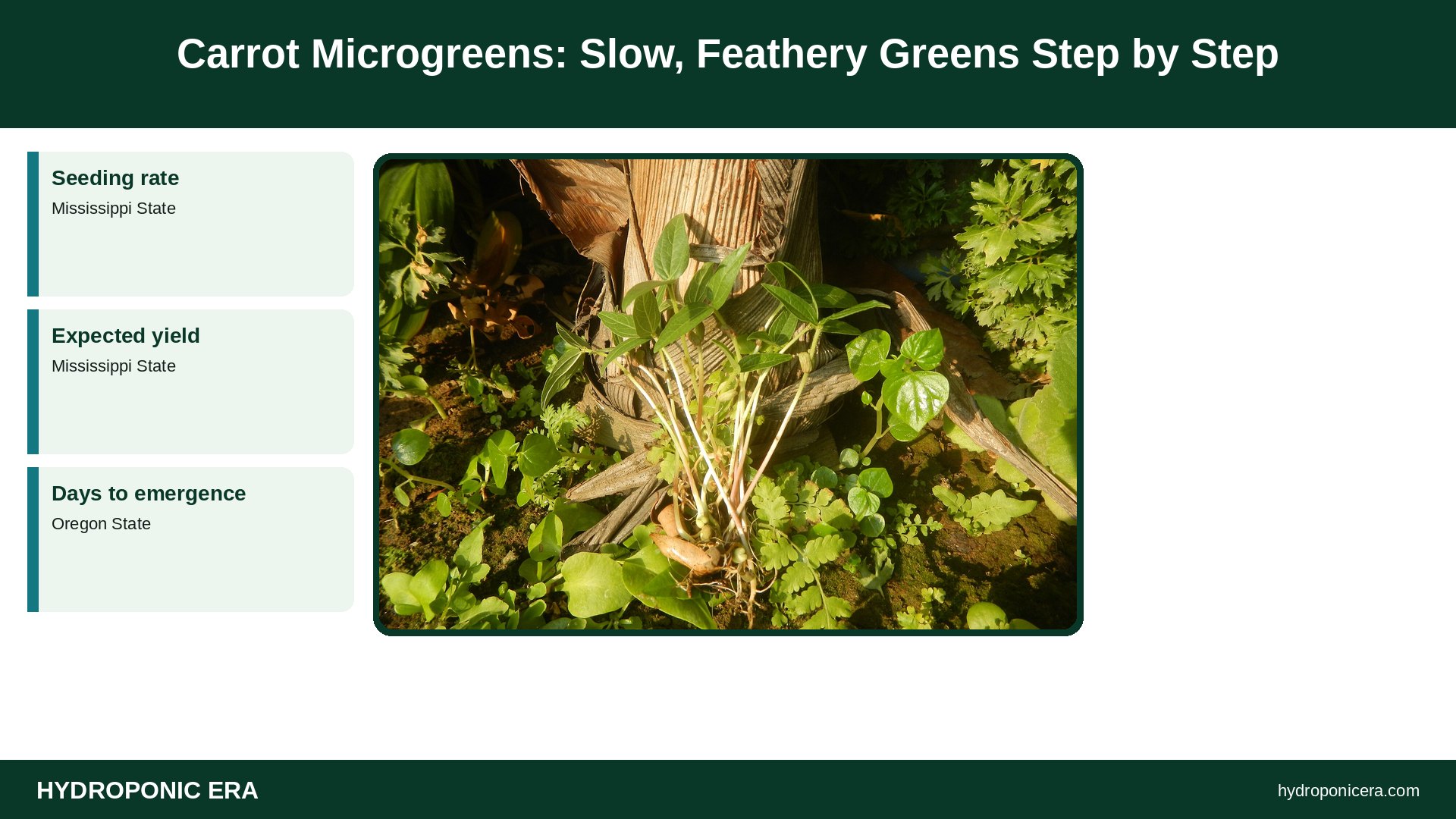
| Seeding rate | 1 teaspoon per tray | Mississippi State |
| Expected yield | 2–3 oz (57–85 g) per tray | Mississippi State |
| Days to emergence | About 7 at 68°F (20°C); 6 at 77–86°F (25–30°C) | Oregon State |
| Optimum germination temp | 80°F (27°C) | Oregon State |
| Days to harvest | 14–20 (VT); 16–25 group (MSU) | Virginia Tech, Mississippi State |
| Flavor | Carrot flavor, fine-textured leaves | Mississippi State |
What Do Carrot Microgreens Taste Like?
Mississippi State Extension describes carrot microgreens as having carrot flavor and fine-textured leaves. The seedlings look like tiny feathery fronds rather than the broad cotyledons of brassicas, so they make an attractive garnish. Virginia Tech lists carrot (Daucus carota) among common microgreens and notes its CEA Innovation Center has successfully grown carrot microgreens on hemp and burlap mats.
Why Are Carrot Microgreens Slower Than Other Greens?
Carrots are in the Apiaceae family, along with dill, cilantro and parsley, which tend to germinate more slowly than brassicas. University of Florida notes that most microgreens germinate in about 2 days, while beets, carrots and Swiss chard take longer. Mississippi State groups carrot with the slower crops ready 16–25 days after germination, and Virginia Tech lists carrot at 14–20 days to harvest. By contrast, Virginia Tech gives radish 6–10 days.
How Does Temperature Affect Carrot Seed Germination?
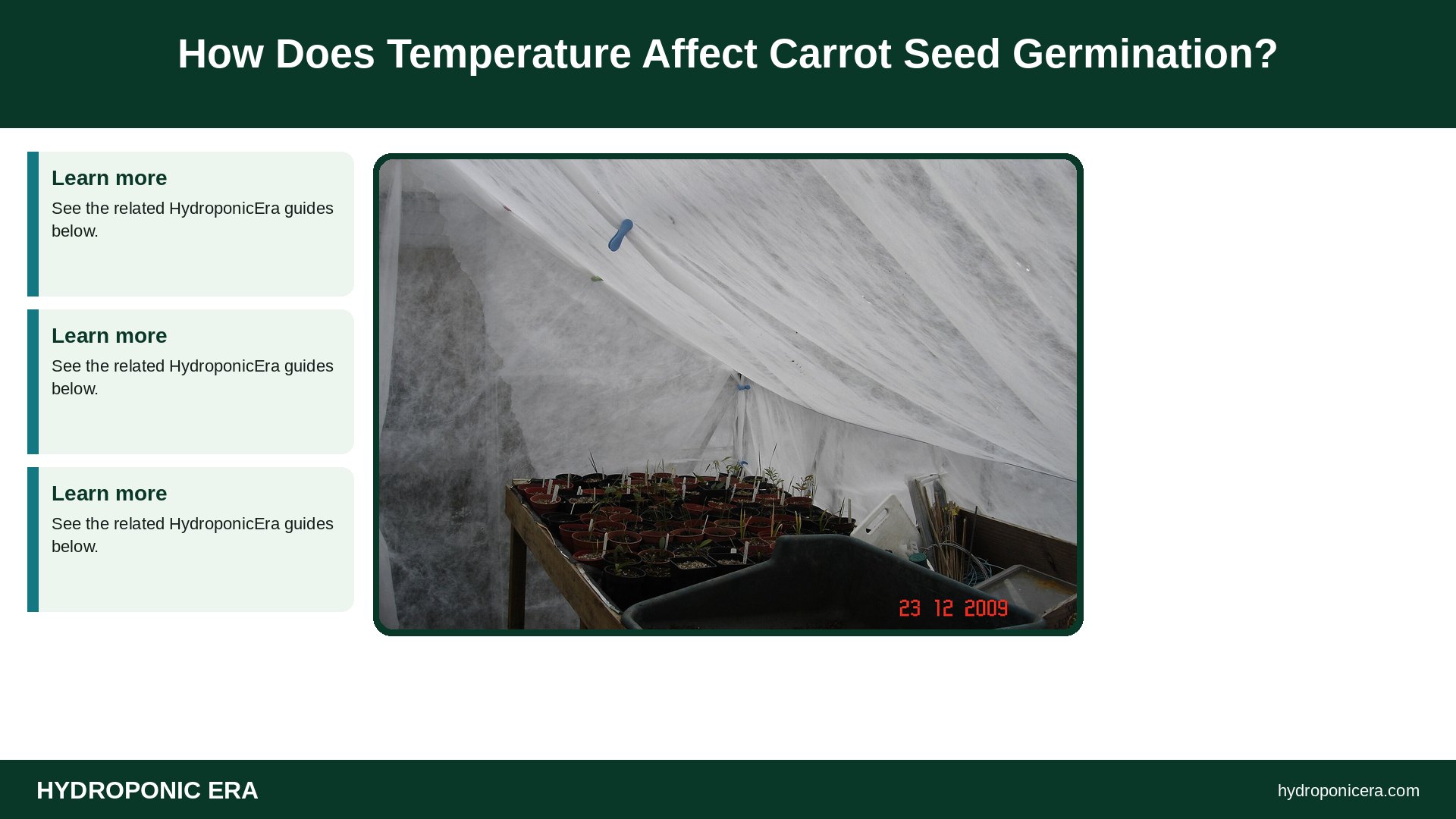
Temperature is the biggest lever. Oregon State Extension’s germination table shows how quickly carrot seed emerges at different temperatures.
| Temperature | Days to emergence |
|---|---|
| 41°F (5°C) | 51 |
| 50°F (10°C) | 17 |
| 59°F (15°C) | 10 |
| 68°F (20°C) | 7 |
| 77°F (25°C) | 6 |
| 86°F (30°C) | 6 |
| 95°F (35°C) | 8 |
Oregon State gives 80°F (27°C) as optimum and 95°F (35°C) as the maximum. A seedling heat mat under the tray can cut germination time in a cool room.
How Do You Grow Carrot Microgreens Step by Step?
- Fill a tray with 1–1.5 in (2.5–4 cm) of moist soilless mix, or lay a damp hemp or burlap mat.
- Weigh or measure seed: about 1 teaspoon per tray, per Mississippi State.
- Scatter evenly and press seeds into contact with the surface.
- Mist and cover with a second tray or lid to hold humidity.
- Keep warm, ideally 68–80°F (20–27°C), until most seeds have emerged.
- Uncover and light once seedlings lift the cover or show green.
- Bottom-water so the fine leaves stay dry.
- Harvest when the first feathery true leaves appear, roughly 14–25 days after sowing.
How Do You Spread Tiny Seeds Evenly?
Carrot seed is small and light, so it clumps easily. University of Maryland suggests spacing microgreen seeds roughly 3/16–1/4 in (5–6 mm) apart, or sowing by weight so every tray gets the same amount. A simple trick is to sprinkle from a folded card or a salt shaker in two passes at right angles. UMD also advises against mixing species in one tray, because different germination speeds leave carrot shaded by faster seedlings.
How Much Light Do Carrot Microgreens Need?
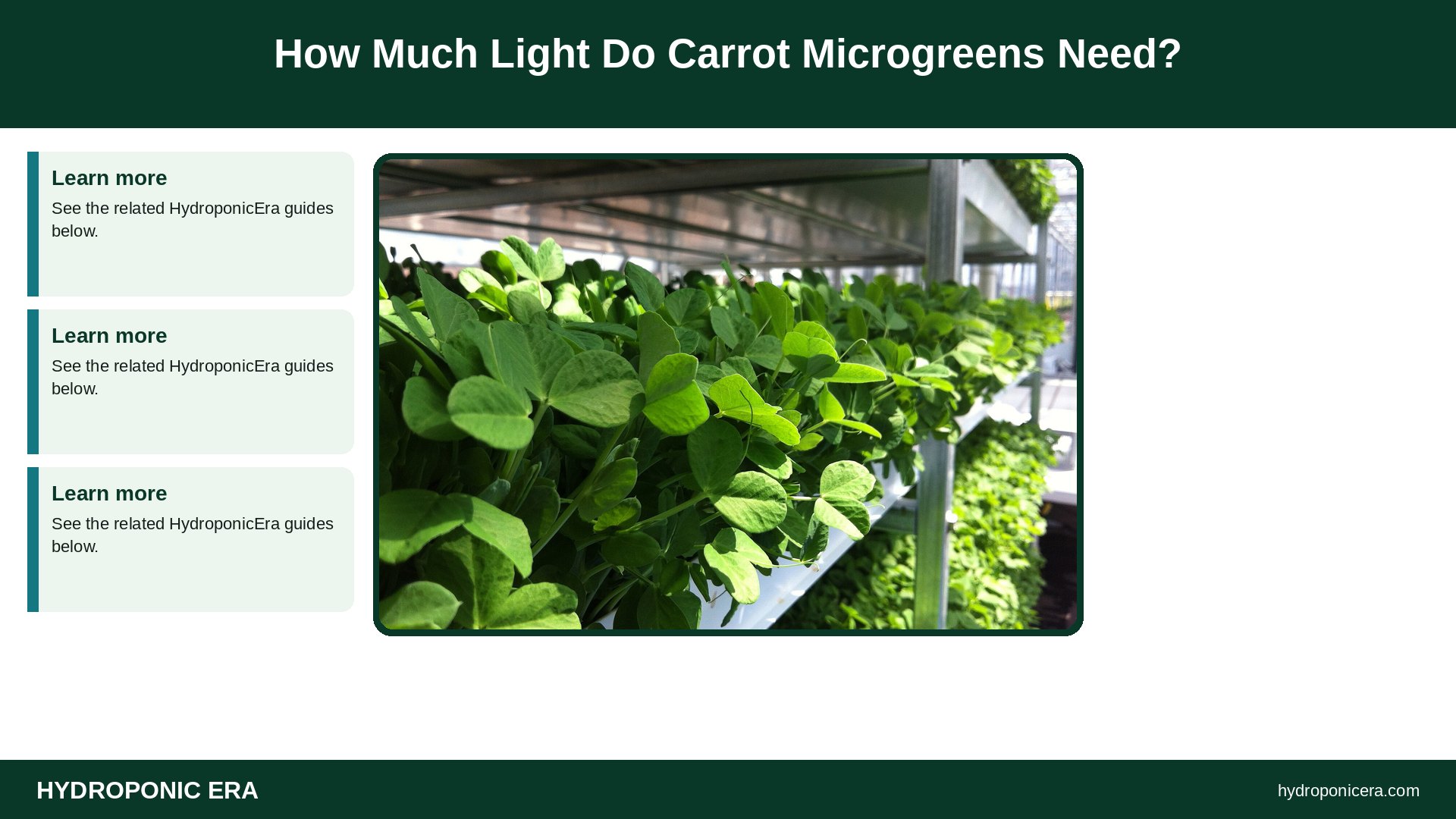
Virginia Tech gives a general microgreen target of a daily light integral (DLI) of 9–16 mol/m²/day, and its CEA Innovation Center runs an 18-hour photoperiod at about 250 µmol/m²/s. University of Maryland suggests about 16 hours of light a day with lights typically 6–12 in (15–30 cm) above the foliage. Carrot seedlings are thin, so low light quickly makes them stretch and flop. Our guide to PPFD and DLI explains how to hit those targets, and leggy seedlings covers stretch.
Can You Grow Carrot Microgreens Hydroponically?
Yes. Virginia Tech reports growing carrot microgreens on hemp and burlap mats, and University of Maryland notes single-use mats of hemp, coir, jute, bamboo or wood fiber can replace potting mix. Keep the mat damp but not flooded, and because carrot takes longer than brassicas, watch closely for mold during the longer cycle. UMD says no fertilizer is needed for microgreens grown in media; on bare mats, some growers add a dilute nutrient solution after germination. Our hydroponic microgreens guide covers the full mat setup.
How Does Carrot Compare With Faster Crops?
| Crop | Days to harvest (VT) | Yield per tray (MSU) |
|---|---|---|
| Carrot | 14–20 | 2–3 oz (57–85 g) |
| Radish | 6–10 | 6–8 oz (170–227 g) |
| Kale | 8–14 | 4–6 oz (113–170 g) |
| Beet | 12–23 | 3–6 oz (85–170 g) |
What Problems Hit Slow Carrot Trays?
- Patchy germination: usually cold media. Warm the tray and keep the surface evenly moist.
- Mold or collapse at the base: overwatering and poor airflow during the long cycle. See damping-off in seedlings.
- Floppy stems: not enough light or lights too far away.
- Low yield: expected; Mississippi State lists only 2–3 oz (57–85 g) per tray.
Are Carrot Microgreens Worth Growing?
For a home kitchen, yes, if you like the flavor and look. For sales, run the numbers first. Carrot microgreens tie up a tray for two to three weeks and return about a third of the weight of a radish tray, according to Mississippi State’s yield ranges. That means cost per ounce is higher, so they usually make sense as a premium garnish or as part of a mix rather than a volume crop. Our COGS worksheet for herbs and microgreens helps you price a slow tray against a fast one.
How Do You Use Feathery Carrot Greens in the Kitchen?
University of Maryland suggests microgreens in wraps, sandwiches, soups, omelets, salads, pesto and smoothies, and as garnishes for grain and bean dishes. Their fine, feathery leaves suit delicate uses: top soups, roasted carrots, fish, or a spring salad just before serving. Because the leaves are soft, add them at the end rather than cooking them.
How Do You Harvest and Store Carrot Microgreens?
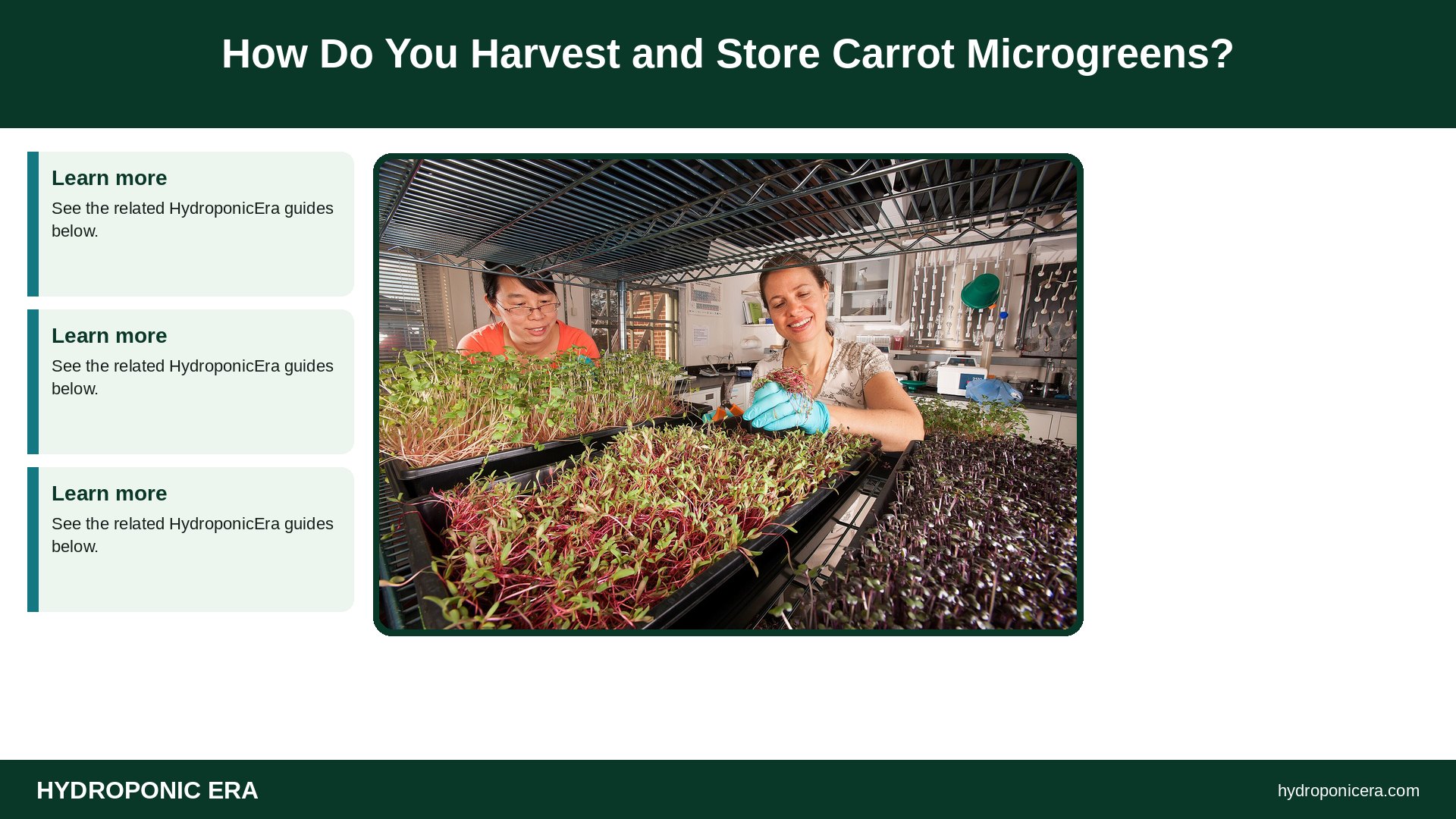
Cut just above the media with clean scissors when the true leaves have expanded. University of Maryland suggests rinsing, patting dry and refrigerating for up to 10 days. If you want full-size roots instead, see how to grow carrots hydroponically.
FAQ About Carrot Microgreens
How long do carrot microgreens take to grow?
About 14–25 days from sowing, depending on temperature and light.
Does carrot seed need soaking?
It’s optional. Soaking isn’t listed for carrot by UMD; warmth matters more.
Do carrot microgreens regrow after cutting?
No. UMD notes cut microgreens don’t regrow.
Why is my carrot tray so slow?
Cool temperatures. At 59°F (15°C), Oregon State shows about 10 days just to emerge.
How much seed for carrot microgreens?
About 1 teaspoon per tray, per Mississippi State.
Sources
- Mississippi State University Extension — Microgreen Varieties for the Mississippi Gardener (P2884)
- Virginia Cooperative Extension — Microgreens Production (SPES-756)
- Oregon State University Extension — Soil Temperature Conditions for Vegetable Seed Germination
- University of Florida IFAS — Grow Your Own Microgreens
- University of Maryland Extension — Growing Microgreens and Baby Greens Indoors
- Photo credits (Wikimedia Commons, edited with titles): 2839Home cooking of ginisang sayote, ampalaya and carrots 12 by Judgefloro (CC0); Fleece lined greenhouse potting tray and seed pots – Flickr – peganum by peganum from Small Dole, England (CC BY-SA 2.0); Lufa Farms Microgreens in Trays by Lufa Farms (CC BY-SA 2.0); Liping Kou observes microgreens by Peggy Greb (Public domain); 20170404-AMS-PJK-0484 (33725727291) by U.S. Department of Agriculture Preston Keres/Office of Communications-Photograph (Public domain)