
How do you grow nasturtium microgreens? Soak the large seeds about 8 hours, sow them on moist potting mix rather than a mat, cover them in darkness and keep them at 65–70°F (18–21°C). They’re slower than radish or broccoli; Iowa State lists 10–14 days to germinate. Harvest nasturtium microgreens as peppery shoots about 3–5 in (8–13 cm) tall, cutting above the seed.
Key takeaway: Nasturtium microgreens taste peppery like the mature leaves. Treat them like sunflower shoots: soak, sow on soil, blackout until they push up, then give strong light.
| Factor | Nasturtium microgreens | Source |
|---|---|---|
| Seed soak | About 8 hours | UF/IFAS |
| Germination temperature | 65–70°F (18–21°C) | Iowa State |
| Light to germinate | Darkness | Iowa State |
| Days to germinate | 10–14 | Iowa State |
| Growing medium | Soil-type media preferred over mats | UF/IFAS |
| Harvest height | 3–5 in (8–13 cm), as a shoot | UF/IFAS |
| Flavor | Spicy, peppery | NC State |
What Are Nasturtium Microgreens?
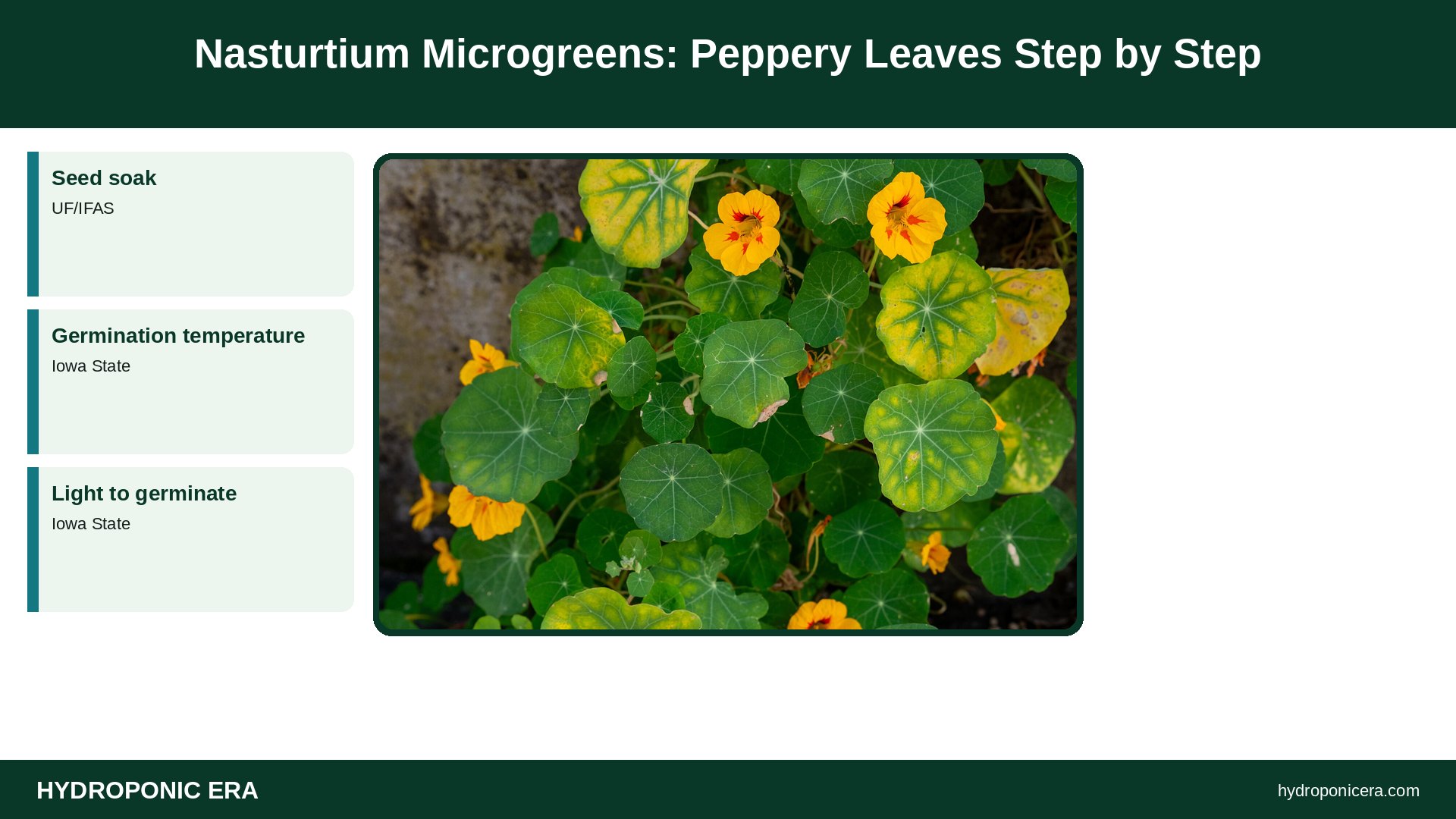
They’re young seedlings of garden nasturtium (Tropaeolum majus), the same annual grown for edible flowers. NC State Extension notes the leaves, buds, flowers, pods and seeds are all edible with a spicy, peppery taste, and the buds contain mustard oil. Virginia Tech lists nasturtium among the crops grown as microgreens. UF/IFAS groups it with sunflower, peas and popcorn as a “shoot” crop, harvested with stems and leaves at 3–5 in (8–13 cm) tall.
Why Are Nasturtium Microgreens Slow to Germinate?
Nasturtium seeds are big and hard-coated. Illinois Extension lists nasturtium among its slower-to-germinate microgreen choices, with amaranth, beet, chard and sunflower, and suggests soaking seed for 6–24 hours to speed things up. Iowa State’s germination table gives 10–14 days at 65–70°F (18–21°C) and marks nasturtium as needing darkness, unlike light-loving dill or lettuce.
| Crop | Germination light (Iowa State) | Days to germinate (Iowa State) |
|---|---|---|
| Nasturtium | Dark | 10–14 |
| Dill | Light | 7–14 |
| Zinnia | Dark | 5–7 |
How Do You Grow Nasturtium Microgreens Step by Step?
- Buy untreated seed meant for eating or sprouting; UF/IFAS advises against treated seed.
- Soak about 8 hours in cool water, per UF/IFAS, then drain.
- Fill a tray with moist seed-starting mix; UF says media works better than mats for nasturtium.
- Sow densely so seeds nearly touch, and press them in.
- Cover with an inverted tray for darkness, the method UF recommends for shoots.
- Hold at 65–70°F (18–21°C); a heat mat helps in a cool room.
- Uncover when seedlings lift the cover an inch or two, then give 12–16 hours of light.
- Bottom-water daily to keep the mix moist but not soggy.
- Harvest at 3–5 in (8–13 cm) by cutting just above the mix.
Our heat mat and dome guide helps with slow, warm-loving seeds.
How Much Seed Do You Need for a Tray?
Seed rates vary with seed size, and nasturtium seed is large, so think in tablespoons rather than teaspoons. Illinois Extension gives approximate starting amounts for home containers:
| Container | Large seed (Illinois Extension) |
|---|---|
| 3 x 6 in (8 x 15 cm) | 1 Tbsp |
| 4 x 8 in (10 x 20 cm) | 2 Tbsp |
| 5 in (13 cm) round | 1⅓ Tbsp |
Illinois also notes microgreens up to about 15 days old need little to no added nutrients, while 15–21 day crops can benefit from a bit more, such as compost mixed into the medium. Because nasturtium is slow, a little compost or a mild feed can help a longer-grown tray.
How Does Nasturtium Compare With Other Shoot Crops?
UF/IFAS lists suggested soak times for the big-seeded shoot crops. Nasturtium sits with sunflower and popcorn at about 8 hours, so you can soak them together and stagger sowing.
| Shoot crop | Suggested soak (UF/IFAS) |
|---|---|
| Peas | 8–12 hours |
| Sunflower | 8 hours |
| Nasturtium | 8 hours |
| Popcorn | 8 hours |
| Winter wheat | 8 hours |
How Much Light Do Nasturtium Microgreens Need?
After the blackout phase, give bright light so stems stay sturdy. UConn Extension recommends 12–16 hours of light a day for microgreens, and University of Maryland suggests keeping grow lights about 6–12 in (15–30 cm) above the foliage. UF notes you do want seedlings to stretch a little for easier harvesting, so a few days of blackout is useful, just not so long that they turn pale and weak. See our light distance guide.
When Should You Harvest Nasturtium Microgreens?
Cut when the round seed leaves are open and stems reach 3–5 in (8–13 cm), before many true leaves form. The first true leaves of nasturtium are the familiar round, parasol-shaped ones. Cut with clean scissors just above the medium and leave the seed hulls behind. UF says harvesting with about 1½ in (4 cm) of stem makes cutting easier. Microgreens don’t regrow, so plan successive trays.
What Do Nasturtium Microgreens Taste Like?
Expect the same peppery bite as mature nasturtium leaves, which NC State describes as spicy and peppery thanks to mustard oil compounds. Use them on sandwiches, tacos, grain bowls and salads, or as a garnish for eggs and soups. For the flowers themselves, see our edible flowers guide.
Why Are My Nasturtium Microgreens Patchy or Moldy?
- Few seeds came up: old seed, too cold, or not soaked; expect up to two weeks.
- Mold on seed coats: too wet under the cover; drain soaked seed well and vent.
- Pale, floppy shoots: blackout too long or weak light afterward.
- Uneven stand: mixed seed sizes; UF recommends pairing crops with similar germination rates.
Can You Grow Nasturtium Microgreens Hydroponically?
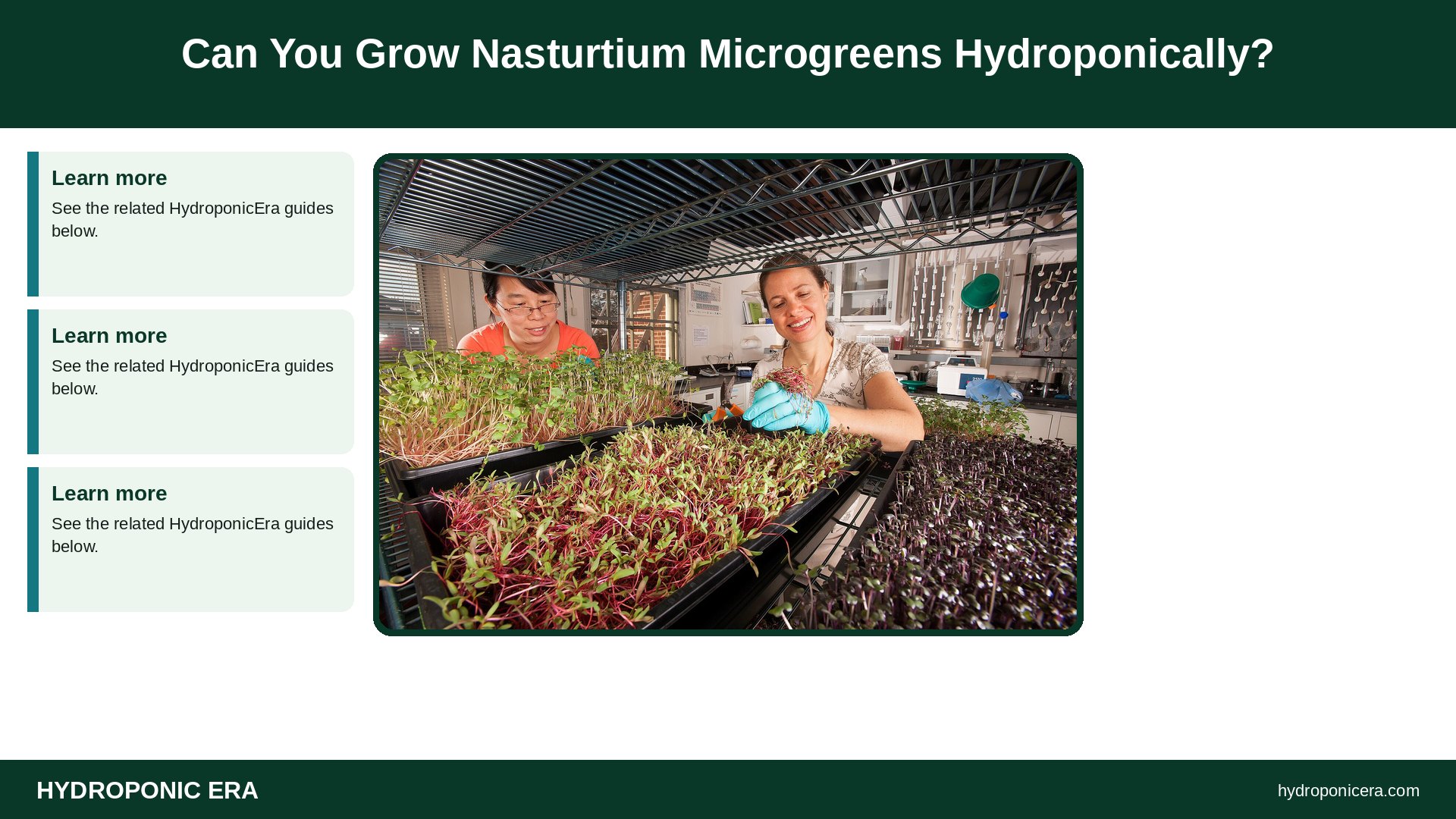
You can, but UF/IFAS lists nasturtium among the crops where soil-type media works better than mats, because large seeds and roots hold together better in a medium. If you use a hydroponic system, coco coir or a thick fiber mat is a better choice than thin paper. Virginia Tech notes commercial microgreens are grown in NFT, ebb-and-flow and aeroponic systems with leafy-green fertilizer at about 1.0 mS/cm and pH 5.5–6.0. For trays and setups, see our microgreens guide.
Are Nasturtium Microgreens Safe to Eat?
Garden nasturtium is a long-used edible plant, and NC State lists its leaves, flowers and seeds as edible. As with all raw sprouts and microgreens, the bigger risk is microbial: buy seed from a reputable supplier, rinse greens before eating and refrigerate them. University of Maryland says to use harvested microgreens right away or refrigerate them for up to 10 days. Read our home food safety guide.
FAQ About Nasturtium Microgreens
Should I soak nasturtium seeds?
Yes; UF/IFAS suggests about 8 hours.
Do nasturtium seeds need dark to germinate?
Yes, Iowa State lists darkness at 65–70°F (18–21°C).
How long until nasturtium microgreens are ready?
Germination alone takes 10–14 days, so plan on a few weeks.
Do nasturtium microgreens regrow?
No; sow a new tray.
Are nasturtium microgreens spicy?
Yes, peppery like the mature leaves.
Sources
- UF/IFAS Extension Duval County (T. DelValle) — Grow Your Own Microgreens
- Iowa State University Extension — Germination Requirements for Annuals and Vegetables
- NC State Extension — Tropaeolum majus
- University of Illinois Extension — Microgreens Tip Sheet
- Virginia Cooperative Extension — Microgreens Production (SPES-756)
- UConn Extension — The Amazing Power of Microgreens
- University of Maryland Extension — Growing Microgreens and Baby Greens Indoors
- Photo credits (Wikimedia Commons, edited with titles): Yellow Tropaeolum Maju with leaves by Balise42 (CC BY-SA 4.0); Close-up of Tropaeolum majus flowers droplets -20190830-RM-081005 by Ermell (CC BY-SA 4.0); Fleece lined greenhouse potting tray and seed pots – Flickr – peganum by peganum from Small Dole, England (CC BY-SA 2.0); Liping Kou observes microgreens by Peggy Greb (Public domain); Lufa Farms Microgreens in Trays by Lufa Farms (CC BY-SA 2.0)