
Are grow lights harmful to humans? For normal home use, no, provided you don’t stare into them. Most LED grow lights emit no UV, and North American horticultural fixtures are rated for eye risk under UL 8800 and IEC 62471. The real concerns are glare from intense blue light, sleep disruption from bright evening light, UV or infrared add-ons, and hot or poorly wired fixtures.
Key takeaway: Are grow lights harmful to humans? Not when used sensibly. Check the fixture’s risk group, don’t look into the diodes, switch lights off or dim them for close work, and keep them off a bedroom schedule.
| Possible hazard | Who it matters for | Simple precaution |
|---|---|---|
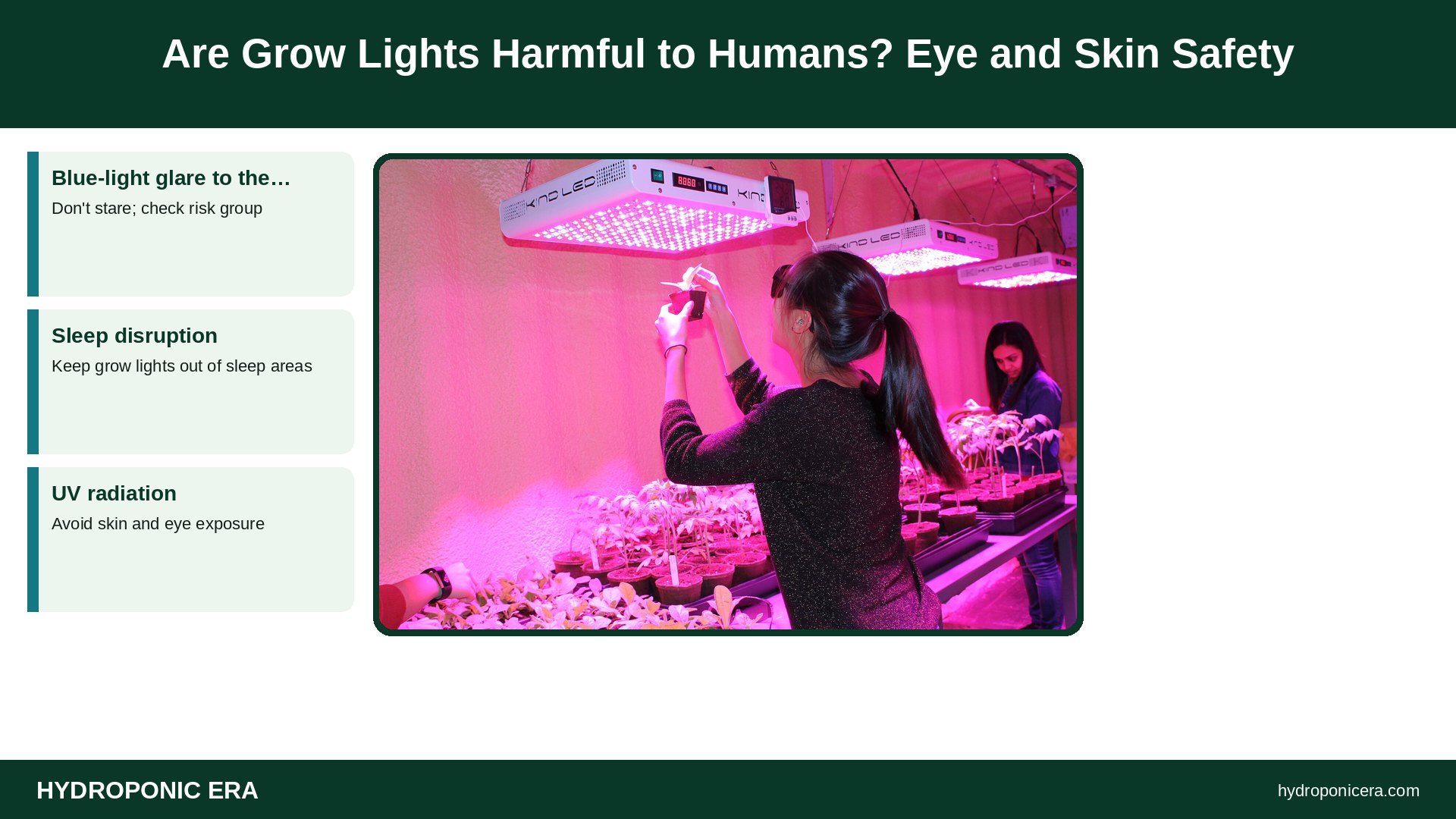
| Blue-light glare to the eyes | Anyone looking into bright LEDs | Don’t stare; check risk group |
| Sleep disruption | Lights in bedrooms or on at night | Keep grow lights out of sleep areas |
| UV radiation | Fixtures with UV diodes or UV lamps | Avoid skin and eye exposure |
| Infrared and heat | HID lamps; IR-supplemented LEDs | Keep distance; avoid touching |
| Fire and shock | Cheap, uncertified or damaged fixtures | Use listed gear and GFCI outlets |
Are Grow Lights Harmful to Humans’ Eyes?
They can be if you stare into a powerful fixture, which is why the industry rates them. Roberto Lopez of Michigan State University explains in an e-GRO Alert that ANSI/CAN/UL 8800:2019 became the main North American safety standard for horticultural lighting in 2019, and it requires a photobiological hazard assessment for skin and eyes under IEC 62471. The standard sorts sources into four risk groups by how long you could look before blue light becomes a hazard.
| IEC 62471 risk group | Maximum safe blue-light viewing time | Meaning |
|---|---|---|
| Exempt (RG0) | More than 10,000 seconds | No photobiological hazard |
| RG1, low risk | 100–10,000 seconds | No hazard under normal behavior |
| RG2, moderate risk | 0.25–100 seconds | Safe because of the aversion response |
| RG3, high risk | Under 0.25 seconds | Hazardous even briefly |
Lopez notes your eye’s natural aversion response usually keeps you from looking directly at a bright source for more than 0.25 seconds. If a fixture is labeled RG2, don’t look directly into it.
What Risk Group Are Most Home Grow Lights In?
Germany’s Federal Office for Radiation Protection (BfS) says most lamps used for general lighting fall in the exempt group or risk group 1, though measurements by Germany’s occupational safety institute showed some LEDs can fall in risk group 2. Small shelf lights and bulb-style grow lamps are generally closer to household lighting, while dense, high-wattage panels are the ones most likely to carry an RG2 label. If a seller won’t state the risk group, treat the fixture as RG2. The risk group is the label’s answer to “are grow lights harmful to humans at this intensity?”, so mount it so the diodes aren’t in your line of sight and don’t inspect plants while it’s at full power.
Why Do Some LED Grow Lights Have Warning Labels?
High-intensity horticultural LEDs often have higher intensities than the high-pressure sodium lamps they replaced and emit purple, pink or white light. The e-GRO Alert says warning labels on fixtures and spec sheets raised worker concern even though HPS lamps never carried them. So are grow lights harmful to humans just because they carry a label? No. The label reflects a tested risk group, not a sign that the light is unusually dangerous in normal use.
Are Grow Lights Harmful to Humans in a Home Setup?
Are grow lights harmful to humans in a normal home grow? Rarely, if you follow a few habits:
- Read the label or spec sheet for the IEC 62471 risk group and a UL 8800 or similar listing.
- Hang lights above eye level or angle them so you don’t look into the diodes.
- Turn fixtures off for close work and use ordinary room lighting, as Lopez recommends.
- Use proper eyewear if you must work under very bright fixtures.
- Put lights on a timer that matches your plants, not your bedtime.
- Keep lights out of bedrooms or block light spill at night.
- Use certified gear plugged into GFCI-protected outlets.
See our electrical safety guide and light schedule guide.
Do You Need Special Glasses for Grow Lights?
Not for brief, casual exposure, but ordinary “blue light blocking” glasses may not help. A 2025 study in HortTechnology tested eight lens types and found that common LED fixtures use a blue LED peaking at 450 nm with little output below 425 nm, while seven of the lenses mainly filtered wavelengths below 425 nm. One lens blocked 98% of blue photons up to 500 nm but significantly altered color perception.
| Eyewear type | Mean light transmittance (Wu and Lefsrud) |
|---|---|
| Welding glasses | 1.77% |
| Polarized glasses | 13.12% |
| Safety goggles | 15.27% |
| Sunglasses | 27.65% |
McGill researchers Wu and Lefsrud tested 12 eyewear products under high-irradiance horticultural LEDs and suggested welding goggles or polarized glasses, advising against sunglasses and safety goggles, especially where infrared is used. Check the lens’s published transmittance data before relying on it. For most hobbyists, though, the answer to “are grow lights harmful to humans?” mostly comes down to not looking into them.
Are Grow Lights Harmful to Humans at Night?
Yes, if they’re bright and on near you at night. Harvard Health explains that light suppresses melatonin, a hormone that influences circadian rhythms, and that blue light at night does so more powerfully. In one Harvard experiment, blue light suppressed melatonin about twice as long as green light of similar brightness. Purple and white grow lights contain plenty of blue, so a fixture running in your bedroom at night is a real sleep issue even if it’s harmless to your skin.
Are UV and Infrared Grow Lights Harmful to Humans?
These are the cases to take seriously. Lopez notes that UV isn’t present in the vast majority of supplemental lighting fixtures, so blue light and infrared are the main concerns. If your fixture adds UV-A or UV-B diodes, treat it like any UV source: avoid exposing skin and eyes. Germicidal UV-C lamps used in reservoir sterilizers must stay sealed; see our UV sterilizer guide. Infrared and older HID lamps also add heat, so keep your distance.
Are Grow Lights Harmful to Humans Through Heat or Fire?
Are grow lights harmful to humans through fire or shock? That’s the more common household risk, and it’s electrical, not optical. UL 8800 covers fire and electrical shock hazards as well as light exposure, which is one reason to buy listed fixtures. Keep cords dry and away from reservoirs, don’t daisy-chain cheap power strips, and give fixtures airflow. For placement, see our light distance guide and our grow light buyer’s guide.
FAQ: Are Grow Lights Harmful to Humans?
Are grow lights harmful to humans’ skin?
Standard LEDs without UV aren’t a skin concern; UV add-ons are.
Are grow lights harmful to humans who sit in the same room?
Yes, if you don’t stare at them and they don’t run at bedtime.
Are purple grow lights harmful to humans’ eyes?
They’re blue-heavy and glaring; avoid direct viewing.
Do sunglasses protect from grow lights?
Poorly, per Wu and Lefsrud; check transmittance data.
Are grow lights harmful to humans if left on all night?
Mainly for sleep, if they’re in your bedroom.
Sources
- Lopez RG, Michigan State University — Are there Risks of Working under LED Supplemental Lighting? e-GRO Alert 11(10), 2022
- Wu B-S, Lefsrud MG — Photobiology Eye Safety for Horticultural LED Lighting, J. Occupational and Environmental Hygiene (2018)
- HortTechnology — Evaluation of Blue Light Blocking Glasses under Sunlight and LEDs (2025)
- German Federal Office for Radiation Protection (BfS) — Protection Against Visible Light
- Harvard Health Publishing — Blue Light Has a Dark Side
- UL — Assessing the Photobiological Safety of LEDs
- Photo credits (Wikimedia Commons, edited with titles): Terramera scientists working in a climate-controlled growth chamber located in Vancouver, BC. The space uses LED lighting, which supports plant growth. (50188965171) by Simon Fraser University – Communications & Marketing (CC BY 2.0); Infrared HDR St Bartholomew’s church Hanworth Norfolk (7531334490) by David from Colorado Springs, United States (CC BY 2.0); Rough diamonds – necklace in UV and normal light B – composite by W.carter (CC BY-SA 4.0); Goat kids under infrared lamp (2) by Cjp24 (CC BY-SA 4.0); Potted plants succulents under grow light Nov 2016 by Asdfjrjjj (CC BY-SA 4.0)