
How do you grow kohlrabi microgreens? Sprinkle about 3 tsp of seed over a tray of moist mix or a hydroponic mat, keep it dark at 65–70°F (18–21°C) until it sprouts in 4–7 days, then give about 16 hours of light. Mississippi State harvests kohlrabi microgreens in 10–15 days, yielding 2–4 oz (57–113 g) per tray.
Key takeaway: Kohlrabi microgreens are one of the easy, fast brassicas. Their purple stems and mild cabbage flavor make them a colorful base for any microgreen mix.
| Factor | Kohlrabi microgreens | Source |
|---|---|---|
| Germination temperature | 65–70°F (18–21°C) | Iowa State |
| Light to germinate | Darkness | Iowa State |
| Days to germinate | 4–7 | Iowa State |
| Seeding rate | 3 tsp per tray | Mississippi State |
| Days to harvest | 10–15 | Mississippi State |
| Expected yield | 2–4 oz (57–113 g) | Mississippi State |
| Flavor | Mild | Mississippi State |
| Daily light | About 16 hours | University of Maryland |
What Are Kohlrabi Microgreens?
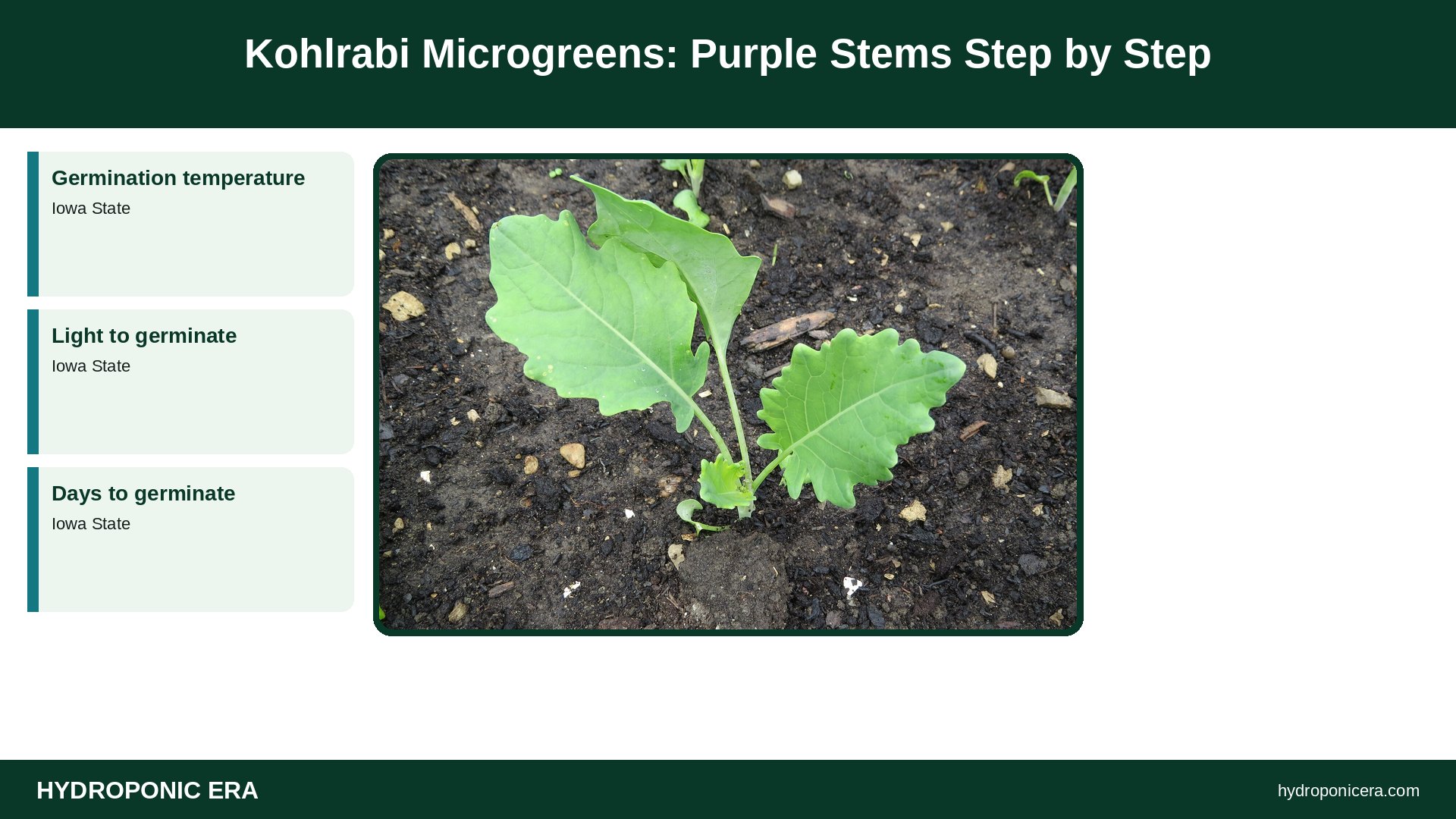
They’re the young seedlings of kohlrabi (Brassica oleracea Gongylodes group), the same plant grown for its swollen, turnip-like stem. Instead of waiting for a bulb, you cut the seedlings once the seed leaves open and the first true leaves start to form. Mississippi State describes purple kohlrabi microgreens as having purple stems, dark green leaves with a purple tint and a mild flavor. University of Maryland notes the cabbage family is especially well suited to microgreens and germinates faster than beet-family crops.
Why Are Kohlrabi Microgreens Easy for Beginners?
UF/IFAS lists kohlrabi among its fast-growing microgreens, alongside kale, mizuna, pac choi, radish and tatsoi. Mississippi State puts purple kohlrabi in its 10–15 day group, the same group as arugula, broccoli, cabbage, kale, mustard and pac choi. The seed is small and doesn’t need soaking, and University of Maryland says cabbage family plants germinate rapidly, in about 36 hours at 72°F (22°C).
| Crop | Germination light (Iowa State) | Days to germinate (Iowa State) |
|---|---|---|
| Kohlrabi | Dark | 4–7 |
| Dill | Light | 7–14 |
| Nasturtium | Dark | 10–14 |
How Do You Grow Kohlrabi Microgreens Step by Step?
- Buy untreated seed in bulk; Mississippi State says small garden-center packets aren’t economical for microgreens.
- Fill a tray with 1–1½ in (2.5–4 cm) of moist soilless mix, or lay a hydroponic grow mat in a standard 10 x 20 in (25 x 51 cm) flat.
- Sow thickly and evenly, about 3 tsp of seed per tray, and press it gently onto the surface.
- Mist and cover the tray to hold warmth and humidity, keeping it dark.
- Hold at 65–70°F (18–21°C) until the seeds sprout, usually within 4–7 days.
- Keep the cover on a few extra days for a short blackout so the stems lengthen.
- Uncover and give about 16 hours of light daily, watering from the bottom.
- Harvest at 10–15 days by cutting just above the mix.
New to trays and mats? Start with our microgreens guide.
How Much Seed Do Kohlrabi Microgreens Need?
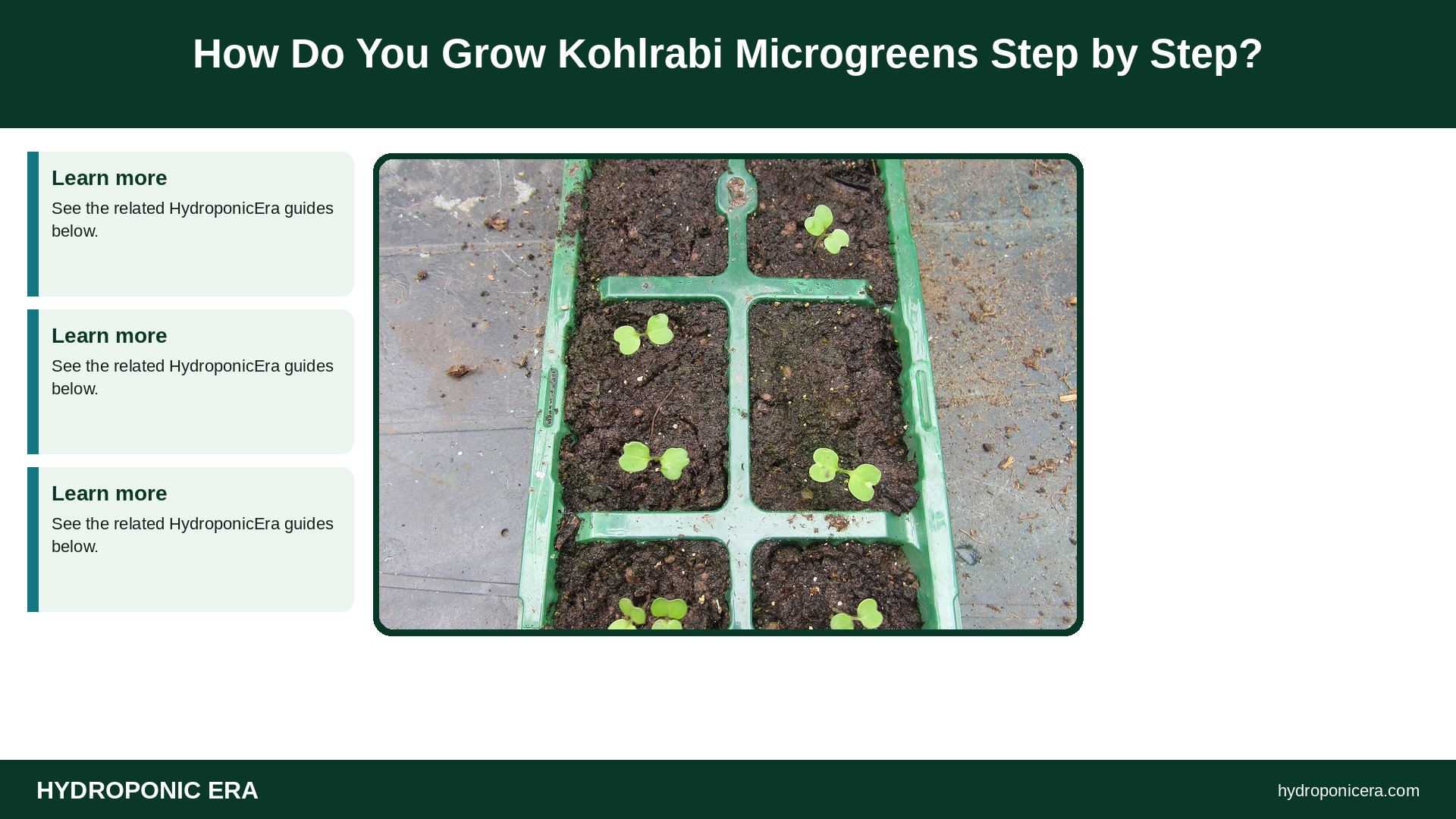
Mississippi State’s microgreen variety guide gives per-tray seeding rates and yields. Kohlrabi uses slightly more seed than cabbage or pac choi but yields a bit less, so plan on more trays if you want the same weight of greens. University of Maryland gives a general rate of about 1 Tbsp (10–15 g) of seed per 10 x 20 in (25 x 51 cm) flat, which lines up with 3 tsp.
| Brassica (Mississippi State) | Seeding rate | Expected yield | Harvest group |
|---|---|---|---|
| Purple kohlrabi | 3 tsp | 2–4 oz (57–113 g) | 10–15 days |
| Red cabbage | 2–3 tsp | 4–6 oz (113–170 g) | 10–15 days |
| Pac choi | 2–3 tsp | 4–6 oz (113–170 g) | 10–15 days |
| Broccoli | 2–3 tsp | 3–5 oz (85–142 g) | 10–15 days |
How Much Light Do Kohlrabi Microgreens Need?
Once the seedlings are up, light keeps the stems sturdy and compact. University of Maryland recommends about 16 hours of light per day and says grow lights are typically 6–12 in (15–30 cm) above the foliage, depending on fixture intensity. It also notes higher light intensity raises phenolic content in microgreens. Use an outlet timer so the schedule stays consistent. Our light distance guide covers hanging height by stage.
When Should You Harvest Kohlrabi Microgreens?
Cut when the seed leaves are fully open and the first true leaves are expanding, usually 10–15 days after sowing per Mississippi State. University of Maryland says microgreens are typically 2–3 in (5–8 cm) tall at harvest. Use clean, sharp scissors and cut just above the mix. The seedlings won’t regrow, so sow a new tray every week for a steady supply.
How Do Kohlrabi Microgreens Compare With Other Brassicas?
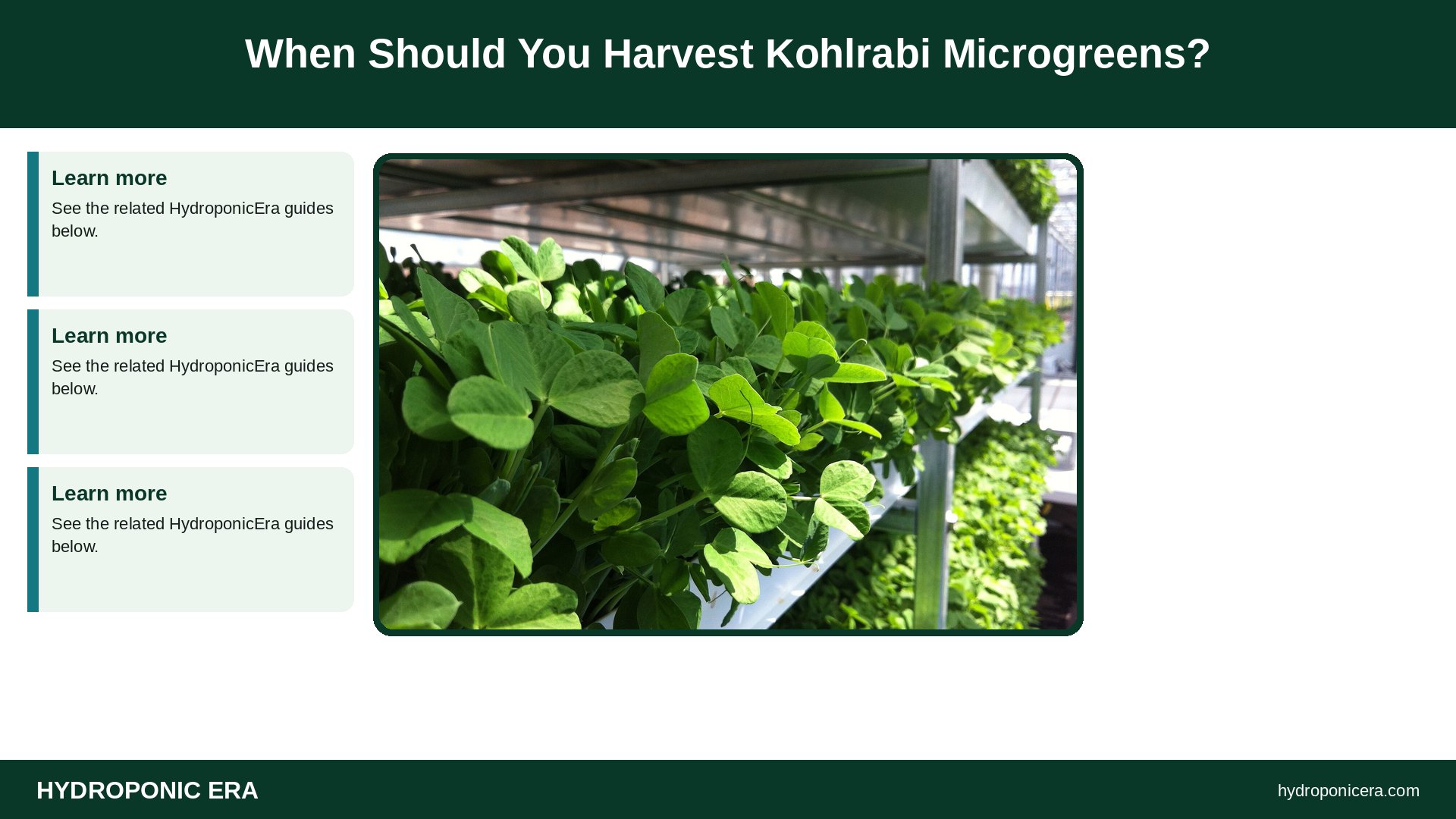
Mississippi State describes the flavor and look of several brassica microgreens. Kohlrabi sits on the mild end, which makes it a good base for mixes and a friendly pick for anyone who finds mustard and radish too hot.
| Brassica microgreen | Flavor (Mississippi State) | Look |
|---|---|---|
| Purple kohlrabi | Mild | Purple stems, purple-tinted leaves |
| Red cabbage | Mild | Dark green leaves, purple margins |
| Red Russian kale | Mild | Blue-green leaves outlined in pink |
| Pac choi | Mild | White stems, green leaves |
| Ruby Streaks mustard | Spicy | Red and dark green leaves |
Can You Grow Kohlrabi Microgreens Hydroponically?
Yes. University of Maryland says microgreens can be grown hydroponically on mats made from hemp, wood fiber, coconut coir, bamboo or jute, cut to fit a standard flat. UF/IFAS photographed kohlrabi growing on a mat beside soil-grown trays in its trials. Virginia Tech notes commercial microgreens are also grown in NFT, ebb-and-flow and aeroponic systems. If you want full-size bulbs instead, see our hydroponic kohlrabi guide or the related hydroponic cabbage guide.
Why Are My Kohlrabi Microgreens Leggy or Moldy?
- Tall, pale, floppy stems: blackout ran too long or light is too weak or too far away.
- Mold or rot: too wet or still air; University of Maryland suggests a gentle fan and venting covers.
- Patchy stand: uneven sowing; small dark seeds are hard to see on dark mix.
How Do You Use Kohlrabi Microgreens?
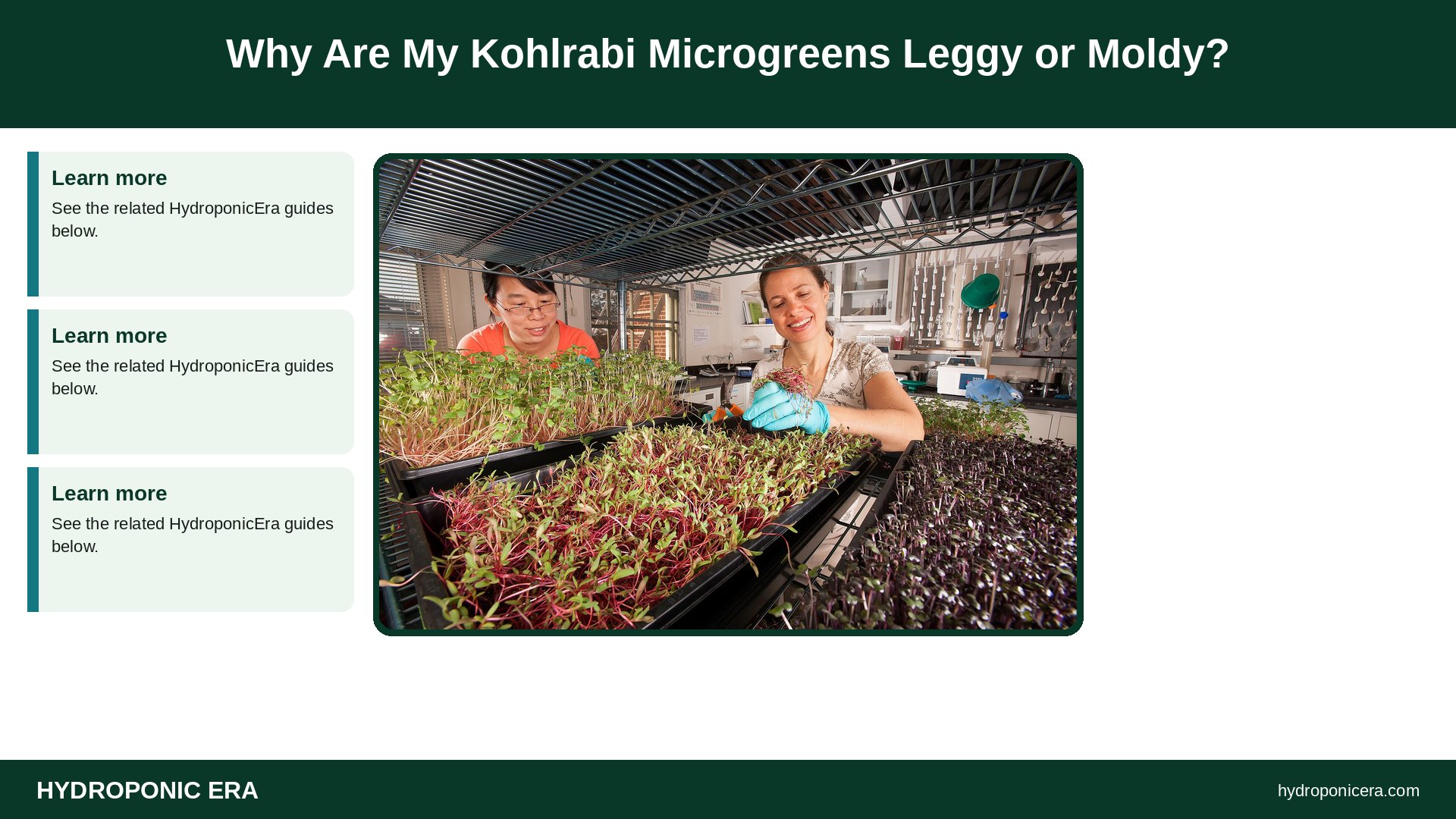
Use them raw, where the purple stems show: on salads, sandwiches, wraps, tacos and grain bowls, or as a garnish for soups and eggs. University of Maryland also suggests stirring microgreens into pesto or smoothies. Their mild cabbage flavor pairs well with spicier greens like mustard or radish in a mix.
Are Kohlrabi Microgreens Nutritious?
Mississippi State notes research has found microgreens high in vitamins C and E, beta-carotene, lutein and zeaxanthin, and University of Maryland says nutrient content varies a lot between crops and growing conditions. No specific nutrient figures for kohlrabi microgreens were found in the extension sources used here, so treat them as one colorful part of a varied diet. Rinse them, pat dry and refrigerate for up to 10 days, per University of Maryland. Read our home food safety guide.
FAQ About Kohlrabi Microgreens
How long do kohlrabi microgreens take to grow?
About 10–15 days from sowing, per Mississippi State.
Do kohlrabi microgreens need to be soaked?
No; the small brassica seed sprouts quickly without soaking.
Do kohlrabi seeds need dark to germinate?
Yes, Iowa State lists darkness at 65–70°F (18–21°C).
What do kohlrabi microgreens taste like?
Mild and cabbage-like, with crisp purple stems.
Do kohlrabi microgreens regrow after cutting?
No; sow a fresh tray.
Sources
- Mississippi State University Extension — Microgreen Varieties for the Mississippi Gardener (P2884)
- Iowa State University Extension — Germination Requirements for Annuals and Vegetables
- University of Maryland Extension — Growing Microgreens and Baby Greens Indoors
- UF/IFAS Extension Duval County (T. DelValle) — Grow Your Own Microgreens
- Virginia Cooperative Extension — Microgreens Production (SPES-756)
- Photo credits (Wikimedia Commons, edited with titles): 2018-06-01 (131) Leaves of young Brassica oleracea var. gongylodes (Kohlrabi) at Bichlhäusl in Frankenfels, Austria by GT1976 (CC BY-SA 4.0); -2020-10-01 Swede beet seedlings (Brassica napus subsp. Rapifera), Trimingham by Kolforn (Kolforn) I’d appreciate if you could mail me (Kolforn@gmail.com) if you (CC BY-SA 4.0); Lufa Farms Microgreens in Trays by Lufa Farms (CC BY-SA 2.0); Liping Kou observes microgreens by Peggy Greb (Public domain); 20160617-AMS-LSC-9000 (61-sec.) (27334710733) by U.S. Department of Agriculture (Public domain)