
How do you grow water hyacinth? Float young plants on still water in full sun after your last frost, keep the water above 50°F (10°C) and thin the mat often, because populations can double in 6–18 days. Before buying, check your state list: water hyacinth is illegal to possess in Florida and Texas and regulated in several other states.
Key takeaway: Water hyacinth is a beautiful, fast-growing floating plant that can clean nutrient-rich water, but it is also one of the world’s worst aquatic weeds. Grow it only where it is legal, keep it contained and never let a single plant reach open water.
| Factor | Water hyacinth | Source |
|---|---|---|
| Botanical name | Pontederia (Eichhornia) crassipes | UF/IFAS |
| Winter hardiness | USDA Zones 9–11 | Missouri Botanical Garden |
| Minimum for new growth | Above 50°F (10°C) | UF/IFAS |
| Light | Full sun, still water | Missouri Botanical Garden |
| Bloom time | June to September, lilac to lavender | Missouri Botanical Garden |
| Spread rate | Can double in 6–18 days | UF/IFAS |
| Legal status | Prohibited in FL and TX; regulated elsewhere | FDACS, TPWD, USDA |
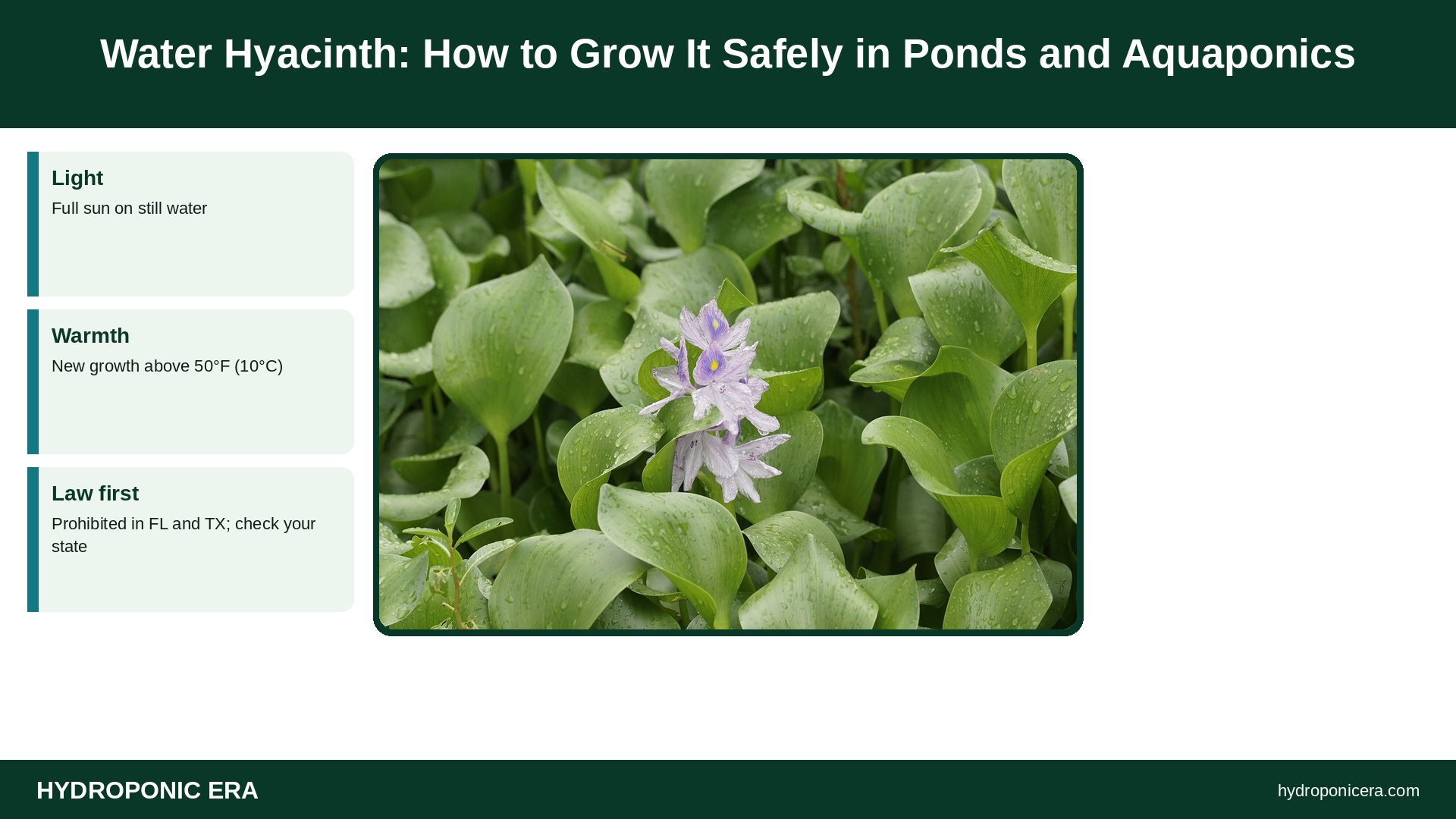
What Is Water Hyacinth?
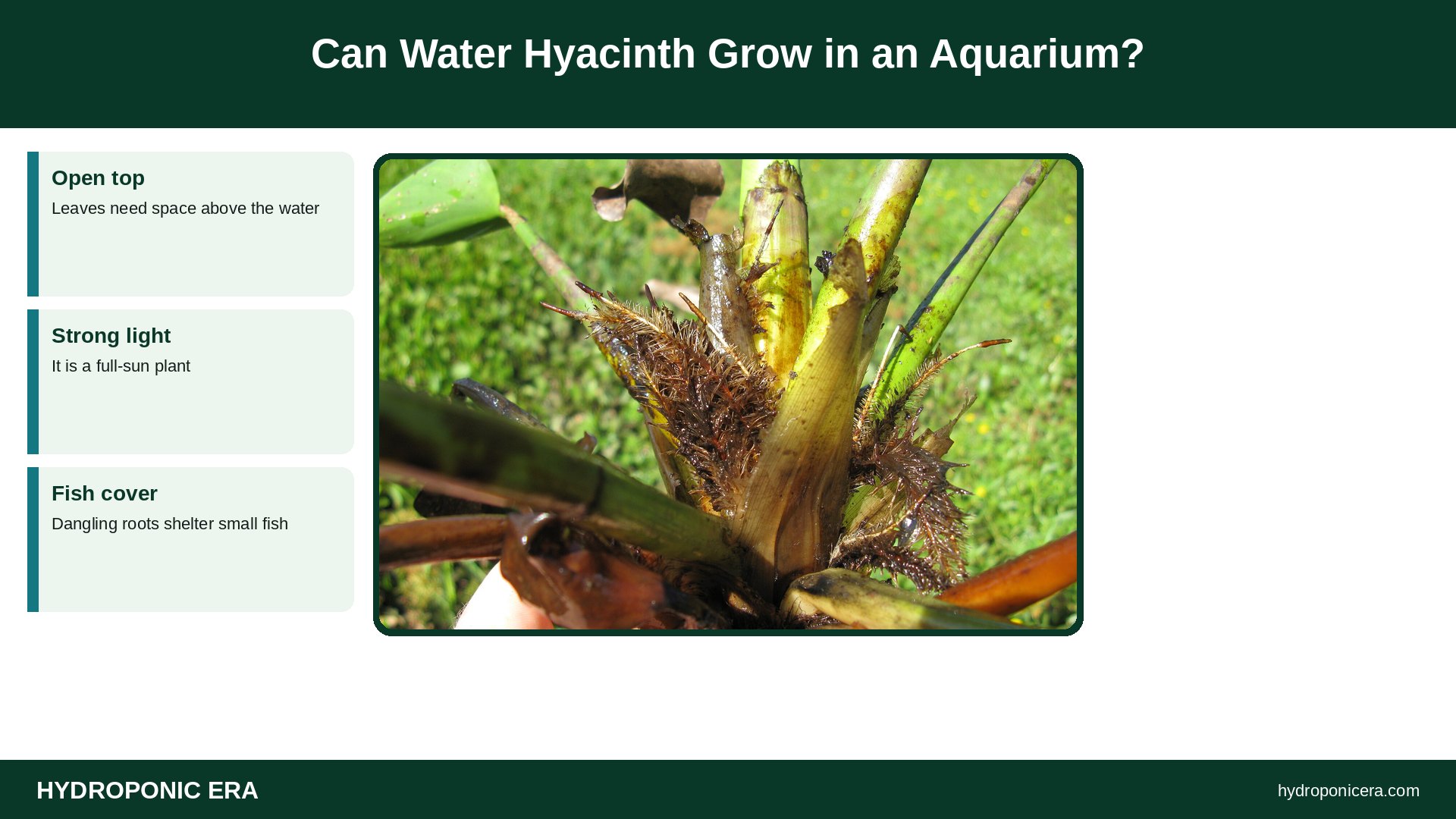
Water hyacinth is a free-floating aquatic perennial native to the Amazon basin in Brazil. It forms rosettes of thick, glossy leaves held up by spongy, inflated leaf stalks that act as floats, with long, feathery dark roots hanging below. In summer it sends up spikes of lavender flowers, each marked with a yellow eye-spot.
The USGS describes leaves about 4.7–5.9 in (12–15 cm) wide on petioles up to 12 in (30 cm) long, and Missouri Botanical Garden lists flower spikes of 8–15 blooms. It is not the spring bulb sold as hyacinth; for that plant, see our guide to growing bulbs in water.
Is Water Hyacinth Legal to Grow in Your State?
It depends on where you live. Water hyacinth is legal to sell in many northern states but prohibited in others, and rules change, so check your state agriculture or wildlife agency before buying. Florida bans possessing, cultivating and selling it, and Texas lists it as a prohibited exotic aquatic plant.
| State | Status of water hyacinth | Source |
|---|---|---|
| Florida | State noxious weed; possession, cultivation and sale illegal | FDACS, UF/IFAS |
| Texas | Prohibited exotic aquatic plant; no possession without a permit | Texas Parks and Wildlife |
| Wisconsin | Prohibited | USDA PLANTS |
| Minnesota | Regulated | USDA PLANTS |
| Alabama | Class C | USDA PLANTS |
| Michigan | Watch list | USDA PLANTS |
Missouri Botanical Garden also flags it as a “Midwest Noxious Weed: Do Not Plant” and notes several southern states have banned its sale. A closely related species, rooted water hyacinth (Eichhornia azurea), is on the federal noxious weed list.
How Do You Grow Water Hyacinth in a Pond or Tub?
Where it’s legal, water hyacinth is easy: it needs warm, still, sunny water and nothing else. Missouri Botanical Garden calls it easily grown on still water in full sun, but rates maintenance as high because it spreads so fast. These seven steps keep it attractive and under control.
- Confirm it’s legal in your state and county before you buy a single plant.
- Use a closed container such as a lined pond, stock tank or patio tub with no overflow to a creek, ditch or storm drain.
- Wait until after your last frost, then scatter small bunches on the surface, as Missouri Botanical Garden suggests.
- Give full sun; the plant needs hot summer weather and full sun to bloom.
- Keep water warm; UF/IFAS says new growth needs temperatures above 50°F (10°C).
- Thin every week or two, pulling daughter plants so they cover no more than part of the surface.
- Bag and trash extras; never toss them into another body of water.
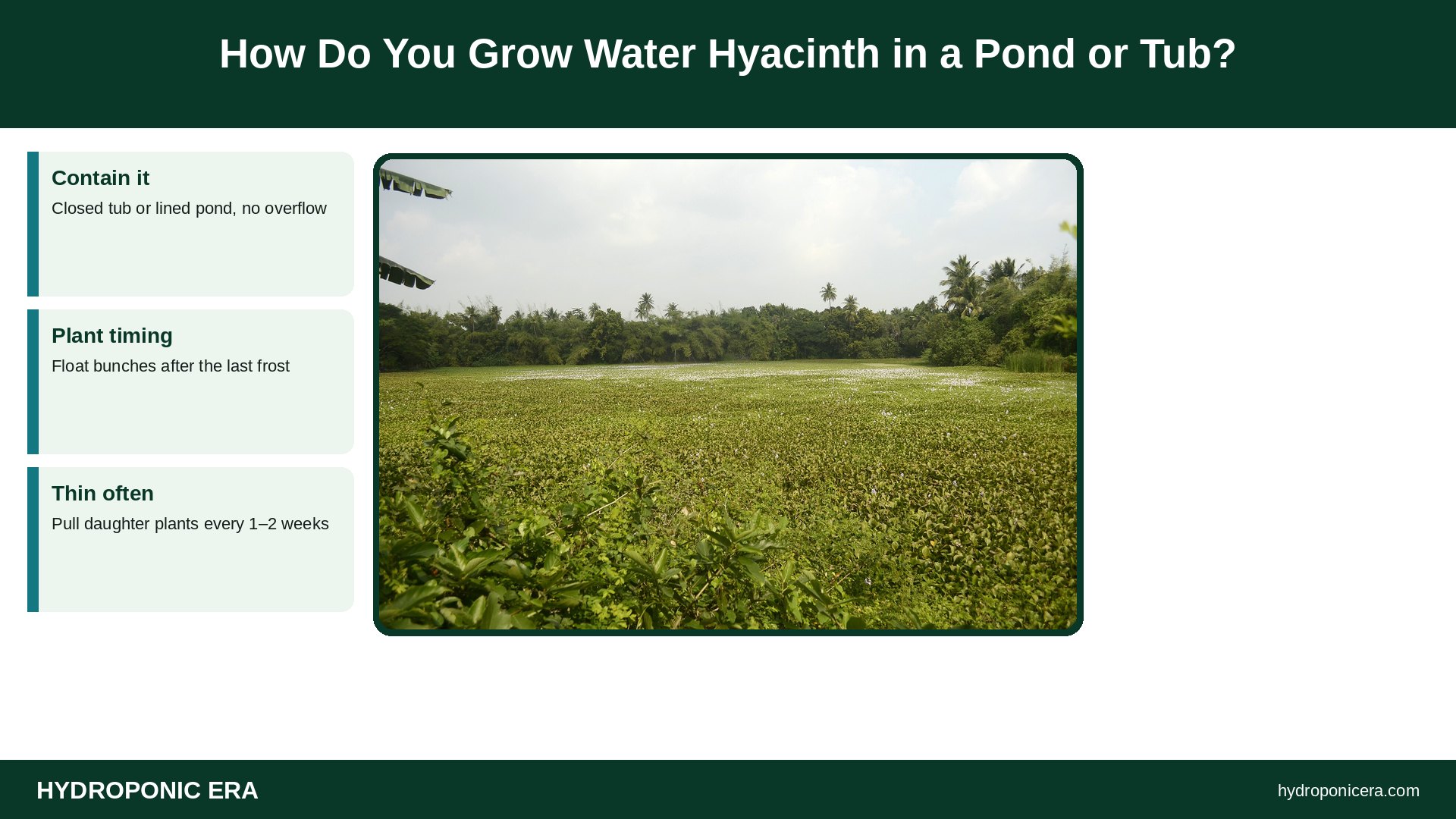
How Fast Does Water Hyacinth Spread?
Very fast. Mature plants send out horizontal stolons that form new daughter plants, and UF/IFAS reports populations can double in as little as 6–18 days. In its example, one plant left alone could become about 500,000 plants within five months, enough to cover an acre (0.4 hectare) of water.
Dense mats can weigh as much as 400 tons per acre (about 900 metric tons per hectare), according to UF/IFAS. Seeds can also stay dormant until drying or temperature swings trigger them, so a “cleaned out” pond can sprout again.
Can You Use Water Hyacinth in Aquaponics or Hydroponics?
It can work as a contained filter plant where it is legal, because it pulls nutrients from water quickly. UF/IFAS says its growth is limited only by temperature and nutrients, and notes research into using water hyacinth for nutrient removal in sewage treatment. Missouri Botanical Garden adds that its foliage shades out algae.
The trade-off is real. UF/IFAS warns dense mats block light and can lower oxygen to levels dangerous for fish, so a fully covered tank is a risk, not a filter. If you try it, keep it in a separate sump or raft section, remove plants weekly and test oxygen. Our aquaponics for beginners guide and dissolved oxygen guide explain the basics. It also competes with your food crops for the same nutrients.
Can Water Hyacinth Grow in an Aquarium?
It can float in an open-top aquarium or indoor tub, but it is a full-sun plant, so most indoor tanks lack enough light for strong growth and flowers. Missouri Botanical Garden notes the dangling roots give small fish shelter and spawning areas, which is why aquarium keepers like it.
Leave space between the leaves and any lid or light, keep the tank warm and expect smaller plants indoors. If you mainly want algae shade on a tank, a smaller floating plant may suit better; our algae guide covers other light-blocking options.
How Do You Overwinter Water Hyacinth?
Outside Zones 9–11 it usually dies in winter, so most gardeners treat it as an annual. Missouri Botanical Garden says you can lift a few plants before frost and keep them in containers of wet, sandy loam in bright light at 60–70°F (16–21°C) indoors, though many growers simply buy new plants each spring.
Don’t move overwintered plants outdoors until the water is reliably above 50°F (10°C), the point UF/IFAS gives for new growth.
Why Is My Water Hyacinth Not Blooming or Looking Weak?
Most problems come down to light, heat, crowding or food. Missouri Botanical Garden says water hyacinth blooms need hot summer weather and full sun, and UF/IFAS ties its growth to temperature and nutrient availability. Check those four things first, before you assume pests or disease are the cause.
- No flowers: too little sun or cool weather; move the tub into full sun.
- Thin, upright stalks: crowding; USGS notes petioles grow thinner and more vertical in dense mats, so thin the plants.
- Pale, slow plants: low nutrients or cool water; UF/IFAS says growth is limited by both.
- Chewed leaves: in the southern U.S., biocontrol insects released to slow the weed may be feeding.
How Do You Dispose of Extra Water Hyacinth Safely?
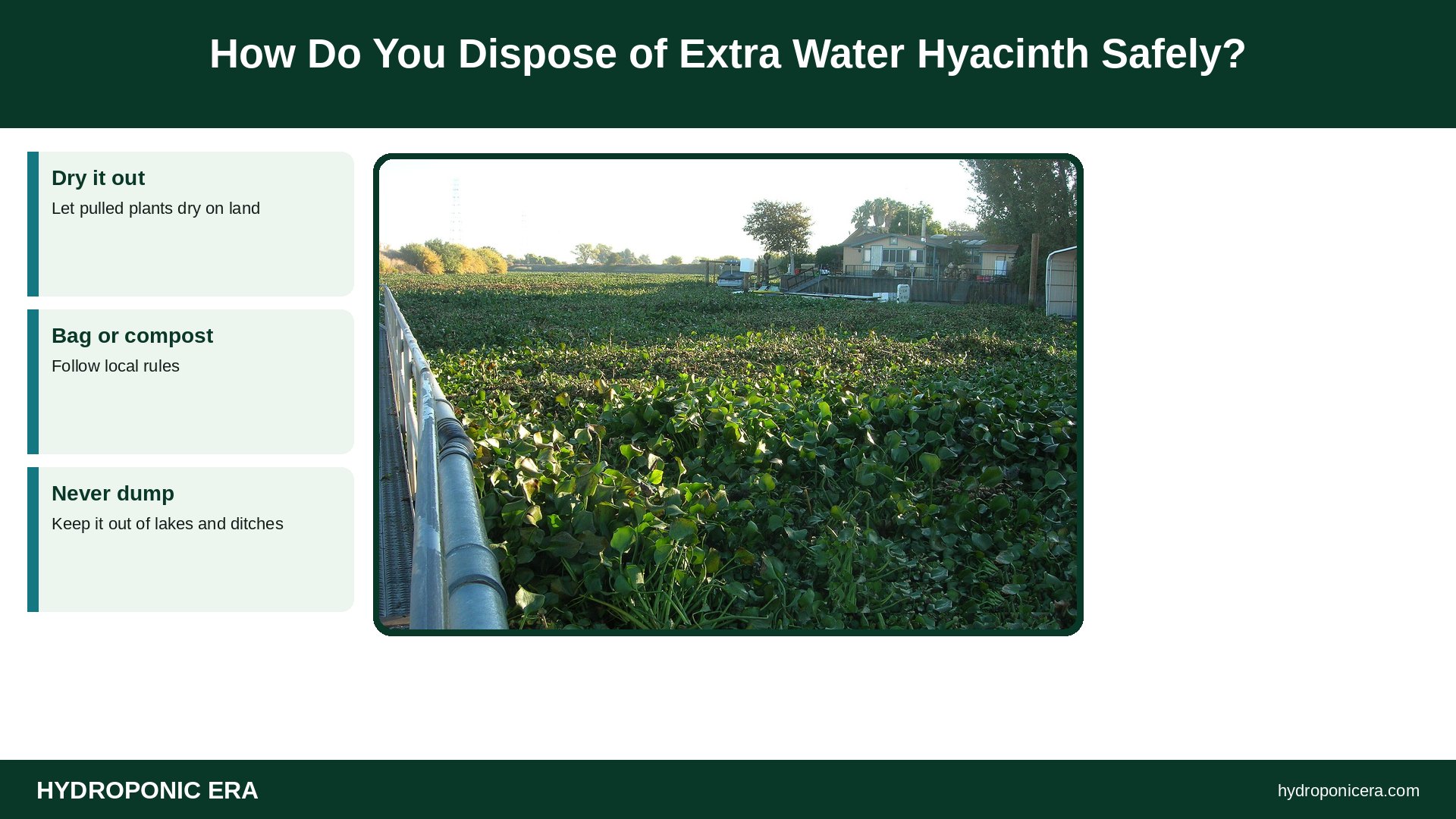
Pull extra plants onto land, let them dry out completely and bag them for the trash or compost them where local rules allow. Never dump them in a lake, stream or drainage ditch. UF/IFAS traces Florida’s St. Johns River infestation to a gardener tossing extra plants into the river around 1890.
Also rinse nets, buckets and boat trailers, since UF/IFAS notes small plants easily hitch rides to new waters. For more on keeping still water healthy, see our guide to mosquito larvae in hydroponics.
Water Hyacinth vs Water Lettuce vs Duckweed: Which Floating Plant?
All three float and shade water, but they differ in size and legal risk. Water hyacinth is the largest and showiest. Texas lists both water hyacinth and water lettuce as prohibited, along with dotted duckweed, so always check the species name, not just the common name.
| Plant | Look | Texas status (TPWD) |
|---|---|---|
| Water hyacinth (P. crassipes) | Rosettes with lavender flower spikes | Prohibited |
| Water lettuce (Pistia stratiotes) | Velvety, pale green rosettes | Prohibited |
| Dotted duckweed (Landoltia punctata) | Tiny floating fronds | Prohibited |
If you want a tiny floating plant for fish food or a lab project, read our duckweed growing guide first and confirm the species is allowed where you live.
FAQ About Water Hyacinth
Is water hyacinth invasive?
Yes, in warm climates. UF/IFAS calls it one of the world’s worst weeds.
Can water hyacinth survive winter?
Only in Zones 9–11; elsewhere it usually dies unless brought indoors.
Does water hyacinth clean pond water?
It absorbs nutrients and shades algae, but thick mats can lower oxygen for fish.
How fast does water hyacinth grow?
Populations can double in 6–18 days in warm, nutrient-rich water.
Is water hyacinth the same as a hyacinth bulb?
No. Spring hyacinth bulbs are a different, unrelated garden plant.
Sources
- UF/IFAS Extension (L. Gettys et al.) — Waterhyacinth: Florida’s Worst Floating Weed (SS-AGR-380)
- Missouri Botanical Garden — Plant Finder: Eichhornia crassipes
- USGS Nonindigenous Aquatic Species — Common water-hyacinth species profile
- Texas Parks and Wildlife — Prohibited exotic aquatic plants
- Florida Department of Agriculture and Consumer Services — Water Hyacinth Permit
- USDA NRCS — PLANTS Database: Eichhornia crassipes
- Photo credits (Wikimedia Commons, edited with titles): Eichhornia crassipes 7839 by Vengolis (CC BY-SA 4.0); Eichhornia crassipes covered pond JEG6087 by PJeganathan (CC BY-SA 4.0); Eichhornia crassipes roots2 (13920097416) by Harry Rose from South West Rocks, Australia (CC BY 2.0); Water Hyacinth in the Delta (7637205710) by Bureau of Reclamation (CC BY-SA 2.0)