
Is a smart garden worth it? A smart garden is worth it if you want fresh herbs or lettuce indoors with little effort. It combines a small hydroponic reservoir, seed pods and a built-in LED light on a timer. It suits leafy greens and herbs best; tomatoes and peppers need more light, space and patience than most countertop units give.
Key takeaway: Buy a smart garden for convenience, not for big yields. Pick one with an adjustable light, a timer, a visible water level and refillable pods, and start with basil, lettuce or parsley.
| Feature | Why it matters | What to look for |
|---|---|---|
| Built-in LED | Indoor plants almost always need extra light | Adjustable height, full spectrum |
| Timer | Leafy greens want 12–16 hours of light | Programmable on/off schedule |
| Reservoir | Roots draw water and nutrients from it | Clear level window, easy to clean |
| Seed pods | Hold seeds in an inert medium | Refillable or third-party options |
| Pump or air stone | Moves oxygen to the roots | Quiet, replaceable parts |
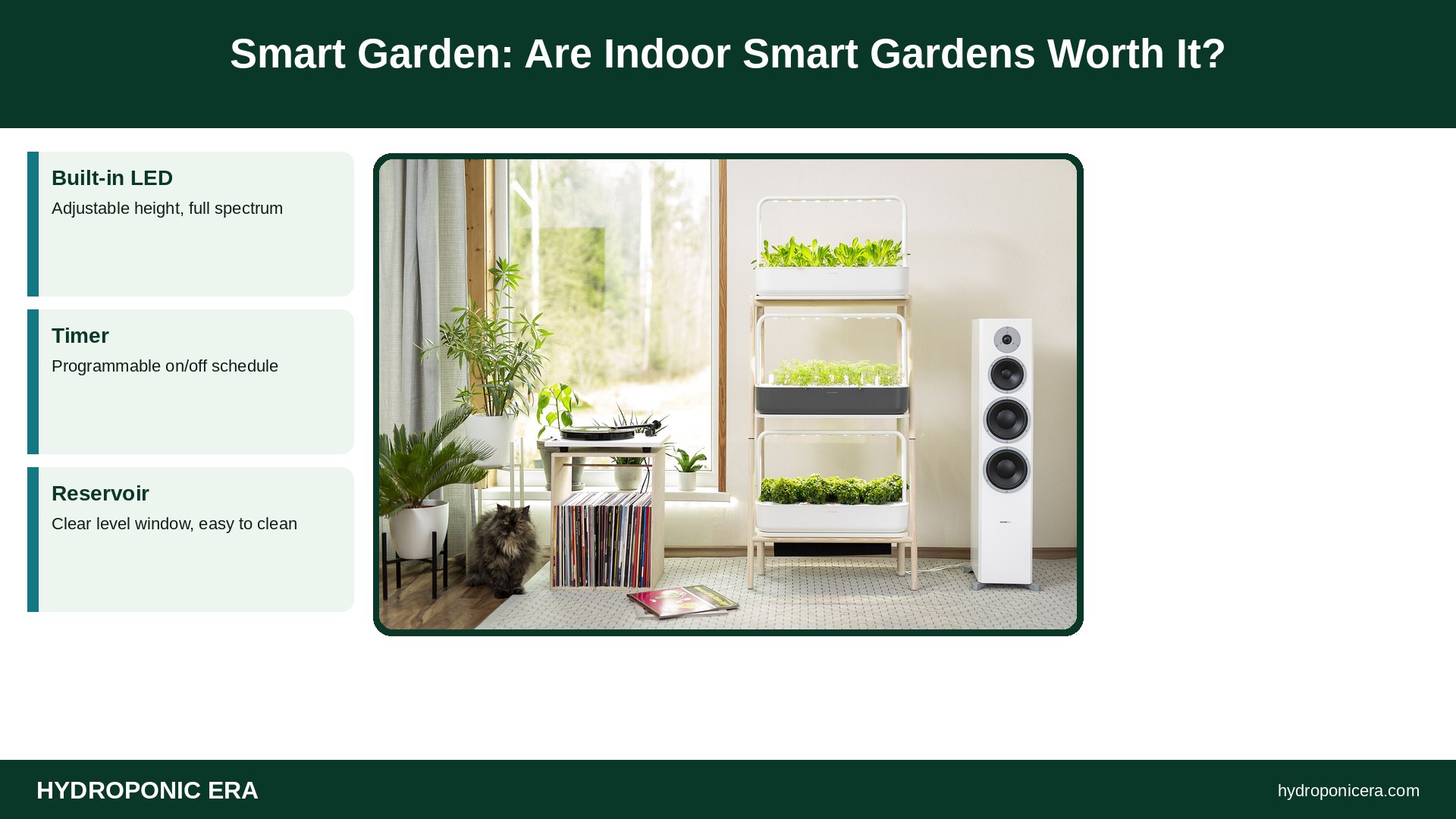
What Is a Smart Garden?
A smart garden is a compact indoor hydroponic kit that grows plants in water instead of soil. Seeds sit in pods of inert media, roots reach a nutrient reservoir, and an LED light hangs above on a timer. Some models add apps, sensors or reminders, but the core is simply water, nutrients and light in one box.
University of Florida IFAS notes that in-home hydroponic kits are increasingly popular with people who lack outdoor space, and that most systems work in basically the same way. Illinois Extension adds that many commercial home systems come with grow lights built in, which is the main feature that separates a smart garden from a jar on a windowsill.
How Does a Smart Garden Work?
A smart garden works by keeping roots in contact with nutrient-rich water while a timed LED supplies light. You fill the tank, add liquid nutrients, drop in seed pods and switch it on. Seeds germinate in the pod, roots grow down into the reservoir and the light runs a set number of hours each day.
South Dakota State University Extension explains that seeds started in inert media such as rockwool are kept moist until they germinate and then draw nutrients from the water. Most countertop units are a form of deep water culture or a simple wicking or pumped system. If you want to understand the method behind them, see our guide to the Kratky method, the simplest no-pump version.
What Grows Best in a Smart Garden?
Herbs and leafy greens grow best in a smart garden. Illinois Extension says lettuce, kale, spinach and herbs are good starter crops indoors because they grow quickly and take little space. Larger fruiting plants such as tomatoes can be grown hydroponically, but they take much longer and need more room than most homes provide.
- Easy: basil, parsley, chives, mint, lettuce, arugula.
- Moderate: cilantro (bolts quickly), dill, kale.
- Hard indoors: tomatoes, peppers and strawberries, which need stronger light and longer schedules.
- Flowers: Illinois Extension notes calendula, pansies and petunias also grow well hydroponically.
For variety ideas, see our list of the best herbs for hydroponics.
How Much Light Does a Smart Garden Need?
A smart garden needs its light on 12–16 hours a day for leafy greens, and up to 18 hours for fruiting plants, according to South Dakota State University Extension. The same guide suggests a light intensity of about 200–400 µmol/m²/s for leafy greens and 400–600 µmol/m²/s for tomatoes and peppers.
The University of Minnesota Extension says supplemental light is almost always necessary for indoor hydroponics, even with a sunny window in winter. It also notes LEDs are very energy efficient, long-lasting and produce little heat, though they cost more up front. Raise the light as plants grow so the tops stay close without scorching. Our guide to light distance by growth stage explains spacing.
How Do You Set Up a Smart Garden Step by Step?
- Pick a spot near an outlet, away from heat vents and direct afternoon sun.
- Rinse the reservoir and fill it to the marked line with room-temperature water.
- Add nutrients exactly as the label directs; more is not better.
- Insert seed pods and cover them with the germination domes if included.
- Set the light low and the timer to 14–16 hours.
- Remove domes once seedlings touch them.
- Top up water as the level drops and add nutrients on schedule.
- Thin and harvest regularly so tall plants do not shade short ones.
How Do You Care for a Smart Garden Each Week?
Care for a smart garden by topping up water, adding nutrients on schedule, raising the light and trimming plants every week. Snip herbs above a leaf pair so they branch. Check roots for brown slime and wipe algae off the reservoir. A full clean and water change every few weeks keeps the system fresh and odor-free.
Most hydroponic herbs prefer a solution pH around 5.5–6.5. If your kit allows testing, our guide on pH control for beginners explains the basics. Green film on the tank wall means light is leaking in; cover unused pod holes, as explained in our post on algae in hydroponic reservoirs.
What Are the Pros and Cons of a Smart Garden?
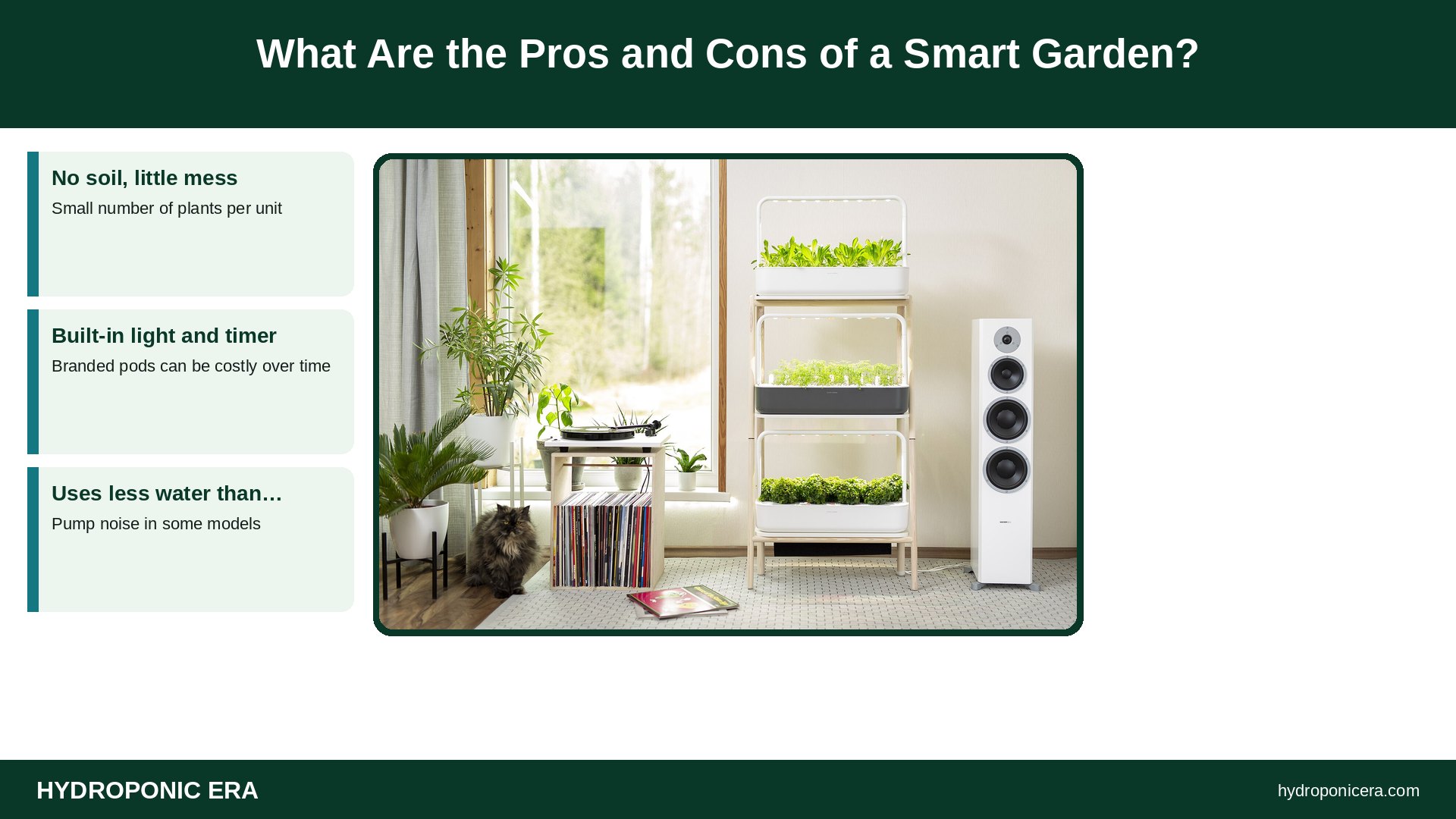
The main pros of a smart garden are convenience, clean indoor growing and year-round herbs. The main cons are small yields, ongoing pod and nutrient costs, and limited light for fruiting crops. It is a great teaching tool and herb supply, but it will not replace a vegetable garden or feed a family on its own.
| Pros | Cons |
|---|---|
| No soil, little mess | Small number of plants per unit |
| Built-in light and timer | Branded pods can be costly over time |
| Uses less water than soil gardening | Pump noise in some models |
| Year-round harvests | Fruiting crops struggle under small lights |
SDSU Extension notes hydroponic systems can use up to 90% less water than traditional soil gardening because water circulates to the roots. You can cut pod costs by making your own; see our guide to DIY seed pods.
Is a Smart Garden Better Than a DIY Setup?
A smart garden is better than a DIY setup if you value plug-and-play convenience and a tidy look. A DIY system is better if you want more plants, bigger lights and lower running costs. The plant biology is the same: both need clean water, balanced nutrients, oxygen at the roots and enough light.
The University of Minnesota Extension describes simple DIY containers with a lid or foam board, net pots and an LED or fluorescent light. If you outgrow a countertop unit, compare options in our vertical system comparison or start with a shelf with grow lights.
Why Are Plants in My Smart Garden Struggling?
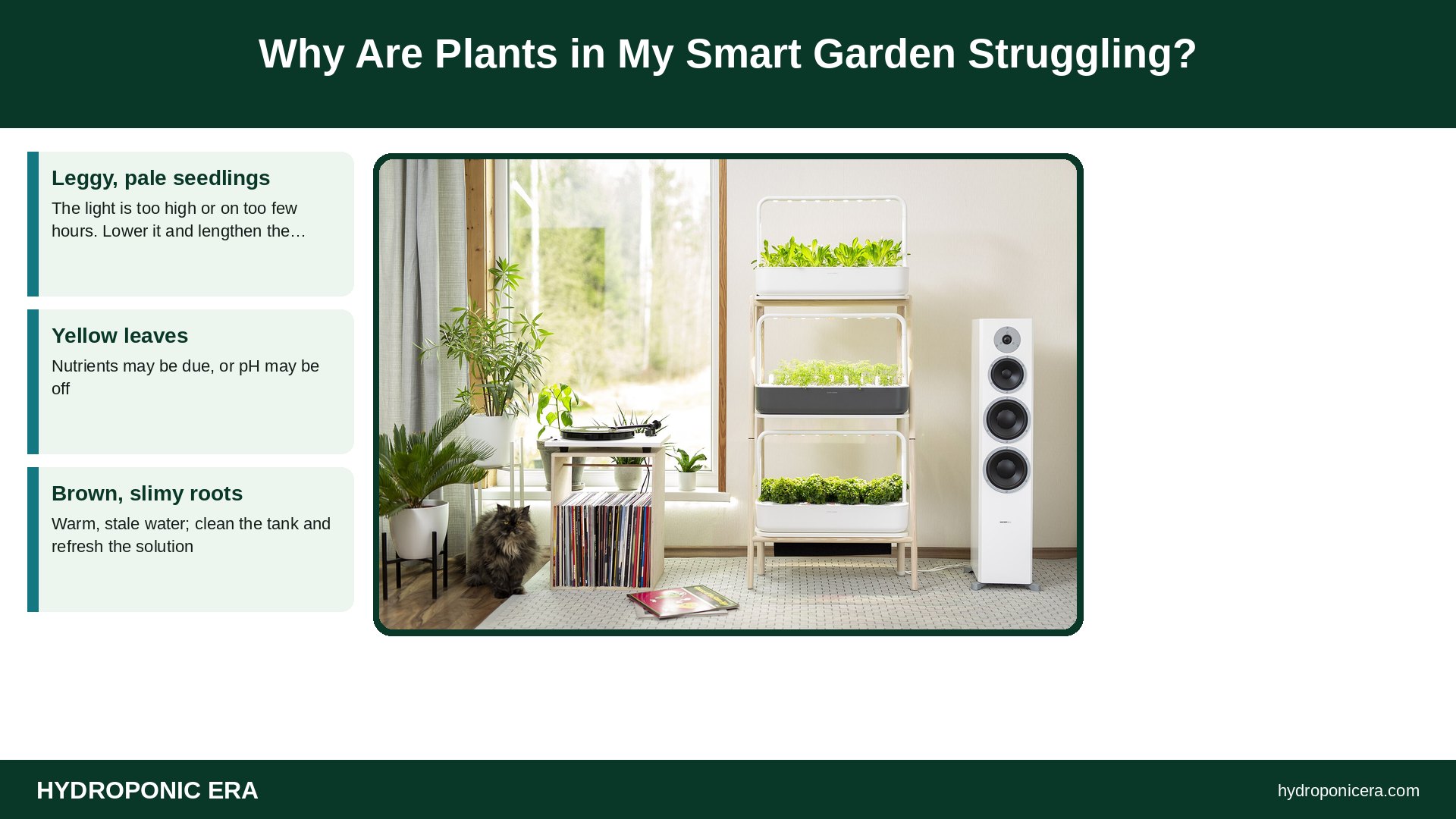
- Leggy, pale seedlings: The light is too high or on too few hours. Lower it and lengthen the schedule.
- Yellow leaves: Nutrients may be due, or pH may be off.
- Brown, slimy roots: Warm, stale water; clean the tank and refresh the solution.
- Seeds not sprouting: Old seed or a pod kept too dry; keep domes on until sprouts appear.
- One plant takes over: Prune hard or remove it so neighbors get light.
See our guide to leggy seedlings and the nutrient deficiency chart for more detail.
FAQs
Do smart gardens need sunlight?
No. The built-in LED replaces sunlight, though a bright room does not hurt.
How long until the first harvest?
Fast herbs and lettuce are often ready to trim within a few weeks; slower herbs take longer.
Can I use any seeds in a smart garden?
Usually yes, if you use a compatible pod or grow sponge.
Is a smart garden expensive to run?
Electricity use is modest because LEDs are efficient; pods and nutrients are the main ongoing cost.
Can I grow tomatoes in a smart garden?
Dwarf types can work, but expect small yields and long waits.
Sources
- University of Illinois Extension — Growing without soil: Getting started with hydroponics at home
- University of Minnesota Extension — Small-scale hydroponics
- UF/IFAS Gardening Solutions — Tabletop Hydroponics Tutorial
- South Dakota State University Extension — Small-scale Hydroponic Production Systems (P-00337)
- Photo credits (Wikimedia Commons, edited with titles): Click & Grow Smart Garden 27 by Janar Raidla (CC BY-SA 4.0); Air Purifier (Levoit LV-H133) (49317867758) by Home Air Quality Guides (CC BY-SA 2.0); Click & Grow Smart Garden 27 by Janar Raidla (CC BY-SA 4.0); Click & Grow Smart Garden 27 by Janar Raidla (CC BY-SA 4.0); Basil plant in a pot 02 by Netha Hussain (CC BY-SA 4.0)