
To stop mosquito larvae in hydroponics, close every opening where a mosquito could reach still water. Seal lids, plug empty net-pot holes and screen overflows. Dump or cover standing water nearby. If larvae still appear, a Bti product labeled for your use kills them without harming people, according to the EPA.
| Question | Quick answer |
|---|---|
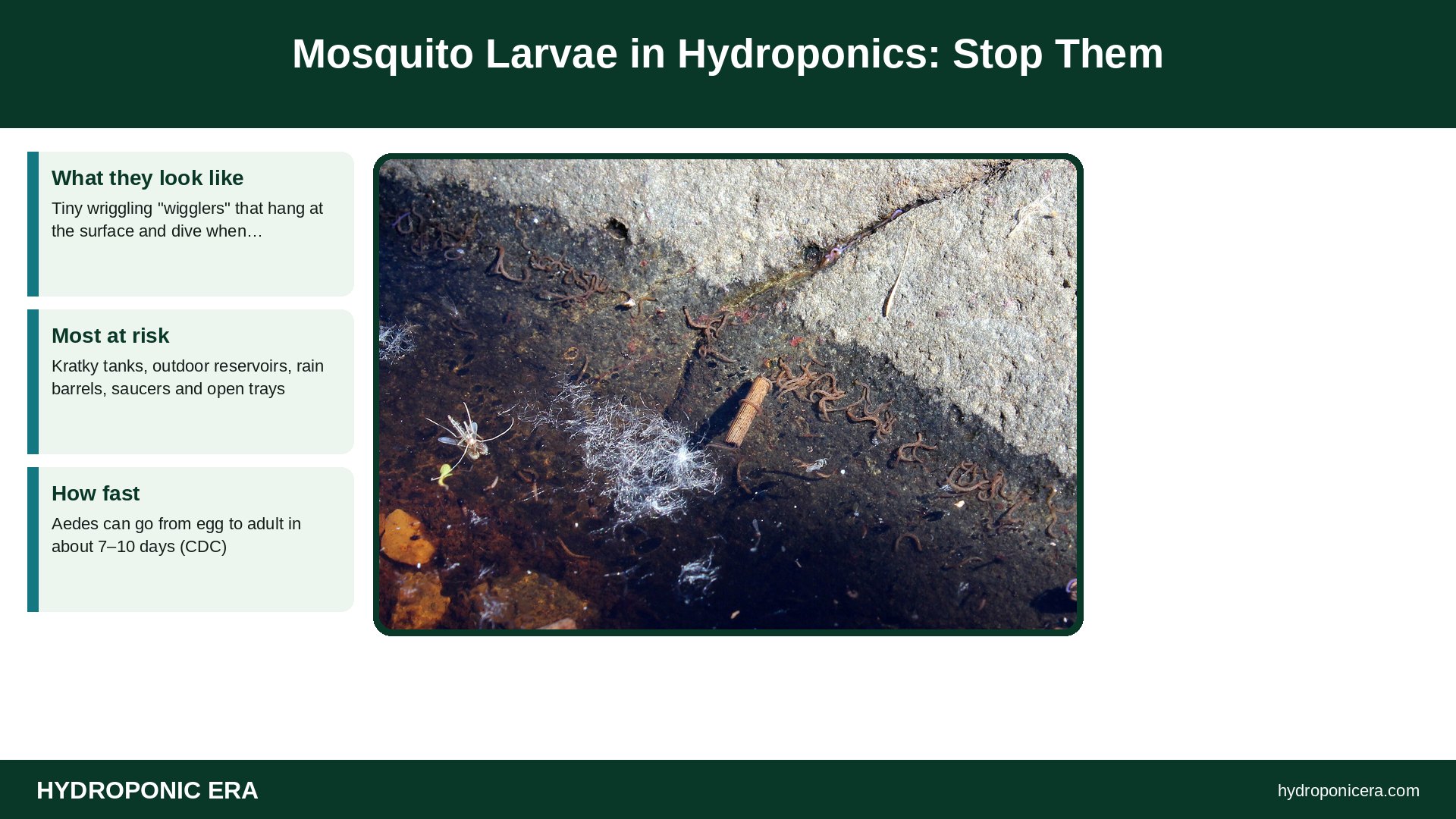
| What they look like | Tiny wriggling “wigglers” that hang at the surface and dive when disturbed |
| Most at risk | Kratky tanks, outdoor reservoirs, rain barrels, saucers and open trays |
| How fast | Aedes can go from egg to adult in about 7–10 days (CDC) |
| Main fix | Light-tight, gap-free lids; plug empty holes; remove standing water |
| Biological larvicide | Bti targets only mosquito, black fly and fungus gnat larvae (EPA) |
| Label rule | Only some Bti products are allowed in drinking water; follow the label (EPA) |
How Do You Know You Have Mosquito Larvae in Hydroponics?
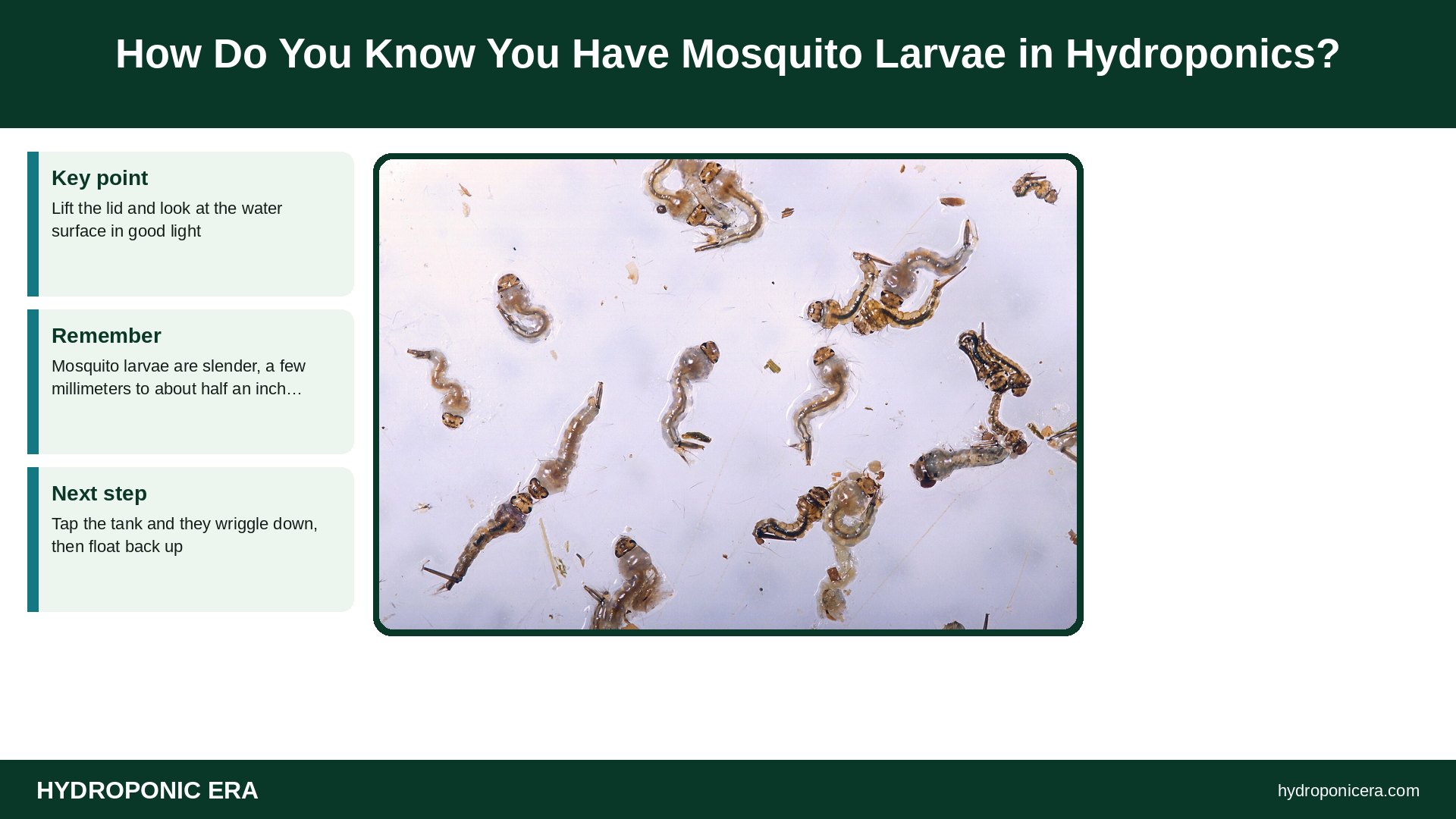
Lift the lid and look at the water surface in good light. Mosquito larvae are slender, a few millimeters to about half an inch long, and hang just under the surface to breathe through a tube at the tail. Tap the tank and they wriggle down, then float back up. Comma-shaped pupae look similar and also move. Fungus gnat larvae, by contrast, live in wet media, not open water; see fungus gnats in hydroponics.
Finding mosquito larvae in hydroponics means an adult female reached the water. Indoors that usually happens through a gap in the lid or an empty net-pot hole. Outdoors, any reservoir, saucer, bucket or rain barrel is fair game.
Why Do Hydroponic Systems Attract Mosquitoes?
Mosquitoes need standing water to breed. The EPA’s first non-spray advice is to eliminate any standing water, “even tiny amounts.” Many hydroponic setups hold exactly that: still, warm, nutrient-rich water under a lid that doesn’t quite seal. The Kratky method is the classic case, because it has no pump and the falling water level leaves an air gap under the lid.
The CDC’s Aedes life-cycle page explains why small gaps matter. Aedes females lay eggs on the inside walls of containers just above the waterline; the eggs can survive drying for up to 8 months and hatch when water rises. The CDC says an Aedes egg takes 7–10 days to develop into an adult. A reservoir you top up regularly can produce a fresh batch of mosquito larvae in hydroponics within one refill cycle.
How Do You Stop Mosquito Larvae in Hydroponics? 7 Steps
- Seal the lid. Use tight-fitting lids and tape seams. Light-proofing helps against algae too; see reservoir lid light-proofing methods.
- Plug every empty hole. Cap unused net-pot sites with a lid, cup or neoprene collar.
- Screen vents and overflows. Fine mesh over air-line holes, drains and overflow pipes blocks egg-laying females.
- Empty standing water. Dump saucers, trays, spare buckets and puddles at least weekly, as the EPA advises.
- Scrub reservoir walls. When you change solution, scrub the inside walls near the waterline to remove any eggs. Our cleaning guide covers safe sanitizing.
- Keep water moving. Recirculating systems and air stones disturb the surface. Moving water won’t replace a sealed lid, but it makes conditions less friendly.
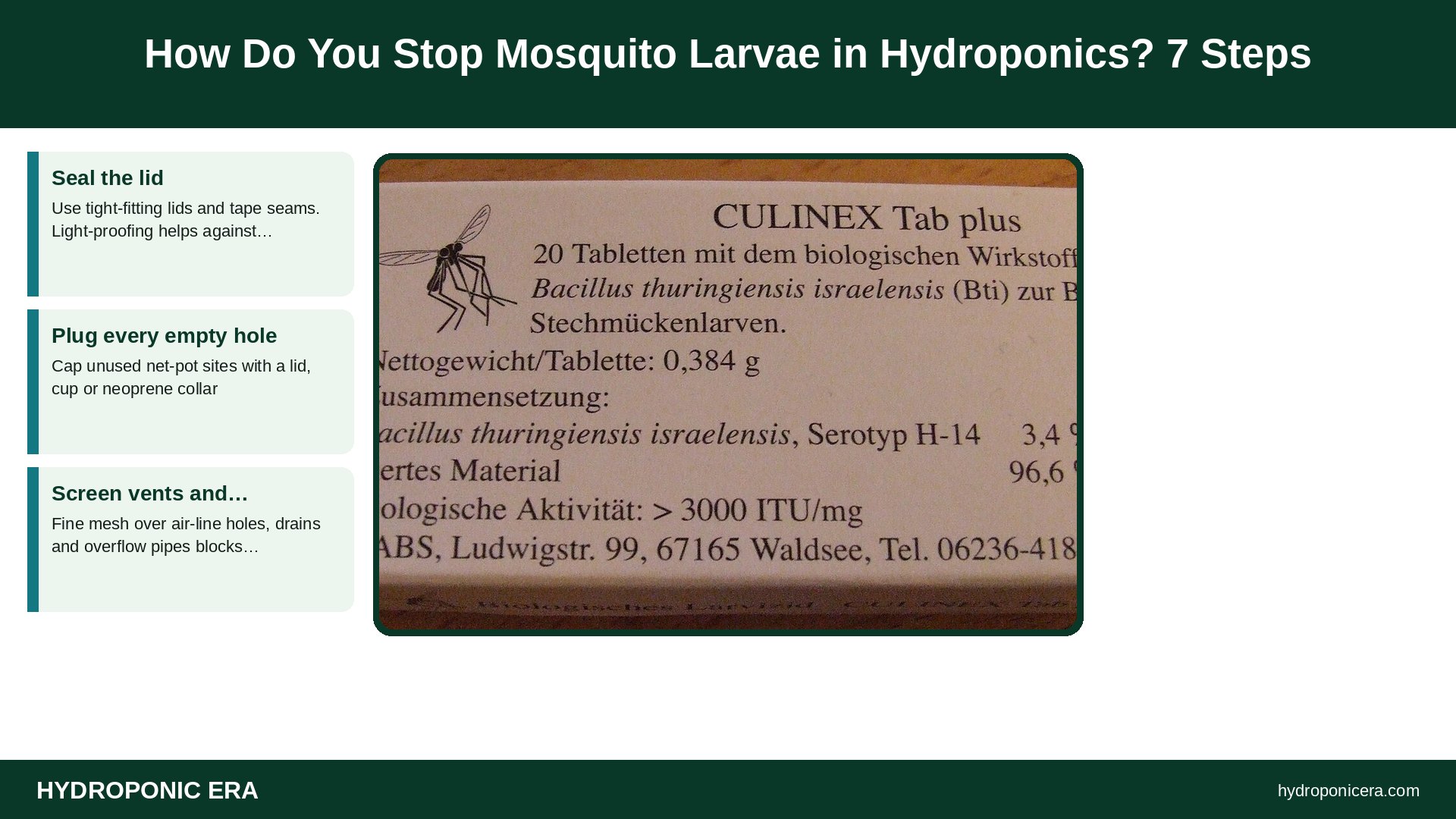
- Use Bti if needed. Treat only where the product label allows, at the label rate.
Most growers stop mosquito larvae in hydroponics with steps 1–4 alone.
Is Bti Safe to Use for Mosquito Larvae in Hydroponics?

Bti is Bacillus thuringiensis subspecies israelensis, a naturally occurring soil bacterium. The EPA says its toxins specifically target only the larvae of mosquitoes, black flies and fungus gnats, that it has no toxicity to people, and that it’s approved for pest control in organic farming. The agency lists five strains in 48 registered products and reports no documented resistance in mosquito populations.
The key caveat is the label. The EPA notes that some Bti products are allowed on certain drinking water, such as cisterns, while others aren’t intended for that use. Before adding any product to a reservoir that feeds food crops, read the label for the sites it allows and the dose. If the label doesn’t cover your use, rely on exclusion instead. Many hydroponic growers already know Bti from fungus gnat control, but a gnat product’s label may differ from a mosquito product’s.
What Should You Do With Water That Already Has Larvae?
- Small indoor tank: Drain it, scrub the walls, refill and seal the lid. This is the fastest way to clear mosquito larvae in hydroponics.
- Larger reservoir: Skim or net visible larvae and pupae, then fix the gap they came through. Consider a labeled Bti product.
- Outdoor tanks and rain barrels: Fit fine mesh and tight lids. See rainwater for hydroponics before using collected water.
Don’t add oil, soap or household chemicals to a nutrient reservoir. They can damage roots and contaminate food crops.
Common Mistakes With Mosquito Larvae in Hydroponics
| Mistake | Why it fails | Better approach |
|---|---|---|
| Ignoring a small lid gap | Females only need a tiny opening | Tape or gasket every seam |
| Leaving empty net-pot holes open | Direct access to still water | Cap them |
| Refilling without scrubbing walls | Eggs above the waterline hatch | Scrub at each change |
| Using any Bti product without reading the label | Not all products cover every water use | Check sites and rate |
| Forgetting saucers and spare buckets | Breeding happens next to the system | Empty weekly |
Do Mosquito Larvae Hurt Plants?
Not directly. Larvae feed on microorganisms and organic particles in the water and don’t attack roots. The real problem is the adults: some species bite and can carry disease. That’s why mosquito larvae in hydroponics are worth fixing quickly even when plants look fine. Dead larvae and debris also add organic matter that can feed algae and biofilm, so a clean, sealed reservoir is better for root health too; see algae in hydroponic reservoirs.
FAQs: Mosquito Larvae in Hydroponics
Can mosquito larvae in hydroponics survive in nutrient solution?
Yes. Ordinary hydroponic nutrient strength doesn’t stop them. Exclusion is what works.
Will hydrogen peroxide kill mosquito larvae in hydroponics?
We didn’t find EPA or extension guidance recommending peroxide as a mosquito larvicide. Drain and seal instead, or use a labeled Bti product.
How long until larvae become adults?
For Aedes, about 7–10 days from egg to adult in warm conditions, according to the CDC.
Are mosquito dunks safe for vegetables?
The EPA says Bti has no toxicity to people and is used in organic farming, but only use a product whose label covers your water use.
Do indoor systems get mosquito larvae in hydroponics?
Less often, but yes, if an adult gets indoors and finds an open tank. Seal lids and cap empty holes.
Related HydroponicEra Guides
- Kratky method hydroponics
- Fungus gnats in hydroponics
- Sticky trap placement for pest pressure
- White fuzz on roots in water
Sources
- U.S. Environmental Protection Agency — Bti for Mosquito Control
- U.S. Environmental Protection Agency — Controlling Mosquitoes at the Larval Stage
- Centers for Disease Control and Prevention — Life Cycle of Aedes Mosquitoes
- Photo credits (Wikimedia Commons, edited with titles): Mosquito nursery by LittleLeafSheep (CC BY 4.0); Culex nigripalpus larvae ARS K9399-1 by Peggy Greb (Public domain); Culinex Tab plus by Claus Ableiter (CC BY-SA 3.0)