
Can you grow a Boston fern in water? A Boston fern in water can live for a while, but it does not root from frond cuttings. The reliable way is to root a runner plantlet or a small division with its crown held above the water line. For long-term growth without soil, semi-hydro in clay pebbles with a weak nutrient solution works better than a plain jar.
Key takeaway: Propagate a Boston fern in water from runners or divisions, never from cut fronds. Keep the crown dry, the roots wet, the light bright but indirect and the room humid.
| Method | Works in water? | Notes |
|---|---|---|
| Frond (leaf) cutting | No | Fronds have no buds to form a new plant |
| Runner plantlet | Yes | Root the tip of a stolon, then pot it |
| Division | Yes, short term | Wash soil off; keep crown above water |
| Semi-hydro (LECA) | Yes, long term | Clay pebbles plus dilute nutrients |
| Spores | Not in a jar | Slow; done on moist media |

What Is a Boston Fern, and Why Grow It in Water?
Boston fern (Nephrolepis exaltata) is a tropical fern native to tropical and subtropical America and grown as a houseplant across the U.S. NC State Extension describes arching fronds 2–3 feet (60–90 cm) long, crowded along slender stolons, or runners, that spread from short rhizomes. Those runners are the key to propagating it in water.
NC State lists cultivars such as ‘Bostoniensis’, with broad, drooping fronds up to 3 feet (90 cm) tall and wide, ‘Compacta’, and ‘Dallas’, which tolerates lower light and less humidity. Boston fern is also tagged as non-toxic for cats and dogs, which makes it a popular pet-safe choice.
Why Won’t Boston Fern Fronds Root in Water?
Boston fern fronds won’t root in water because ferns do not grow from leaf cuttings the way pothos or philodendron stems do. New fern plants come from the rhizome, from runners or from spores. A cut frond has no growing point, so it sits in water, slowly yellows and rots. Use a runner or a crown division instead.
How Do You Start a Boston Fern in Water From a Runner?
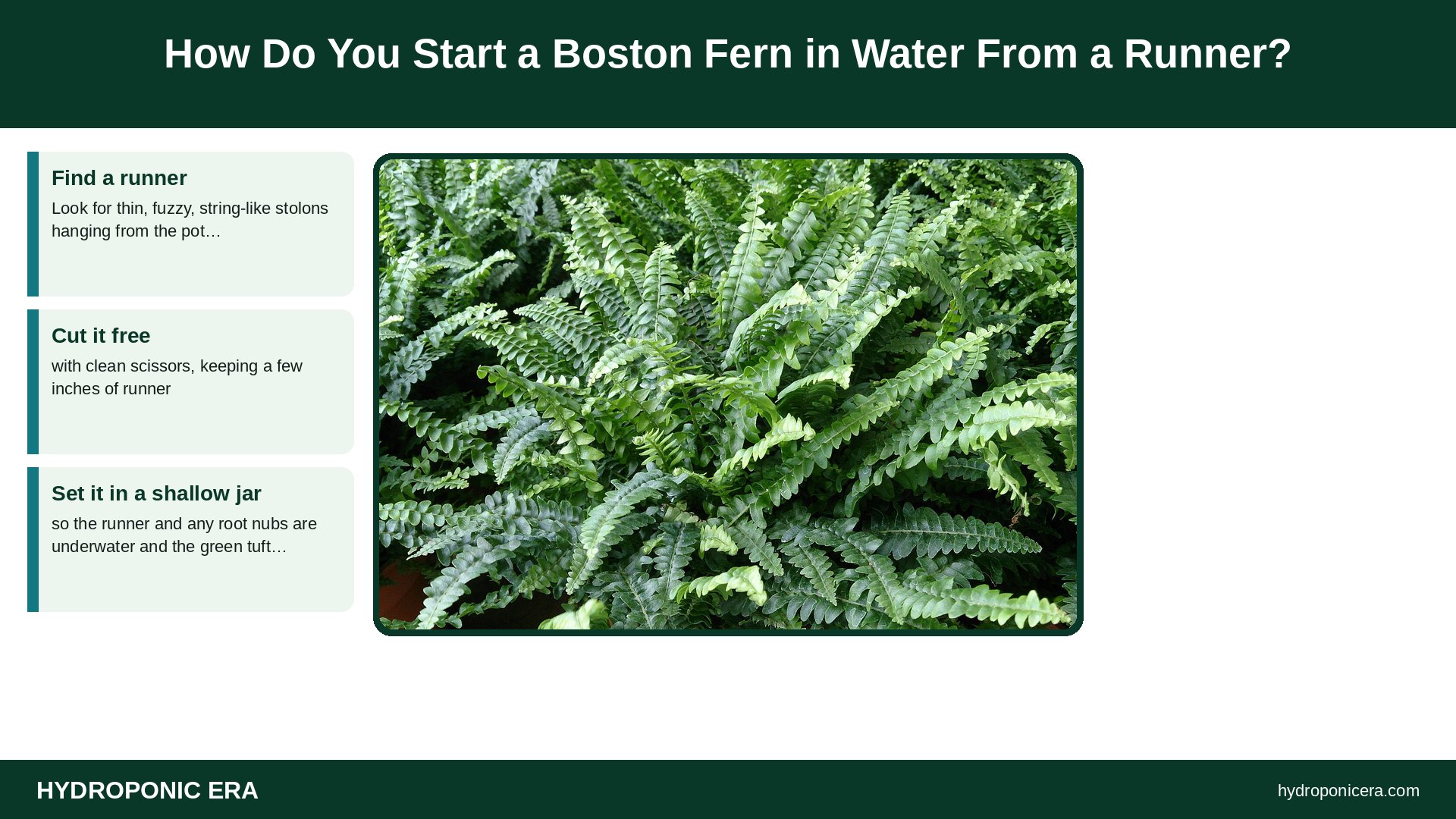
- Find a runner. Look for thin, fuzzy, string-like stolons hanging from the pot, ideally with a tiny fern tuft at the end.
- Cut it free with clean scissors, keeping a few inches of runner.
- Set it in a shallow jar so the runner and any root nubs are underwater and the green tuft stays above.
- Place it in bright, indirect light, as NC State recommends for the parent plant.
- Keep it warm, around 60–70°F (16–21°C).
- Change the water weekly or when it clouds.
- Pot it once several roots are about 1 inch (2.5 cm) long.
Penn State Extension describes the soil version of this, called natural layering: pin a runner plantlet onto a pot of moist media with a U-shaped pin, then sever it from the parent once roots form. That method is more reliable than water, so use it if jar runners keep rotting.
Can a Boston Fern in Water Grow From a Division?
You can grow a small Boston fern division in water short term. Penn State Extension says clump-forming plants can be divided by gently pulling or cutting plantlets apart and replanting them right away. To keep a Boston fern in water, wash the soil off the roots, then suspend the division so the roots are wet and the crown stays dry.
A wide jar with a mesh top or a net pot works well. Expect some frond drop as soil roots adjust to water. Trim browned fronds at the base. If you plan to keep it soil-free, move it into semi-hydro within a few weeks.
Is Semi-Hydro Better Than Keeping a Boston Fern in Water?

Semi-hydro is better than plain water for a Boston fern you want to keep long term. Clay pebbles hold the crown above water, give roots air and wick moisture up evenly, which suits a plant that NC State says needs consistently moist roots that never dry out. Add a weak, complete nutrient solution to feed it.
Keep the water level in the bottom third of the container so upper roots get oxygen. See our guide to clay pebbles and the basics of wick systems.
What Conditions Does a Boston Fern in Water Need?
A Boston fern in water needs bright, indirect light, steady warmth around 60–70°F (16–21°C) and high humidity, according to NC State Extension. Kitchens and bathrooms are good spots, or you can set the container on a tray of wet pebbles. In winter the plant slows down, so feed less and change water a little less often.
| Factor | Target | Source |
|---|---|---|
| Light | Bright, indirect | NC State |
| Temperature | 60–70°F (16–21°C) | NC State |
| Humidity | High; pebble tray or bathroom | NC State |
| Rooting temperature | 75–80°F (24–27°C) media | Penn State |
| Water change | Weekly | General practice |
Why Is My Boston Fern in Water Turning Brown?
- Dry air: Crispy brown frond tips are common in heated homes. Raise humidity.
- Crown underwater: A soaked crown rots. Lift it above the water line.
- Stale water: Cloudy, smelly water harms roots. Refresh it and rinse the jar.
- Direct sun: Scorches fronds. Move to filtered light.
- No nutrients: Pale fronds after a month or two in plain water mean it needs feeding.
Brown, slimy roots signal rot; our guide to brown hydroponic roots explains the fixes.
How Do You Move a Boston Fern in Water to Soil?
Move a rooted Boston fern runner or division to soil once roots are about 1 inch (2.5 cm) long. Use a loose, peat-free or peat-based potting mix that holds moisture, and keep it evenly moist for the first few weeks while water roots adapt. NC State warns the soil should never dry out, but avoid soggy pots in winter.
What Pests Affect a Boston Fern in Water?
NC State Extension says scale and spider mites can be a problem when the air around a Boston fern is too dry, and it also lists the Florida fern caterpillar. Check frond undersides and stems regularly. Rinsing fronds in the shower helps. Be careful with sprays, because ferns can be sensitive to some oils and soaps.
See our guide to spider mites for safe control options.
Which Plants Are Easier Than a Boston Fern in Water?

If you want a fern-like look with easier water rooting, try plants that root from stem cuttings. Pothos, philodendron and spider plant all adapt quickly. Our guides to pothos in water, spider plant in water and the full list of plants that grow in water are good next steps.
FAQs
Can I put a whole Boston fern in a vase of water?
Only briefly. Soil roots often rot; transition it to semi-hydro instead.
How long do runners take to root?
Usually a few weeks in warm, bright conditions.
Is Boston fern safe for pets?
NC State tags it non-toxic for cats and dogs.
Can a Boston fern live in a bathroom?
Yes, if it gets bright, indirect light.
Should I mist a Boston fern?
A pebble tray or humidifier raises humidity more steadily than misting.
Sources
- North Carolina State Extension — Nephrolepis exaltata (Boston Fern)
- Penn State Extension — Propagating Houseplants
- Photo credits (Wikimedia Commons, edited with titles): Nephrolepis exaltata ‘Tiger’ kz01 by Krzysztof Ziarnek, Kenraiz (CC BY-SA 4.0); Boston Fern (Nephrolepis exaltata) by Mokkie (CC BY-SA 3.0); Basilikum (Ocimum basilicum) Stecklinge — Josef Schlaghecken by Schlaghecken Josef (CC BY-SA 4.0); Hydroton by Lucis (CC BY-SA 3.0); Ficus cuttings with roots in a bottle, White background by Biusch (CC BY-SA 3.0)