
Can you do plant tissue culture at home? Yes. Plant tissue culture at home uses a sugar-and-nutrient gel, clean glass jars, a pressure cooker and careful sterile technique to grow new plants from tiny pieces of leaf or stem. University of Illinois Extension recommends African violet as an easy first plant and gives a kitchen-ingredient medium recipe.
Key takeaway: Contamination is the main challenge. Fungi and bacteria love the sugary medium, so success depends on sterilizing the medium, tools and plant pieces, and on working in a still, clean space. Start small with an easy plant before trying orchids or rare species.
| Stage | What happens | Key detail (Illinois Extension) |
|---|---|---|
| Make medium | Boil sugar, fertilizer, vitamins and agar | Boil 2–5 minutes until agar dissolves |
| Sterilize | Pressure-cook jars and medium | 15 psi for 15 minutes |
| Disinfest plant | Soak pieces in dilute bleach | 10% bleach plus a few drops of soap, 15 minutes |
| Rinse | Sterile water rinses | Four rinses |
| Grow | Jars under light | About 75°F (24°C), 16 hours of light |
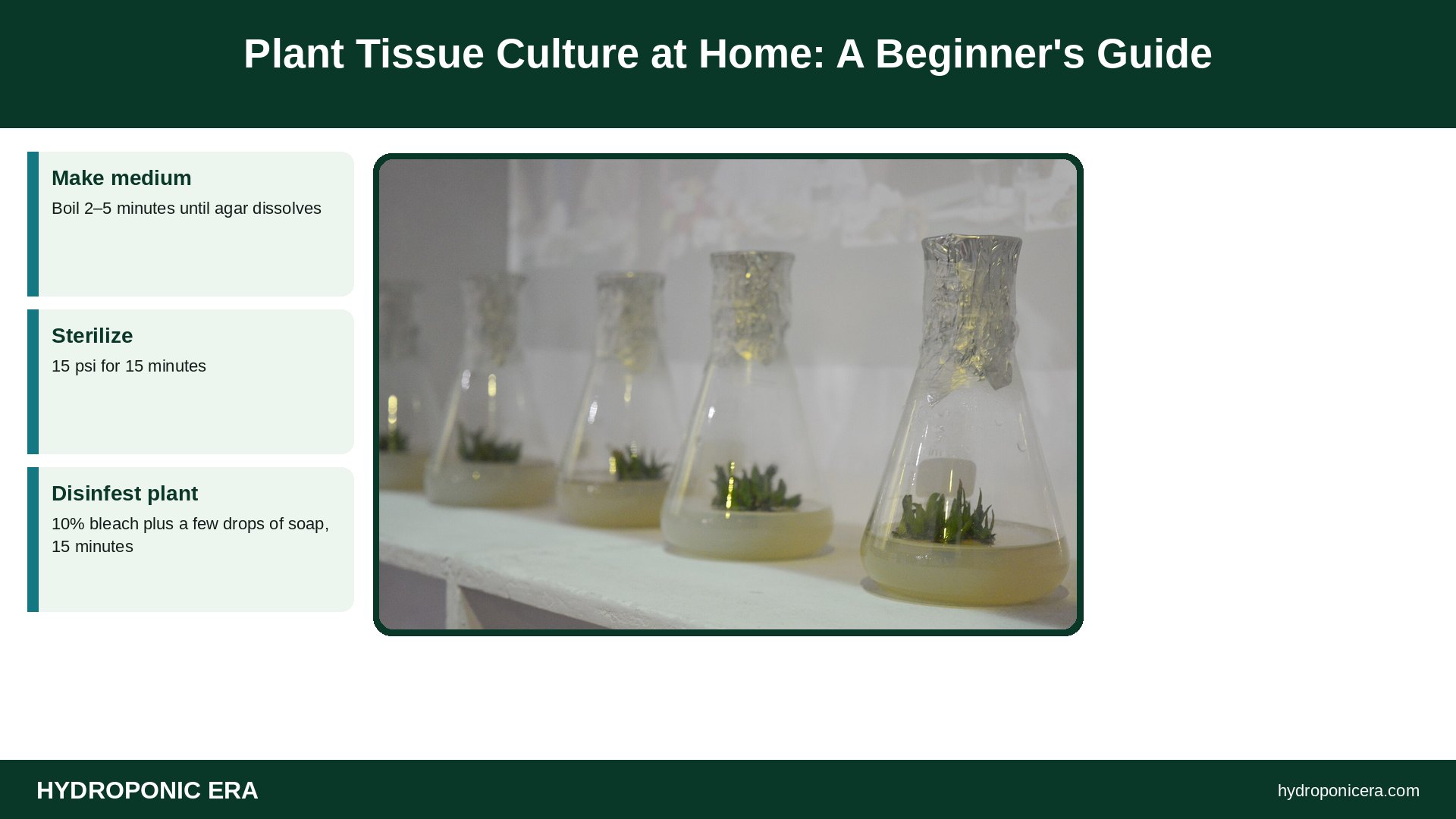
What Is Plant Tissue Culture at Home?
Plant tissue culture, also called micropropagation, grows plants “in vitro” on a nutrient medium under sterile conditions. Illinois Extension explains that leaves, stems, buds, seeds, roots or even a few cells can develop into a full clone of the mother plant. Orchids are a common commercial example.
For plant tissue culture at home, the appeal is making many identical plants from one small piece. The Royal Horticultural Society notes that micropropagation can increase plants up to ten times faster than conventional propagation and can be used to eliminate viruses.
What Supplies Do You Need for Plant Tissue Culture at Home?
Illinois Extension’s home list is short: a face mask, bleach, a saucepan, rubbing alcohol, pressure-safe glass containers, a pressure cooker, aluminum foil, glass jars with lids, dish soap, long-handled tweezers and a razor blade. A clean, draft-free room is just as important as the gear.
- Pressure cooker: the key tool; boiling alone does not reliably sterilize.
- Glass jars: baby food or small canning jars with lids.
- Still air: turn off fans and close windows while you work.
- Optional: a homemade still-air box, a clear tote turned on its side with arm holes.
How Do You Make a Home Tissue Culture Medium?
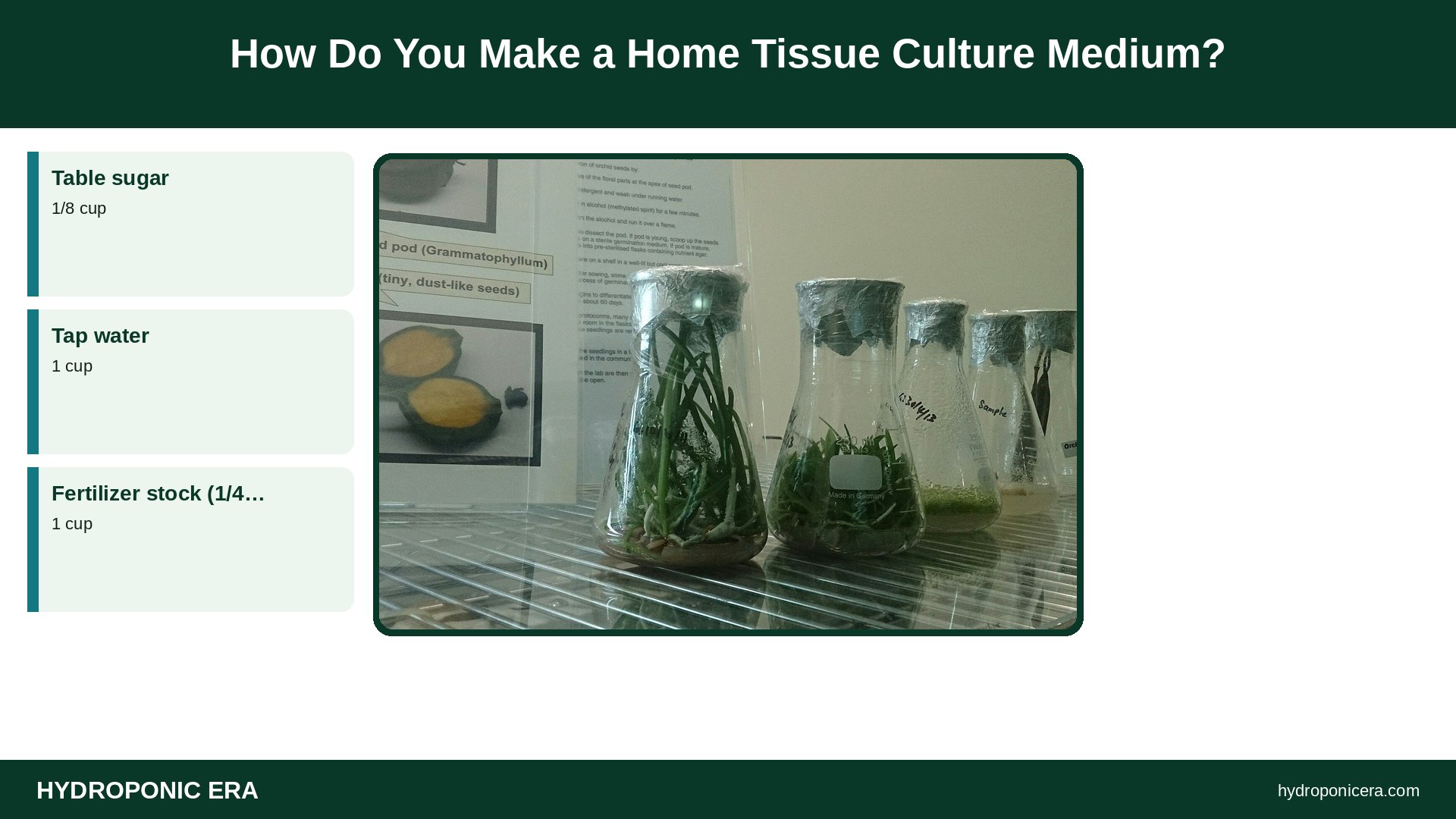
Illinois Extension shares a home medium, adapted from Bridgen and Brand (1985), made from table sugar, tap water, soluble fertilizer stock, inositol, a thiamine vitamin tablet and agar flakes. The ingredients are boiled until the agar dissolves, poured into jars, covered with foil and pressure-cooked to sterilize them.
| Ingredient (makes 1 pint) | Amount |
|---|---|
| Table sugar | 1/8 cup |
| Tap water | 1 cup |
| Fertilizer stock (1/4 tbsp balanced 10-10-10 per gallon of water) | 1 cup |
| Inositol tablet (250 mg) | 1/2 tablet, crushed |
| Vitamin tablet with thiamine | 1/4 tablet, crushed |
| Agar flakes | 2 tablespoons |
Labs often use premixed Murashige and Skoog (MS) medium instead. UF/IFAS gives a beginner MS recipe of 4.4 g/L MS salts, 30 g/L sugar and 8 g/L agar for begonias.
How Do You Do Plant Tissue Culture at Home Step by Step?
Plant tissue culture at home follows four stages: sterilize the medium, sterilize your tools and plant pieces, place pieces on the medium, and grow them under light. Illinois Extension stresses washing hands, wearing a mask and never breathing over open jars, since one spore can ruin a culture.
- Clean: wash glassware with 10% bleach; wipe the work area with bleach and alcohol.
- Cook and sterilize the medium in a pressure cooker at 15 psi for 15 minutes, plus a jar of water.
- Set: pour sterile medium into jars, cap and refrigerate overnight.
- Wrap tools in foil and sterilize them.
- Disinfest plant pieces in 10% bleach (50 mL bleach in 450 mL sterile water) with 3–5 drops of dish soap for 15 minutes.
- Rinse four times in sterile water.
- Trim bleach-burned edges and cut pieces small.
- Plant: press leaf pieces slightly into the medium; push stem pieces in halfway.
- Label and grow at about 75°F (24°C) under light 16 hours a day.
Which Plants Are Easiest for Plant Tissue Culture at Home?
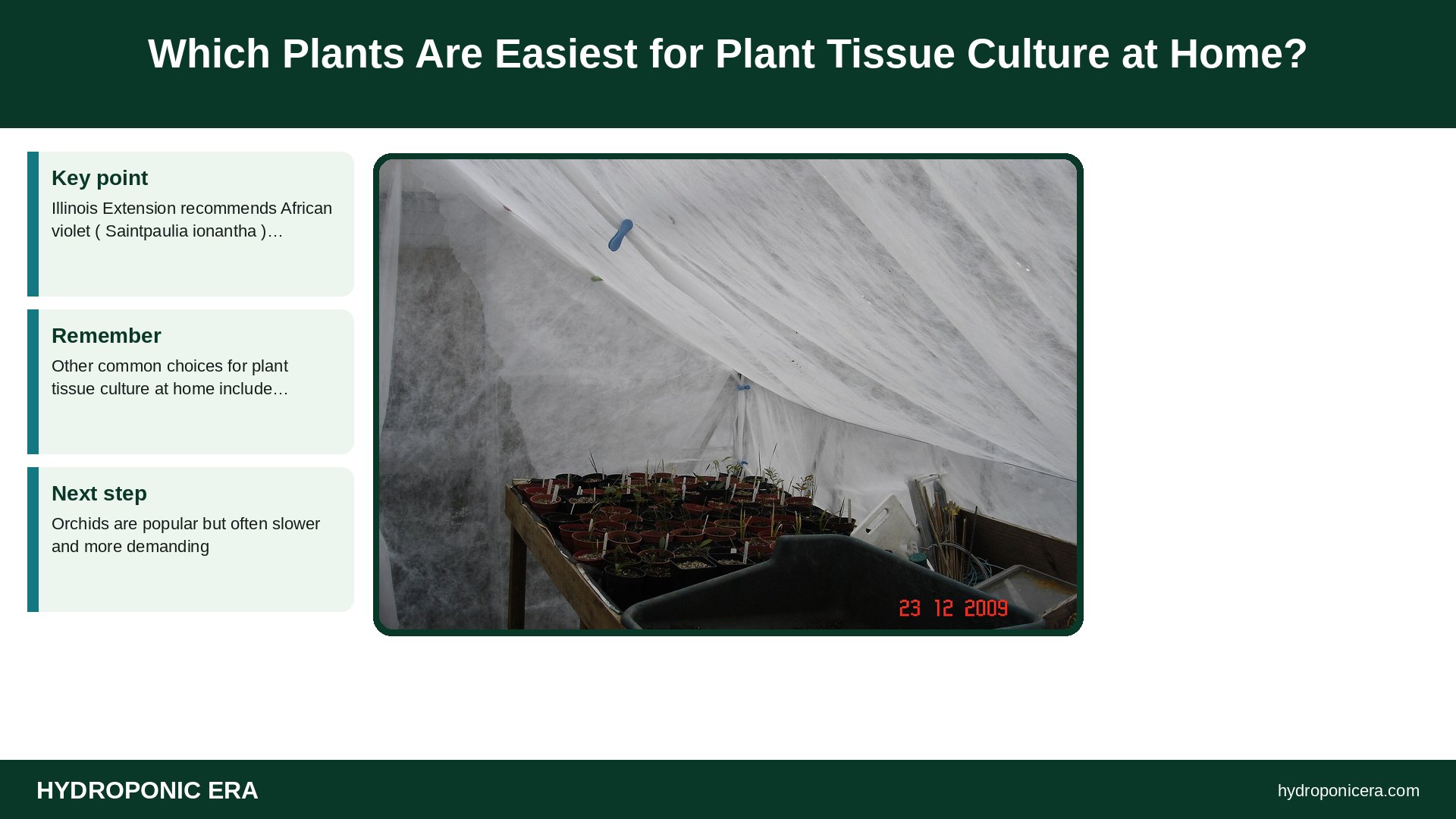
Illinois Extension recommends African violet (Saintpaulia ionantha) for beginners, using leaf pieces. Other common choices for plant tissue culture at home include begonias, ferns, carnivorous plants and some succulents. Orchids are popular but often slower and more demanding. Start with soft, fast-growing plants with clean, healthy leaves.
Keep a simple log for each batch of plant tissue culture at home: date, plant, bleach time and results. Patterns in contamination show up fast. Also check plant tags before cloning: patented varieties may not be legally propagated for sale.
Why Does Plant Tissue Culture at Home Get Contaminated?
In plant tissue culture at home, contamination happens when fungi or bacteria get into the jar, from the plant surface, unclean tools, air movement or your breath. Fuzzy growth or cloudy, slimy spots on the medium usually appear within days. Illinois Extension advises discarding the contents if fungus attacks the plant material, rather than trying to save it.
- Fuzzy mold: air or tool contamination; improve sterile technique.
- Slime around the explant: bacteria inside the tissue; use younger, cleaner leaves.
- Browning pieces: too much bleach or damaged tissue; trim edges more.
- No growth: cool room or weak medium; keep it near 75°F (24°C).
Our article on sterile vs living root zones explains how microbes behave in plant systems.
How Do You Move Tissue Culture Plants to Soil?
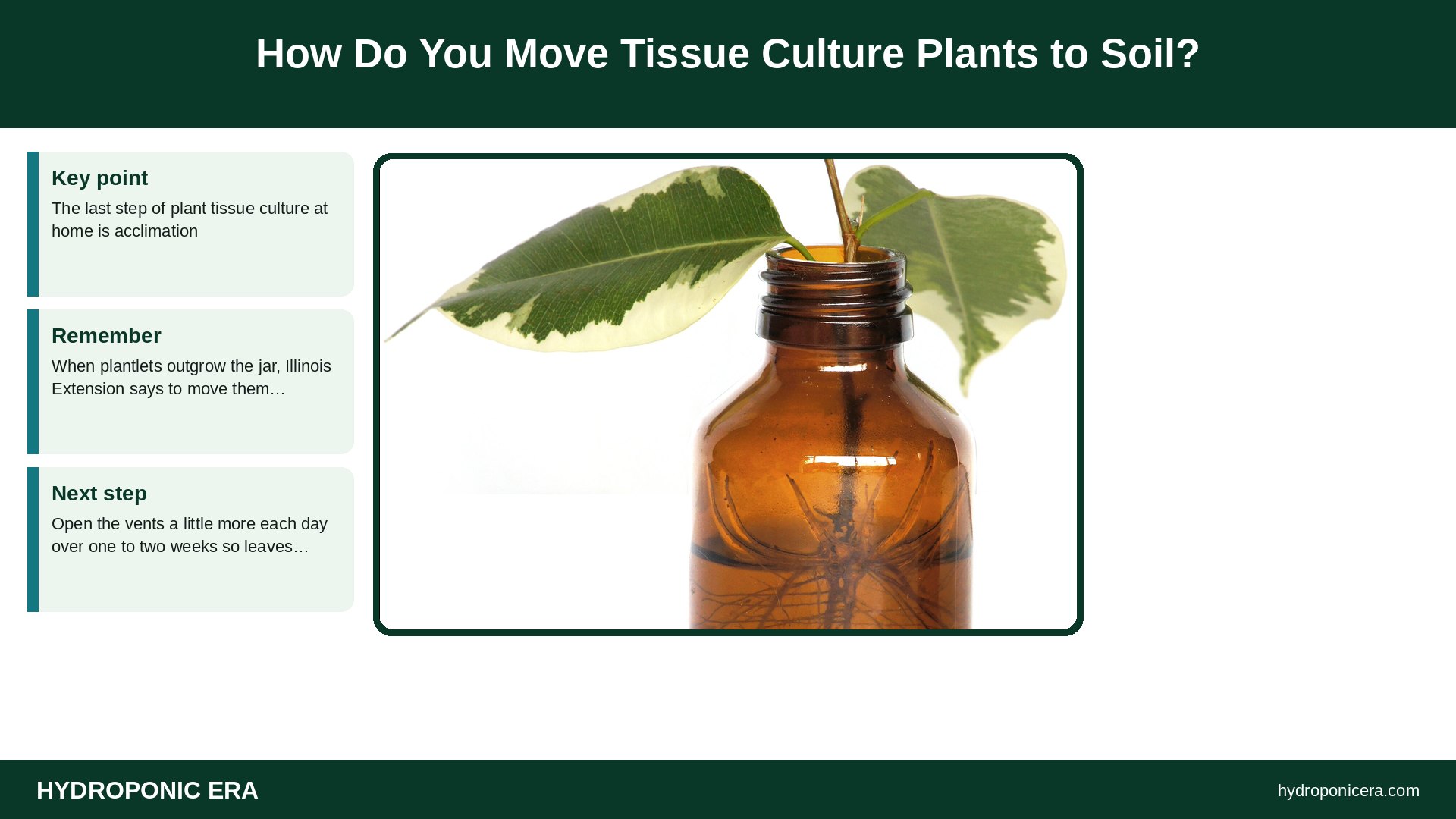
The last step of plant tissue culture at home is acclimation. When plantlets outgrow the jar, Illinois Extension says to move them to a new container and begin acclimating them “ex vitro.” Rinse off the gel, plant in moist seed-starting mix, and keep them under a clear dome. Open the vents a little more each day over one to two weeks so leaves adjust to drier air.
Our humidity dome guide and cloning guide help with this hardening step.
FAQ About Plant Tissue Culture at Home
Do I need a laminar flow hood?
No. Many hobbyists use a still-air box and careful technique.
Can I use a microwave instead of a pressure cooker?
A microwave does not reliably sterilize. Illinois Extension uses a pressure cooker.
How long until plantlets form?
It varies by plant, often several weeks to a few months.
Is household bleach safe to use?
Yes, diluted and with ventilation. Never mix bleach with other cleaners.
Is tissue culture the same as cloning cuttings?
Both make clones, but tissue culture uses tiny pieces on sterile gel.
Sources
- University of Illinois Extension — Micropropagation at Home: How to Make New Plants With Tissue Culture
- UF/IFAS Extension — A Beginner’s Guide to Begonias: Micropropagation and Tissue Culture
- Royal Horticultural Society — Micropropagation
- Photo credits (Wikimedia Commons, edited with titles): Plant tissue culture sample by Syed Sajidul Islam (CC BY-SA 4.0); Orchid tissue cultivation by ProjectManhattan (CC BY-SA 3.0); Fleece lined greenhouse potting tray and seed pots – Flickr – peganum by peganum from Small Dole, England (CC BY-SA 2.0); Ficus cuttings with roots in a bottle, White background by Biusch (CC BY-SA 3.0)