
What is a window farm? A window farm is a small vertical hydroponic garden that hangs in a sunny window. The classic design stacks upside-down plastic bottles with holes for plants, and a small air pump lifts nutrient water to the top so it trickles back down past the roots. It grows herbs and greens without soil in tiny apartments.
Key takeaway: A window farm works best for lettuce, herbs and other leafy crops. Use a south-facing window, a closed nutrient loop, clay pebbles for support and a backup grow light for short winter days.
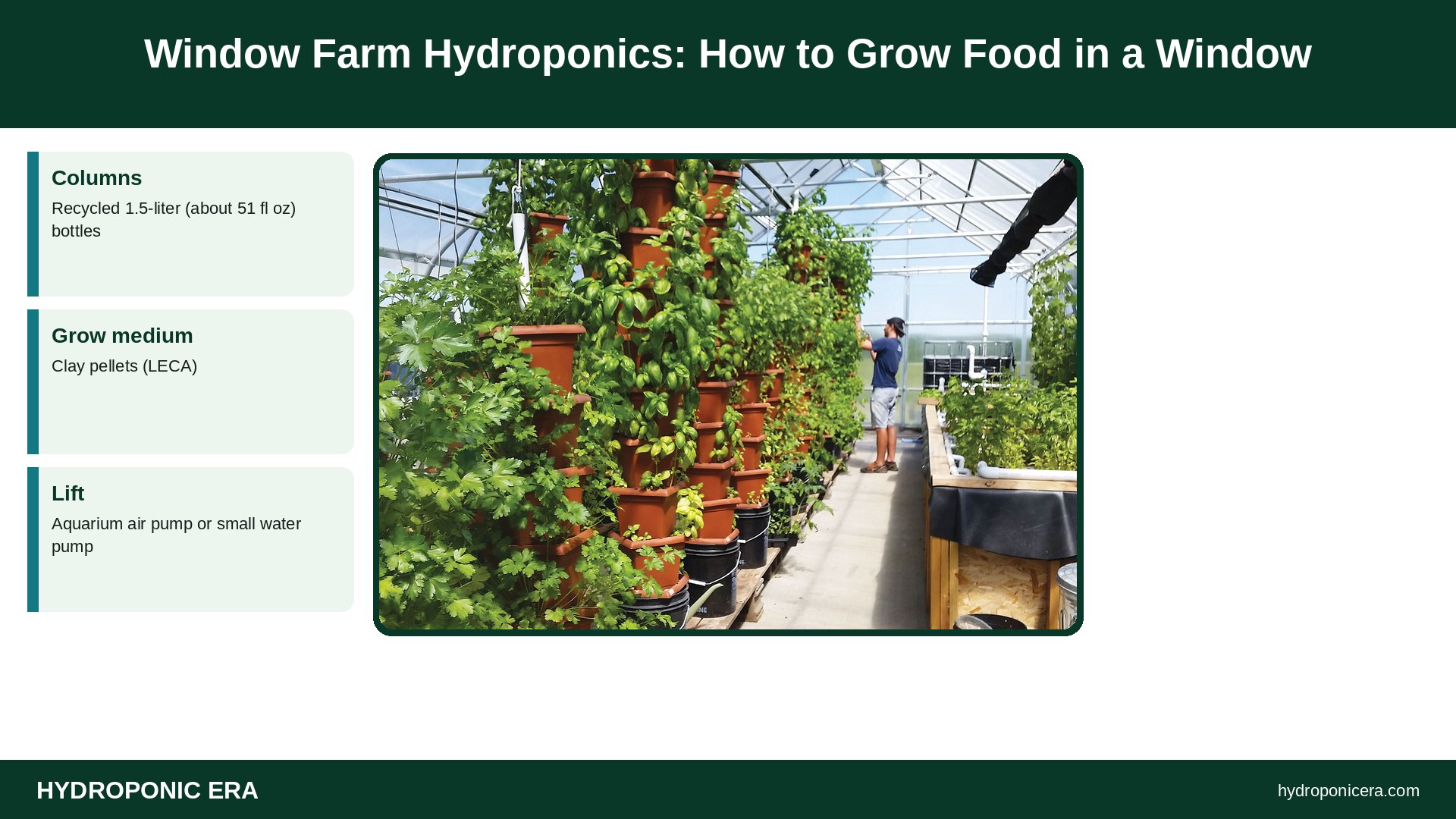
| Part | What it does | Typical DIY choice |
|---|---|---|
| Columns | Hold plants vertically | Recycled 1.5-liter (about 51 fl oz) bottles |
| Grow medium | Anchors roots | Clay pellets (LECA) |
| Lift | Moves water to the top | Aquarium air pump or small water pump |
| Reservoir | Holds nutrient solution | Bottom bottle or tub |
| Support | Hangs the column | Art-hanging cable or strong cord |
Where Did the Window Farm Idea Come From?
The window farm idea came from Britta Riley and Rebecca Bray, who built their first model in a 4 x 6 foot (1.2 x 1.8 m) New York City apartment window in 2009, according to Civil Eats. They described it as a modular, low-energy edible window garden built from low-impact or recycled local materials, and they shared the design openly.
NPR reported in 2010 that window farmers used recycled 1.5-liter water bottles, clay pellets, plastic tubing and inexpensive fish tank air pumps, and that windowfarms.org had about 4,000 registered users. Riley later presented the project at TED in a talk called “A garden in my apartment.” The DIY design still inspires home growers today.
How Does a Window Farm Work?
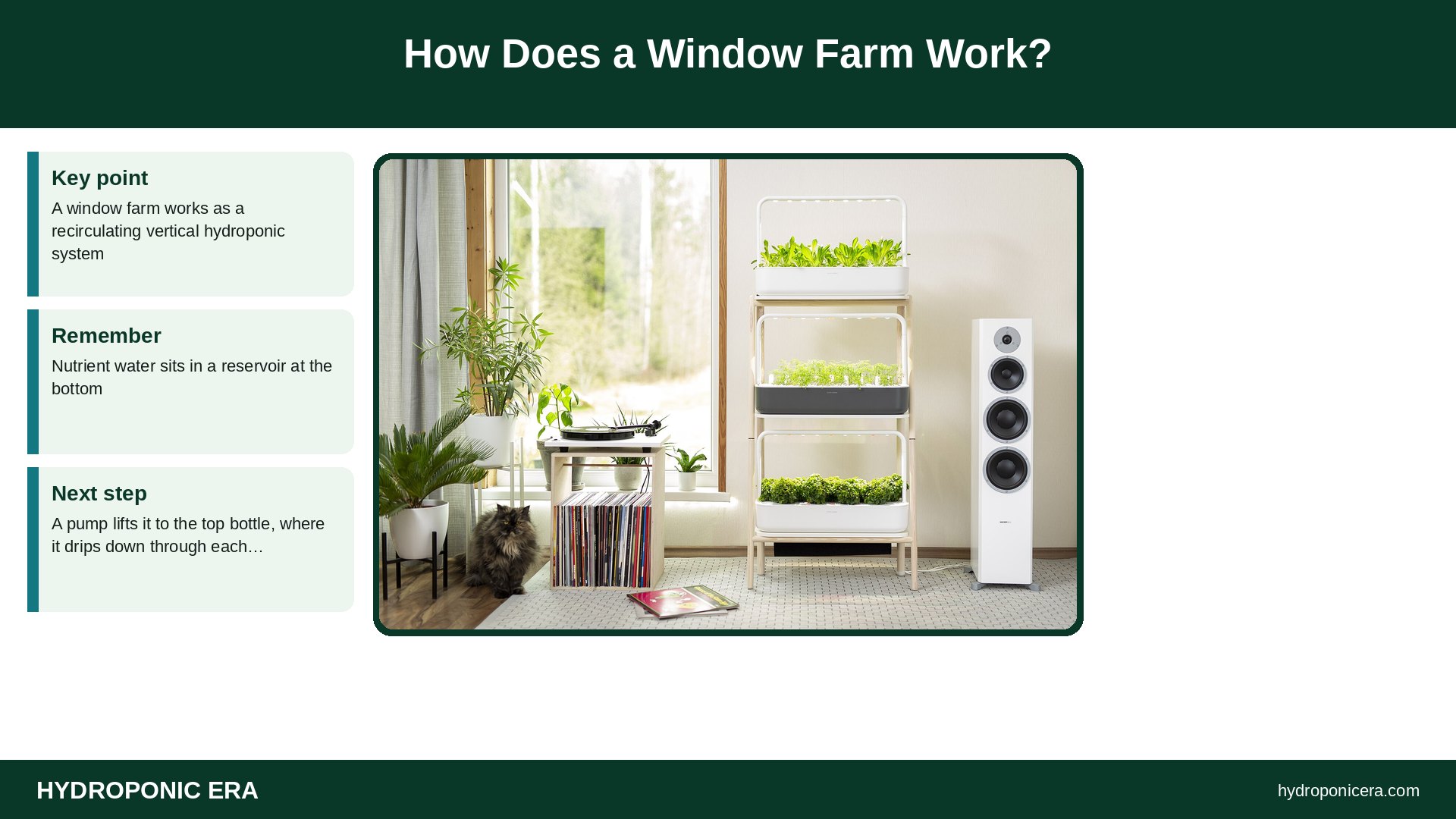
A window farm works as a recirculating vertical hydroponic system. Nutrient water sits in a reservoir at the bottom. A pump lifts it to the top bottle, where it drips down through each planted bottle and over the roots, then returns to the reservoir. NPR described the simplest version as a column of upside-down bottles with plants growing from holes cut in the sides.
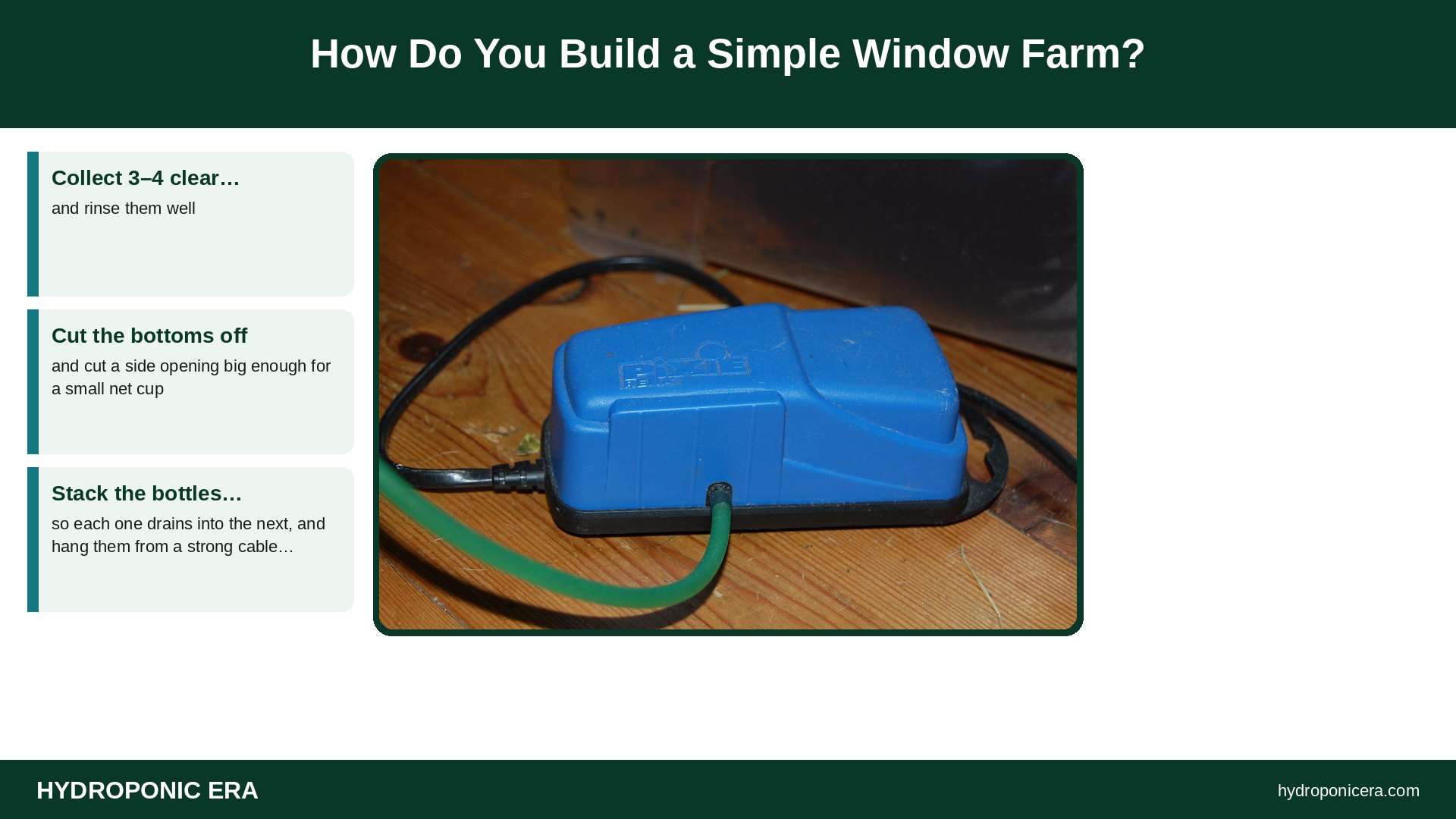
In an air-lift design, an aquarium air pump pushes bubbles into a thin tube, and the rising bubbles carry water up with them. That is quieter and uses less power than many water pumps. Riley said in her TED talk that switching to air pumps helped shrink the system’s carbon footprint. If you know NFT or a tower garden, the idea is similar, just turned into a window display.
What Can You Grow in a Window Farm?
You can grow leafy greens and herbs best in a window farm. Civil Eats reported that the large Eyebeam installation grew cherry tomatoes, peppers, basil, bok choy, okra, chives, flowers and herbs, while sweet potatoes struggled. With lettuce, the creators estimated about a salad a week from a larger unit. Small pockets favor compact crops.
| Crop | Window farm fit | Why |
|---|---|---|
| Loose-leaf lettuce | Excellent | Small, fast, cut-and-come-again |
| Basil, mint, chives | Excellent | Compact and fragrant |
| Bok choy, kale | Good | Harvest young leaves |
| Cherry tomatoes, peppers | Possible | Need more light and support |
| Root crops | Poor | Little room for roots to swell |
For variety ideas, see our list of the best lettuce varieties for hydroponics.
How Do You Build a Simple Window Farm?
- Collect 3–4 clear 1.5-liter bottles and rinse them well.
- Cut the bottoms off and cut a side opening big enough for a small net cup.
- Stack the bottles neck-down so each one drains into the next, and hang them from a strong cable or hook.
- Fill each net cup with rinsed clay pebbles and add a seedling or rooted cutting.
- Set a reservoir below the bottom bottle to catch drainage.
- Run an air-lift tube or pump line from the reservoir to the top bottle.
- Add a mild hydroponic nutrient, check for leaks, then put the pump on a timer.
NPR said the website’s three-plant starter design needed materials costing about $30 in 2010. Prices vary today, but the parts are still cheap. Our guide to clay pebbles explains how to rinse and reuse them.
Is a Window Enough Light for a Window Farm?
A window is often not enough light for a window farm, especially from late fall through winter. University of Minnesota Extension notes that indoor hydroponic plants almost always need supplemental lighting. A bright south-facing window helps, but plants near the bottom of the column and on cloudy days get much less light than the top.
South Dakota State University Extension suggests about 12–16 hours of light daily for leafy greens. Hang a slim LED bar beside the column for gray months. See our light schedule guide and grow light basics.
How Do You Maintain a Window Farm?
Maintain a window farm by topping up water every few days, refreshing the nutrient solution about once a week and checking that every bottle drips evenly. Civil Eats noted the original model flushed its water weekly. Wipe off any algae, because clear bottles let light reach the roots and the solution.
- Weekly: drain, rinse and refill the reservoir with fresh solution.
- Every few days: top up with plain water as plants drink.
- Monthly: clean tubes and the air stone.
- Always: keep a towel or tray under the reservoir for drips.
What Problems Happen With a Window Farm?
The most common window farm problems are leaks, algae, uneven drip and heat near the glass. Paint or wrap the bottles to block light and slow algae. Check tube clamps after every refill. In summer, a sun-baked window can heat the solution, so move the reservoir out of direct sun or shade it.
Pests such as aphids also find indoor greens; our aphids and mites guide covers safe controls. For slimy roots, read our brown roots guide.
How Much Does a Window Farm Cost to Run?
A window farm costs very little to run. The main ongoing costs are electricity for a small pump, hydroponic nutrients, seeds and an occasional replacement tube or air stone. Civil Eats reported that the creators estimated about $100 to set up a larger unit and about $15 for maintenance in 2009; prices are higher today, but the parts remain inexpensive.
A timer cuts pump run time and power use. If you add an LED bar for winter, it will likely use more electricity than the pump, so choose an efficient fixture and match hours to the crop.
Window Farm vs Other Small Hydroponic Systems
A window farm costs little and looks striking, but a countertop kit or a simple jar is easier for first-timers. Choose a window farm if you enjoy DIY and have a bright window. Choose a Kratky jar for zero electricity, or read our small-space hydroponics guide for more layouts.
FAQs
Does a window farm need a pump?
Yes for the classic design. An air pump or small water pump moves the solution to the top.
Is a window farm noisy?
Air pumps make a soft hum; rubber feet reduce vibration.
Can I use tap water?
Usually yes. Let chlorinated water sit or use a dechlorinator, then add nutrients.
Which window is best?
In the U.S., a south-facing window gets the most light.
Will it work in winter?
Yes, with a supplemental LED for short days.
Sources
- Civil Eats — A New Kind of Garden (2009)
- NPR — Window Farming: A Do-It-Yourself Veggie Venture (2010)
- TED — Britta Riley: A garden in my apartment
- University of Minnesota Extension — Small-scale hydroponics
- South Dakota State University Extension — Small-scale Hydroponic Production Systems (P-00337)
- Photo credits (Wikimedia Commons, edited with titles): Vertical Tower Aquaponic System by Heather Husen (CC BY-SA 4.0); Click & Grow Smart Garden 27 by Janar Raidla (CC BY-SA 4.0); Aquarium-air-pump by User:Corydoras-adolfoi (CC BY-SA 4.0); Romaine lettuce by Rainer Zenz (CC BY-SA 3.0); Basil plant in a pot 02 by Netha Hussain (CC BY-SA 4.0)