
What is spinosad for plants? Spinosad for plants is a natural insecticide made by a soil bacterium. It controls caterpillars, thrips, leafminers, some beetles and fruit flies by attacking their nervous system after they eat or touch it. Several products are approved for organic growing, and it is low in toxicity to people and pets when label directions are followed.
Key takeaway: Use spinosad for plants on chewing pests and thrips, spray in the evening when bees are not foraging, cover leaf undersides and always follow the label for rates and harvest intervals.
| Fact | What sources report |
|---|---|
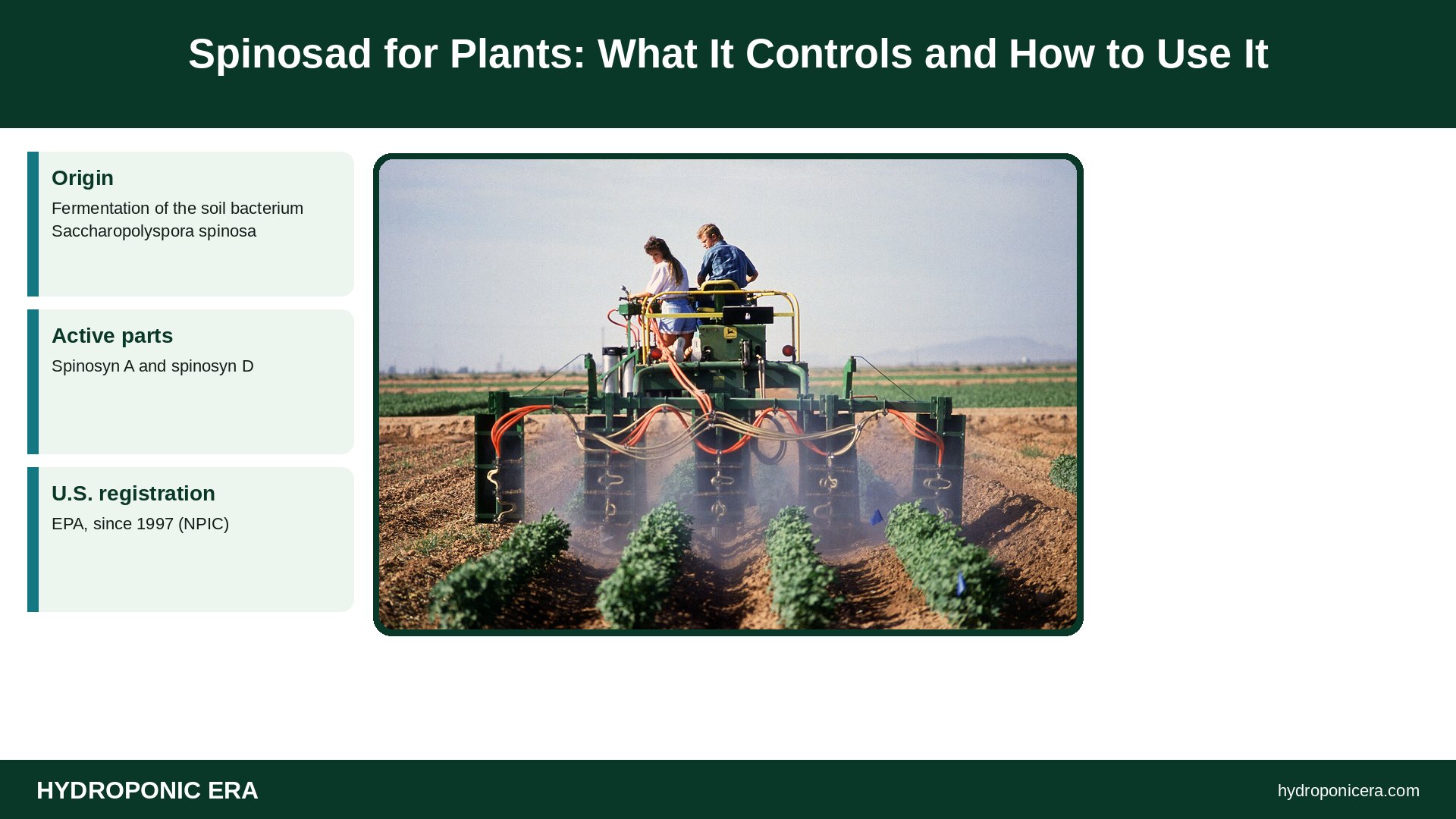
| Origin | Fermentation of the soil bacterium Saccharopolyspora spinosa |
| Active parts | Spinosyn A and spinosyn D |
| U.S. registration | EPA, since 1997 (NPIC) |
| How it kills | Nervous system; paralysis within 1–2 days |
| Main targets | Caterpillars, thrips, leafminers, flies, some beetles |
| Bee risk | Very toxic when wet; little effect once dry |
What Is Spinosad, and Where Does It Come From?
Spinosad is a mixture of two natural compounds, spinosyn A and spinosyn D, produced when the soil bacterium Saccharopolyspora spinosa is fermented. The National Pesticide Information Center (NPIC) says it has been registered by the U.S. EPA since 1997 and appears in more than 80 products, including sprays, dusts, granules and baits.
NPIC also notes that some of these products are approved for organic agriculture, and the same active ingredient is used in FDA-regulated treatments for head lice and pet fleas. That does not make every bottle suitable for food crops, so check that your label lists vegetables or herbs before spraying plants you will eat.
How Does Spinosad for Plants Work?
Spinosad for plants works by overexciting the insect nervous system. NPIC explains that insects that eat or touch it suffer uncontrolled muscle flexing, then paralysis and death, typically within 1–2 days. A review by Mayes and colleagues describes this as a novel mode of action on nicotinic receptors, which is why it can help where pests resist older insecticides.
Because it works best when eaten, chewing pests and thrips that feed on treated tissue are hit hardest. Sucking insects that feed deep in the plant, such as aphids, are not a strong target. For those, look at contact options like soap.
Which Pests Does Spinosad Control?
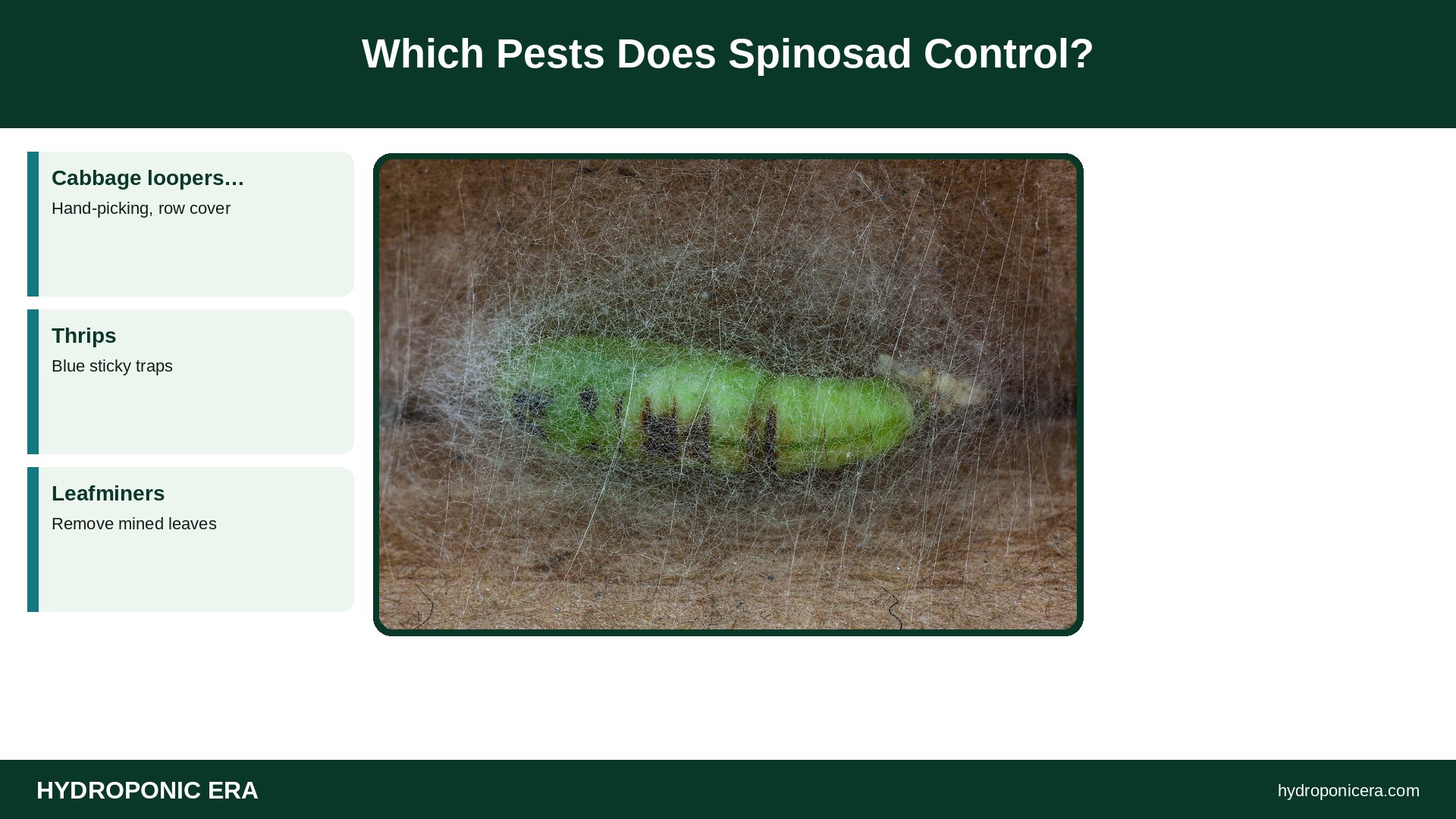
Spinosad controls a wide range of chewing and rasping insects. NPIC lists thrips, leafminers, spider mites, mosquitoes, ants and fruit flies among its targets, while research reviews highlight strong activity on caterpillars, some flies and beetles. Check the product label, because each formula is registered for specific pests and crops.
| Pest | Result | Better partner |
|---|---|---|
| Cabbage loopers, hornworms | Strong | Hand-picking, row cover |
| Thrips | Strong; repeat sprays | Blue sticky traps |
| Leafminers | Good | Remove mined leaves |
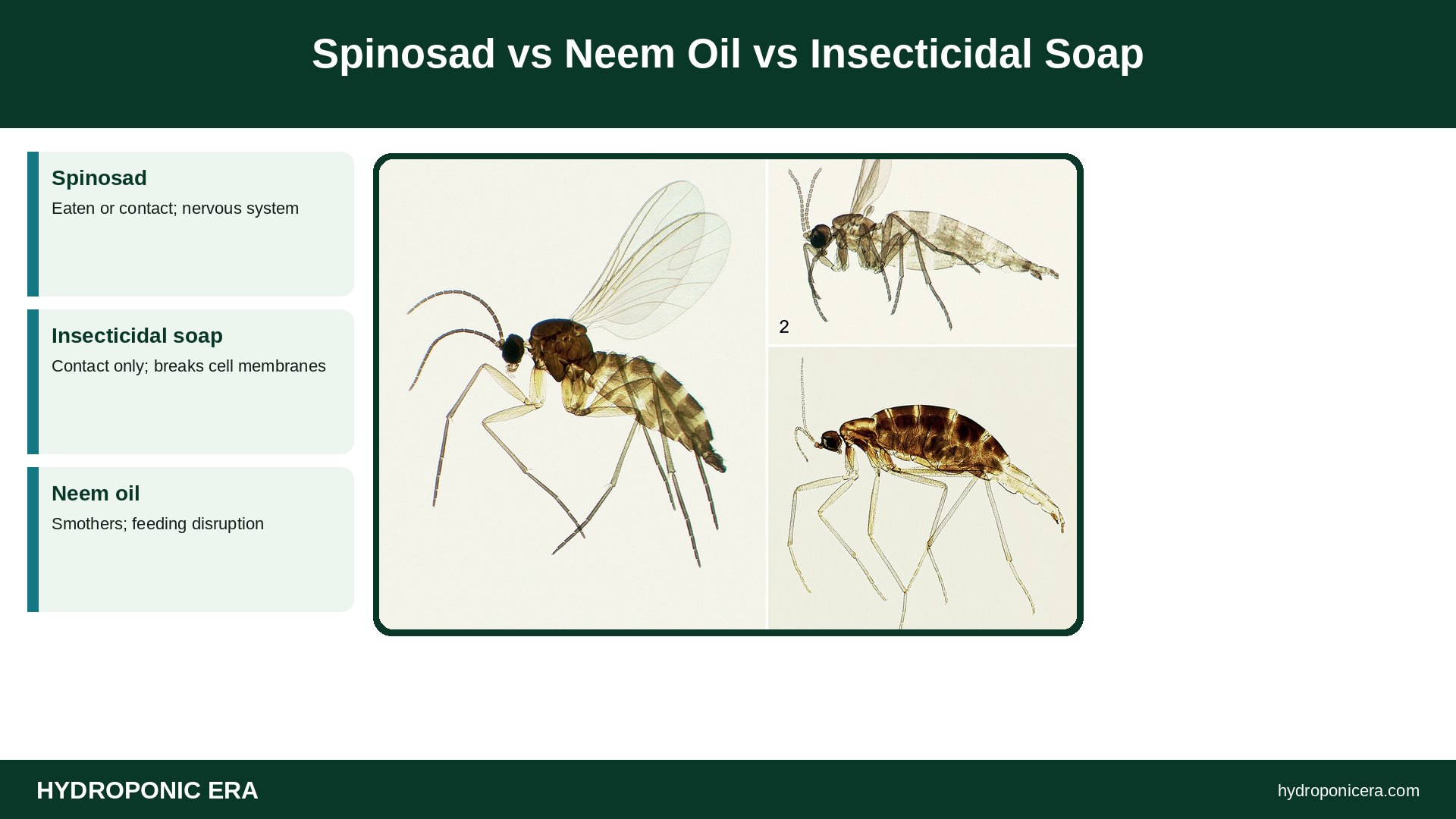
| Fungus gnat larvae | Label-dependent | Dry media surface, BTI |
| Aphids, whiteflies | Weak | Insecticidal soap |
See our guides to thrips in hydroponics and fungus gnats.
How Do You Use Spinosad for Plants Safely?
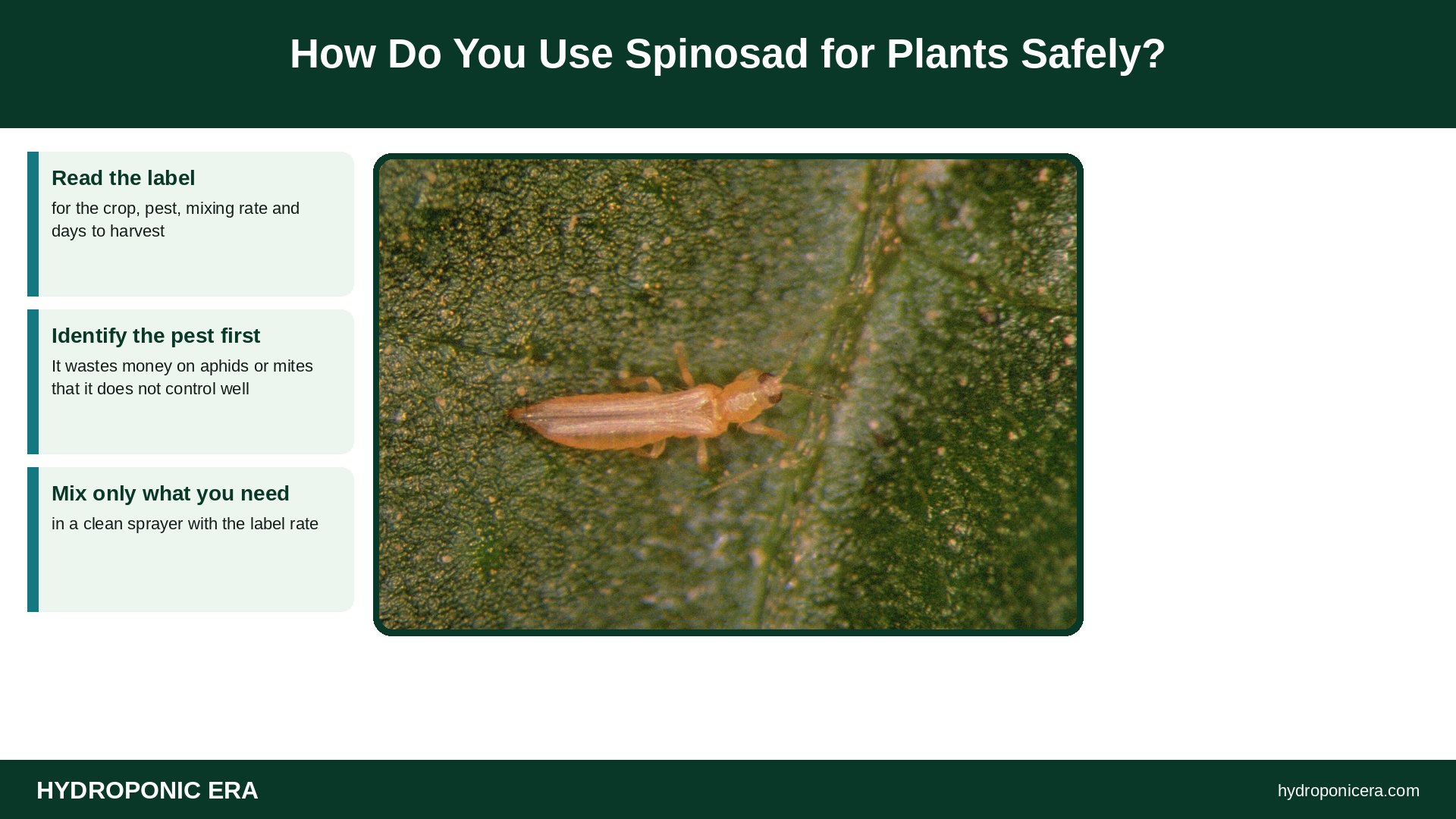
- Read the label for the crop, pest, mixing rate and days to harvest.
- Identify the pest first. It wastes money on aphids or mites that it does not control well.
- Mix only what you need in a clean sprayer with the label rate.
- Spray in the evening or early morning when bees are not active.
- Cover both leaf surfaces, where thrips and caterpillars feed.
- Let it dry before pets or people touch the plants.
- Repeat only as the label allows, and rotate with other methods to slow resistance.
Wear gloves and eye protection, since NPIC notes it can irritate skin and eyes. Wash hands before eating.
Is Spinosad Safe for Bees and Beneficial Insects?
Spinosad is very highly toxic to bees while it is wet, but NPIC reports that it has little or no effect on honey bees and other beneficial insects after sprays have dried. Research by Miles in the Bulletin of Insectology found that dried residues, generally after about 3 hours or less, posed negligible risk. Spraying at dusk is the simple fix.
Never spray open blooms that bees are visiting. Indoors, keep sprays away from released predators such as lacewings until residues dry, and check the label for compatibility with beneficials.
Can You Use Spinosad for Plants in Hydroponics?
You can use spinosad for plants in hydroponics as a foliar spray, but keep it out of the nutrient reservoir. Cover the reservoir or net-pot openings, spray leaves only, and let runoff dry before it drips into the system. Never add it to recirculating solution unless a label specifically allows it.
NPIC says spinosad breaks down in sunlight, with leaf half-lives of 2 to 16 days and less than a day in sunlit water, but it lasts much longer in dark water. Indoor light is weaker than sunlight, so residues may last longer indoors. See our hydroponic pest guide for an IPM plan.
Is Spinosad Safe for People and Pets?
Spinosad is low in toxicity to people and other mammals, according to NPIC. It is poorly absorbed through skin, and most of an eaten dose leaves the body within 1–2 days. It was not linked to cancer in long-term animal studies. It can irritate the eyes and skin, so follow label first aid steps.
NPIC also reports that it is practically non-toxic to moderately toxic to fish, depending on species. Keep sprays away from ponds and aquaponics fish tanks.
What Should You Check on the Label Before Spraying?
Check four things on the label before you spray: the crops listed, the pests listed, the mixing rate and the pre-harvest interval, which is the number of days you must wait before picking. Home garden products differ from farm products in strength, so never copy a rate from a different brand.
- Crop list: herbs, leafy greens and fruiting vegetables may be listed separately.
- Indoor use: some labels cover greenhouses; others are outdoor only.
- Maximum applications: limits per season protect against resistance.
- Organic listing: look for an OMRI seal if you grow organically.
Spinosad vs Neem Oil vs Insecticidal Soap
| Product | Best for | How it works |
|---|---|---|
| Spinosad | Caterpillars, thrips, leafminers | Eaten or contact; nervous system |
| Insecticidal soap | Aphids, whiteflies, mites | Contact only; breaks cell membranes |
| Neem oil | Soft-bodied pests, some mildews | Smothers; feeding disruption |
Rotating products with different modes of action slows resistance. Pair sprays with sticky traps, as covered in our sticky trap guide.
FAQs
Is it organic?
Some products are approved for organic use. Look for an OMRI or organic listing on the label.
How fast does it work?
Pests usually stop feeding quickly and die within 1–2 days, NPIC says.
Does spinosad kill aphids?
Not well. Use insecticidal soap or beneficial insects instead.
Can I spray spinosad on vegetables?
Yes, if the label lists the crop. Follow the days-to-harvest interval.
Does rain wash it off?
Check the label for drying time; heavy rain soon after spraying may mean a repeat application.
Sources
- National Pesticide Information Center — Spinosad General Fact Sheet
- Mayes MA et al. — Spinosad toxicity to pollinators and associated risk, Reviews of Environmental Contamination and Toxicology (2003)
- Miles M — The effects of spinosad, a naturally derived insect control agent to the honeybee, Bulletin of Insectology 56(1) (2003)
- UC IPM — Less Toxic Insecticides
- Photo credits (Wikimedia Commons, edited with titles): K4817-4 (8497812386) by USDAgov (Public domain); Cabbage looper in cocoon by مانفی (CC BY-SA 4.0); Frankliniella occidentalis 5364132-LGPT by Frank Peairs, Colorado State University, Bugwood.org (CC BY 3.0); Sciaridae (10.3897-zookeys.957.46528) Figures 1–3 by Menzel F, Gammelmo Ø, Olsen KM, Köhler A (2020) The Black Fungus Gnats (Diptera, (CC BY 4.0); Striped ladybird with aphids (4560537745) by Ton Rulkens from Mozambique (CC BY-SA 2.0)