
What is insecticidal soap for plants? Insecticidal soap for plants is a spray made from potassium salts of fatty acids that kills soft-bodied pests on contact. It works on aphids, whiteflies, mealybugs, young scale insects and spider mites by breaking down their outer membranes. It leaves no lasting residue, so you must hit pests directly and repeat every 4–7 days.
Key takeaway: Use a labeled insecticidal soap for plants, not dish soap. Spot test first, spray in the cool of morning or evening, wet every pest you can see and repeat until the population is gone.
| Question | Short answer |
|---|---|
| Active ingredient | Potassium salts of fatty acids |
| How it kills | Contact only; disrupts membranes, insects dry out |
| Residual effect | None once dry |
| Best targets | Aphids, whiteflies, mealybugs, mites, scale crawlers |
| Not effective on | Caterpillars and beetle larvae |
| Repeat interval | Every 4–7 days for mites and scale crawlers |
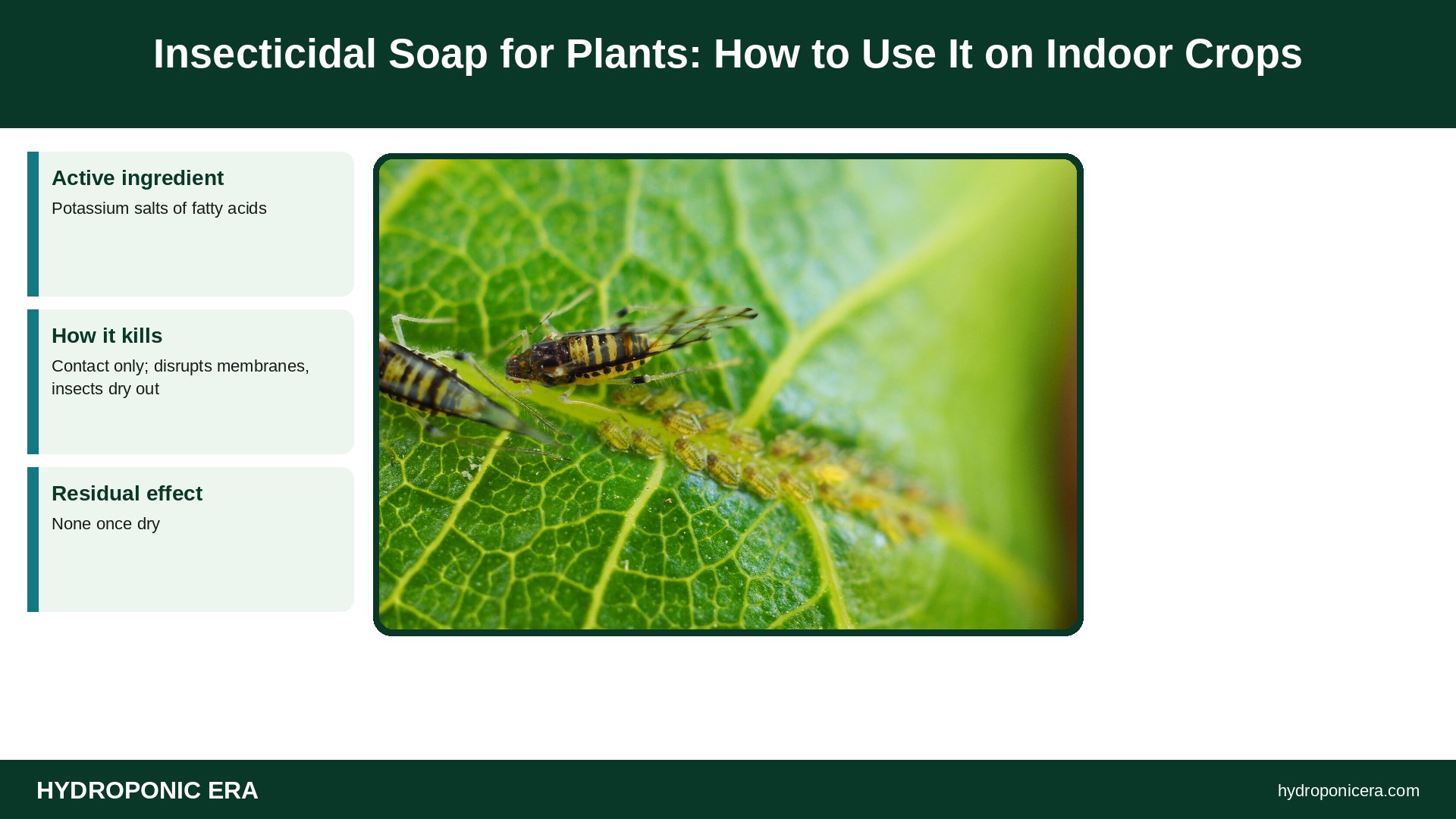
What Is Insecticidal Soap Made Of?
Insecticidal soap is made of potassium salts of fatty acids, according to Colorado State University Extension. These soaps were first registered with the EPA as pesticides in 1947. They are refined for plant use, which is why commercial products are more predictable than household dish detergents, many of which are not true soaps at all.
UC Agriculture and Natural Resources notes that soap sprays are typically used at about 2–3% concentration. Ready-to-use bottles are already diluted; concentrates must be mixed exactly as the label says.
How Does Insecticidal Soap for Plants Kill Pests?
Insecticidal soap for plants kills pests only by direct contact. Colorado State Extension explains that the fatty acids disrupt cell membranes, so the insect loses its protective coating and dehydrates. Once the spray dries, it no longer works, so a pest that walks onto a dry leaf later is not affected.
That lack of residue is both the strength and the weakness. It is gentle on the environment and you can harvest soon after, but coverage must be thorough and you will usually need several sprays to catch newly hatched pests.
Which Pests Does Insecticidal Soap Control?
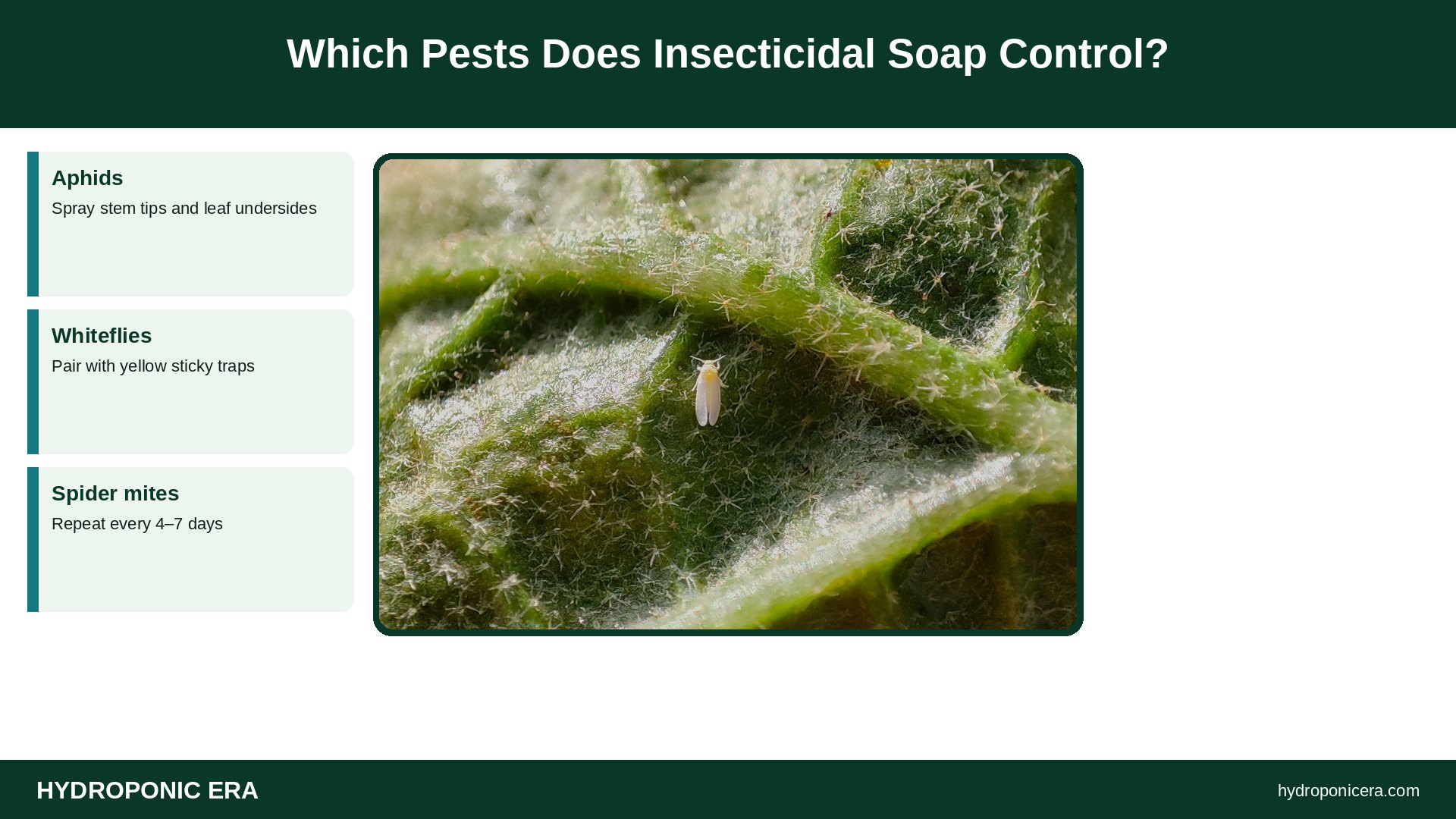
Insecticidal soap controls small, soft-bodied pests. Colorado State Extension lists aphids, young scales, whiteflies, psyllids, mealybugs and spider mites. It also notes that caterpillars and beetle larvae are essentially immune. Adult scales with hard covers are also hard to reach.
| Pest | Soap result | Tip |
|---|---|---|
| Aphids | Very good | Spray stem tips and leaf undersides |
| Whiteflies | Good on nymphs | Pair with yellow sticky traps |
| Spider mites | Good with repeats | Repeat every 4–7 days |
| Mealybugs | Fair | Hit cottony clusters directly |
| Caterpillars | Poor | Use spinosad or hand-picking |
Read our guides to whiteflies, spider mites and mealybugs and scale.
How Do You Use Insecticidal Soap for Plants Correctly?
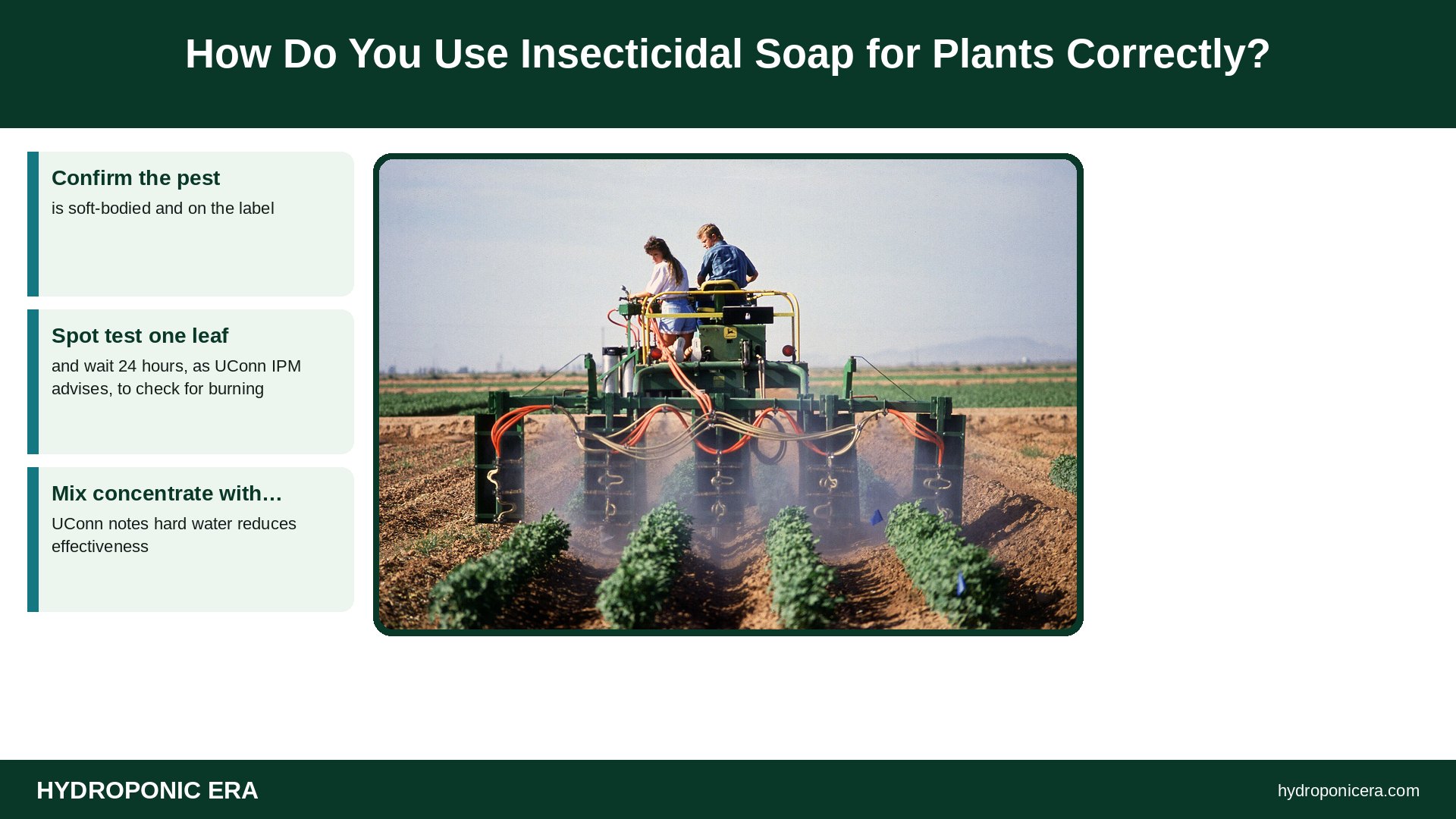
- Confirm the pest is soft-bodied and on the label.
- Spot test one leaf and wait 24 hours, as UConn IPM advises, to check for burning.
- Mix concentrate with soft or distilled water. UConn notes hard water reduces effectiveness.
- Spray early morning or evening when it is cool and slow drying helps the soap act.
- Soak the pests, especially leaf undersides, stems and new growth.
- Rinse sensitive plants with clean water a couple of hours later, a UC ANR tip to reduce leaf injury.
- Repeat every 4–7 days until pests are gone.
When Should You Not Use Insecticidal Soap?
Do not use insecticidal soap on drought-stressed plants, unrooted cuttings, soft new growth or when temperatures are above 90°F (32°C), according to UConn IPM. Heat and stress make leaf burn more likely. Water plants the day before and spray in shade.
Some plants are naturally sensitive. UConn lists begonia, cucumber, delicate ferns, dieffenbachia, fuchsia, gardenia, impatiens, jade, lantana, ivy, palms, poinsettia, schefflera and some succulents. UC ANR adds sweet pea, cherries, plum and some tomato varieties. Test these first or choose another option.
Is Insecticidal Soap Safe for Beneficial Insects?
Insecticidal soap is safer than broad-spectrum sprays, but it can still kill beneficial insects it hits. Colorado State Extension and UConn both warn that predatory mites are harmed by direct sprays. If you release predators or ladybugs, spray soap first, wait until it dries, then release them.
Because soap has no residue, beneficials that arrive after drying are not affected. That makes it a good fit for an integrated plan that also uses sticky traps.
Can You Use Insecticidal Soap for Plants in Hydroponics?
Yes, insecticidal soap for plants works well in hydroponics when you keep it out of the reservoir. Soap in recirculating solution can foam and coat roots. Cover the reservoir and net cups, spray foliage only, and wipe up drips. Indoor grow rooms are a good fit because spraying at lights-off gives slow drying.
See our full aphids and mites guide for monitoring tips.
Insecticidal Soap vs Neem Oil vs Horticultural Oil
Insecticidal soap, neem oil and horticultural oil all work mainly by contact, but they differ in what they hit and how long they last. Soap dries quickly and leaves nothing behind. Oils coat and smother pests and their eggs, and some can also suppress powdery mildew, but oils raise the risk of leaf burn in heat.
| Product | Best for | Main caution |
|---|---|---|
| Insecticidal soap | Aphids, whiteflies, mites, mealybugs | Must wet pests; repeat sprays |
| Neem oil | Soft-bodied pests, some mildews | Leaf burn in heat or bright light |
| Horticultural oil | Scale, mite eggs, overwintering pests | Do not mix with sulfur sprays |
| Spinosad | Caterpillars, thrips, leafminers | Toxic to bees while wet |
Never mix products in the same tank unless both labels allow it, and do not apply oil and soap on the same day. UC IPM lists all of these among less toxic options for home gardens.
Should You Make Homemade Insecticidal Soap?
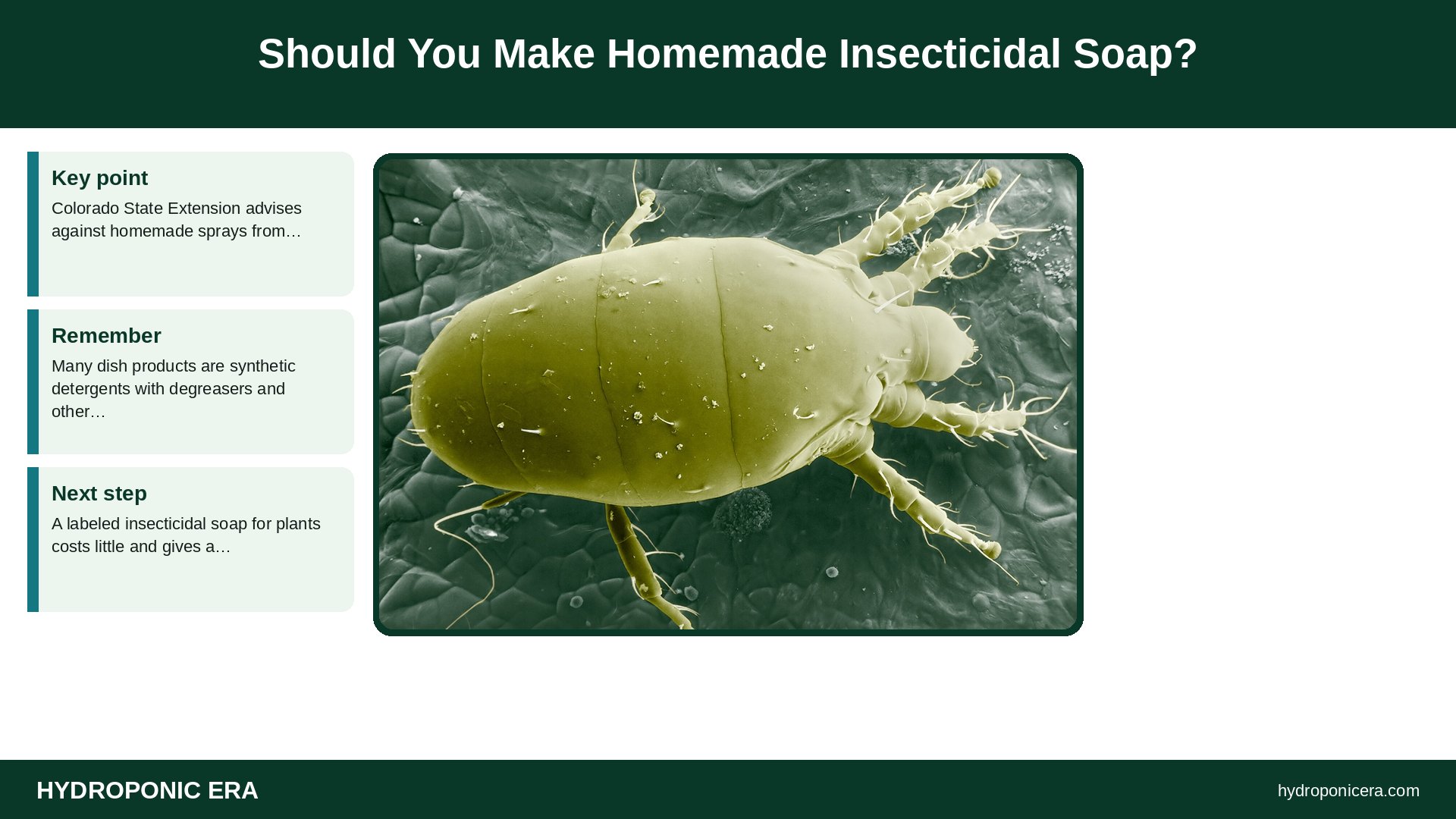
Colorado State Extension advises against homemade sprays from household soaps and detergents. Many dish products are synthetic detergents with degreasers and other additives that can injure plants, and homemade mixes are not consistently formulated or tested. A labeled insecticidal soap for plants costs little and gives a known, tested concentration.
For chewing pests that soap cannot stop, use a product labeled for caterpillars, such as spinosad, or hand-pick them.
FAQs
Is insecticidal soap organic?
Many brands are OMRI listed for organic use. Check the label.
How long until I can harvest?
Follow the label; many soap products have very short or no harvest wait.
Can I spray every day?
No. Daily sprays raise the risk of leaf injury; follow the 4–7 day interval.
Does it kill fungus gnats?
It can kill adults it hits but does little to larvae in the media.
Why didn’t it work?
Usually poor coverage, hard water or too few repeat sprays.
Sources
- Colorado State University Extension — Insect Control: Soaps and Detergents (5.547)
- UC Agriculture and Natural Resources — Soap Sprays as Insecticides
- UConn IPM — Insecticidal Soap Fact Sheet (2023)
- UC IPM — Less Toxic Insecticides
- Photo credits (Wikimedia Commons, edited with titles): Aphids on a leaf, 2025 early summertime Alconbury Weald by ISAAC THE BOY (CC BY 4.0); Bemisia tabaci under leaf of eggplant by Wee Hong (CC BY-SA 4.0); K4817-4 (8497812386) by USDAgov (Public domain); Polyphagotarsonemus latus, USDA BARC by Erbe, Pooley: USDA ARS Electron and Confocal Microscopy Unit (Public domain); Striped ladybird with aphids (4560537745) by Ton Rulkens from Mozambique (CC BY-SA 2.0)