
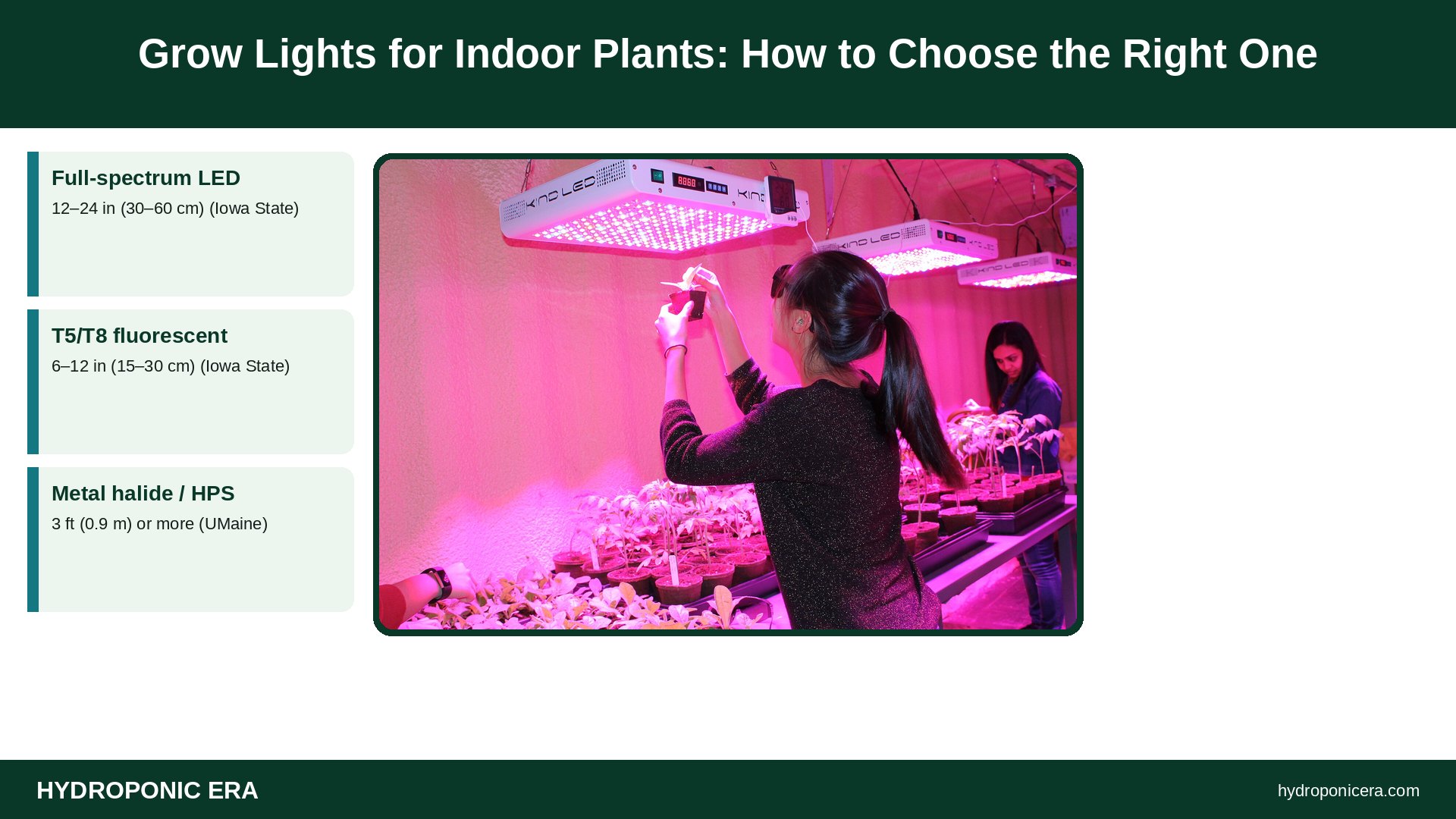
What are the best grow lights for indoor plants? Full-spectrum white LED grow lights are the best choice for most indoor plants. They run cool, use little power and last long. Iowa State Extension suggests hanging LEDs about 12–24 inches (30–60 cm) from foliage and running them on a timer for 12–14 hours a day, never more than 16 for most home setups.
Key takeaway: When choosing grow lights for indoor plants, focus on light quantity and distance, not just color. A dim light too far away cannot be fixed with more hours, so match fixture size to your plants, keep it close, and watch how the plants respond.
| Grow light type | Best for | Typical distance from foliage |
|---|---|---|
| Full-spectrum LED | Most houseplants, herbs, greens | 12–24 in (30–60 cm) (Iowa State) |
| T5/T8 fluorescent | Seedlings, foliage plants | 6–12 in (15–30 cm) (Iowa State) |
| Metal halide / HPS | Large, high-light plants | 3 ft (0.9 m) or more (UMaine) |
| Incandescent | Not recommended | Too hot, mostly red light (UMD) |
Do You Really Need Grow Lights for Indoor Plants?
Many indoor plants need grow lights, especially in winter or away from windows. Iowa State Extension says light is often the most limiting growth factor indoors and that nearly all indoor plants would benefit from supplemental light in winter. University of Maine Extension notes north-facing windows get the least direct sun, and light drops quickly the farther plants sit from the glass.
Signs of too little light include pale leaves, small new leaves, long gaps between leaves and stems leaning toward the window. UMaine lists thin leaves, longer internodes and long leaf stalks as classic symptoms.
Which Type of Grow Lights for Indoor Plants Is Best?
LEDs are the best grow lights for indoor plants in most homes. UMaine Extension says LEDs are now the most common lights for small houseplants because they are inexpensive to operate and give off little heat, and it recommends buying LEDs over fluorescent for efficiency and longevity. Fluorescent tubes still work well for seedlings and foliage plants.
Avoid incandescent bulbs. University of Maryland Extension notes they give off more heat and less, mostly red, light than fluorescent tubes. Compare LED options in our grow light buying guide.
What Light Color Should Grow Lights for Indoor Plants Have?
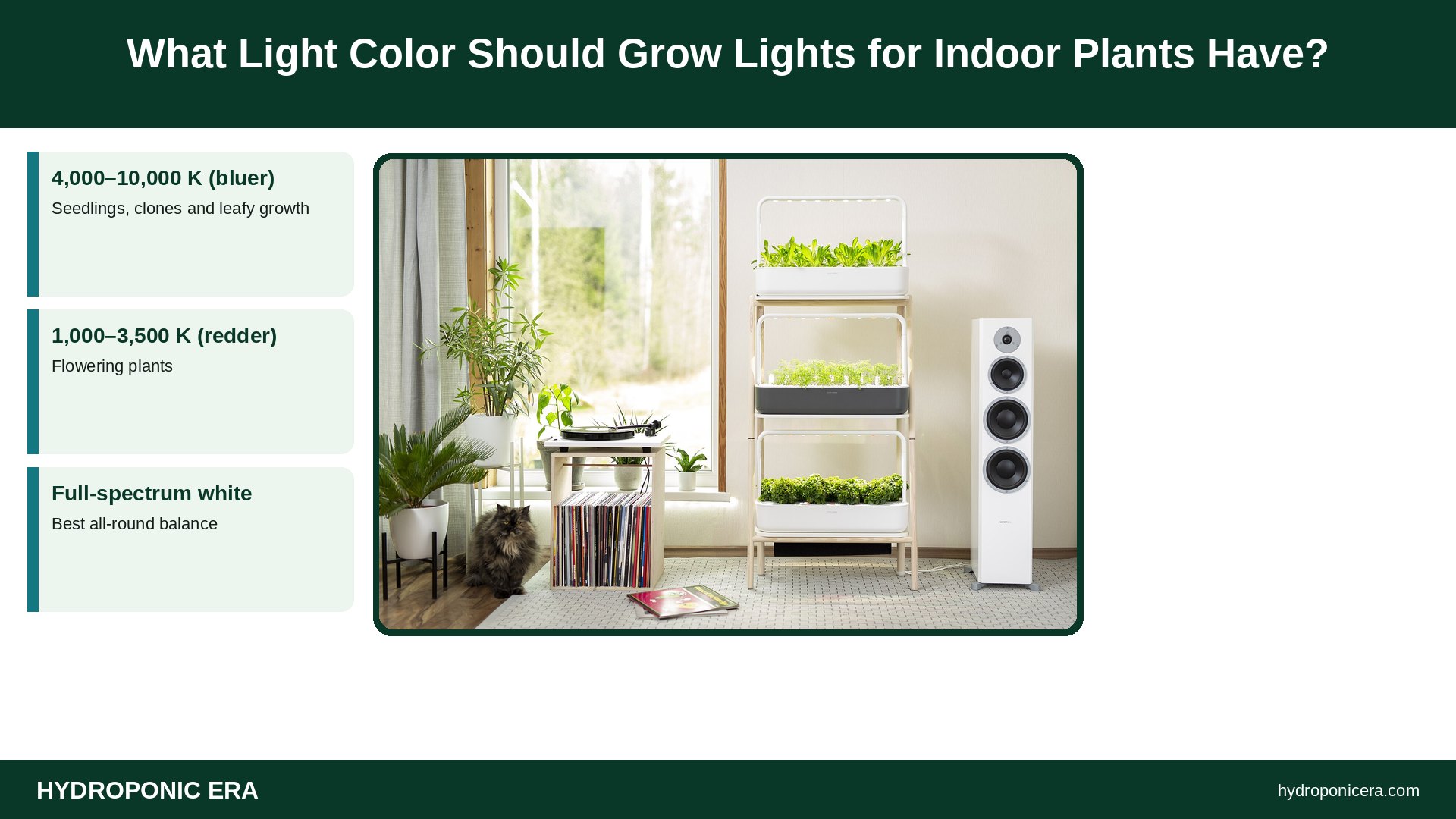
Choose full-spectrum white grow lights for indoor plants unless you have a specific reason not to. UMaine Extension says that for optimal growth, the best balance remains full-spectrum, or white, light, and that purple “blurple” red-and-blue LEDs are a combination rather than a better option. White light also lets you see pests and leaf color clearly.
| Color temperature | UMaine guidance |
|---|---|
| 4,000–10,000 K (bluer) | Seedlings, clones and leafy growth |
| 1,000–3,500 K (redder) | Flowering plants |
| Full-spectrum white | Best all-round balance |
Green light is not wasted either; see our article on PPFD and DLI for how to measure what plants actually receive.
How Far Should Grow Lights for Indoor Plants Hang?
Keep LED grow lights about 12–24 inches (30–60 cm) from indoor plant foliage and fluorescent tubes 6–12 inches (15–30 cm) away, according to Iowa State Extension. Light intensity drops fast with distance: UNH Extension found one LED bar needed 8 hours a day at 8 inches (20 cm) above a crop, but 16 hours at 20 inches (51 cm).
- Too close: short leaf stalks and crinkled, leathery leaves (UMaine), or bleached spots.
- Too far: thin, pale leaves and stretched stems.
- Adjust: raise or lower the light on a chain, or raise plants on bricks, as Iowa State suggests.
See our light distance by growth stage guide.
How Many Hours a Day Should Grow Lights Run for Indoor Plants?
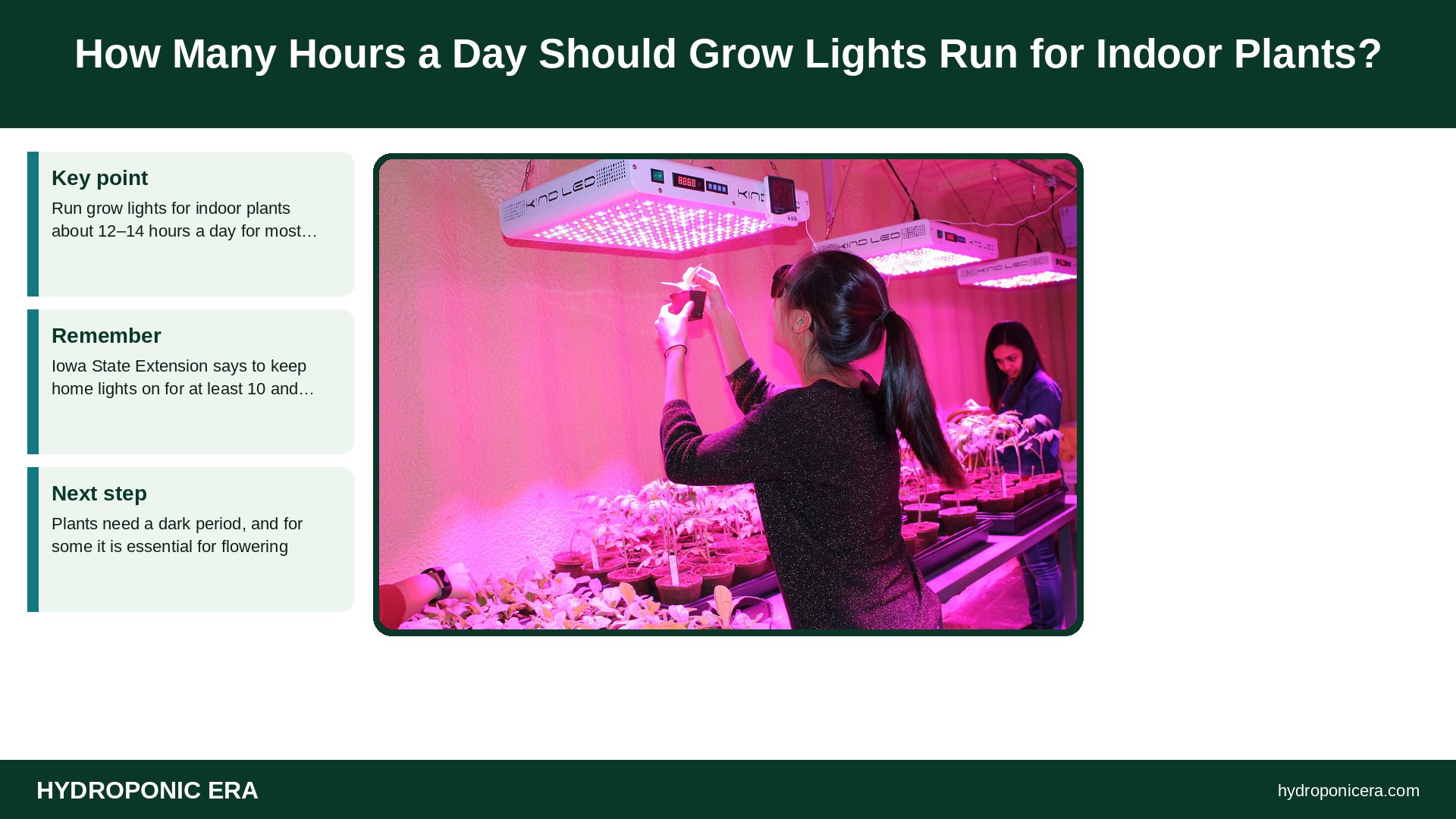
Run grow lights for indoor plants about 12–14 hours a day for most species. Iowa State Extension says to keep home lights on for at least 10 and no more than 16 hours, and to use a timer. Plants need a dark period, and for some it is essential for flowering. UMaine suggests 16–18 hours, so treat these ranges as starting points.
Seedlings often get 14–16 hours, per Iowa State. Learn more in our light schedule guide.
How Much Wattage Do Grow Lights for Indoor Plants Need?
A useful rule of thumb from University of Maine Extension is about 25 watts of LED per square foot (about 270 W per m²) for plants to flourish, while metal halide or high-pressure sodium needs about double that. Many LEDs are dimmable, so you can start lower and adjust. For houseplants with modest needs, a small LED panel or bar is often enough.
| Growing area | LED watts at about 25 W/sq ft |
|---|---|
| 1 × 1 ft (0.09 m²) | About 25 W |
| 2 × 2 ft (0.37 m²) | About 100 W |
| 2 × 4 ft (0.74 m²) | About 200 W |
How Do You Set Up Grow Lights for Indoor Plants?
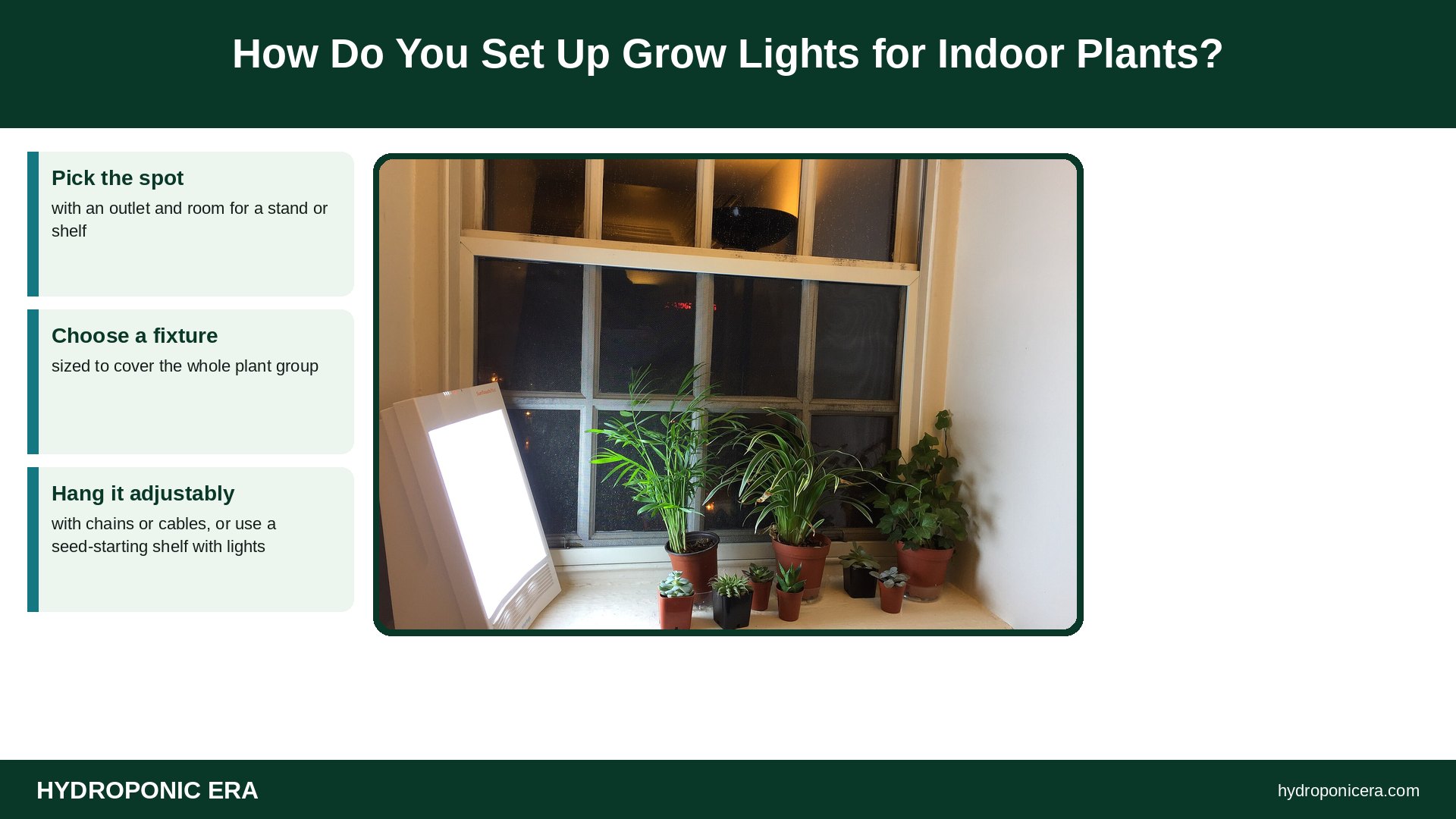
- Pick the spot with an outlet and room for a stand or shelf.
- Choose a fixture sized to cover the whole plant group.
- Hang it adjustably with chains or cables, or use a seed-starting shelf with lights.
- Set the height using the distances above.
- Add a timer for a steady day length.
- Use reflectors such as white or Mylar surfaces; Iowa State says they help light reach more of the canopy.
- Watch for several weeks and adjust distance, hours or fixture, as Iowa State’s trial-and-error method suggests.
Which Plants Need the Strongest Grow Lights for Indoor Plants?
Fruiting and sun-loving plants need the strongest grow lights for indoor plants, while foliage houseplants need the least. UMaine Extension notes light needs, measured as daily light integral (DLI), vary by plant and stage. Tomatoes, peppers and citrus want bright, close light; herbs and lettuce need moderate light; pothos, philodendron and snake plant grow under modest LEDs.
| Plant group | Light need | Practical setup |
|---|---|---|
| Pothos, philodendron, ZZ, snake plant | Low to medium | Small LED bulb or bar |
| Herbs, lettuce, microgreens | Medium | LED bar or panel close above |
| Tomatoes, peppers, citrus, succulents | High | Larger LED panel, longer hours |
Grow lights for indoor plants work best when you group plants by need under the same fixture.
FAQs
Can a regular LED bulb work as a grow light?
Yes, for low-light plants. Iowa State gives shop-light setups that work when placed close enough.
Can grow lights stay on 24 hours?
No. Iowa State recommends no more than 16 hours for home growers.
Do grow lights raise my electric bill much?
LEDs use little power; multiply watts by hours to estimate kWh.
Are grow lights bad for my eyes?
Do not stare into bright LEDs; white light is easier to work under than purple.
How do I know if my light is strong enough?
Use a PPFD meter or watch for compact, deep-colored growth.
Sources
- Iowa State University Extension — How to Set Up Supplemental Lights for Indoor Plants
- University of Maine Cooperative Extension — Growing Houseplants Under Artificial Lights (Bulletin #2614)
- University of New Hampshire Extension — Growing Seedlings Under Lights
- University of Maryland Extension — Grow Lights for Starting Seeds Indoors
- Photo credits (Wikimedia Commons, edited with titles): Terramera scientists working in a climate-controlled growth chamber located in Vancouver, BC. The space uses LED lighting, which supports plant growth. (50188965171) by Simon Fraser University – Communications & Marketing (CC BY 2.0); Click & Grow Smart Garden 27 by Janar Raidla (CC BY-SA 4.0); Terramera scientists working in a climate-controlled growth chamber located in Vancouver, BC. The space uses LED lighting, which supports plant growth. (50188965171) by Simon Fraser University – Communications & Marketing (CC BY 2.0); Potted plants succulents under grow light Nov 2016 by Asdfjrjjj (CC BY-SA 4.0); Low-key photograph of light bulb, Straume, Norway julesvernex2 by Jules Verne Times Two (CC BY-SA 4.0)