
Is barramundi aquaponics a good idea? Barramundi aquaponics can work in the US if you can hold warm water near 82°F (28°C) year-round, give the fish strong aeration and filtration, and buy legal fingerlings. Barramundi grow fast in fresh water, but they are predatory, need heat, and some states restrict them.
Key takeaway: Barramundi suit heated, indoor or greenhouse systems more than backyard tanks in cool climates. Check your state’s rules first, budget for heating, and stock fish of similar size.
| Factor | What to plan for |
|---|---|
| Water temperature | About 79–86°F (26–30°C); near 82°F (28°C) is commonly cited as best |
| Cold limit | Feeding and growth slow sharply below about 68°F (20°C) |
| Salinity | Grows in fresh water; breeding needs sea water |
| Behavior | Predatory; grade by size |
| Legal status | Varies by state; restricted in Florida |
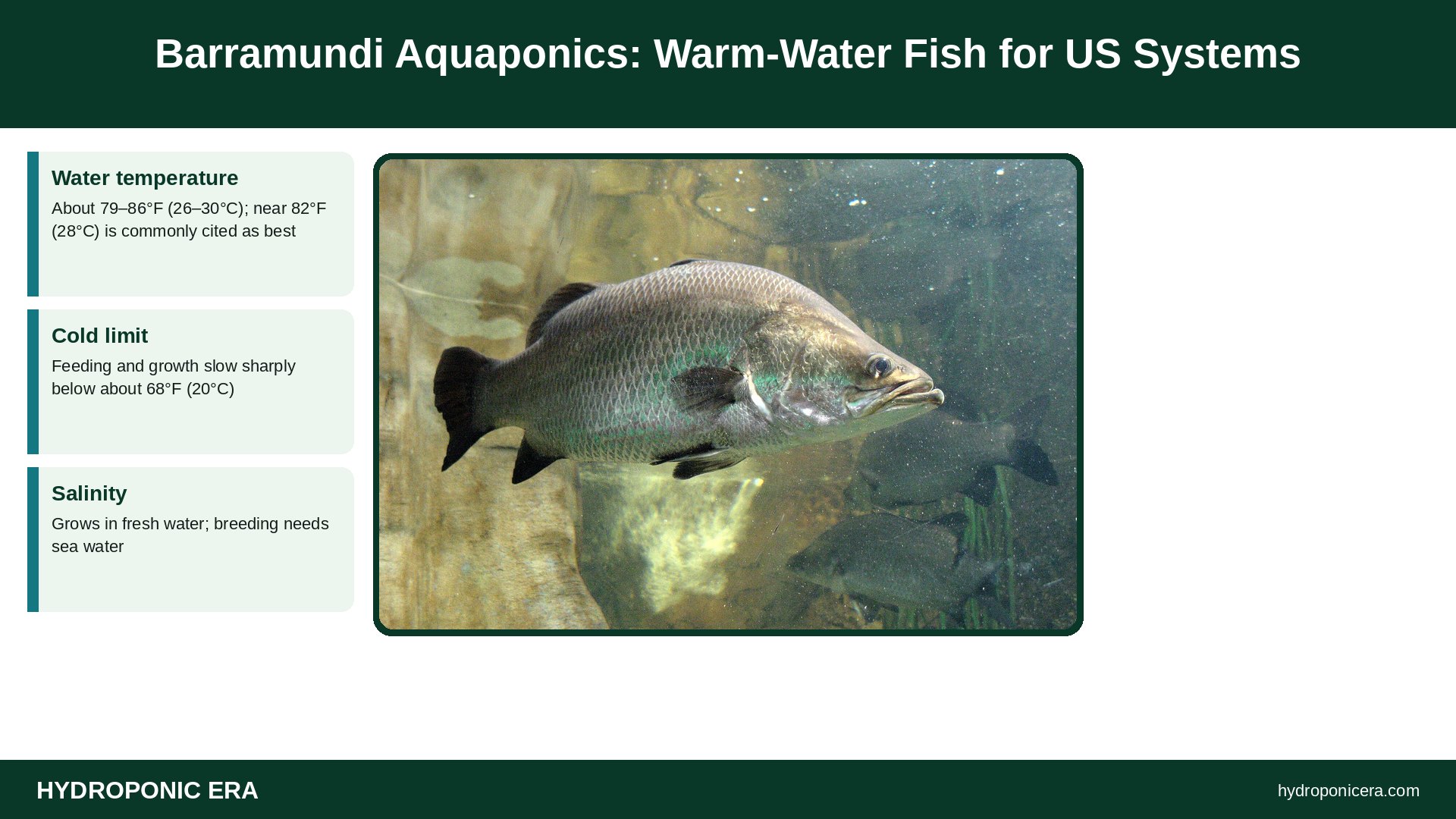
What Is Barramundi Aquaponics?
Barramundi aquaponics raises barramundi (Lates calcarifer), also called Asian sea bass, in a recirculating tank while their waste feeds plants in grow beds or rafts. Bacteria convert ammonia from fish waste into nitrate, and plants absorb it before clean water returns to the fish. It works like any fish-and-plant loop, but at tropical temperatures.
The species is euryhaline, meaning it tolerates a wide range of salinity. It can be farmed in fresh water, which is why some US recirculating farms raise it indoors. New to the idea? Start with our aquaponics for beginners guide.
What Temperature Do Barramundi Need?
Barramundi need warm water, with growth strongest around 79–86°F (26–30°C) and about 82°F (28°C) often described as ideal by aquaculture agencies such as NSW DPI. Below roughly 68°F (20°C), feeding drops and growth stalls. In most of the US, that means heaters, insulation, and usually an indoor room or greenhouse.
- Heat the water, not the room, with properly sized aquarium or tank heaters.
- Insulate tanks and cover them at night.
- Add an alarm or thermometer you check daily.
- Plan for outages: heat and air both stop when power fails.
Our guides to aquarium heaters and backup power for pumps help with both.

Is Barramundi Aquaponics Legal in the US?
Barramundi aquaponics is legal in some states and restricted in others. In Florida, the Department of Agriculture and Consumer Services treats barramundi as a restricted species: growers need an aquaculture certificate, a Restricted Species Authorization, and indoor facilities. Other states have their own lists, so contact your state wildlife or agriculture agency before buying fish.
Even where they are allowed, never release live fish into local waters, and buy fingerlings only from a licensed supplier.
Which Plants Grow Best in Barramundi Aquaponics?
Warm water suits heat-loving plants, so barramundi aquaponics pairs well with basil, water spinach, mint, peppers, tomatoes and okra. Lettuce can struggle and bolt in water near 82°F (28°C). FAO’s small-scale aquaponics manual notes fruiting crops generally need more fish feed per area than leafy greens.
| Plant | Fit for warm water | Notes |
|---|---|---|
| Basil | Excellent | Fast and easy in rafts or beds |
| Water spinach | Excellent | Check state rules; restricted in some places |
| Peppers and tomatoes | Good | Need media beds and more nutrients |
| Lettuce | Fair | Prone to bolting in warm water |
See our guide on growing water spinach for its legal notes.
How Do You Set Up Barramundi Aquaponics Step by Step?
To set up barramundi aquaponics, confirm legality, build a heated tank with a solids filter and biofilter, cycle it fully, then add fingerlings at a light stocking rate and grow plants alongside. Increase feed slowly as fish grow and plants show they can use the nutrients.
- Check permits with your state agency.
- Choose a tank with a lid; barramundi can jump.
- Add filtration: a settling tank plus biofilter or media bed.
- Install heaters and strong aeration.
- Cycle the system until ammonia and nitrite read 0.
- Stock fingerlings of similar size, lightly at first.
- Feed a quality pellet and remove uneaten food.

How Big Should a Barramundi Aquaponics System Be?
A barramundi aquaponics system should be large enough to keep stocking light and temperatures stable. FAO’s small-scale aquaponics manual recommends keeping fish density at or below about 44 lb (20 kg) of fish per 264 gal (1,000 L) of water for small home units. Bigger water volumes also lose heat more slowly and buffer mistakes.
- Small tanks swing in temperature quickly and suit fingerlings only.
- IBC-size tanks of about 275 gal (1,000 L) are a common starting point.
- Grow beds should be sized to the daily feed you give, not the tank alone.
- Plan harvests so density stays under your limit as fish gain weight.
How Do You Feed and Grade Lates Calcarifer?
Feed Lates calcarifer a high-protein floating or slow-sinking pellet sized for their mouths, several small meals a day, and only what they clear in a few minutes. Because barramundi are predators, larger fish can eat smaller tankmates. Sorting fish by size, called grading, is standard practice in farms and helps prevent losses.
Watch the fish while they eat. Slow feeding often signals cool water or poor water quality, not a full stomach.
How Much Oxygen and Filtration Do Barramundi Need?
Barramundi are active, fast-growing fish, and warm water holds less dissolved oxygen than cool water, so aeration has to be generous. Use air stones or a venturi in the fish tank, a solids filter before the plant beds, and test ammonia, nitrite, pH and temperature regularly, especially as fish grow.
Our guide to dissolved oxygen explains why heat lowers oxygen.
What Are the Downsides of Barramundi Aquaponics?
The main downsides are heating cost, legal limits, and fingerling supply. Barramundi cannot breed in fresh water because spawning requires sea water, so you must buy new fingerlings for each batch. Tilapia or catfish may be easier in many states, but barramundi offer a mild, popular eating fish where heat is affordable.
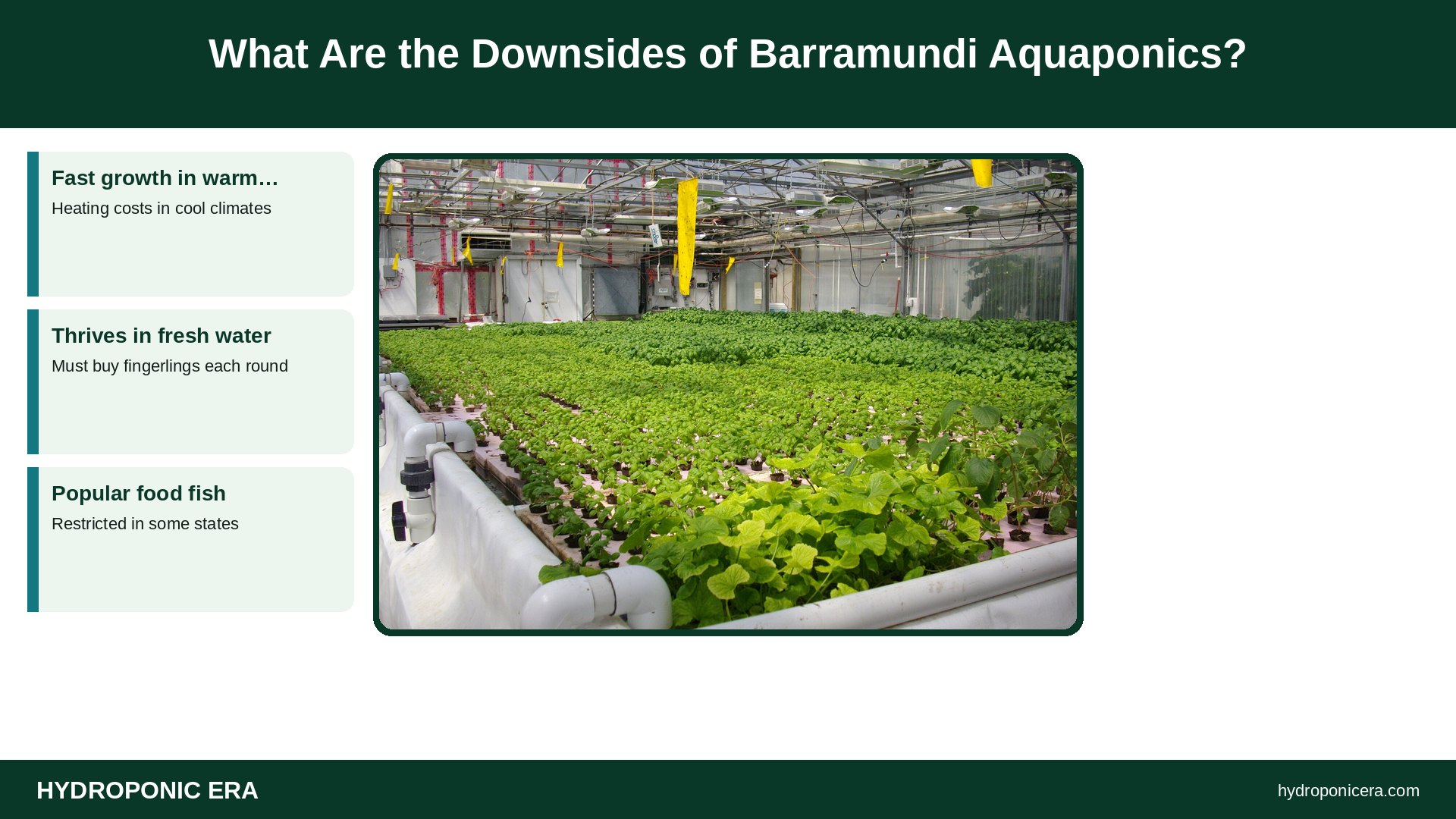
| Pros | Cons |
|---|---|
| Fast growth in warm water | Heating costs in cool climates |
| Thrives in fresh water | Must buy fingerlings each round |
| Popular food fish | Restricted in some states |
FAQ About Barramundi Aquaponics
Can barramundi live in fresh water?
Yes. They are euryhaline and grow in fresh water.
Can barramundi breed in my system?
No. Spawning needs sea water and hatchery conditions.
Can I keep them outdoors?
Only where water stays warm; Florida requires indoor culture.
Can I mix them with other fish?
Avoid it; they eat smaller fish.
Is tilapia easier?
Often yes, but rules differ by state too.
For a broader start, see our fish farming for beginners guide.
Sources
- NSW Department of Primary Industries — Barramundi Industry Profile
- Florida Department of Agriculture and Consumer Services — Aquaculture: Food Fish
- FAO Fisheries and Aquaculture Technical Paper 589 — Small-scale aquaponic food production
- Southern Regional Aquaculture Center — Aquaponics: Integrating Fish and Plant Culture (SRAC 454)
- Photo credits (Wikimedia Commons, edited with titles): Lates calcarifer, 2014-09-19a by Mitch Ames (CC BY-SA 4.0); Solanum lycopersicum in aquaponics at the NC Greenhouse Nursery by Gogerr (CC BY-SA 4.0); Feeding fish (51250565367) by USFWS Mountain Prairie (Public domain); CDC South Aquaponics Raft Tank 1 2010-07-17 by Bryghtknyght (CC BY 3.0)